Abstract:
The article describes a common “desk-native” pattern it labels the “mouth-breath lunch” bug: you eat lunch at your computer with Slack and screens still demanding attention, yet 30–120 minutes later your body behaves as if lunch never happened—refreshing tabs aimlessly, feeling sudden urgency for coffee, scanning the kitchen, and taking “standing bites” at the counter—because regulation never fully came back online after stress. Rather than framing this as a diagnosis or willpower problem, it treats the post-lunch craving as an “error message” that often mimics hunger but shows up as fast, tight, and picky (needing something sweet, crunchy, warm, or coffee-adjacent), especially in the “seams” right after tense meetings when the call ends but the body stays keyed up through lingering stress and breathing drift. The proposed fix is a low-effort experiment: before stacking sugar and caffeine on top of an already upregulated system, run a 90-second breathing “downshift” (quiet nasal inhale if possible, longer quiet exhale, 6–10 cycles, then re-check), use a two-question test (“If stress were zero, would food still be interesting?” and “Would any food work, or only something specific?”), and if hunger remains, simply refuel with a small, chewable, desk-legal snack like yogurt, eggs, nuts and fruit, or hummus and vegetables. To keep it from becoming another self-improvement project, it suggests a tiny 5-day output log—counting urgent snacks, “panic” coffee #2, kitchen laps, afternoon crash severity, and standing bites—so you can see whether the pattern is improving without building a new dashboard.
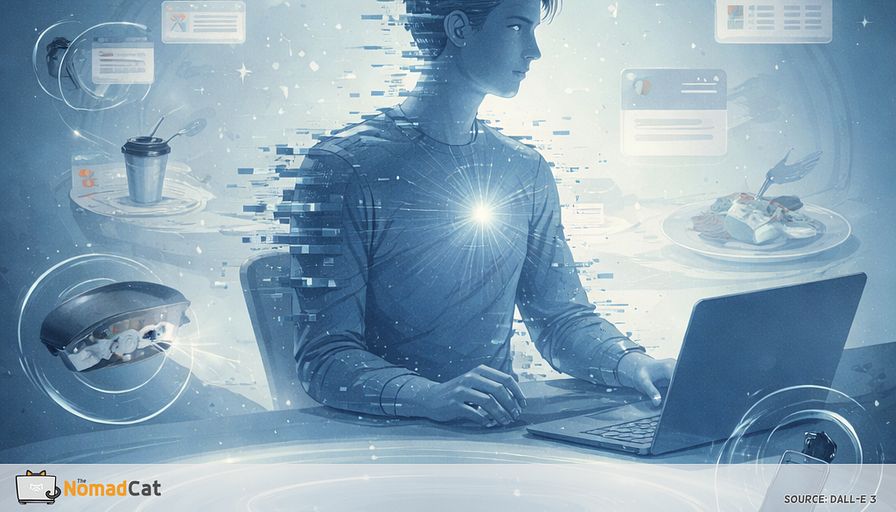
You know the moment. Lunch is done, the plate is gone, Slack is still loud, and you are technically back at work. Then 30–120 minutes later, the system starts acting like lunch never happened. Tabs get refreshed for no reason. Coffee feels strangely urgent. You end up doing a “quick bite” while standing at the counter, like it is a normal feature.
This article is a debug log for that specific desk-native bug. Not a diagnosis, not a personality trait, not a new set of rules to manage. Just a useful label for a common mismatch where food went in, but regulation did not come back online. And yes, I know it too well: years at desks in Beijing, then Berlin, now Lisbon, often working past midnight, makes these patterns very… familiar.
Here is what you will get out of it, without the motivational poster tone:
- What “mouth-breath lunch” is and the usual signals that show up after lunch at a desk
- Why it can feel like hunger, but arrives with urgency and picky cravings
- How screen stress and post-meeting seams can keep the body “online” even when the call ends
- A simple 90-second breathing downshift you can test before stacking sugar and coffee on top of an already-up system
- A fast 2-question check to separate real hunger from a state-change request
- A small, low-effort way to track whether this is improving without turning it into a project
If this sounds a bit too nerdy for something as basic as snacking, yes. But that is the point. When the day is built from meetings, micro-stress spikes, and desk lunches, the body throws small error messages. The trick is noticing them early, and picking the cheapest fix that actually works.
The mouth breath lunch bug
The signature moment after lunch
Lunch happens. The plate is gone, the laptop is still open, Slack is still doing Slack things, and the mug is already back in hand.
What shows up next is less “hunger” and more hunt mode: you start scanning the kitchen like a search bar, you hover on delivery apps without deciding, you feel weirdly impatient with your own inbox, and suddenly a standing bite feels like the only format that fits the next 7 minutes.
That mismatch is the clue. You ate, yet you are still hunting. It is easier to spot when looking at behaviors and context cues, not mood labels. Habits often run as cue → response loops tied to stable moments like “after lunch at the desk” (Wood & Neal, 2007). Distracted eating can also weaken memory of the meal and increase later intake in some settings (Robinson et al., 2013).
Common signals
- Open-mouth scrolling, jaw hanging
- Chewing gum like it’s part of the meeting agenda
- Jaw clenching while reading a tense thread
- Re-filling coffee on autopilot
- “Standing bites” at the counter, no plate, no pause
- Grabbing something warm or sweet right after a stressful message
- Grabbing something crunchy right after a call ends
- Eating while typing with 1 hand, like it’s a normal UI pattern
- Dry mouth + fast scrolling, like you are trying to outrun the feeling
Stress can shift breathing patterns fast (Boiten, Frijda & Wientjes, 1994). Respiration and emotion regulation systems talk to each other (Homma & Masaoka, 2008). The point is not “your breathing causes snacks.” The point is that stress shows up in the body in visible ways.
Also, keep the false positives.
- If lunch was tiny or skipped, you might just be hungry.
- This can overlap with distracted desk eating (Robinson et al., 2013).
- Stress-related eating is real but variable across people (Torres & Nowson, 2007).
Mouth-breath lunch is a debug tag for a desk-native failure mode where lunch happens but regulation does not. Not a diagnosis. Just a label that lets you log the pattern without turning it into identity.
Why it feels like hunger
Urgency and pickiness are a clue
Classic hunger is often slow and broad. It ramps up over hours, and “any real food” sounds acceptable. Regulation cravings show up fast, feel tight, and get weirdly picky. Not “I could eat,” but “I need something sweet” or “only something crunchy will work.” Stress can tilt preference toward more rewarding, palatable foods, which helps explain why the urge targets dessert-tier options even when lunch happened (Adam & Epel, 2007). This matters at a desk because state changes happen every 30 minutes and recovery is not guaranteed.
The meeting ends but the body stays online
A lot of knowledge-work stress is evaluation. Someone watched. Someone judged. Social-evaluative threat can drive a stronger cortisol response than neutral effort, and the timing can lag the event (Dickerson & Kemeny, 2004).
In plain terms: the meeting ends, but your body can stay keyed up after the “Leave” click. So you open Slack, see a follow-up message, your shoulders go up again, and the fastest off-switch near a keyboard is caffeine or something edible.
Why standing snacks happen
The standing snack is a delivery format chosen by urgency. It is fast, quiet, and you can stop at any moment. That makes it feel “safe” in a day that is already packed. The kitchen counter becomes a cue, and the loop runs on context more than intention (Wood & Neal, 2007).
The error message model
Treat the urge like an error message that looks like hunger but might be a state-change request. Or just: your body asking for a downshift. The quick fix becomes whatever is closest and fastest, not whatever is most logical. To pick a cheaper fix, it helps to admit uncertainty, then test a lower-cost switch before escalating to sugar plus coffee.
Screen stress and breathing drift
Stress shifts breathing
Stress shifts breathing. Rate often goes up, breaths get shallower, rhythm gets messy, sometimes with sighs or little breath holds, even if the body is just sitting there (Boiten, Frijda & Wientjes, 1994). Now translate that into a desk day made of tiny stress spikes between long stretches of stillness.
The seam is where it leaks
Desk stress is rarely 1 big event. It is 40 micro transitions.
- leaving a call and immediately opening Slack
- seeing a calendar gap of 7 minutes and trying to “use it well”
- reading a tense thread and then switching into a doc like nothing happened
- sending a risky message, then watching the typing indicator
- opening the inbox “just for one thing”
- walking to the kitchen “just for water” and forgetting why you went
During mental stress, the body tends to move into a more activated mode, and recovery doesn’t always snap back instantly. Then you click Leave, and that is the seam where you suddenly notice the “need something now” signal.
It is tempting to blame mouth breathing itself. Keep it honest.
Route is the part we do not measure well
Most real-world sensors capture breathing rate or chest movement, not whether air went through the nose or the mouth. So claims like “Slack conflict makes you mouth-breathe” are mostly plausible stories, not cleanly measured facts. And HRV can swing just because breathing changed, which makes it easy to over-read if respiration is not tracked (Shaffer & Ginsberg, 2017).
A practical lever exists even with imperfect data
Even if route is unclear, reducing excessive ventilation and restoring a calmer exhale pattern at predictable transitions is a low-risk patch to test. Paced breathing has decent evidence behind it as a way to shift stress physiology in a calmer direction (Lehrer & Gevirtz, 2014). In real desk terms, “improve” can look like: the urge intensity drops, you skip the kitchen lap, or coffee #2 stops feeling urgent.
CO2 tolerance and the wired fog
This matters for the post-lunch window because a lot of people aren’t actually “low on fuel” then—they’re still slightly revved from the seam, and the body is looking for a quick change.
Ventilation mismatch can feel like hunger or panic
One possible bridge is CO2. If breathing is higher than the moment requires, CO2 can drop and produce sensations that read like alarm, dizziness, or fog, even without a dramatic “panic breathing” scene (Gardner, 1996). Not oxygen. Ventilation.
If someone wants to measure this properly, end-tidal CO2 is the better marker—a rough proxy for how “over-ventilated” you are.
Why sugar and coffee become the default buttons
When the system is upregulated, fast regulators become attractive. For many people under stress, that means more pull toward palatable foods, especially sweet and high-fat options (Adam & Epel, 2007). Add caffeine as the quickest cognitive lever at a desk (Smith, 2002), and you get the classic combo that “fixes” the sensation fast, even if it does not address what set it off.
Keep it testable. If a quick breathing downshift reduces the urge in the next 2–5 minutes, that signal is useful even if the full chain is unclear. If nothing changes, that is also data. In-the-moment sampling beats later memory reconstruction for these states (Shiffman, Stone & Hufford, 2008).
The 90-second CO2 downshift
Use a seam
A calendar reminder is easy to ignore when you are mid-call or mid “just 1 more message.” Seams are different. Seams are editable. Pick 1 seam and treat it like a small experiment.
Possible triggers
- Before coffee #2
- Immediately after a tense call ends
- When you notice open-mouth scrolling or jaw tension
- Right before walking to the kitchen “just to check”
Keep friction low and optics boring. This should feel like a software patch you run quietly, not a performance.
A protocol that stays simple
A fair objection is that many paced breathing studies use longer sessions, often closer to 5 minutes. True. Still, a short downshift can be useful as triage before stacking coffee and sugar onto an already-up system.
- Inhale through the nose if possible, small and quiet
- Exhale a bit longer than the inhale, also quiet
- Repeat 6–10 cycles, no forcing, no big chest movement
- Wait 30 seconds, then re-check the urge before touching snacks or caffeine
(If you are the type who measures everything: yes, longer windows are cleaner for HRV numbers. This is not that. It’s a quick probe.)
Common ways to make it worse
- Over-inhaling until you get lightheaded (more ventilation is not the fix if the issue is already “too much breathing”) (Gardner, 1996)
- Turning it into deep dramatic breathing, which is conspicuous and usually inhale-heavy (no drama)
Safety guardrails. If dizziness shows up, panic ramps up, breathing feels worse, or any respiratory condition flares, stop. Skip breath holds and retention here. This is not acute asthma or COPD care.
Debug it in 30 seconds
The 2-question check
Before negotiating with the kitchen, use 2 quick checks.
Question 1
If stress was 0 right now, would food still be interesting?
Question 2
Would any food work, or does it have to be warm, sweet, crunchy, or coffee-adjacent?
Then test. Do the 90-second downshift and re-check. If the urge drops meaningfully, treat it as a state correction request, not a refuel emergency. If it does not move, assume real hunger or a different bug, and just eat.
If hunger remains, refuel without a plan
If hunger is still there after the downshift, treat it like real input need and eat a small chewable anchor that is desk-legal and low mess. The goal is refuel, not perfect nutrition.
- Plain yogurt or skyr
- 2 hard-boiled eggs
- Tuna or salmon pouch
- Edamame
- Hummus with carrots or cucumbers
- Nuts plus a piece of fruit
- Cheese with whole-grain crackers
- Leftover chicken or tofu, cold is fine
Caffeine can feel like the obvious switch because it reliably increases alertness (Smith, 2002). Sometimes it is also withdrawal reversal wearing a fake mustache (James & Rogers, 2005). Late caffeine can bite sleep. In 1 study, 400 mg still disrupted sleep even when consumed 6 hours before bedtime (Drake et al., 2013).
5-day output check
Make it almost stupidly small so it survives the day when meetings pile up and lunch is 12 minutes at the keyboard. Track outputs you can see near the event, because memory later is not reliable (Stone & Shiffman, 2002; Shiffman, Stone & Hufford, 2008).
- # of urgent snacks in the 30–120 min after lunch
- coffee #2 that feels like panic more than taste
- kitchen laps that start as “just water”
- 15:30–17:00 crash severity (none, mild, brutal)
- “standing bites” count at the counter
Binary is enough.
- Downshift used Y/N
- Urge reduced Y/N
- Optional urge 0–10 before and 0–10 after
Optional, if you already have a chest strap like a Polar H10: you can also glance at how fast you calm down after a tense call (not as a score, just as a pattern). If logging adds stress, stop. Nobody needs another dashboard.
Desk lunch plus nonstop screens can create a weird bug where food went in, but the system stays “online.” The tell is the 30–120 minute window where the urge feels urgent and picky, not slow and flexible. That is often less about willpower and more about context, stress seams after meetings, and breathing drift that keeps the body in a higher gear.
The useful move here is treating the craving like an error message, then running a cheap test before stacking sugar and coffee on top. A 90-second downshift, then a 2-question check, can separate real hunger from a state-change request. If hunger stays, eat something simple and chewable and move on.
Most people have one early signal—coffee urgency, kitchen laps, or the standing bite. Spot that one, and the rest gets easier.
You might be interested by these articles:


Why your inbox makes you snack and how to break the loop

The 90 second gap after calls that sends you to the fridge

Your 15:30 snack urge is usually a boredom bug not hunger

Ambient sugar is why your afternoon feels underfueled anyway

The 3 minute exit handshake that stops the dinner cliff after deep work

Advancements in Solar Power Tech

Enhancing Teamwork with Cobots