Abstract:
The article argues that the “foggy” exhaustion many desk and remote workers feel—followed by a late “midnight competence spike,” thin easily disturbed sleep, and early waking with a “fast-boot” brain—is often not a discipline or phone-notifications problem but a light-contrast problem: modern indoor days are too dim to deliver a strong biological “day” signal (monitors, blinds-down glare control, waiting-room lighting), while evenings stay too bright (overheads, bright kitchens, and especially close, cool “camera-ready” key lights), leaving the brain stuck in a gray zone that delays internal timing and weakens nighttime melatonin signaling. Instead of turning sleep into a hobby or buying meters, it recommends two small levers—get a brief but real dose of morning daylight within 60–90 minutes of waking (a boring 10‑minute outdoor loop, balcony coffee, even working right by an open window) and make the last ~90 minutes before bed credibly dim and warm by killing overheads/key lights and using a single low warm lamp—then run a simple 3‑night A/B test and log only three “error” symptoms (late second wind, fast-boot early wake, and whether sleep felt solid vs sliced). The author, a metrics-minded physics-background desk veteran who still hasn’t “solved” sleep, frames the goal as quick debugging and small environmental changes, not perfection or a new identity.
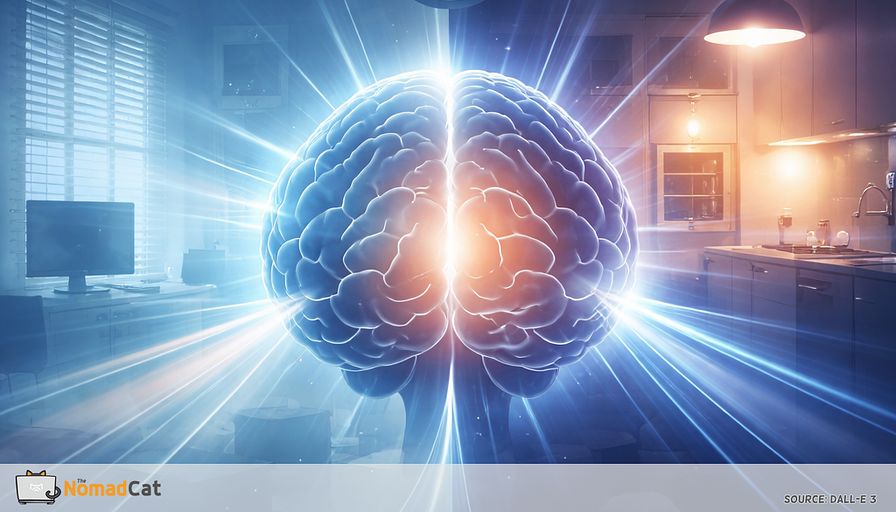
A workday can look totally reasonable and still feel like walking through fog. You sit down, the screen does the heavy lifting, the blinds stay down to avoid glare, and the room lighting is “fine” in the same way a waiting room is fine. By 15:00, there’s yawning. By 16:00, caffeine is doing project management.
If that sounds familiar, it is often not a willpower problem. It is an inputs problem.
This article is about a specific pattern that shows up in desk-based life, especially with remote work and long screen days.
- Dim days indoors that never quite wake the system up
- Bright evenings that accidentally tell the brain it is still daytime
- The weird “midnight competence spike” where thinking suddenly feels easier
- Sleep that looks normal on paper but feels thin, sliced, and easy to disturb
Your brain expects contrast: a loud day signal and a quiet night signal. Modern schedules can deliver a gray zone instead, and then the system starts throwing small errors. Late second wind. Early wake with a fast-boot brain. Tired-but-wired evenings even when work ended hours ago.
So we’ll keep it practical. What actually matters in the lighting setup, why overhead lights and “camera-ready” key lights can be bigger culprits than phones, and a small A/B-style test to check if light contrast is a real constraint this week. Small changes, not perfection, and definitely not a new personality type.
The low contrast day problem
When a calm week still feels exhausting
By 15:00 there is yawning, back-to-back calls start to feel weirdly heavy, and caffeine becomes scaffolding.
This is less about willpower and more about inputs. Most modern life happens indoors anyway, around 87% of the time (Klepeis et al., 2001). Indoor light is often around 50 to 500 lux. Outside is more like 5,000 to 100,000 lux.
Then the weird part is that many people don’t stay tired. They get a late surge.
The midnight competence spike
Somewhere around 22:30 to 00:30, the brain suddenly gets traction. Not a doomscroll spiral. More like “oh, so this is what thinking feels like.” It can even come with a small, annoying confidence boost.
Late light tends to delay internal timing (Khalsa et al., 2003). Strong natural light-dark cycles tend to pull timing earlier (Wright et al., 2013). So that second wind is not always proof someone is a “night person.”
Sleep that looks normal but feels thin
The night can start okay, but it feels light, sliced, or easy to disturb. Early waking is common, with a fast-boot brain that acts like it got a push notification at 05:40.
Ordinary room light in the evening can suppress melatonin and shorten its duration (Gooley et al., 2011). If this is hard to pin down, the Consensus Sleep Diary has a simple sleep-quality line that captures that “thin sleep” feeling without needing a lab (Carney et al., 2012).
Not just phones, boundaries, or overthinking
This is not only notifications, bad boundaries, rumination, or telepressure where the job expects instant replies (Barber & Santuzzi, 2015). Those are real.
This is the annoying version where work stopped at 20:30 and the body still behaves like it’s on call.
The day was dim, the evening was bright, and the system got low-contrast signals the whole time.
Contrast failure in plain terms
The mechanism
Your brain expects a loud day signal and a quiet night signal. A desk schedule often delivers neither, so the system runs in a gray zone.
In lab terms, it follows the same direction as the light phase response curve: morning light pulls timing earlier and evening light pushes it later, and strong light-dark cycles tend to shift people earlier (Khalsa et al., 2003; Wright et al., 2013). In desk terms, a dim indoor morning plus a bright 21:00 kitchen can set up exactly the “sleep looks normal, feels thin” pattern.
The brightness gap is not subtle. Indoors is often 50 to 500 lux at the eye. Outdoors is 5,000 to 100,000 lux. A short outdoor exposure can outweigh hours of “normal” room lighting, at least for what the brain registers.
Window access matters too. Office workers with windows get more daylight exposure and tend to report better sleep outcomes (Boubekri et al., 2014).
On the night side, ordinary room light can suppress melatonin and shorten its duration (Gooley et al., 2011). The relationship is dose-dependent, so moderate increases can matter (Zeitzer et al., 2000). It is not just blue pixels. The boring villains are often overhead lights and bright kitchen task lighting that makes a late dishwashing session feel like a 14:00 meeting.
One warning before anyone buys a meter and starts measuring the hallway. Lux is not the full story, because spectrum and eye-level exposure matter more than the bulb label. Melanopic EDI is a better proxy for the biological “loudness” of light—basically, how much the light tells your brain “it’s daytime.” If you want something more practical, there are readable guides that use that idea without turning it into a science project (Brown et al., 2022).
Why this is a work system output
How offices and homes get misconfigured
Screen work has its own physics problem. Guidelines push hard on glare and reflections for visual comfort, so the safe solution becomes dimmer ambient light and blinds down (ISO 9241, EN 12464-1). That blinds behavior is not a weird personal quirk either. It is a known pattern in buildings once screens and sun patches enter the room (Reinhart & Voss, 2003).
WFH reproduces the same tradeoff, just with less support. A common setup is a laptop and external monitor tuned for readability, a window in the wrong place, and camera-ready light aimed at the face. Daylight also drops fast once the desk is deeper than the daylit zone, roughly 1 to 2 times the window head height.
Then collaboration stretches the bright setup later than planned: a “quick sync” with a team a few time zones away turns into a 21:30 call, the key light comes on, and you’ve basically built the camera light trap into the schedule.
Even with decent boundaries, bright screens plus presentable room light can push physiology around. Evening light can shift melatonin quickly, within the same night (Zeitzer et al., 2000). The culprit is often boring, not dramatic.
The harmless culprits that keep your brain in daytime
Room light matters more than screen light
Think in light-at-the-eye terms. A laptop alone is often around 10 to 40 lux and 5 to 25 melanopic EDI lux. Add an overhead LED and you jump to something like 50 to 200 lux and 20 to 120 melanopic EDI. So yes, it can be 23:00 and still look like daytime to your biology (Gooley et al., 2011).
A quick vibe check is usually enough, honestly. Common evening setups that overshoot a sleep-friendly target like ≤10 melanopic EDI lux (Brown et al., 2022) include:
- Bright white kitchen with task lights
- Living room overheads
- Bathroom mirror lighting that is too good at being bright
A decent heuristic is this: if the room is bright enough that cleaning feels efficient, it is bright enough to tell your brain it is still day. It sounds simplistic, but light effects are dose-dependent (Zeitzer et al., 2000).
The camera light trap
The trap is not the call itself. It is the key light.
Ring lights and desk lights are close, aimed at the face, and often cool in color, so they hit the eyes hard. Cooler spectra tend to be more activating (Brainard et al., 2001; Thapan et al., 2001).
Then it goes like this. Late meeting, key light on, call ends, and the setup stays—you don’t even stand up; you just mute, keep typing, and the room keeps shouting “noon.”
A low-friction rule set can work better than purity. For example:
- no key light after a set hour
- switch to ≤3000K warm light
- dim it
- keep the background darker so your face is visible without flooding the room
Screens still matter (Chang et al., 2015), but lowering the whole environment often buys more than obsessing over a single app setting.
The light contrast patch
Make mornings loud
This does not need a lifestyle redesign. It usually needs a small exposure that actually counts, ideally within 60 to 90 minutes after waking, when it fits around kids, commutes, and the first meeting.
Morning light tends to pull timing earlier, evening light pushes it later (Khalsa et al., 2003). If outside is impossible, proximity to a window is the next best lever.
Short, boring outdoor time works because outdoor light is 5,000 to 100,000 lux while indoor is often 50 to 500 lux (Klepeis et al., 2001).
- 10 minutes outside, boring loop
- coffee on a balcony, face to daylight
- trash run, no sunglasses if safe
Perfection is not required. Even working the first block within arm’s reach of a window, facing toward daylight, with blinds open, can matter. Daylight drops fast with distance from the window (Reinhart & Walkenhorst, 2001).
Make evenings quiet
In practice this is a few scene swaps, not a ritual. Screens can stay if needed, but lowering the environment is often the big lever since ordinary room light before bed can suppress and shorten melatonin signaling (Gooley et al., 2011).
A directional north star is keeping the last 90 minutes dim and warm, roughly aiming toward ≤10 melanopic EDI lux (Brown et al., 2022).
If there was a late bright call, the night can still end on the right signal:
- off overhead lights
- 1 warm lamp, dim
- monitor at lowest comfortable brightness
- avoid bright kitchen plus laptop
If late work has to be bright, a useful move is ending with a fast lights-down change so the last cue your brain gets is night, not still 14:00. Physiology reacts quickly to light changes (Zeitzer et al., 2000). Optional tools like night mode, warmer settings, or amber glasses help for some (Burkhart & Phelps, 2009; van der Lely et al., 2015).
The 3 night debug without making it a hobby
The simplest A B test
Measure only the signature symptoms, not everything. Night 1 stays normal. Nights 2 to 3 apply Move A and Move B. The point is a fast debug, not a new identity.
The only morning log worth keeping
A tiny log done while making coffee works better than big impressions and matches how diaries capture nightly change (Carney et al., 2012). Check these 3 boxes:
- late second wind after 22:00
- fast-boot brain on early wake
- sleep felt 1 block vs thin or sliced
Early improvement often looks like less midnight sharpness, fewer early-wake boot sequences, and slightly better tolerance the next day even if sleep is not perfect. If nothing changes, it does not mean you failed. It just means light contrast was not the main constraint this week.
And yes, this is coming from someone born in 1974, who studied fundamental physics at a Paris university, and now in Lisbon (since 2023), after Berlin (2017–2023) and Beijing (2008–2017), still very metrics-minded and still ending up at a desk often past midnight. That is exactly why the test is meant to avoid becoming another dashboard.
If a desk day feels like fog and the brain suddenly wakes up at 23:30, it is not automatically a discipline issue. Often it is a contrast issue. Dim indoor days do not give the system a clear “day” signal, then bright evenings keep telling it to stay online.
The result is familiar. Thin, easily disturbed sleep, early wake with a fast-boot brain, and caffeine doing late-afternoon project management.
The fix is not perfection or a new hobby. It is usually 2 small levers. Make the morning unmistakably bright, even briefly. Make the last 90 minutes credibly dim and warm, especially by killing overhead lights and camera lights. Then run the 3-night A/B check and watch the “error logs” change.
Most weeks it’s one of 2 signatures: the midnight competence spike, or the thin sleep that looks fine in a diary and feels wrong in the body.
You might be interested by these articles:


03:00 planning mode is a context bug not stress

8 hours in bed and still tired debug your fragmented sleep

A productive day can still break your sleep fix the missing downshift signal

Your bed is not a workspace fix the cues that boot up work brain at night

After dinner no more invisible work so your sleep can actually power down

Why pausing your tech career climb can be your smartest move

How blockchain makes startup equity less of a headache