 Gilles Crofils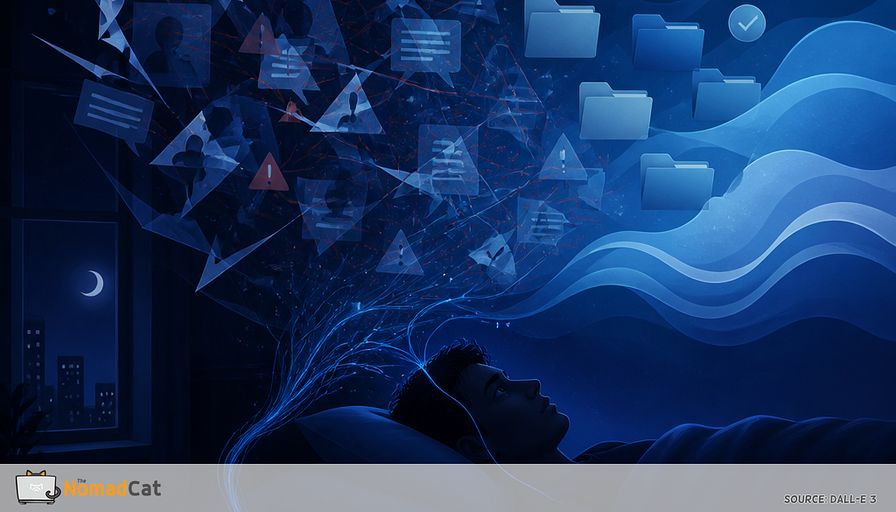
A 10-hour desk day can end “fine” and still ruin the night.
Not because you worked late. Not because you scrolled too much. But because the last 90 minutes of work quietly loaded the worst kind of stress right before sleep.
You close the laptop. Dinner happens. Bedtime happens. Then 04:00 happens. Instant-on brain—jaw tight, shoulders up near your ears. Light, restart-prone sleep. It’s like the workday ended, but recovery never started.
This article is about that annoying gap. Not motivation. Not another evening checklist. Just a practical way to see why late-day stress costs more, and what to do when you can’t simply “work less.” I’ve spent most of my adult life at a desk—Beijing, then Berlin, now Lisbon—and the one variable I still don’t reliably control is sleep when work runs late.
Here’s what will be covered:
- Why the same problem is more expensive at 17:30 than at 10:30
- The specific late-day triggers that keep the system running after log-off, called the activation stack
- A cleaner way to structure evening work using closure-grade tasks so you don’t open new loops
- A simple 3-day debug to spot whether conflict, judgment, or risk work is actually what’s breaking the night
- A couple of scheduling moves that help without turning your calendar into a lifestyle project
- When it’s no longer a workflow issue and it makes sense to get real clinical help
The point is not to become calmer as a person. It’s to stop scheduling the hardest inputs right before your brain is supposed to power down.
The late afternoon cortisol tax
The day that ends badly
At 16:30 the Slack thread that was “just a quick check” turns into a tone-reading contest. At 17:10 the doc comes back with comments that feel less like edits and more like a verdict. At 18:20 a client note lands with that polite wording that somehow means “explain yourself.” You answer, you keep it professional, you get the approvals, you even log off more or less on time. Dinner is normal, bedtime is normal. And still, the night has this thin quality, like sleep is happening but not really sticking.
This is the annoying gap between “work ended” and “recovery started.” You can do everything right on paper and still wake up feeling like something kept running in the background. The usual pattern is not going to bed late. It’s:
- micro-wakeups
- early boot at 04:00 or 05:00 with an instant-on brain
- light, restart-prone sleep
So if the hours are stable, what changed? Often it’s the late-day input that didn’t cool off before bedtime.
A useful way to think about it: why is the same stress more expensive at 17:30 than at 10:30? Because some stress isn’t just “busy.” It’s the stress of being judged. Your competence or status is on the line, sometimes with real consequences. Add low control and it gets worse. And late in the day, there’s not much time left before sleep.
Think of it like an incident getting triggered right before nightly maintenance. You can shut the laptop, but the system is still stuck in deploy mode. This isn’t about discipline. It’s about inputs landing too late to clear.
Why late-day stress costs more
Less runway before sleep
A problem at 10:30 has cooling time built in: more meetings, a coffee run, some context switch that forces your brain to drop it. The same problem at 17:30 has almost no runway, so the downshift gets delayed.
Also, for a lot of people, evenings bias toward alertness. Great if you want to finish a slide deck. Not great if you want your mind to stop doing incident response.
Reputation threat is not the same as being busy
Even if the argument “ended,” the brain often keeps it running.
It’s the fear of looking incompetent, unreliable, or out of place. In real life it looks polite but costly:
- a calibration thread where your judgment is being compared line by line
- an exec update where 1 sentence can quietly re-rank your credibility
- a client note that reads like “no worries” but means “this is now your problem”
You can be sitting still, no raised voice, no drama, and still feel like you just sprinted.
Rumination is the overnight courier
The bridge between a late-day status threat and a bad night is often replay. That just means your mind keeps working the problem after it’s over. If the stakes were social, the replay tends to be social too:
- what should I have said
- why did I phrase it like that
- what will they say tomorrow
- will this be brought up in a bigger meeting
Quiet is when the replay starts.
The activation stack
The 4 kinds of work that keep running after you log off
After a 10-hour desk day, it’s rarely the hours that break the night. It’s the activation stack you loaded in the last 90 minutes. The mix of evaluation, stakes, and social exposure makes it hard to mentally detach even when the laptop is closed.
Here are the usual suspects:
- Conflict threads
- Judgment moments
- Risk approvals
- Social ambiguity work
Conflict threads
The thread starts as “quick clarification” and ends with tone doing 80% of the damage. A line like “This is unacceptable” turns a normal issue into a competence question. Now you’re defending you, not just the work.
One boring but effective principle: separate people from the problem. It reduces the “you vs them” feeling, which is exactly what spikes late-day activation.
Judgment moments
Quieter but brutal: decisions you can’t easily undo. Review comments that are “very thoughtful” in the first sentence and very final in the second. Feedback often pulls attention away from the task and toward the self, which is fuel for pre-sleep self-critique.
Private vs public is an intensity multiplier. A comment in a doc is one thing. The same comment in a channel with 12 people and 2 seniors is a different animal.
Risk approvals
Shipping, signing off numbers, approving copy that will be public, sending the email that commits the team to a date. You hit send, and the mind opens a new tab:
If this goes wrong, will I be able to justify it tomorrow?
When the consequence horizon stays open, the stress system stays a bit online too.
Social ambiguity work
This is the most expensive category and the least visible: delicate feedback, political coordination, stakeholder alignment, “optics.” It’s expensive because the success criteria are social and half implicit.
The brain keeps simulating outcomes like a broken Monte Carlo. Somehow it never samples the “everyone is fine and nothing bad happens” scenario.
Closure-grade evening work
Work that usually costs less sleep
You don’t need to stop working at 18:00. You often just need different work.
Closure-grade tasks are tasks you can finish without creating new branches, new social risk, or new open loops.
A rough rule of thumb: if it can trigger a reply thread, it is not closure-grade.
Examples that keep the system quieter
- Clean up formatting and fix obvious typos
- Write a neutral summary of decisions made
- Prep tomorrow’s agenda and links
- File receipts and do basic admin
- Rename files and organize folders
- Small refactor that needs no approval
- Draft a message and schedule it for morning
- Add notes so future-you has context
A 3-day debug that isolates the real culprit
After a 10-hour desk day, the last thing needed is a spreadsheet about sleep. Keep it simple so it actually happens. This is not “measuring sleep.” It’s a tiny debug to test 1 idea: does late-day activation predict how the night feels.
One line per day. Wearables optional. A paper notebook is fine.
The 3 questions and nothing else
Write these each evening or next morning:
-
Last 90 minutes included conflict, judgment, or risk work (Y/N)
-
After log-off I felt I might have to defend this tomorrow (Y/N)
-
Sleep felt continuous (0/1)
Define continuous in plain terms: no long awake stretches, and no full mental boot at 04:00 where the brain starts writing rebuttals.
If “conflict/judgment/risk = yes” and “defend tomorrow = yes” keeps landing next to “continuous = 0,” you’ve found a work-design lever. If there’s no pattern, that’s also useful. It saves you weeks of rearranging Slack habits when the issue is something else (caffeine timing, reflux, temperature, on-call interruptions).
Sequencing beats another evening routine
Set a cutoff for new heat
The simplest lever is a personal cutoff for no new heat somewhere between 16:30 and 18:00.
After that time, work is allowed, but only the closure-grade kind.
The key is no starting, not no finishing. Finishing is predictable. Starting is where surprise activation enters.
Make the calendar do the hard part
This isn’t productivity theater. It’s putting evaluation and conflict earlier so there’s time to cool off, and so your brain doesn’t keep running it at 23:40.
Moves that usually help:
- Put risky conversations in a defined hot window earlier in the day
- Schedule approvals and decisions before the last meetings start slipping
- Put high-stakes messages in 1 block, then stop poking the hornet’s nest
- When something is contentious, move it to tomorrow with a specific next time
- Draft late messages, but delay-send them to the morning
Chronotype differences exist. The point is not “morning good.” The point is: not right before bed.
Contain what you cannot move
Sometimes the heat arrives at 18:40 anyway. Pretending it didn’t happen just guarantees that 03:00 becomes a rehearsal session.
You’re not trying to become zen at 23:00. You’re trying to stop the rebuttal generator.
Write a 4 line receipt and stop
Use this exact template. Keep it blunt.
What happened
What is not happening tonight
Next step and when
If I wake up I will reread line 3
Treat line 2 as the boundary, really. Keep the dose boring. About 5 minutes is plenty. If it makes you more awake, drop it.
What success looks like
After a 10-hour desk day, wins show up in boring places. Not in a perfect sleep score. More like “the system stopped rebooting at 05:00.”
- Fewer nights where you fall asleep fine but wake up instant-on
- Fewer awakenings you actually remember
- Less 05:00 urge to check inbox “just to see”
- Less rereading yesterday’s thread before coffee
- Fewer defensive draft replies written in your head while brushing teeth
None of this requires less work. The change is mostly sequencing: protect the last block of work from heat so recovery can actually start.
When to stop tweaking workflow and get help
If sleep problems happen at least 3 nights per week, last at least 3 months, and cause distress or daytime impairment, that matches a common clinical threshold for chronic insomnia disorder. Also worth taking seriously: severe daytime sleepiness that makes driving unsafe, loud snoring or gasping, or major mood symptoms.
At that point, a practical next step is to talk to a sleep clinician about CBT-I (in most clinical guidelines, it’s the first-line treatment for persistent insomnia), and to get screened for sleep apnea and other contributors. This article stays in the lane of a common desk-worker pattern where late-day evaluation and conflict timing mess with detachment. If it doesn’t fit, that is useful data too.
If your day is 10 hours of meetings, desk lunch, and “quick” threads that turn weird at 17:30, the problem is not discipline. It’s timing. Late-day conflict, judgment, risk approvals, and social ambiguity are expensive because there’s no runway before bed, so the brain keeps doing incident response at 04:00.
The practical fix is also unglamorous. Protect the last 60 to 90 minutes from new heat. Keep evening work closure-grade so it ends cleanly instead of opening new loops. If sleep is still rough, run the simple 3-day debug to see what actually predicts a bad night, then adjust sequencing rather than adding another routine. And if it’s 3 nights a week for 3 months with real daytime fallout, it’s probably time for proper clinical help like CBT-I.
Most people think it’s the screen. Often it’s the last weird thread at 17:30.


