
Abstract:
The article explains why you can finish a normal 10-hour desk day “on time” yet still lie awake doing crisp, almost professional mental replays—rewriting a one-line Slack message, re-running a meeting moment, or auditing whether you sounded competent or likable—because work’s *execution load* ends when the calendar clears but *evaluation load* often begins when the room gets quiet. It argues that bedtime rumination is frequently social threat-monitoring (“how did I land?”) intensified by role-switching residue from cycling through manager, analyst, negotiator, and even part-time therapist, and that this audience-based replay keeps stress physiology active more than unfinished tasks do (with research examples like the Trier Social Stress Test for evaluation-driven cortisol, and findings that concrete task-list writing can reduce intrusions). Instead of a big life overhaul or a new app, it предлагает a practical “systems” fix: use a two-question check to identify whether nighttime thoughts are task-based or status/tone-based; move high-social-evaluation work earlier (treating ~16:00 as a “role deadline”); batch roles and avoid “minting new personas” late day; standardize sensitive communications with templates; keep a simple 4-line handoff log (roles worn today, open social loops, tomorrow’s first role, and one permission to not solve anything tonight); and reduce after-hours ambiguity by adding explicit expectation lines like “No need to respond tonight,” noting that telepressure is driven by expectations as much as volume. It closes by defining progress as fewer scene replays and less vibe-checking, and advises seeking screening/CBT-I help if sleep issues persist or show red flags.
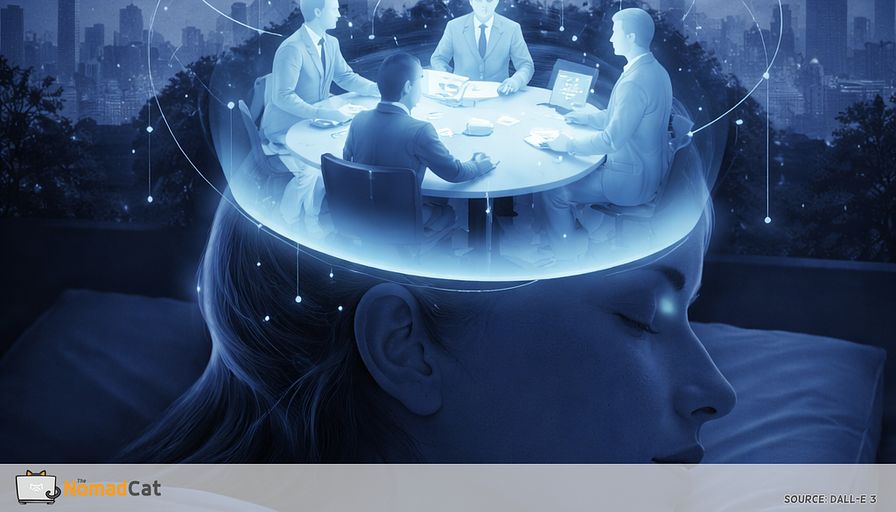
The day ends on time, at least on paper. Laptop closed. Lights out. Then the brain spins up like it just got a new brief. Not chaotic panic, more like quiet internal editing. Replaying a meeting in higher resolution than it deserved. Rewriting a 1-line Slack message. Running a silent audit on tone, status, and “did I land okay.”
If that sounds familiar, it helps to name what’s happening without turning it into a personality diagnosis. A normal 10-hour desk day can still wreck sleep, not because there was a crisis, but because the doing part of work ends before the evaluation part does. Execution load shuts down when the calendar clears. Evaluation load shows up later, right when the room gets quiet.
This pattern got sharper for me across office life in Beijing, then Berlin, and now Lisbon. Different cities, same late-night brain audit.
No big overhaul. No new app to babysit. Just a cleaner handoff between work mode and sleep, so you can wake up feeling less like you spent the night in meetings.
Role switching follows you into bed
When the day ends but your brain is still performing
The weird part is how professional the replay feels. Not a messy to-do list, more like your mind edits scenes and drafts alternate versions. That pause in a meeting. That 1 Slack sentence. That look someone gave you. Looping like this can keep the stress response switched on longer than the moment deserves.
The mismatch is rough. Sleep duration can look normal, but you wake up like you slept with tabs open. Functional, yes. Restored, not really. This is a common pattern, not a personality flaw.
A normal day can still break your sleep
Execution load closes faster than evaluation load
Bad sleep after a crisis day makes sense. The unfair version is a clean day, no fires, tasks mostly under control, and still the brain is sharp at bedtime.
A useful distinction is execution vs evaluation.
- Execution load is “do the thing” thinking.
- Evaluation load is “how did I land” thinking.
Switching tabs is cheap. Switching identities is expensive. You can solve problems all day and still feel fine, but the emotion-heavy replay tends to be what ruins recovery.
Identity switching leaves residue
Manager, analyst, negotiator, therapist, presenter. Each swap carries scoring and uncertainty, not just tasks. Unclear or incompatible expectations drain you earlier in the day. Add emotional labor, the tone work and the constant “how should I sound right now”, and bedtime becomes the moment your brain tries to finish the social math.
Social evaluation keeps your system awake
Why your brain treats being judged like a threat
A lot of bedtime replay is basically threat monitoring with better branding.
Did I disappoint someone. Did I look competent. Did I drop in status.
Like sending a “quick update” to a stakeholder and then rereading your own tone 12 times because their reply was just “ok”.
After a 10-hour desk day, the room finally gets quiet, and your brain suddenly has bandwidth to run the audit.
Evaluation is one of the fastest ways to switch the stress response on. The Trier Social Stress Test, a mock interview plus mental math under observation, reliably increases cortisol (Kirschbaum, Pirke, & Hellhammer, 1993). Work isn’t that lab task, but many moments have the same ingredients: evaluation plus low control.
This also explains why “just plan better” often doesn’t work. Repetitive thinking can extend activation after the event is over, like leaving a process running in the background.
Not all work thoughts hit sleep the same way
Timing is part of the problem. When messages stop, the mind often switches from doing work to evaluating how work went. The emotional replay is the one that tends to mess with sleep.
Planning can help when it creates closure. Writing down tasks can reduce work thoughts popping up at bedtime for unfinished work (Scullin et al., 2018). In practice, it works because the next step stops living only in your head.
- Planning is concrete next steps, externalized.
- Replay is image-based, social, “how did I land.”
Quiet is when your brain does the merge
During the day, you run on interrupts. Meetings, Slack, tone shifts, micro-audits of competence and warmth. There is not really time to consolidate. When it finally gets quiet, the brain starts replaying.
If this repeats, it can become a loop. Poor sleep can make social cues feel sharper the next day. Then small frictions land bigger. Not destiny. Just feedback loops.
A 2-question check
After a 10-hour desk day, it helps to run a tiny self-check before trying another fix. Not psychoanalysis. Just classifying what kind of mental load is leaking into bed.
Question 1 what is this thought about?
Are the thoughts mostly about what you must do, or about how you came across.
Quick cues it is evaluation load
- tone and wording
- credibility and competence
- likeability and warmth
- status and hierarchy
- embarrassment about a tiny moment
Question 2 are you switching audiences?
Are you switching audiences. Boss, client, team, peer, investor, direct report. If yes, that is usually role residue, not a messy task list. Different audiences come with different expectations and display rules.
What your answers change tonight
If it is mostly task-based, offloading can help, because concrete plans reduce work thoughts popping up at bedtime for unfinished work (Scullin et al., 2018).
If it is mostly audience-based, planning can feel weirdly ineffective, because the brain is not missing tasks. It is missing a stable handoff. That’s why emotional rumination tends to be worse for sleep than calm problem-solving.
A late-afternoon cutoff
The goal is not to be calmer in bed. The goal is to stop feeding the machine in late afternoon, when the recovery runway is short. If you go to bed around 22:00–00:00, the last 6–8 hours before bed are where late activation has the easiest path into the night. Pick a cutoff you can hold most days. I use 16:00, but it’s not a law.
Define what counts as high social evaluation work.
High social evaluation work is anything where the main variable is not correctness, but how you land under judgment, often with low control.
- performance feedback that could be read as blame
- stakeholder updates where status is on the line
- delicate Slack or email tone work with power dynamics
- negotiation emails where every sentence is a lever
- conflict repair and apology messages
- announcing a decision that will disappoint someone
These aren’t bad tasks. They are expensive tasks. They cost reputation attention, not only time.
If role residue is the real issue, moving evaluation-heavy moments earlier can reduce the 23:30 scene replays even if total workload stays similar.
Work design that reduces identity thrash
Batch roles and stop minting new personas late day
Don’t try to calm the system at 23:30. Reduce the number of unintegrated roles you generate after your cutoff. It’s a queue problem, not a willpower problem.
2 upstream options that still fit inside a 10-hour desk day
-
Role batching when possible
- Cluster high-social-evaluation work earlier.
- Keep late day for low-social-cost execution.
Late-day safe list, when possible
- analysis and deep work
- cleanup and admin
- drafting without sending
- private prep for tomorrow
-
No new personas after dinner
- No delicate tone crafting.
- No politics.
- No reputation-protection writing.
- Yes to closure tasks like filing notes, scheduling, or sending plain confirmations.
Some roles cannot be moved. Then the move is standardization. Templates reduce variability, which reduces the number of judgment calls your brain has to keep re-running. A fixed status update structure helps. A fixed feedback structure helps.
The 4 line role handoff log
Keep it plain so it survives busy weeks. A to-do list closes task loops. This closes identity loops by naming which persona is on duty first tomorrow. Writing things down can offload cognitive load and support sleep onset (Scullin et al., 2018).
Write 4 lines where work already lives, paper or plain notes, not a new app
1. Today I wore (example “manager, negotiator, firefighter”)
2. Open social loops (example “waiting for X reply, Y felt tense”)
3. Tomorrow first role (name 1 role only)
4. 1 permission (what you are not solving tonight)
If 4 lines is too much, do 2 lines only
- Open social loops
- Tomorrow first role
Consistency helps more than perfect formatting.
Message design that stops the tone guessing
Make late messages less ambiguous
After a 10-hour desk day, a soft ping at 18:40 can be worse than 6 clear ones. Ambiguity breeds multiple interpretations, and at 00:40 the brain tends to rehearse them all. When expectations are fuzzy, telepressure rises because people start monitoring for implied urgency (Barber & Santuzzi, 2015). Meaning: one vague message can create more mental work than several clear ones, because your brain has to infer urgency.
A simple tweak is adding 1 explicit expectation line to late-day messages.
- “No need to respond tonight.”
- “Decision tomorrow 11:00, I’ll bring options.”
After-hours ICT use is linked to poorer recovery and sleep-related outcomes (Derks et al., 2015). Evidence for specific footer lines is thinner, so treat this as plausible, not guaranteed.
What progress looks like and when to stop tinkering
Progress is often boring. The content of thoughts shifts before sleep time changes.
Morning signs
- less urge to reopen threads to check the vibe
- faster start without rereading everything
- more tolerance for mild ambiguity
Night signs
- fewer scene replays in bed
- thoughts feel more task-like, less audience-like
- sleep feels more continuous, even if total time is unchanged
If sleep problems persist, stop debugging alone. Screening prompts, not self-diagnosis
- persistent severe daytime sleepiness
- loud snoring or gasping
- restless legs sensations
- weeks-long deterioration
- low mood or escalating anxiety
CBT-I is recommended as first-line treatment for chronic insomnia (Qaseem et al., 2016). It’s a structured, skills-based approach that targets the loop of sleep disruption (not just “try harder to relax”). Digital CBT-I also shows meaningful effectiveness in large reviews (Trauer et al., 2015).
A 10-hour desk day can end “on time” and still steal the night. Not because you forgot tasks, but because execution stops and evaluation starts. The replay in bed is often social math, plus role residue from being manager, analyst, negotiator, and sometimes part-time therapist. Naming that difference matters, because task planning can create closure, while audience-based replay keeps the system running.
The practical wins here are small and boring, which is kind of the point. Move high-evaluation work earlier when possible. Batch roles so you stop minting new personas late day. Leave a short handoff log so your brain doesn’t keep tabs open at 00:40. Clearer late messages help too, mainly by reducing ambiguity.
Most nights it isn’t unfinished work keeping you up. It’s the unpaid invoice of evaluation.
You might be interested by these articles:


Work is over but your body is still in competence mode at midnight

Thin sleep is a workday monitoring bug not a bedtime failure

Your sleep is thin because your brain is still on standby

When the last meeting ends too late your sleep keeps buffering

After dinner no more invisible work so your sleep can actually power down

Why video calls wreck your neck after you hit Leave

How invisible connectors boost your tech portfolio




