Abstract:
The article explains how a workday filled with constant micro-interruptions—Slack pings, doc comments, “2 mins?” requests, quick approvals, and meeting churn—can keep your brain in a subtle “on-watch” state that carries into the night, producing sleep that feels thin (more wake-ups, work-flavored dreams, and an early-morning “boot-up” where your mind starts scanning tomorrow before your body is fully awake). Rather than blaming bedtime habits or screen time as a moral failure, it frames the core problem as attention fragmentation: frequent context switching creates “attention residue,” trains a faster internal sampling rate, and leaves behind many tiny unfinished loops that drive rumination and monitoring even during otherwise calm evenings—an effect the author relates to years of desk-based, always-reachable work across Beijing, Berlin, and Lisbon, where sleep becomes the variable that won’t cooperate. To diagnose whether the issue is truly sleep or recovery that never starts, it proposes a simple 2-day contrast check (a ping-heavy day versus a day with two longer uninterrupted blocks) using morning signals like whether sleep felt segmented, whether you woke with a “scan urge,” and whether your mind was online before coffee. The suggested fixes are upstream workday “knobs,” not heroic willpower at 23:00: batch reactive communication into two bounded windows (“2×30”), protect a daily single-thread hour to finish one shippable artifact, avoid starting new loops in the last 90–120 minutes of the day, and use clearer handoffs (status pins and short scripts like “next update at 15:00, no need to reply”) to reduce ping-backs and uncertainty; progress is measured by less monitoring rather than perfect sleep, while persistent nonrestorative sleep or red flags (snoring/gasping, restless legs, dangerous sleepiness, drowsy driving) should prompt CBT-I and medical screening.
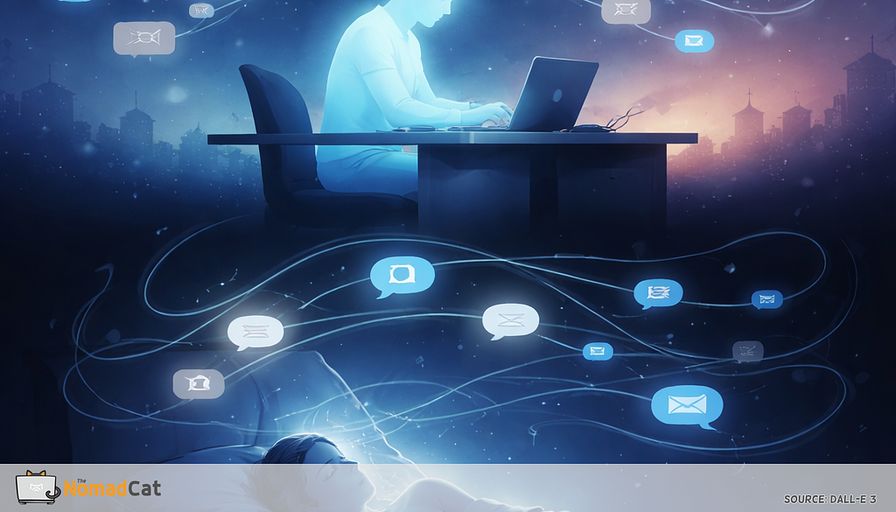
Slack pings. Doc comments. Quick approvals. “2 mins?” checks that somehow multiply. Nothing is dramatic, and that’s almost the problem. The day turns into a long scroll of tiny context switches, where you spend more time reloading your brain than actually doing the work.
Then night comes and sleep gets… thin.
If you’re on screens all day, jumping between meetings, eating lunch at the desk, and telling yourself you’ll exercise “later”, yeah, this pattern can feel annoyingly familiar. There’s often a bit of guilt in there too. Like you should be able to fix it with a better bedtime routine. The kind you definitely run perfectly during deadline weeks. But perfection isn’t required here. Small changes count.
This article is about that pattern. Not as a moral story about screen time, and not as another bedtime checklist. The main idea is simple. A workday that keeps poking your attention can keep your system in “on-watch” mode, and sleep inherits it.
Here’s what you’ll get in the next sections
- Why frequent interruptions leave “attention residue” and make it harder to mentally detach later
- How remote work and always-reachable norms quietly train a faster sampling rate, even on calm evenings
- A low-effort 2-day contrast check to spot whether your issue is really sleep, or recovery that never started
- Practical workday knobs that reduce churn without pretending you can ignore humans, like bounded comms windows, a single-thread block, and better handoffs that kill ping-backs
- What progress tends to look like, plus a few red flags that are worth a proper screening instead of stacking more hacks
If your days look productive on paper but your nights feel like you’re still half on call, this should feel familiar. And hopefully a bit relieving too. The fix is often upstream, in how the day is shaped, not in forcing yourself to “do sleep better” at 23:00.
When your workday behaves like an attack on attention
Slack pings, doc comments, quick approvals, “2 mins?” checks, meeting follow-ups, calendar reshuffles. None of it is dramatic. But the day becomes a long stream of tiny context switches.
Interruption research backs the shape: even “small” interruptions often cost you a few minutes of “wait, what was I doing?” before you’re really back in the task (Altmann & Trafton, 2002).
This fits insomnia models that focus on hyperarousal and mental monitoring, not “you did bedtime wrong” (Harvey, 2002). When thinking loops keep running, activation can carry over even without a clear trigger.
It’s not always late pings. Not always 1 big unresolved decision. After-hours tech use can hurt sleep by blocking mental detachment (Lanaj, Johnson, & Barnes, 2014). But there’s another pattern too. Even with a quiet evening, a day full of attention fragmentation can leave you under-recovered because detachment never really started (Sonnentag & Fritz, 2007).
A useful way to think about it is lots of small hits to attention. Not 1 giant problem, but hundreds of small ones. When you switch, part of your brain stays stuck to the previous thread. Irritation becomes the baseline (Leroy, 2009). Sleep then inherits this subtle posture of “is something coming”, like the brain kept the sampling rate a bit too high.
Why desk work makes this feel normal
Modern chat rewards speed, not closure. A quick “on it” calms everyone else’s system, so responsiveness becomes a competence signal. That’s telepressure, and it reliably harms detachment and recovery (Barber & Santuzzi, 2015). It’s why a “quick on it” reply can feel safer than actually finishing the work.
Remote work adds a twist. The issue is not only message volume. It’s thread-count and restart cost. 20 messages in 2 clusters can be fine. 20 messages spread across 9 hours becomes constant restart.
Without commute and hallway buffers, there’s no chapter break. Just tab-switching until dinner. The author has spent most of adult life at a desk across Beijing, Berlin, and now Lisbon—and still manages to do workations across europe on bad chairs and worse desks. Add “often past midnight” weeks on top of that, and it’s easy to slip into “always reachable” mode, where sleep is the variable that won’t cooperate.
Your brain learns a fast sampling rate
When restarts stack, the day starts to feel urgent even if output is fine. The interruption is not only the ping. It’s the invisible restart tax: where was I, what changed, what did I miss.
Altmann and Trafton’s “Memory for Goals” model is basically this. In practice it looks less like theory and more like you reopening the same tab three times, rereading the same Slack thread, and still not trusting what you last decided.
Frequent switching also trains impatience. If uncertainty has burned you 12 times already, you start paying an “attention premium” to avoid surprises. That’s when tab-hoarding shows up, or rereading the same thread because you don’t quite trust your own memory anymore. Interruption-related irritation and strain are a known pattern (Baethge & Rigotti, 2013).
Then there’s the night scanning problem. Interrupt-driven days produce unfinished micro-tasks.
- “can you review”
- “quick tweak”
- “just approve this”
Each one is small, but it doesn’t close cleanly. Work research links unfinished tasks to rumination and impaired recovery, including sleep-related outcomes (Syrek & Antoni, 2014). The Zeigarnik effect is a useful historical anchor here, but not a law of physics.
So instead of 1 big unresolved decision, you get 20 tiny ones. Together they create a background “system scan”, like a health check that keeps polling for errors. And it’s the opposite of detachment, a core recovery mechanism (Sonnentag & Fritz, 2007).
Practical implication. If late afternoon kept spawning new threads, bedtime fixes alone will feel weak. Your nervous system is not impressed by herbal tea if your brain expects more packets. Policy-style changes often help because they reduce expectation-driven arousal rather than asking for willpower at 23:00.
The 2-day contrast check
Pick Day A and Day B that match on the boring confounders. Same wake time, same first coffee timing, similar work hours and bedtime. Let the main difference be churn.
- Day A is ping-heavy and meeting-churn
- Day B still has work, but has 2 longer uninterrupted blocks
Then check 3 morning signals, not a sleep score. The point is within-person A/B logic.
Keep it stupid-simple. Yes or no, or 2 words. You are checking for the monitoring flavor, not “did i get 8 hours”.
- did sleep feel like 1 block or many segments
- did you wake with a scan urge, like you need to check what you missed
- was your mind “online” before coffee
2 days is not research. It’s a debug probe. If the same pattern repeats across a few weeks, that’s enough signal to redesign the workday, not the pillow.
If you want 1 metric use the scan urge
The scan urge targets the “on-watch feeling” directly. It lines up with perseverative cognition, where the mind keeps chewing on work after the stressor is gone (Brosschot, Gerin, & Thayer, 2006).
Notice the first 60 seconds after waking. If your hand moves toward the phone before your feet hit the floor, that’s data, not a morality play.
If one of the confounders below happens, mark that day as “noisy data” and don’t over-interpret it.
Confounders worth noting so you don’t blame Slack for everything
- noise
- sick kid
- alcohol
- pain
- late caffeine
- meds
- snoring partner
Workday knobs that reduce churn
Put reactive comms in 2 bounded windows
Batching only works if people aren’t left guessing. A simple constraint is the 2×30 rule.
- 2 windows of 30 minutes per day for Slack and email replies
- outside the windows, you triage not dialogue
“Triage not dialogue” means you acknowledge, capture the next action, and close the loop on timing—more like “Next update at 15:00. No need to reply.” than an open-ended back-and-forth. The goal is fewer state changes, not ignoring humans. Constrained checking has been linked to lower stress in field work on email batching (Mark, Voida, & Cardello, 2012).
To keep it socially workable, reduce uncertainty.
- put a simple reply schedule in status, with 1 clear urgent path
- use 1 escalation channel for truly urgent items, not “ping me everywhere”
Defaults beat willpower. That’s the point.
Protect one single-thread block
Protect 1 single-thread hour most days, 45–60 minutes where you finish 1 artifact end-to-end. A PR. A memo. A small analysis you can actually ship. Single-threading matters because attention residue is real (Leroy, 2009).
Then protect the last 90–120 minutes from creating new loops. Pick a cutoff where you do closure and handoffs only, not fresh asks. This maps cleanly to the unfinished-tasks → rumination chain.
Make it specific so people don’t ping again for reassurance.
- “Yes, i saw it. Can we pick this up tomorrow 10:30”
- “I’ll send an update at 15:00, no need to reply”
Timing is a signal. Reducing uncertainty reduces follow-up messages.
Reduce ping-backs with status pins and simple scripts
A tiny certainty artifact goes far. A status pin at end of day can say what’s true, who owns what, and when the next checkpoint is, like a small handoff.
- “PR #481 in review, blocker is X, next update tomorrow 11:00, owner is me”
Planning like this can reduce intrusive thoughts compared to leaving goals unstructured, and it supports detachment through a feeling of control and closure (Masicampo & Baumeister, 2011).
There’s also a clean sleep-adjacent anchor. In a lab RCT, 5 minutes writing a to-do list led to faster sleep onset versus writing completed tasks (Scullin et al., 2018). Translation. Get the next actions out of your head before you are horizontal.
Message endings that kill uncertainty tend to work well.
- “Got it. I’ll deliver by tomorrow 11:00.”
- “Next update at 15:00. No need to reply.”
- “Blocked on X. I’ll proceed with Y unless you object by 16:00.”
Scripts aren’t about being cold. They lower interrupt density for everyone.
What progress looks like and when to stop DIY
Progress rarely looks like perfect sleep. It more often looks like less monitoring.
Night markers tend to be boring.
- sleep feels heavier
- fewer early boot-ups
- fewer vivid “still working” dreams
- less wake-and-scan impulse
Daytime proof can show up first.
- less tab-hoarding
- less rereading the same thread because ambiguity feels less threatening
If sleep stays nonrestorative even after interruption density and after-hours pressure drop, it’s usually a sign to stop stacking micro-fixes and consider evidence-based insomnia treatment like CBT-I, plus basic medical screening for sleep disorders.
Quick red flags that deserve earlier screening
- loud snoring or gasping pauses in sleep
- restless legs symptoms that push you to move at night
- dangerous daytime sleepiness
- drowsy driving
Optional screeners like the ISI or PSQI can support a clinician conversation, but they’re not a home diagnosis. The systems frame still holds either way. Reduce the daytime sampling rate, and nights often stop acting like they’re on call.
If your days are a blur of pings and “2 mins?” requests, it makes sense that nights can feel thin. The problem is often not bedtime behavior. It is the daytime sampling rate your brain learned to run. Frequent interruptions leave attention residue, create a pile of tiny unfinished loops, and keep the nervous system in light-monitoring mode long after the laptop is closed.
The encouraging part is that the fix is usually upstream and pretty unglamorous. Try a quick 2-day contrast check. Then tweak a few workday knobs that reduce churn without pretending you can ignore people, like 2 bounded comms windows, 1 single-thread hour, and clearer handoffs that kill ping-backs. If mornings start with a scan, the fix is usually in yesterday’s thread-count.
Notes (extra references)
Barber & Jenkins (2014); Mark, Gudith, & Klocke (2008); Monk, Trafton, & Boehm-Davis (2008); Riemann et al. (2010); Kushlev & Dunn (2015); Syrek et al. (2017).
You might be interested by these articles:


Your 1st 45 minutes are training your 02:00 brain so change the input order

Thin sleep is leftover context from a chopped up desk day

Your brain never clocks out when work can still ping you at night in Beijing Berlin or Lisbon

Your sleep is thin because your brain is still on standby

Micro-checking after work is keeping your brain in intake mode at night

Blink debt the real reason your eyes crash at 17:30

Turning Data Challenges into Success for European Startups