Abstract:
The article explains why late meetings can wreck sleep even when you do all the “right” evening habits, arguing this is a predictable timing issue—“calendar physics”—rather than a personal failure: live meetings act as intense social inputs that keep the brain in evaluation mode, creating a “stress tail” that turns bedtime into a replay loop of one awkward sentence, someone’s micro-smile, a two-second silence, and even an early-morning status scan, leaving sleep feeling “thin, like you slept with 14 tabs open.” It highlights how meetings (especially video calls with gaze, self-view, and forced stillness) demand more mental “social compute” than solo work, and why end time often matters more than workload; without a commute or natural transition, remote workers can stay stuck in the same chair and lighting, compounding arousal and physical stiffness. The practical remedy is to protect a “downshift gap” (often around two hours) between the last meeting and lights-out by making small system tweaks—pull calls earlier, default to 25- or 50-minute meetings, use camera-optional or turn off self-view, and replace “on-stage” status time with written artifacts with explicit response expectations (“comments by tomorrow 15:00, no replies expected tonight”). It also offers a deliberately boring six-minute post-call “hard landing” (write what was decided, what’s next, and what you are not doing tonight) to stop unpaid mental overtime, plus diplomacy-friendly scripts and fairness norms for global teams (rotate timezone pain, protect one late-free evening weekly, cap overlap calls). Finally, it notes that if sleep is still poor without late meetings—or if red flags like apnea symptoms or chronic insomnia appear—the right lever may be clinical care such as CBT-I, not further calendar tweaking.
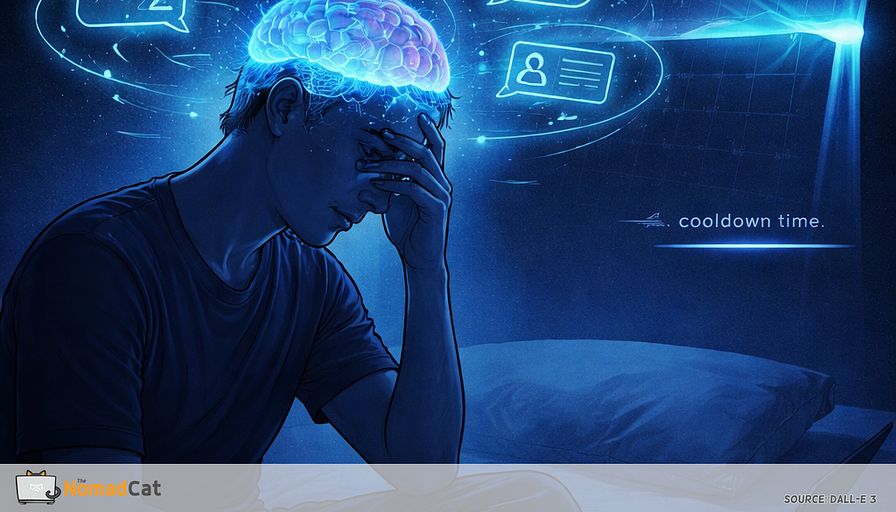
You did everything “right.” Laptop shut at 21:12. Dinner was fine. Phone on mute. No doomscrolling. Then lights-out arrives and the body is clearly tired… but the brain is still in meeting mode. Social. Alert. Ready to answer a “quick question” that no one asked.
If that sounds familiar, it’s not a character flaw and it’s not a mystery. Late meetings can leave a stress tail. The call ends, but the system doesn’t downshift on schedule, so bedtime turns into a replay buffer. One sentence you said. Someone’s micro-smile. The 2 seconds of silence. Then the early-morning status scan before you even move.
This article is here to name that pattern and treat it like a timing problem, not a morality play about sleep rules. The goal is simple. Fewer nights that feel thin, like you slept with 14 tabs open.
What this covers, in plain terms
- Why meetings heat your brain more than solo work, even when you barely talk
- The calendar cliff problem and the downshift gap (why end time matters so much)
- Small system changes—calendar, buffers, camera rules, artifacts, and scripts—that reduce late-meeting fallout
- When scheduling is not the lever and it’s time to treat sleep as a clinical issue, not a calendar issue
No perfection required. For me, this is closer to debugging than self-improvement. Adjust a few inputs, watch the logs, and stop blaming yourself for a system that’s doing exactly what it does under social load.
The late meeting signature
The clean evening that still does not work
You close the laptop at 21:12. Dinner is normal. Phone on mute. No doomscrolling. And still, at lights-out, the body is tired but the brain stays weirdly social, like it could jump back into “so, quick question” mode.
That mismatch is common. You can be genuinely tired and still feel mentally switched on (Riemann et al., 2010). And if you went from a live room of faces to brushing your teeth in 5 minutes, your nervous system didn’t get the memo.
On late-meeting days, the sleep log often shows the same cluster of bugs
- Replaying 1 sentence you said, then someone’s micro-smile, then the 2 seconds of silence after it
- Mentally rewriting what you should have answered
- A faint “am i being judged” feeling, even if nobody was rude
- Waking early and doing a fast status scan before you even move
- Getting back to sleep, but it feels thin, like you never fully powered down
This is not a diagnosis. It’s the brain staying revved up at bedtime (Harvey, 2002).
The point is simpler than most advice makes it. A live meeting is often the last strong input of the day. The event ends, but the replay can keep running after it’s over (Brosschot, Gerin, & Thayer, 2006). Predictable output, not a character flaw.
A useful frame is calendar physics, not sleep hygiene morality. If the last meeting ends too close to bedtime, recovery time gets squeezed and the system has no cooldown window. Stress and sleep are timing-sensitive in an unsexy way (Meerlo et al., 2008).
Why meetings heat your brain more than solo work
The arousal has a tail
In solo work, you can be messy in private. In a meeting, you are “on” even if you barely talk. You track faces, tone, timing, status, and your own voice at the same time. Quiet, but alert. Your system treats it like a test.
That tracks with a basic idea from stress research. Being evaluated by others reliably raises stress responses (Dickerson & Kemeny, 2004).
The loop is familiar. You speak. You wait. You prepare a sentence. You cancel it. You speak anyway. Then you watch the reaction. Even friendly teams create uncertainty and that small risk of looking confused in public. Video calls add their own flavor (Bailenson, 2021).
The annoying part is timing. The body doesn’t always downshift when the call ends. If the meeting was even slightly tense, replay becomes free overtime. Rumination can keep stress running after the event (Brosschot, Gerin, & Thayer, 2006). Put it late and the tail overlaps with sleep.
Remote work can amplify this. Video calls stack extra social compute. Gaze. Self-view. Stillness. You watch faces “staring at” you, you monitor your own face, and your body sits frozen like a screenshot—especially when you’re presenting and the only feedback is 8 muted squares and your own face in the corner. A lot of people feel it as “why am i tired, i only sat there.”
Often the key variable isn’t workload. It’s end time.
The calendar cliff and the downshift gap
End time beats workload more often than people expect
A heavy day that ends at 17:30 can still leave runway. There is time to detach and do something that isn’t performance, which helps recovery (Sonnentag & Fritz, 2007).
A lighter day with a 19:30–20:30 overlap call can look fine on paper, yet sleep gets thin. The stress tail simply lands closer to bedtime.
Late meetings also aren’t automatically a boundaries issue. Sometimes it’s global-team geometry. The overlap window is narrow, so everyone crowds onto it. The schedule problem is structural, not moral.
One more stacking factor is light. Late meetings keep you under bright indoor light and backlit screens later, which can push sleep later too (Chang et al., 2015; Gooley et al., 2011). It stacks on top of the “still on stage” feeling. “Relax harder” rarely fixes a timing problem.
A metric you can feel without tracking
The downshift gap is the hours between the last meeting ending and lights-out. Think of it as cooldown time, not virtue.
A simple working guess is that many people sleep worse when that gap drops under about 2 hours. Not a rule. Just a place to start. If your “thin” nights show up at 90 minutes, your number is 90 minutes; if they show up at 3 hours, yours is 3.
Remote work makes this harder even when you “stop working.” No commute walk. No stairs. No coffee run. The day ends in the same chair, under the same light, with the same tabs still open, so the switch from work brain to night brain doesn’t get a natural handoff (Sonnentag & Fritz, 2007).
This is the part I underestimated for years, because I thought “ending work” was a binary switch. The author has spent years at a desk across Beijing, Berlin, and now Lisbon, with mostly remote stretches on bad chairs and worse desks. That missing transition is real.
And remote work adds another physical creep. Less background movement often shows up later as stiff neck, tight shoulders, lower back pain, poorer sleep, and the classic low-energy-after-lunch slump. It is rarely a personal failure. It’s a system that lost its old defaults.
Fixes that change the system around the meeting
Create buffer without reinventing your life
Pulling a call 30–60 minutes earlier, or shortening it by 15 minutes, is often the least political change with the biggest effect.
Two boring defaults that often survive org reality
- 25-minute meetings instead of 30
- 50-minute meetings instead of 60
If a late call is unavoidable, reduce the social compute cost. When visuals are not needed, allow camera-off. If camera-on is needed, turning off self-view can help. Videoconference fatigue is tied to constant self-presentation and nonverbal pressure (Bailenson, 2021).
Swap stage time for artifacts
Async can remove the on-stage feeling, but only if response time expectations are explicit. Otherwise it becomes a soft meeting that never ends.
A practical pattern is pre-read for conveyance, then the live call only for convergence.
A simple written decision request can include the question, 2–3 options, and a deadline. And one line can prevent night work
“Comments welcome by tomorrow 15:00, no replies expected tonight.”
That converts vague pressure into something you can drop for the evening.
A hard landing after the call
A post-meeting landing can be 6 minutes and intentionally boring. Write 3 bullets
- What was decided
- What is next
- What you are not doing tonight
This gets the thoughts out of your head and onto something dumb and reliable, like paper or a notes app. It also reduces the “keep replaying so i don’t forget” loop (Harvey, 2002). A brief to-do list writing task has been shown to help people fall asleep faster (Scullin et al., 2018).
Common trap behaviors after late calls
- Deck polishing
- Defensive emails
- Scanning threads for tone
This isn’t laziness. It’s the brain staying in threat-monitoring mode, just wearing a professional outfit (Brosschot, Gerin, & Thayer, 2006).
Scripts and experiments that do not sound like a cry for help
Scripts that survive org politics
Asking to move a meeting can trigger the “not committed” vibe. So framing matters.
- “Can we pull this 30 min earlier next time so we’re sharper on the decision”
- “Could we do 25 min and keep the last 5 for notes so we don’t re-litigate tomorrow”
- “If we keep it at this time, can we make it camera optional to reduce fatigue”
- “Happy to stay live for the decision, but can we move the status part to a doc”
Fairness norms for global teams
For distributed teams, making this about fairness often works better than making it about sleep. Right-to-disconnect norms can help legitimize the ask.
- Rotate the overlap pain, do not always pick the same timezone
- Protect 1 late-free evening per person per week
- Cap overlap calls per week, and push the rest into written updates
A 7-day causality check with no apps
The goal is not a new tracking hobby. It’s a tiny debug log.
For 7 mornings, write 2 fields only
- Last meeting end time
- Sleep felt deep or thin
Look for clustering, not perfection. If thin nights pile up when the downshift gap drops under a certain number of hours, that’s your local threshold.
Boring success is not “8 hours, woke up glowing.” It’s lower mental noise. Fewer bedtime replays. Less early-morning status scanning. Less urge to do reputation cleanup.
When this is not the explanation
If sleep is thin even on weeks with no late meetings, scheduling is probably not the main lever. For persistent insomnia, clinical guidelines point toward CBT-I as first-line treatment (Qaseem et al., 2016; Sateia et al., 2017).
A few red flags are worth treating as “screen this,” not “tweak the calendar”
- Loud snoring or gasping, or someone noticing breathing pauses
- Restless legs symptoms that keep sleep from starting
- Dangerous daytime sleepiness, especially drowsy driving
- Insomnia symptoms at least 3 nights per week for at least 3 months, with daytime impairment, despite adequate opportunity (ICSD-3)
Calendar fixes can make the runway longer. They do not fly the plane for you.
If late meetings keep stealing your sleep, it’s not because you “failed” at evening rules. It’s calendar physics. A live call is a strong social input, and it leaves a stress tail that doesn’t respect your lights-out time. When the downshift gap gets squeezed, the brain keeps running replay and doing reputation cleanup, even if the day looked reasonable on paper.
The fix is often boring on purpose. Move the end time earlier when you can. Shorten defaults to 25 or 50. Make camera optional when visuals don’t matter. Swap status for a doc. And after the call, do a 6-minute hard landing so your head doesn’t keep backups all night.
When the last call ends 2 hours before bed, a lot of the “reputation cleanup” stops showing up at 01:00.
You might be interested by these articles:


When work ends but evaluation starts your brain keeps auditing in bed

A productive day can still break your sleep fix the missing downshift signal

Your workday ended but your brain is still on duty at 23:40

Sleep looks fine but your brain never downshifted

Thin sleep is leftover context from a chopped up desk day

Threat Hunting Techniques for Proactive Cybersecurity Defense

Harnessing Reinforcement Learning Power