Abstract:
The article addresses a specific kind of “thin sleep” where you fall asleep normally but wake around 03:00 and become instantly, calmly “online,” mentally sorting tomorrow, replaying half-decisions, or drafting replies you won’t send—then drifting back into lighter sleep. Its core message is that brief awakenings are normal; the real problem is the speed of post-wake mental engagement, which is often fueled by modern “context collapse” in desk and remote work where one room (and even one chair, lighting setup, and screen glow) has to serve as office, living space, and bedroom, leaving the brain running a background “resolver” to figure out what mode it’s in. The piece frames this as a human-factors “mode error” or UI bug rather than a personal failing, amplified by reachability norms and telepressure (the sense you could respond) plus cues like visible work clutter and the fact that work is one tap away. Instead of prescribing a big bedtime routine, it proposes a simple two-night “debug” using three yes/no questions (shared work/sleep setup, work-like evening visual field, and whether you oriented to tomorrow within 30 seconds of waking), then recommends low-effort state-separation signals: a 30-second visual boundary (put away/cover/turn away devices), consistent warm-dim evening lighting, posture/chair changes, added device friction (log out, move apps, put the laptop out of reach, fixed check windows), and optionally a one-line “next touch” note. It culminates in a six-minute “micro commute” (put hardware away, briefly change scene for sensory contrast, write “Next work touch: ___ at ___”) to make “work off” believable, while noting improvements should be boring and gradual and urging escalation to CBT-I or medical evaluation for red-flag sleep symptoms.
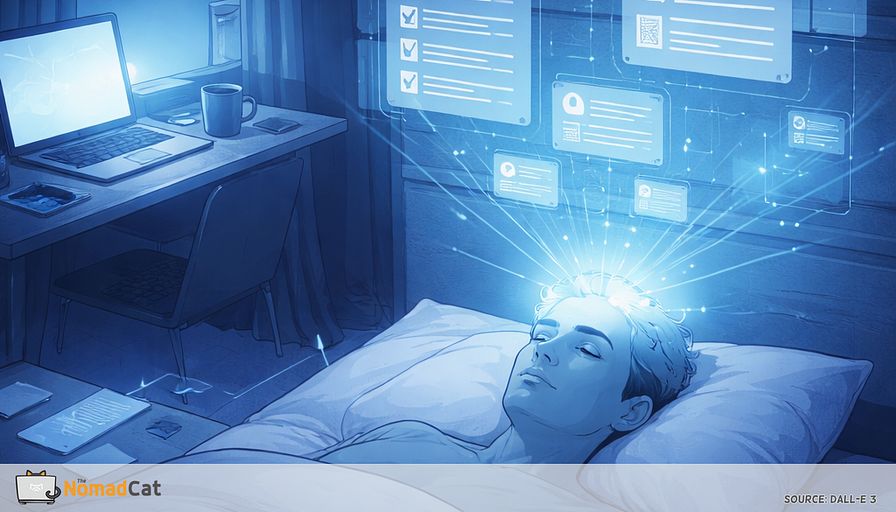
You go to bed tired in the normal way. No crisis. No late Slack. And still, at 03:00, you pop awake like your brain just hit a power button. Not anxious, not dramatic. Just instantly online. In 30 seconds you’re sorting tomorrow, replaying a half-decision, mentally drafting a reply you will not send. Then you fall back asleep, but the sleep feels thin.
This article is for that specific kind of night. The one where it doesn’t feel like “stress” so much as your system never fully leaves work mode. Not because you’re weak on boundaries, but because modern desk life quietly removed the old separators. Same room, same chair, same screen glow, different “mode”. Your brain does what any decent device does with unclear state: it keeps checking.
I’m French (born in 1974), living in Lisbon since 2023 after years between Berlin and Beijing, and I’ve spent a lot of nights at a desk that quietly ran past midnight. This pattern is familiar.
The goal here is modest and practical. Not perfect sleep, not a new evening program. Just fewer wake-ups that turn into calm planning, and a bedroom that stops acting like a work launcher. It’s not very glamorous, but it can help.
Here’s what we’ll cover:
- Why brief awakenings are normal, and why the problem is the speed of mental engagement after them
- How context collapse makes 1 space run 3 operating modes and keeps a background “resolver” running
- The role of reachability norms and telepressure, even when you technically logged off
- Why visual cues and fast access keep work “live” at night
- A simple 2-night debug to test whether state separation is the real issue
- A few low-effort mode markers and a 6-minute “micro commute” to make work-off more believable
If your schedule is packed, your day is screen-heavy, and you’re allergic to productivity-coach vibes, good. This is more like fixing a UI bug than fixing your personality.
The sleep tax of context collapse
A quiet night, still on standby
Brief awakenings are normal. The annoying part is what happens in the 30 seconds after.
- you wake up from almost nothing
- no panic, just instant coherence
- brain opens a tab list and starts sorting priorities
- morning “fast boot” loads work mode before anything
That calm planning still counts as work-like rumination. Repetitive problem-focused thinking can keep your system activated even when it feels reasonable. One common insomnia model also flags this post-wake checking and mental engagement as a thing that keeps the pattern going.
This is not on-call vigilance. Not doomscrolling. Not “working in bed” with a laptop open. It’s simpler. Your evening setup does not clearly tell your brain which mode it’s in, so the state stays fuzzy.
You can think of it as the brain in the wrong mode. When the system state isn’t obvious, mistakes go up. And when you’re tired, you do worse if you have to infer what’s going on instead of recognizing it. A micro-awakening becomes a restart point: quick context scan, tiny rehearsal of tomorrow, back to lighter sleep.
The good news is also boring: if you change what keeps the loop going, sleep maintenance can improve over time—meaning fewer wake-ups that turn into full “planning sessions,” even if your sleep is not magically perfect. CBT-I tends to move in that direction too: less time awake and engaged in the night, more ability to drop back off.
Context collapse is a systems bug
When 1 room runs 3 operating modes
Older life had crude separators. Now the same corner hosts work, leisure, and sleep. Transitions stop being obvious.
Context collapse, in plain terms, means your brain keeps a background “resolver” running to figure out what state it’s in. Same lighting. Same screen glow. Same chair. Same hunched posture. Detachment isn’t only willpower. It’s shaped by workload and context, and by whether the environment and norms support keeping work and home separate.
The commute was an enforced context switch
The commute forced state separation with sensory change and a block of unreachable time. Remote work removed that boundary layer, so switching off became optional and, frankly, fragile.
Research on work and recovery backs this up: detachment is a real thing you can measure, and being online at home tends to make it harder.
Reachability norms keep the system armed
Even if you log off properly, culture can keep the system armed. A single “ASAP” message creates an availability posture: you could respond.
Telepressure is linked to worse recovery and sleep-related outcomes—things like poorer perceived sleep quality and more trouble switching off at night. Late-night smartphone use for work also lines up with worse sleep. No villain needed. The norm is enough.
The loop behind calm 03:00 planning
Brief awakenings are not the bug. The bug is how fast your brain engages after waking.
Knowledge work sticks. You carry half-decisions, open loops, and social stakes. When the environment looks like work, it becomes easy for your brain to do a “fast boot” into tomorrow:
- tabs you left open
- a draft you did not send
- 1 decision you postponed
Quiet brains also wander toward goals, so work thoughts can win the first 30-second race without any dramatic stress story.
And yes, “productive” thoughts still count as activation. You can be calm and still keep yourself awake.
Why the whole room can keep work online
Stimulus control, a core CBT-I piece, aims to recondition bed and bedroom cues. That matters. But you can keep the bed “clean” and still sleep thin because the rest of the room keeps signaling work.
Two things leak work mode most:
- What you see
- What you can access fast
Visual clutter increases attentional load. Also, unfinished or cluttered home environments have been linked with stress patterns. From bed, 1 glance at a monitor glow, a laptop on a chair, or a pile of papers can flip the mode before you even have a full sentence in your head. It’s that tiny moment where your eyes land on the desk and your body goes, “oh right, that thing,” before you even sit up.
Then there’s access. If work is 1 tap away, the brain treats it as live. Even the mere presence of a phone can reduce available cognitive capacity. And checking is often self-initiated habit, not notification-driven.
Friction is not punishment. It’s a boundary tool.
A 2-night debug and a few cheap mode markers
This is not a sleep study and not a new bedtime project. It’s a quick debug to test one hypothesis: your environment is failing at state separation.
Use 2 normal weeknights. Don’t change bedtime. Don’t add supplements. Don’t track 12 variables. In the morning, write down the minimum you recall, loosely like a simple sleep diary.
The 3 yes/no questions
For 2 nights, answer these:
-
Did you do any work-like activity in the same physical setup you later slept in?
-
Did your evening visual field still look like work?
- After a wake-up, did you orient to tomorrow within 30 seconds?
If your answers are mostly “yes,” treat it like a UI issue: hidden state creates mode confusion, and micro-awakenings become restart points. If it’s mostly “no,” this lever might not be yours, and it’s worth looking elsewhere (schedule, caffeine, medical factors) without forcing the theory.
Mode markers that cost almost nothing
The point is contrast, not interior design. Pick a few cues your tired brain can recognize instantly.
1) A 30-second visual boundary after work
Pick 1:
- put the laptop in a bag or drawer
- cover the monitor with a cloth, or close the lid and turn it away
- clear the center of the desk so the “work altar” disappears
This helps because salient objects pull attention. If open loops keep pinging, pairing removal with a tiny plan can help too.
2) Light as the theme switch
Rule: bright and white for work, then 1 consistent warm and dim source for evening.
Room light before bed can suppress melatonin. eReader light in the evening can also shift timing and alertness. Keep it boringly consistent so your brain learns the cue.
3) Posture as a blunt segmentation tool
Reserve 1 chair as the work chair. Evenings default to literally anywhere else.
Evidence on posture effects is mixed. But as a segmentation signal, posture still works because it’s obvious and physical.
4) Reduce implied availability with device friction
Pick 1:
- log out of work accounts on the phone or move work apps off the first screen
- shut down the work laptop and put it out of reach, not just closed on the desk
- set 1 or 2 fixed email check windows instead of ambient checking
Distance is a legit tool, not a moral statement.
Only if needed: 1-minute “next touch” note
Write 1 line: “Tomorrow 09:30 first action is X.” Planning can reduce intrusive goal thoughts. One study found that writing a short to-do list before bed improved sleep onset compared to listing completed tasks.
A 6-minute micro commute
Remote work removed the transition infrastructure. No door, no street noise, no dead time where work cannot reach you. This 6-minute sequence is not about getting calm. It is about making “work off” believable.
1 minute Close, shut, put away. Hardware out of reach. Checking bursts are often opportunity-driven.
3 minutes Change scene, boring on purpose. Hallway loop, step outside, take out the trash. The point is sensory contrast.
2 minutes Write 1 line and stop: Next work touch: ____ at ____. Externalizing a next action can reduce bedtime planning. Less cognitive activity after waking matters.
Boring progress
You do not need a sleep app to see whether this helps. The target is less cognitive engagement after awakenings, not perfect continuity.
Signs you’re moving the needle:
- fewer wake-ups that turn into “tomorrow simulation”
- less composing replies in your head at 03:00
- less “fast boot” into mid-task mode on waking
Cue changes can feel noticeable in a few days because the room looks different. The stable part tends to take weeks, like many cue-response patterns. CBT-I studies also show improvements over weeks rather than overnight.
When to escalate
This is not a cure for chronic insomnia, and not a replacement for CBT-I, which is recommended as first-line treatment for chronic insomnia. Some symptoms should override DIY:
- loud snoring, gasping, or witnessed breathing pauses
- dangerous daytime sleepiness, especially drowsy driving
- insomnia that is severe, persistent, and impairing despite basic changes
- parasomnias with injury risk (sleepwalking, dream enactment)
- restless legs symptoms that repeatedly delay sleep
The scope stays narrow on purpose. No supplements. No elaborate evening scripts. No worshipping a sleep score.
The whole point is a boring UI rule: make state visible so errors drop when you are tired. Tiny visibility changes can be enough to stop the 03:00 fast boot from feeling automatic.
You might be interested by these articles:


Your bed is not a workspace fix the cues that boot up work brain at night

8 hours in bed and still tired debug your fragmented sleep

Sleep looks fine but your brain never downshifted

Thin sleep is a workday monitoring bug not a bedtime failure

A productive day can still break your sleep fix the missing downshift signal

Building a Sustainable Future: Embracing the Circular Economy in Construction

Optimizing Data Governance Strategies