Abstract:
The article argues that desk-worker health plans don’t usually fail because of laziness or lack of knowledge, but because they’re built on a fragile assumption: that other people won’t need you at the exact “handover” moments when a workout, real lunch, or bedtime routine is supposed to start—like the recurring scenario where a 45‑minute post-work gym slot gets erased by a meeting that runs 12 minutes over, a “quick call,” and a flood of Slack pings until it’s 18:40 and you’re still mentally on the job. Instead of treating missed habits as a personal flaw, it reframes the problem as structural (interruption “restart costs,” telepressure to respond, and an intention–behavior gap) and recommends a systems approach designed for a “multiplayer” week: identify the repeat “veto points” that overwrite health actions by making a fast, blameless “veto map” (who/what interrupts, where it hits, what rule you feel compelled to obey), then redesign habits to have high “uptime” by being interruptible, relocatable, low-setup, low-observability, and socially easy to negotiate. The piece emphasizes small, resilient “behavior units” that still deliver benefits when the day gets chopped up—brief walking breaks (especially after meals), tiny “exercise snacks” like short stair bursts, desk-legal protein-first food defaults, and simple sleep anchors like a fixed wake time and a caffeine cutoff—supported by lightweight coordination protocols (one true urgent channel, explicit response-time norms, and short “away” statuses like “Away 12 min back 14:10”) and scripts that reduce drama at work and at home. Success is measured not by perfect streaks but by smaller gaps and faster recovery after inevitable vetoes, so health keeps running even when Tuesday behaves like Tuesday.
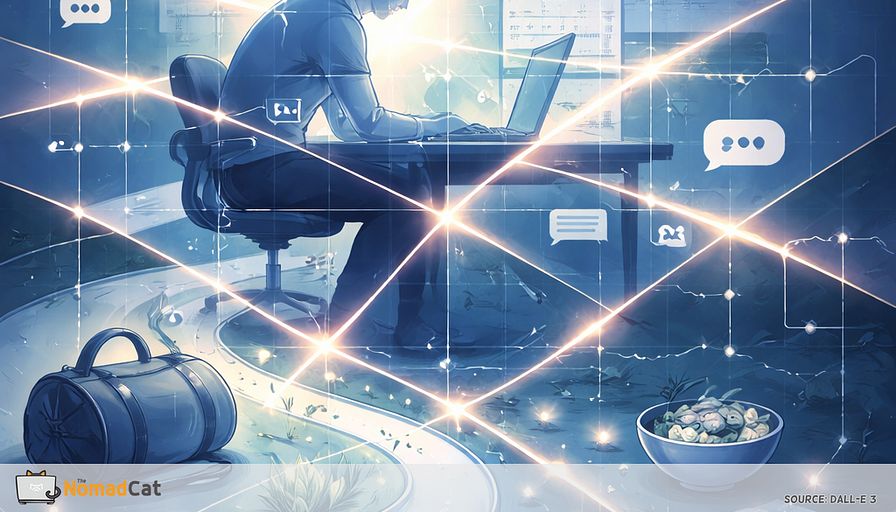
If your week is 10 hours at a desk, lunch is whatever fits between calls, and “free time” really means “someone might still need me,” this will feel familiar. You block 45 minutes for a workout. You even pack the bag. Then the meeting runs long, a teammate needs “a quick one,” Slack lights up, and it’s 18:40 and you’re still mentally at work.
If that leads to mild guilt or annoyance, fair. But the problem is usually not that you forgot what a gym is. It’s that your plan relied on a clean handover you didn’t actually control.
That is where desk-worker health plans break. Not at motivation. Not at knowledge. They break at handovers, seams, and tiny interruptions that have a real restart cost. Calendar time looks official, but in a callable job it’s often provisional.
I’m writing this as a French person who’s done desk-heavy work across Berlin and Beijing and now lives in Lisbon. My early warning sign is boring: a tightness in the upper back that builds quietly for hours, until it forces me to move.
This article is about treating health like a system that has to run inside a multiplayer week. The goal is not perfect routines. It’s routines that survive normal chaos and recover fast after a veto, without turning into a second job.
Here’s what you’ll get, without the polished “just be disciplined” stuff:
- Why it feels personal when it’s often structural (and why guilt is usually a missing-prerequisites problem)
- The specific veto points where plans die on normal weeks, especially the seams between meetings and home life
- A simple veto map you can build fast, like a debug log, to spot what keeps overwriting your health actions
- One survivable behavior unit that still runs when Tuesday behaves like Tuesday
If most health advice sounds like it was written for someone with uninterrupted evenings and no message queue, good. That skepticism is reasonable. The interesting question isn’t “how do I become a new person.” It’s “what would make this plan executable when Tuesday behaves like Tuesday.”
Where desk worker health plans actually break
The handover moment that kills the plan
Tuesday, 18:40. The calendar says workout. The gym bag is there. Then a teammate pings “quick one,” the meeting before runs 12 minutes over, and suddenly someone else is waiting for an answer. Nothing failed inside the workout. The plan got overwritten at the exact moment it required other humans to not need you.
This is how tight shoulders become the default, and bedtime slides later again—because you never got the clean “work ends, body starts” switch.
Interruptions have a real restart cost. Mark, Gonzalez, and Harris (2005) showed that after a disruption, people pay a resumption lag. That lag eats the exact margins where exercise, cooking, or a decent lunch would live.
Calendar time is not execution authority
Most advice assumes unilateral control. If time is blocked, it should happen. Desk work often runs on the opposite assumption: time is callable.
Callable time means this. Even if a slot exists on the calendar, other people and systems can still claim it with believable urgency. Scheduled becomes provisional, and your 18:30 slot is socially owned by whoever pings last.
Interruptions are not neutral. They add strain and fatigue, and over a week the accumulation is hard to miss (Baethge & Rigotti, 2013).
Plans fail at dependencies, not at motivation
A cleaner reframe is this: you didn’t fail the plan, you failed the handover.
A plan is agreement-dependent when executing it requires alignment with other people’s priorities, availability expectations, or household timing. Those dependencies stay invisible on a calm week, then show up the minute work or family becomes normal again.
That’s why intentions can be sincere and still not convert into behavior (Sheeran, 2002). It feels personal, but it is often structural. Meanwhile lunch becomes scrolling with a fork, and your lower back only complains when you finally stand up.
Why it feels personal when it is structural
Guilt is often a missing prerequisites problem
People remember the planned behavior and forget its prerequisites.
Plan: strength session at 18:30.
Prerequisites: nobody schedules over it, no one needs an answer, access to space, enough quiet to switch modes.
Plan: eat better at lunch.
Prerequisites: a real break, food available, no back-to-back calls, not eating while typing.
When prerequisites are social—being temporarily unreachable, or not being the on-call adult—missing them gets mislabeled as a personal lapse.
Operational takeaway: if you missed today, treat it as “not started today,” not “I quit.” (Vrijens et al., 2012, makes this distinction in more formal terms.)
Urgency is socially subsidized, health is not
Other people’s requests arrive with urgency cues: Slack marked urgent, a manager tone, a client waiting. Refusing has a reputational cost, so the default response is speed.
Barber and Santuzzi (2015) describe telepressure as the urge to respond quickly to messages. When responsiveness becomes the default, the first things to lose are usually the unsponsored ones: walking, cooking, bedtime.
If it needs perfect solitude, it is a vacation plan
If a routine requires 0 interruptions, 0 pings, and 0 last-minute requests, it’s not a desk routine. It’s a vacation routine.
The realistic target is multiplayer compatibility, not bigger habits.
The veto points you can actually spot
Most desk-worker plans do not die in the big blocks. They die in the seams.
Common breakpoints on normal weeks:
- The quick call that is never quick
- “Can you review now because someone is waiting on your yes”
- A stakeholder escalation that upgrades everything else to later
- A meeting overrun that eats the exact 12-minute seam you needed to change clothes, walk, or eat
- The Slack ping you answer “just to be safe,” because silence feels like risk
- The interruption that looks small, then costs you the restart tax and the thread is gone
- The end-of-day handoff where you are technically free, but socially still on-call
Once you treat these as default runtime, the next move is not willpower. It is logging which seam gets overwritten most often.
Treat it like a debug log, not a personality test
A useful stance is blameless forensics. More incident report, less moral story.
Write what happened right before it broke. What ping arrived, what you were doing, what you thought would “only take a minute,” and what it displaced. No drama, just cause and effect.
The veto map that fits a desk week
Build a veto map in 15 minutes
A veto is anything that can overwrite a health action in real life: a person, a channel, a system, or an implied rule. The veto can be legitimate—a real incident, a sick kid, a true client escalation. The issue is not that vetoes exist. It is that the plan quietly depended on them not happening.
List the top 5 repeat veto sources. For each one, note where it hits and what it demands.
Template:
- Veto source
- Where it hits
- What it demands
Example:
- Manager via Slack
- 17:30 to 19:00 seam
- Answer now so others can continue
Now add one more line per veto source.
1) The implied rule you were obeyingThe key question is not “why did I fail.” It is “what implied rule was I obeying.”
Common rules:
- Respond instantly or look unreliable
- Be flexible or be the problem
- Don’t be difficult at dinner
Use a metric that matches real weeks. Not streaks.
Track max gap and time to resume after a veto.
Hypothetical example: if Tuesday gets vetoed, the win is resuming Wednesday, not waiting for next week.
3) What the map usually revealsMost plans are agreement-dependent in two or three spots. Fix one missing agreement, and suddenly small behaviors can run without drama.
4) How to pick a workaroundIf a seam is fragile, pick a behavior unit that needs fewer prerequisites. Something interruptible, low-setup, and easy to defend socially.
Behaviors that survive the multiplayer week
Fragmented movement still counts
Breaking up sitting with short movement bouts helps with the blood-sugar spike after lunch—the one that makes you sleepy at 15:00. A meta-analysis on interrupting sitting found consistent benefits for glucose and insulin, with walking breaks generally outperforming just standing (Saunders et al., 2018).
Normal-language takeaway: if your afternoons crash, two minutes now is sometimes more realistic than 45 minutes later.
A simple unit that matches this logic is an easy 10-minute walk after lunch. Not as a fitness flex. More like a “keep the afternoon usable” tool that is easier to defend than disappearing for an hour.
Tiny exercise snacks can help too (optional)
There is evidence that very short vigorous “exercise snacks” can improve VO₂max—cardio capacity / how fast you get out of breath—with minimal time cost (Allison et al., 2017). It’s the between-meetings version.
Concrete example: a few short stair bursts spread across the day, done when it is already normal to be in a stairwell. Intensity is optional and context-dependent.
Examples that survive overwrites
Small units with high uptime (movement)
On desk weeks, the winning move is rarely more motivation. It is picking units that keep value even when someone steals the last 7 minutes.
Movement examples built to be stoppable:
- 2 to 3 minutes walking every 30 minutes
- 10 minutes easy walk after lunch
- Stand up during low-stakes calls
- Walk while a file exports
If you want one thing to try, make it the 10-minute after-lunch walk. It plugs into a seam that already exists, it doesn’t require special gear, and it tends to play well with “callable time.”
If your week is 10 hours at a desk, lunch is squeezed between calls, and “free time” is callable time, the point isn’t to become disciplined enough to outrun interruptions. It’s to stop designing plans that require clean handovers in a week that doesn’t produce them.
Most people only have one seam that causes 80% of the overwrites; once you name it, the rest stops feeling mysterious.
You might be interested by these articles:


Design health habits for calendar chaos without restarting monday

Microbreaks that survive pings and meeting overruns

The post meeting minute where healthy plans disappear

Write desk health like software with degraded mode built in

Pause-safe movement for meeting-heavy desk days

Advancing Your Data Security Strategy

VR-Based Team Training