Abstract:
The article argues that desk-day health plans usually fail not from lack of motivation but in a tiny “handoff seam”—the 60–120 seconds after a meeting ends—when your hand reflexively goes to Slack or email and the day snaps back to its default of sitting, screen-snacking, dry eyes, stiff shoulders, and “I’ll work out next week,” a pattern the author recognizes from years of late-night desk work across Beijing, Berlin, and Lisbon. Drawing on research about interruptions, context-switching, and “telepressure,” it explains why calendar blocks and clean transitions are a fantasy in fragmented knowledge work and frames the problem as an interface/design flaw rather than a character flaw. It identifies three practical “bugs” that kill follow-through—work never feeling “done,” endless tab-switch loops, and the re-entry/optics tax of stepping away—and proposes “patches” that survive rude, chaotic days: event-based if-then triggers that fire before new input (e.g., when you click Leave meeting, stand up before opening chat; refill water before pasting the next link), a 10-second resumption note to create fast closure, and tiny movements that start in under 30 seconds and are reversible (brief walks during exports, standing for audio-only call segments). Instead of guilt or streak-tracking, it recommends a quick, blameless two-minute “handoff autopsy” with six questions to identify what dependency or default won, then shipping a small patch and measuring seam reliability, with the payoff being fewer desk lunches and late-day crashes and more control over the day as it actually happens.
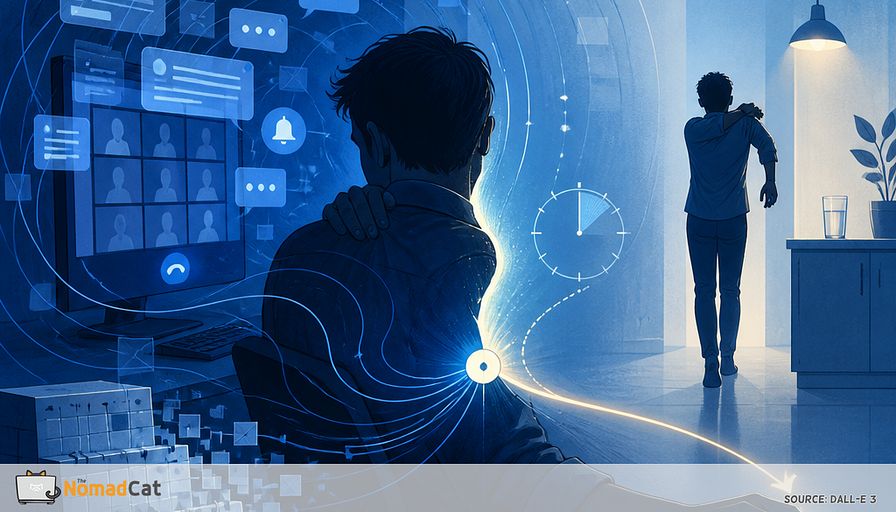
The plan usually doesn’t fail at the gym, or in the kitchen, or on the yoga mat you bought with honest intentions. It fails in a much smaller place. The 60 to 120 seconds after a meeting ends, when your hand goes to the mouse and your day quietly falls back to the default.
If this sounds familiar, that’s not a compliment, but it is normal. Desk work has no clean edges. Meetings run long, messages arrive right on cue, and your brain pays a re-entry tax before your body even gets a chance to stand up. Then the usual loop starts. Stiff shoulders. Dry eyes. Lunch at the desk. That late-afternoon crash you pretend is just coffee timing. Another week where exercise becomes “next week,” and dinner becomes whatever can be eaten with 1 hand on the mouse.
This article is about fixing this failure point, specifically, without turning your life into a spreadsheet or pretending you have empty afternoons. The goal is not more motivation. It is a plan that still runs on rude days.
Here’s what you’ll get, in plain terms
- Why calendar blocks lie, and why attention doesn’t follow them
- The hidden seam where follow-through dies, especially after meetings
- 3 common “interface bugs” that make healthy plans hard to run on desk days
- Small, event-based triggers that work even when the schedule collapses
- A fast, blameless way to debug a miss so it becomes a patch, not guilt
No heroics. No perfect morning routine. Just a practical way to make the healthy option the lowest-friction next move, even when Slack is doing what Slack does.
Where the plan breaks
A normal miss in slow motion
The meeting ends 6 minutes late, everyone drops, and your hand is already on the mouse. A ping lands, then another, and suddenly you are back inside email and chat threads like nothing happened. You blink and notice the dry eyes, the small tightness between the shoulder blades. I have spent most of my adult life at desks in Beijing, Berlin, and now Lisbon, often past midnight, and that upper-back signal is the first warning.
That drift has a specific size, and it is smaller than most people think.
It is the post-meeting minute. Roughly 60 to 120 seconds where the day picks the default before you choose anything. If that minute gets filled with “just checking messages,” the rest follows. Your “quick check” is a trapdoor. Desk work is fragmented, and that fragmentation tracks with stress (Mark, Gudith & Klocke, 2008). (Related notes: interruption timing and remote communication load make this seam even easier to lose—Gillie & Broadbent, 1989; Bailey & Konstan, 2006; DeFilippis et al., 2020.)
Interruption timing matters. Breaks at natural breakpoints are less costly than breaks mid-thought (Gillie & Broadbent, 1989). The end of a meeting looks like a breakpoint on the calendar, but your body often hasn’t gotten the memo yet—your shoulders are still up around your ears and your eyes are still dry.
So the right conclusion is not “try harder.” It is “the spec is wrong.”
Most health plans assume a clean handoff. They assume:
- the meeting ends on time
- your head clears right away
- no new pings land in the gap
But desk days are built on interruption and context switching. Returning to a task has a restart cost because you have to reload the goal in your head (Altmann & Trafton, 2002). Across studies, interruptions reliably increase strain (Tams, Hill & Thatcher, 2014)—which is why, right after a call, you usually won’t feel like moving; you’ll feel like closing loops. The clean start condition many plans wait for just doesn’t appear.
If a plan only works on polite days with empty buffers and no one messaging you, it is not a plan. It is a demo. This is normal systems behavior, not a character flaw. Good design reduces reliance on memory and willpower (Norman).
Why desk days erase edges
The calendar is in blocks but attention is not
A lot of advice assumes clear segments. Work ends, you stop thinking, you stand up, you do the next thing. Desk work is rarely like that. It is more like partial attention all day. You are never fully off, only less on. Field studies of knowledge workers show days split into many short switches, not long clean stretches (González & Mark, 2004; Czerwinski et al., 2004).
When an interruption happens, the brain does not just return. It has to reload what mattered. Even brief interruptions create a resumption lag (Monk, Trafton & Boehm-Davis, 2008), and that’s why “I’ll just check” becomes 12 minutes. After a meeting, the lowest-friction move is often a screen move. A quick check of Slack becomes a longer loop because it dodges the heavier cost of deciding what to do next.
Then the social layer makes that default feel mandatory.
Telepressure is the urge to respond quickly because responsiveness signals competence (Barber & Santuzzi, 2015). In practice it looks like this: you stand up, you even half-turn toward the kitchen, then you see the ping and sit back down “for 30 seconds” so nobody thinks you disappeared. Mobile tools can create an autonomy paradox where you are technically free, but also never really off the hook (Mazmanian et al., 2013). Yet experiments suggest that checking less frequently can reduce stress (Kushlev & Dunn, 2015). Meaning the constant checking is not as necessary as it feels.
So the fix is less about motivation and more about interface design. Small frictions are real barriers, not excuses (Herd & Moynihan, 2018). When plans fail, it is often because multiple small holes line up in the system, not because someone lacked character (Reason, Swiss cheese model).
The 3 interface bugs that kill follow-through
Bug 1 Work never declares done
Modern calendars are packed with back-to-backs, and remote work made meetings and messaging even more interleaved (DeFilippis et al., 2020). When a call runs over and a thread reopens, replying feels safer than moving, because “done” never gets stamped.
Unfinished work leaves residue. When a task is left open, part of attention stays attached to it, and starting a non-screen action suddenly feels expensive (Leroy, 2009). A small plan can reduce that interference, because it gives the brain a placeholder for completion (Masicampo & Baumeister, 2011).
Patch it by manufacturing a commit point with an if-then trigger. Implementation intentions work because they connect a clear event to a specific action (Gollwitzer & Sheeran, 2006). The key is that the trigger fires before any new input.
- When the call ends, stand up before opening chat
- When you click Leave meeting, walk to the kitchen before touching email
- When the next meeting link is copied, refill water first, then paste
Keep it small enough to survive a brutal calendar. A plan can still succeed by starting even if you only have 3 minutes. Short breaks tend to help with fatigue and energy (Kim, Park & Niu, 2017; Bennett, Bakker & Field, 2020).
Bug 2 The tab switch that never ends
The pattern is familiar. Call ends, you open Slack for 1 thing, then you are doing message triage while your body stays glued to the chair. Constant switching tracks with higher stress (Mark, Gudith & Klocke, 2008). The only “quick” thing is how fast 20 minutes disappears.
Even brief interruptions add restart cost. You do not just return to work, you retrieve the goal again (Altmann & Trafton, 2002). So the quick check creates more future work, which then proves you cannot step away later.
You need a closure cue that is faster than the check itself.
A useful workaround is a 10-second resumption note. It replaces mental rehearsal with a visible cue, reducing interference from unfulfilled goals (Masicampo & Baumeister, 2011) and helping goal retrieval on return (Altmann & Trafton, 2002).
Example note
Next touch reply to X with 2 bullets then send doc link
If your plan needs you to win a willpower fight against inboxes, it will lose. Design the seam so the healthy option is the lowest-friction next click, or the next movement.
Bug 3 The re-entry and optics tax
Stepping away can feel like creating a backlog plus a re-orientation cost. Sitting reads as working. Standing, stretching, or eating can feel oddly visible. People report needing permission to move in some offices (Hadgraft et al., 2016). In monitored environments, leaving the workstation can be discouraged (Bain & Taylor, 2000).
So pick seam actions that are reversible and low-drama, but still change your body state.
- Stand while listening to audio-only parts of a call
- Walk 60 seconds while a file exports or a build runs
- Do kitchen-only refills so movement is normal, not theatrical
Brief breaks can still be useful (Kim, Park & Niu, 2017), and short walking interruptions have measurable same-day effects in controlled studies (Dempsey et al., 2016).
Different failures with the same root cause
Your gym after work plan usually doesn’t die at the gym. It dies at 17:58 when the meeting runs over, then 2 pings arrive, and the brain pays the re-entry tax before it even stands up. 18:00 becomes 18:30 inertia.
Food hits the same wall with a different default. If there is no clean 20 minutes after calls, dinner prep gets postponed, then replaced by screen-compatible food, because it can be paused between replies. Time pressure reduces the capacity to plan meals (Welch et al., 2009). Long hours push eating into irregular patterns (Lowden et al., 2010). Then the post-lunch crash shows up later and feels mysterious.
Even tools fail the same way. Standing desks and trackers often don’t vanish because of discomfort first, but because optics and a bad week collide, then streak logic turns into quiet guilt. Tracking helps more when it is low-burden and decision-linked than when it turns into performance (Bolger & Laurenceau). Personally, with a physics brain and too many dashboards, I’ve learned that a metric that can’t change a decision quickly becomes a guilt machine.
A blameless handoff autopsy
A 6-question autopsy you can run in 2 minutes
Misses are logs, not moral failures. Treat the last “I was going to move but didn’t” like a blameless post-mortem. Find the exact handoff moment, then ask what made the plan non-runnable.
- What was the intended next action, in 5 words
- What was the seam event, exactly (clicked Leave, camera off)
- What was still open in your head from work
- What did the next action require right then (privacy, shoes, water, food, a 10-minute buffer)
- What grabbed you first
- What did you do instead, and why did it feel safer
Mini-run (realistic, not heroic)
- Intended action: walk 5 minutes
- Seam event: clicked Leave meeting at 17:58
- Open loop: “I owe 2 replies and a doc link”
- Missing dependency: a 10-minute buffer (next meeting already looming)
- Default that won: Slack triage (felt safer than starting and stopping)
- Patch: write the 10-second resumption note, then stand before opening chat
The competitor is usually not doing nothing. It is a default with a rule behind it, like availability, speed, or reversibility.
Capture the output in 1 line so it does not become another project. You are labeling a seam bug, not issuing a verdict on discipline. Example line
17:58 seam, default Slack triage, dependency missing 10-min buffer, patch resumption note then stand
Patch the seam not the habit
Make triggers event-based and immediate
Clock-time plans fail because the clock does not care that your meeting ran over and Slack lit up. Event triggers still happen on chaotic days, which is why if-then planning tends to work better than vague intention (Gollwitzer & Sheeran, 2006).
Pick a seam you already hit, then attach the smallest next move.
- When you click Leave meeting
- When you press Send on the last email in a thread
- When the kettle starts
Minimum viable seam action starts in under 30 seconds and has almost no prerequisites. Blunt rule: if it needs 7 things to be true, it will die at the seam. Extra steps are not minor, they are real burden (Herd & Moynihan, 2018).
Examples
- Stand up and take 6 slow breaths
- Walk for 60 seconds while the next tab loads
And yes, small moves count. Breaking up sitting with brief light movement can improve same-day post-meal glucose and insulin compared with uninterrupted sitting (Dunstan et al., 2012; Dempsey et al., 2016). Tiny seam actions do not look impressive, but they interrupt the sit loop your body seems to notice.
Reduce dependencies and make interruptions survivable
Design for work-as-done, not work-as-imagined. Reduce prerequisites rather than hoping for better days. Removing 1 dependency often beats adding 10% motivation.
Also make the action safe to pause without losing the whole attempt. Interruptions impose a re-entry cost because goals have to be retrieved again (Altmann & Trafton, 2002). It helps to pre-decide a fallback.
A plain coping plan
If I get pinged mid-break, then I answer 1 urgent thing, write a 10-second note, and return to the smallest next step
If you track anything, track seam reliability not streaks. Keep it low-burden (Bolger & Laurenceau), and think in coverage over time.
- Seams crossed today x / y
- Time-to-resume after a miss (minutes)
Boring wins are still wins. And honestly, on weeks when I’m at the desk past midnight, the only thing that works is the thing that still works when I’m tired and slightly annoyed.
If desk-day health plans keep “failing,” it is rarely because you are lazy. It is because the plan expects clean edges that desk work doesn’t have. The real breaking point is that tiny seam after a meeting ends, when the tab switch happens and the default wins.
- Use event-based triggers that fire before new input
- Make the next move tiny enough to start in under 30 seconds
- Remove dependencies so it still runs on rude days
- When you miss, do a quick, blameless autopsy and ship a small patch
This pays off in real ways you can feel. Less stiffness, fewer desk lunches, fewer late-day crashes—and less of that tightness between the shoulder blades that shows up right after the calls stack up.
Most people don’t have ten different problems here. They have one seam that accounts for most of the misses: the post-meeting minute, the lunch drift, or the 17:58 slide.
You might be interested by these articles:


Your health plan needs glue code for meeting-to-meeting days

Write desk health like software with degraded mode built in

Your breaks keep getting deleted by the calendar

Stop losing breaks to the shared calendar

Your calendar is the boss not your motivation

Unlocking PHP's Secrets with phpinfo()

Revolutionizing Medicine with Surgical Robots