Abstract:
The article explains “thin sleep”—nights where you fall asleep easily but sleep stays light and restart-prone—arguing it often comes not from bedtime habits or anxiety but from a chopped-up knowledge-work day that leaves your brain “resume-ready” due to attention residue, role switching, and too many unfinished “warm” contexts (like half-edited docs, Slack threads without next steps, or a ticket you only opened to peek), which then show up as waking briefly with an instantly-online mind, and mornings spent scanning, keeping tabs open, rereading paragraphs, and grazing the inbox for control while delaying the hardest task. Using a simple “cache” metaphor, it says the real problem is unfinished work staying mentally loaded, so detachment requires giving the brain a credible boundary signal via small work-design tweaks that fit inside a demanding schedule: a two-day no-gadget A/B self-check comparing a normal day to a deliberately lower-switch day (tracking “restored vs scanning” mornings), plus practical levers like a 16:00 “tool freeze” (no new docs/threads/tickets), a late-day “two-surface cap” to consolidate instead of explore, and a 3-minute log-off context flush that lists what’s still warm, assigns a next allowed touch time, and states that nothing else is runnable tonight—along with safety rails urging medical evaluation for red flags like sleep apnea symptoms, unsafe daytime sleepiness, or long-running insomnia (with CBT-I as first-line).
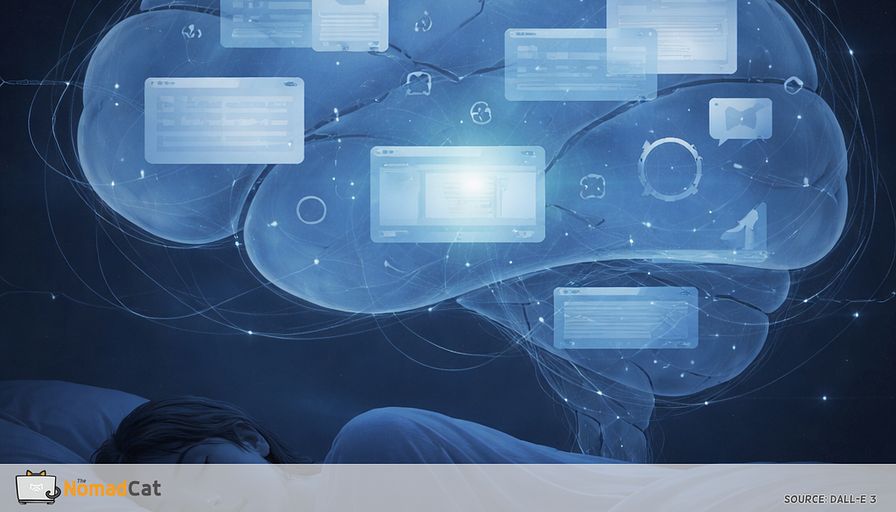
You log off after a normal desk day and nothing is “on fire”. Still, your brain keeps acting like it is. Slack pings, email threads, Jira, 2 half-edited docs, a quick call, “just 1 more” spreadsheet check. It’s not very dramatic, just… chopped-up. And later, the night gets weird.
I’m french, born in 1974, and after years at a desk from Beijing to Berlin, now Lisbon, i still recognize this pattern: nothing urgent, but the brain refuses to power down.
This is the kind of sleep where you fall asleep fast, but the night stays light and thin. You wake 3 times for 30 seconds, and each time the brain is instantly online, like a laptop lid reopening. Morning comes and you’re not panicking, you’re scanning — that quiet, annoying sense you forgot something but can’t name it. Tabs feel unsafe to close. You reread the same paragraph. You graze the inbox to feel “back in control” while the hard start stays untouched until 11:00.
It’s tempting to blame motivation, anxiety, or generic “sleep hygiene”. But a cleaner explanation is often upstream. Interruptions leave attention residue. Role-switching leaves unfinished contexts warm in the background. So even if you feel calm, you can still be on standby.
Here’s the mechanism, then a few small knobs that don’t require a new evening routine:
- what “thin sleep” is and why it shows up after high-switch days
- a quick 2-day self-check you can run without gadgets
- a few work-design tweaks that reduce late-day churn (tool freeze, surface cap, context flush)
No perfect evening routine needed. Just fewer runnable processes in the head at 22:30. That’s the whole goal.
Thin sleep from a chopped-up day
You fall asleep but you never cool down
A normal desk day can be chopped-up without being dramatic. You bounce between Slack pings, email threads, a Jira ticket, 2 docs half-edited, a quick call, and “just 1 more” spreadsheet check. You log off. Emotionally, it’s fine. Each ping is small, but the restart cost adds up. Interruptions add strain even when nothing is “on fire” (González & Mark, 2004). Then the weird part happens at night.
Thin sleep is when falling asleep is easy, but the night stays light and thin. You wake 3 times for 30 seconds and each time the brain is instantly online, like a laptop lid reopening. It’s not lying awake for hours; it’s micro-wakes with instant “back at work” orientation. In the morning you’re not panicking, you’re scanning.
Recovery is not only hours asleep. It’s also mental detachment. When your mind is still running work in the background, sleep quality tends to be worse (Sonnentag & Fritz, 2007).
The next-day stuff often gets mislabeled as a motivation problem, but it matches something more mechanical: attention residue and the cost of resuming after interruptions (Leroy, 2009; Altmann & Trafton, 2002).
- 18 tabs open, none feels safe to close
- rereading the same paragraph, again and again
- inbox grazing, not really answering anything
- chasing quick wins to feel “back in control”
- avoiding the hard start for 2 hours
This can look like rumination, but it doesn’t feel the same. Rumination is usually one sticky theme replaying, and it can wreck sleep (Querstret & Cropley, 2012). Switching residue is more like background “orientation work” your brain keeps running so it can jump back in fast.
Switching residue is not just another sleep hygiene issue
Roles switch too
The missing detail is that switching is not only apps. It’s roles.
- reachability pressure can feel like being on-call in your head (Barber & Santuzzi, 2015)
- late screen light can shift sleep timing and alertness (Chang et al., 2015)
- open loops replay because nothing feels closed
- switching churn leaves you “resume-ready” even after a quiet evening
So yes, you can do the clean evening thing and still get thin sleep if the workday ended in high churn.
In knowledge work, switching is often role switching. Writer, reviewer, negotiator, firefighter, planner, therapist-for-the-team. Each role comes with a different mini threat model, in plain words. What could break, what looks unfinished. Task switching has costs even when it feels smooth (Monsell, 2003). Your body stays a bit ready because the definition of “done” keeps moving.
A simple model is enough
Late switching, lower capacity, more interference (Cowan, 2001) → more prep and re-prep to change tasks (Rogers & Monsell, 1995) → more scanning for what’s urgent → day ends while still monitoring → sleep stays light, thin.
Nothing mystical. Just a brain that didn’t get a clear boundary signal.
A cache model you can actually use
Context residue works like hot-loaded tabs
The key word is unfinished, not switching itself.
Think of it like a cache that never cools down. Each time you switch, you load a context. If you leave mid-flight, it stays warm in the background. So the day ends with 12 warm things and the system never hits true idle. A draft left half-argued. A Slack thread with no clear next step. A ticket you opened just to “peek” (Leroy, 2009; Syrek et al., 2017).
Sleep depends on the brain trusting that nothing is actionable tonight. Switch away from a finished unit and the loop can close. Switch away from something mid-way and the brain keeps state for resumption, then pays again later to rebuild where you were (Altmann & Trafton, 2002).
A practical bridge is cognitive offloading. A small external note that carries “where to restart” so the mind doesn’t keep it cached (Risko & Gilbert, 2016).
This is why you can feel calm and still sleep thin. It’s not drama, it’s eligibility. Even light after-hours work communication keeps some contexts tagged as “might restart,” even if you don’t answer (Boswell & Olson-Buchanan, 2007). The brain is annoyingly literal.
Calm is not the same as downshifted
Feeling fine can still mean being on standby
You can feel calm, not anxious, not even annoyed. But calm can still mean high readiness, like sitting in an airport with a boarding pass and no gate announced yet. Effort-Recovery is basically the idea that load creates a recovery debt, and not feeling worried doesn’t mean the debt got paid.
If late-day switching is the driver, bedtime tweaks help, but they’re not the main lever. It’s like cleaning the logs while requests are still arriving. Work-related cognitive activation is linked to poorer sleep quality even with “light” work like checking a phone (Lanaj, Johnson & Barnes, 2014). Upstream boundary design matters.
Also, skepticism is reasonable. Anything that sounds like a sleep brand tends to get… creative. A more honest signal is how many work contexts still feel armed at 22:30.
A 2-day self-check without gadgets
Day A and Day B with one variable
Run it like an A/B test for desk life. My default is physics brain: change 1 variable, watch the output.
1) Day A stays normal. Same work hours, roughly same bedtime.
2) Day B is deliberately lower-switch. Fewer check-ins, more batching, fewer thread hops.
3) Keep the rest boring. No heroic add-ons.
Switching is normal in knowledge work (González & Mark, 2004). The goal is only “lower,” not “zero.” Batching communication is one of the rare interventions tested in the wild and linked to lower stress (Kushlev & Dunn, 2015). Not a sleep promise, but a decent upstream proxy.
What counts as a switch
Make switches visible, otherwise Day B becomes vibes.
A switch can be
- new surface or window set (doc to Slack to calendar)
- new role (builder to reviewer to negotiator)
- joining or leaving a meeting
- picking up a new thread after dropping another mid-way
No guilt. Some meetings are real work. The point is to spot optional churn, not pretend you control the calendar.
The morning readout
Sleep hours matter, but “am i restored” is the output.
Each morning answer yes or no
- restored within 20 minutes of waking
- scanning on wake, checking what’s urgent or forgotten
- sticky before noon rereading, reopening, hesitating on starts
Optional: 1 number. Rate sleepiness 1–9 (Karolinska Sleepiness Scale).
Interpretation is simple. If lower-switch Day B changes the morning signature, the lever is probably upstream.
Safety rails
Work-design tweaks can help, but chronic bad sleep deserves real evaluation. Red flags worth not debugging alone:
- loud snoring, gasping, or witnessed pauses in breathing
- severe daytime sleepiness that feels unsafe
- insomnia most nights for months
If you’re stuck in that “i’m doing everything right and still waking up scanning” loop, it’s worth getting proper help instead of adding more tweaks. For insomnia, CBT-I is the standard first-line treatment.
Late day churn fixes that feel like work design
The 16:00 tool freeze
After 16:00, use a simple default: no new work surfaces. Keep working, but only to close, ship, or tidy what is already open. Unfinished tasks predict poorer detachment and worse sleep (Syrek et al., 2017).
No new
- doc
- thread
- ticket
Urgent work exists, so this needs an escape hatch. “Urgent” means can’t wait until tomorrow without real damage, ideally defined with a team escalation norm, not vibes.
If the freeze is too strict, use a softer cap. The success picture at 18:30 is boring. Fewer half-started threads. Less itch for “just 1 more check.” Fewer runnable processes in the head.
The 2 surface cap for the last 90 minutes
In the last 90 minutes, stay inside at most 2 contexts. Like 1 doc plus 1 comms channel. End of day becomes consolidation, not exploration. Working memory limits mean more open contexts creates more interference (Cowan, 2001).
When switching is unavoidable, make it less sticky with a 10-second note.
- Leaving: X
- Tomorrow at: __
- First step: __
This is not journaling. It’s an operational breadcrumb, a retrieval cue to reduce resumption lag (Altmann & Trafton, 2002) and a small cognitive offload (Risko & Gilbert, 2016). Writing a to-do list can also help people fall asleep faster in lab studies (Scullin et al., 2018).
A 3-minute context flush
Do this at log-off, not later in bed.
1) List 3 work contexts still warm.
2) For each, write the next allowed touch time.
3) Write 1 sentence: Nothing else is runnable tonight.
The medium doesn’t matter. Notes app, paper, text file. Credibility matters. A real time beats “tomorrow” because it lets you drop the state (Risko & Gilbert, 2016). Example: “Slack thread with legal, next touch 10:00.”
A win is not perfect serenity. It’s less urge to reopen tools and less incident-response scanning on wake.
Upstream team design
If you can influence team norms, these are boring but effective:
- batch intake into 2 windows and make it visible. Less micro-interruption can reduce stress (Kushlev & Dunn, 2015).
- use a one-line state post with a return time to reduce reachability pressure (Barber & Santuzzi, 2015). “Heads down on X, next check at 15:30.”
- keep a clear escalation path for real urgencies.
Some roles are different. If you’re ops or support, interruption is the job. The fix is routing, triage, and off-duty coverage, not pretending nobody will ping. The shared goal stays the same: fewer half-open contexts at the end of the day, so sleep is less thin.
Thin sleep is often not a bedtime problem. It’s a “too many runnable processes” problem left over from a chopped-up day. When the day ends mid-context, the brain stays resume-ready, even if you feel calm. That shows up as light nights with quick micro-wakes, then a morning spent scanning, reopening tabs, and grazing the inbox to feel stable.
The good news is you don’t need a perfect evening. Small work-design knobs can do a lot: a 16:00 tool freeze, a 2-surface cap late day, and a 3-minute context flush that tells your brain what is allowed tomorrow and what is not runnable tonight. Add the 2-day A/B self-check and you get feedback, not vibes.
What is the one “warm context” that tends to follow you into the night, even when the day looked normal?
You might be interested by these articles:


A productive day can still break your sleep fix the missing downshift signal

Your 1st 45 minutes are training your 02:00 brain so change the input order

How pingy workdays keep your sleep on watch

Your workday ended but your brain is still on duty at 23:40

Thin sleep is a workday monitoring bug not a bedtime failure

European Startups Redefining Innovation with Brain-Computer Interfaces

Turn hard 1:1s into stand up calls not camera statues