Abstract:
The article explains a common pattern where sleep starts to unravel 48–72 hours before high‑stakes “revocable” moments like demos, reviews, launches, or deceptively calm “approval” blocks—not necessarily on the night you worked late—because evaluation uncertainty keeps the nervous system in hyperarousal (“tired but wired”) and the brain in preview mode even when logic says it’s safe to rest. It describes a distinctive signature: you may fall asleep easily, but the second half of the night turns fragile, with an abrupt 04:50 wake-up where the mind “boots” instantly into triage, a small alarm-like urgency in the chest, and lightweight rehearsing and pre-solving (like compiling a build with warnings). Rather than blaming character or chasing perfect sleep hygiene, it argues for creating a more credible “done” signal before bed and offers a minimal 3-day self-check—compare a night before a high-review day, a low-stakes day, and the night after the review—focusing on continuity and how quickly your mind starts planning, not total hours slept, plus three quick prompts (instant task prioritizing, rehearsing replies to comments not yet received, and the urge to check messages/docs) to catch overnight monitoring without turning it into a tracking project. It also sets a safety boundary: if problems persist beyond three months or include severe sleepiness, loud snoring, gasping, or mood red flags, it’s worth screening for issues like chronic insomnia (CBT‑I as first-line) or sleep apnea rather than attributing everything to deadlines.
You look at the week and it seems fine. A demo on Thursday. A review on Friday. One “approval” block that sounds calm, but never is. I’ve done this dance in Beijing, then Berlin, now Lisbon: the calendar item is small, the body reaction is not.
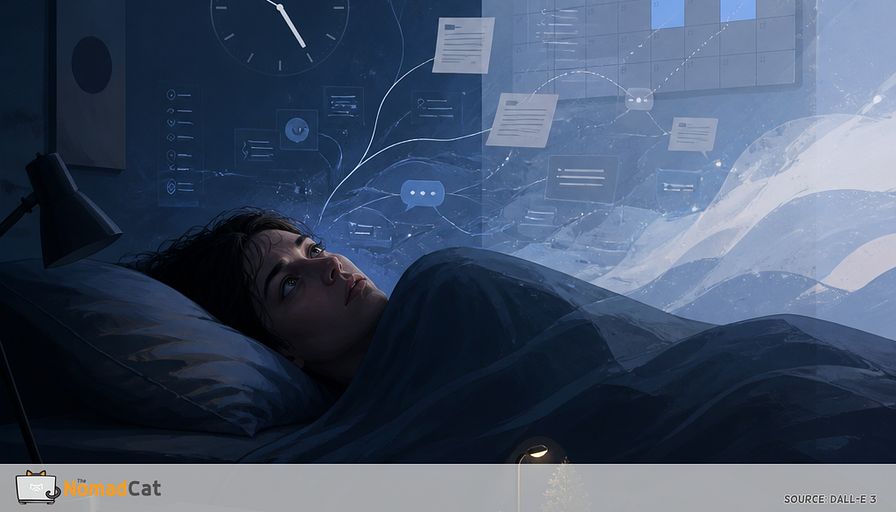
Then sleep starts slipping. Not the night you work late. Often 48 to 72 hours before. You go to bed at a reasonable time, you even fall asleep… and then the second half of the night turns thin. 04:50 wake-up. Brain fully booted. Tiny alarm in the chest. No drama, just instant triage. And later, at 10:00, you’re functioning, but you feel slightly cheated.
If that pattern feels familiar, it helps to know it is not random, and it is not a character flaw. When an outcome is still revocable, judged, uncertain, the nervous system can stay in preview mode longer than your logic agrees with. Sleep researchers call this kind of “tired but wired” state hyperarousal—meaning your threat detector is still on, even if your rational brain signed off.
This article is about making that pattern make sense, and then making it smaller. Not with perfect sleep hygiene or a new personality. With a believable done signal before night.
Here’s what you’ll get, in practical terms
- Why sleep can break 2 nights before a review day, not only the night right before
- The specific sleep signature of evaluation stress, especially early wake-ups and a fragile second half of the night
- A simple 3-day self-check to tell whether your sleep tracks evaluation moments or just hours worked
- 3 quick questions that catch overnight monitoring before it becomes a whole new tracking project
- A clean safety boundary for when it is worth screening for insomnia or sleep apnea instead of blaming the calendar
The 48 to 72 hour slide
A calendar pattern that is weirdly consistent
And somehow the sleep issue doesn’t start the night you work late. It starts 2 nights before. Even when the evening is quiet, even when bedtime looks responsible. That timing is the clue.
Recovery is not a fixed trait. It moves day by day depending on what is pending. Uncertainty is especially good at keeping the nervous system in preview mode longer than you would like. From there, the night feels less like rest and more like monitoring.
This is not about having a messy calendar. It is about the specific kind of calendar item where the outcome can still change.
The de-guilt part matters. The goal is not to become magically calmer. The system is pushing your brain to stay online because the situation is still revocable and still judged. Sleep researchers often describe this as hyperarousal, aka tired but wired. It’s not a personality flaw. It’s preview mode that won’t fully close.
So instead of “fixing yourself,” the more practical target is a believable done signal before night.
A done signal that works
“Done” here doesn’t mean perfect or finished forever. It means: nothing important is revocable tonight. A few desk-work-shaped options:
-
Write the one-paragraph “definition of done for tomorrow” (what “good enough” looks like for the demo/review, in plain language). This closes the open loop your brain keeps trying to solve at 04:50.
-
Create a “parking lot” list for revocable items (questions you can’t answer yet, risks you can’t resolve tonight, comments you haven’t received). Put them somewhere visible for morning so your brain doesn’t have to keep them in RAM.
- Set a hard “no new input” line (last time you will open Slack/email/docs). If the thing that can change the outcome is still dripping in at 22:30, your nervous system will treat the outcome as still live.
The sleep signature before review days
Here is how it often looks. You finish a normal desk day, close the laptop at a reasonable hour. No crisis. No big Slack explosion. You go to bed and you fall asleep fine.
Then around 04:50 you wake up, not slowly, but instantly. The brain boots straight into triage. A small urgency in the chest, like a tiny alarm that does not ring but still insists.
The weird part is not the wake-up. It is the timing. About 2 nights before the review, not necessarily the night right before.
That predictability matters. In the hyperarousal framing, it’s not just less sleep. It’s sleep that gets easier to break under evaluation stress. You can do everything “correct” and still have the system refuse to fully stand down.
The subjective signature is also pretty specific. Falling asleep can be easy, almost suspiciously easy. Then the second half of the night gets thin. You are not fully awake, not really asleep either.
The brain runs lightweight simulations, like it’s compiling a build with warnings but no hard errors. And the “warnings” are usually specific: comments you haven’t received yet, questions you can’t pre-answer, the one slide that could get poked.
This is why duration can look fine while recovery feels missing. Hours look acceptable, body feels unrested. The casualty is continuity.
You might see more time awake after sleep starts, more micro-awakenings, and an earlier final wake time. You end up with a night that is front-loaded and easy to interrupt.
One more differentiator, because it reduces confusion.
If sleep worsens specifically before review, approval, launch, or demo days, it points to evaluation dynamics more than generic too much work. If it was only workload, the worst nights would reliably track the latest log-off, and often they don’t.
Also tight deadlines are not rare. Around 60% of workers report working to tight deadlines at least a quarter of the time (Eurofound EWCS 2015). Common input, common output: if the brain learns that deadlines equal “revocable outcomes,” it starts previewing early.
A fast self-check is to watch 3 nights in a row and note what sleep tracks more.
- Evaluation moments
- Actual hours worked
That difference tells you what lever is likely to matter next.
A 3 day self check for deadline linked sleep
A tiny comparison that beats tracking everything
Make it concrete with a few mornings and 1 pen. If you want to check fast, compare these 2 nights:
- 1 night before a high review day
- 1 night right after the review moment
The question is not total sleep time. It is how fast the mind boots into planning, and whether the second half of the night feels lighter.
Keep it minimal, because too much tracking can become… another form of monitoring. A simple felt check is enough to see a pattern.
3 questions that catch overnight monitoring
Success here is not perfect sleep. It is a clearer signal of what is driving the wake ups, without turning your life into a sleep spreadsheet.
- Woke up and instantly prioritized tasks in my head
- Rehearsed replies to comments not received yet
- Felt urge to check messages or docs, even resisted
That urge to check matters because uncertainty often pulls people toward reassurance seeking.
And as an analogy, checking can reduce doubt for a moment, then teach the brain to ask for more checking next time. Not a diagnosis, just the same loop shape.
What counts as a win
A win is less overnight polling and less morning scan urgency, even if you still wake up once.
If the mind takes longer to start rehearsing, or the checking urge drops, the nervous system probably got that done signal. Uncertainty keeps anticipatory responding running, and clearer boundaries help it stand down.
A quick safety boundary before you blame your calendar
If sleep problems persist 3+ months, or there is severe daytime sleepiness, loud snoring, gasping, or mood red flags, deadlines are not the only suspect and it is worth proper screening. If the pattern still maps cleanly to review cycles even when work volume is low, that’s a work-structure clue; if it doesn’t map, screen broadly.
For chronic insomnia, CBT-I (a structured, practical therapy for insomnia) is often recommended as a first option. And sleep apnea is commonly underdiagnosed, so it is smart to rule it out rather than power through.
If your sleep goes weird 48 to 72 hours before a demo or review, it is probably not “you being dramatic.” It is the system reacting to a revocable outcome. The brain stays in preview mode, and the second half of the night becomes fragile even when you did nothing wrong.
The useful move is not perfect sleep hygiene. It is giving your nervous system a believable done signal before bed, so the overnight monitoring loop has less to chew on. My instinct is always to measure; here, the smallest useful measurement is 3 mornings. Watch for instant task triage at 04:50, and notice if it tracks evaluation moments more than late log-offs.
And keep a safety boundary. If this is chronic or comes with loud snoring, gasping, big sleepiness, it is worth screening, not guessing.
What’s the next review-day “warning” your brain compiles overnight?
You might be interested by these articles:


Your sleep is thin because your brain is still on standby

At 03:00 your brain starts doing reputation management

When work ends but evaluation starts your brain keeps auditing in bed

The 02:17 reboot after a 10-hour desk day and how to make it boring again

Decompression first why sleep still feels useless after a crunch

The real cost of waiting to make a change

Micro-collaborations make side-hustles safer and smarter