Abstract:
The article describes a common “desk day volatility” that hits remote workers after a rushed lunch at the keyboard—often 60–120 minutes later—where focus doesn’t dramatically crash but subtly degrades into rereading the same paragraph, tab “pinball,” typos and copy‑paste glitches, sharper Slack tone, impulse sends, and oddly heavy trivial decisions; it argues this pattern is often misread as a discipline or personality problem when it’s really a predictable curve amplified by sitting all day (losing the muscle “movement sink” that normally blunts post‑meal effects), stress-driven food choices that disguise the real cause, caffeine that can temporarily patch things while adding physiological and withdrawal “noise,” and fragmented snacking (like sweet coffee, biscuits, and bites without a boundary) that creates multiple mini-spikes. Rather than tracking, dieting, or self-diagnosing a condition, it proposes one calendar-proof rule to reduce the spike‑then‑slide: pair any carb with a “stabilizer” (protein/fiber/volume) ideally first or alongside—yogurt before the pastry, nuts before sweet coffee, protein and veg first and starch last—plus optional light walking as a bonus (walking beats standing) when possible. To keep it practical, it offers low-friction café/office/delivery tactics (including the slightly weird but effective “eat the sandwich filling first”) and a simple 5‑day A/B “debug” that logs only whether you paired a stabilizer and then labels the 16:30 outcome (steady, foggy, edgy, coffee‑urgent, meeting hangover), aiming for fewer unforced errors and less 15:30 email hostility without turning eating into an app-driven project.
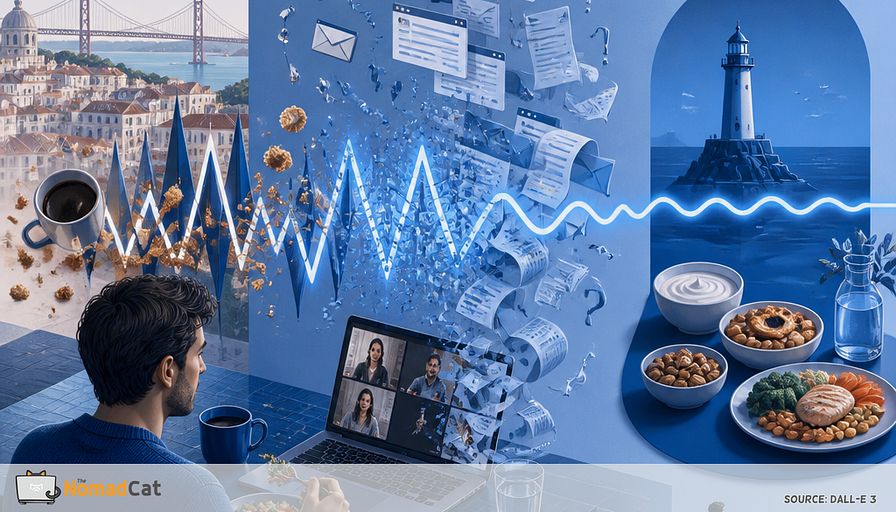
Remote day. Camera on. Here in Lisbon, that usually means lunch happens at the keyboard because the next meeting starts in 7 minutes. Then, 60 to 120 minutes later, something slips. Not the dramatic kind. More like your brain stayed online but started returning the wrong values.
It shows up as tiny work errors first; I’ll list the fingerprints in a second.
This article is about that desk day volatility pattern, and why it often gets blamed on “lack of discipline” when it’s more like a system you haven’t set up for sitting still all day.
We’ll cover what’s actually making the post-lunch wobble worse on desk days, even when the meal looks normal. Things like sitting removing the movement sink, stress pushing food choices and hiding the real issue, caffeine acting like a quick patch that sometimes adds noise, and snack grazing creating multiple small peaks.
Then we’ll get practical with 1 rule that usually survives real calendars. Pair the carb with a stabilizer, ideally first. No tracking. No perfection. Just a small constraint that can reduce the spike-then-slide pattern that makes emails feel personally offensive at 15:30.
You’ll also get low-friction examples for cafés, office snacks, and delivery lunches, plus a simple 5-day debug that doesn’t require an app or a new personality. The goal is not to label a condition. It’s to reduce the size of the swings so the afternoon has less friction and fewer unforced errors.
The desk day volatility pattern
Remote day. Camera-on blocks. Lunch at the keyboard because the next meeting starts in 7 minutes. Then, 60 to 120 minutes later, the work degrades in small, annoying ways, like a system that stayed up but started returning wrong values.
Not dramatic sleepiness. More like tiny errors, impatience, and friction that feels like personality.
There is a normal post-lunch dip for many people, and meals can make it stronger without being the whole story. In lab-style attention tasks, the failure mode isn’t “I’m sleepy,” it’s variability: a few more micro-lapses, a slightly slower restart after interruptions, and more “why did I hit send” moments—exactly the kind of stuff you notice as meeting hangovers and impulse replies.
If the pattern is real, it leaves fingerprints in the work.
- Rereading loops, same paragraph 3 times, still blurry
- Tab pinball, switching apps without progressing anything
- Typos while editing, even in sentences you know
- Copy-paste mistakes, missing a line or duplicating one
- Slack tone drifts, shorter, sharper, less charitable
- Impulse replies, hit send before thinking 10 seconds
- Decision drag, trivial choices feel weirdly heavy
- Longer restart time after meetings, like cold-booting focus
Sometimes it also feels like hunger, but with a different texture.
Volatility cravings often arrive urgent and specific. I need a sweet coffee now. Not later. Not an apple.
True hunger is usually broader and calmer. Ok, i should eat soon. Anything normal will do.
A reactive or post-meal blood sugar dip can happen for some people, but it’s also easy to self-label badly. If symptoms are severe or keep coming back, proper diagnosis is a medical conversation. The goal here is not to slap a condition name on a normal desk wobble.
The practical goal is reducing swing amplitude.
Think wave, not flat battery. You are not low energy all day, you are on a curve that sometimes bounces. The cost is signal-to-noise. When the internal signal is unstable, decisions get slower and communication gets noisier.
Why desk days make normal meals hit harder
4 amplifiers you can’t see from the plate
Hours of sitting remove a big “sink” your muscles usually provide. So the same lunch can hit harder than on an active day because there is less demand to pull glucose out of the blood.
On desk days, the difference is often just “no interruption at all” versus “a tiny break that includes a bit of walking.” When you stay parked for a full 60–90 minutes after eating, the curve tends to be sharper than if you naturally break it up (even briefly) the way you do on a day with errands or commuting.
Time pressure nudges food toward fast carbs, delays noticing what’s going on, and turns it into a work problem.
Under strain, “i can’t focus” shows up before “i should eat something real.” Once the brain labels it as work, tone gets sharper and you assume it’s your character, not your inputs. Stress also tends to increase preference for more rewarding, energy-dense foods, with big differences between people.
- Caffeine is a patch that can add noise
Caffeine is the easiest fix. It can also make the curve noisier.
This seems to show up most when coffee is stacked with or right after a carb-heavy snack—pastry + latte, sweet iced coffee, the “quick bar” between meetings. For some people, that combo makes the post-meal wobble worse, not better. Then there’s the obvious mess in real life: caffeine withdrawal can look like blood sugar stuff too—fatigue, irritability, difficulty concentrating.
A common loop is coffee at 14:30 to survive the calendar, wobble at 16:00, and lunch gets blamed even when it’s the combo.
- Food fragmentation creates multiple small peaks
Liquid calories and tiny treats stack into multiple peaks, and appetite signals get noisy instead of clear.
People often compensate less for beverage calories than for solid calories. And snack timing can create extra swings.
- Sweet coffee that is basically dessert in a cup
- Biscuit drift from the kitchen
- Just a bite while standing, no plate, no stop point
Now the useful question is what tiny change still runs on a desk day.
The stabilizer pairing rule
The rule changes the curve not the meal
If a desk day sets you up for carb-first choices—sweet coffee, pastry, bread-heavy lunch—the rule is simple.
Pair the carb with a stabilizer, ideally first or at the same time.
The target is fewer spikes and fewer slides, not perfect eating.
This is not keto, and it’s not tracking. And coming from someone who owns a Decathlon sport watch and has had phases of over-measuring things, this is intentionally the “do less, get most of the benefit” version.
Short-term focus seems to care about stability more than heroics. Some controlled meal research links steadier post-meal curves with steadier attention later on, but it depends a lot on timing, the task, and the person. So no, this is not “hacking your brain.” It’s just reducing volatility in the exact window where desk work punishes small lapses.
A stabilizer, in office terms, is just something that slows the curve enough that your inbox stops feeling personally offensive.
What counts as a stabilizer at a desk
A boring definition helps. A stabilizer is an add-on that is easy, quiet, fast, and usually looks like protein or fiber plus a bit of volume.
Office-friendly examples
- Plain Greek yogurt or skyr with the pastry
- 2 eggs with toast or a sandwich
- A handful of nuts with sweet coffee
- Oats, chia pudding, or a higher-fiber yogurt bowl (the thicker, less-sugary stuff tends to behave better)
A nuance that saves time later.
Adding fat can lower the early peak for some people, but it can also stretch the tail by slowing stomach emptying. So “just add butter” is not a universal answer.
Carbs last is the low-friction sequencing trick
In many lunch situations, order is the only variable you control.
- Protein and veg first
- Then starch
- Then dessert
Research on meal sequencing suggests carbs eaten after vegetables and protein can reduce post-meal spikes compared with carbs first.
Concrete desk-lunch version
- Sandwich plus salad: start with the salad, then focus on the filling, bread later
- Rice bowl: vegetables and protein first, rice later
Dessert still fits. It just goes at the end, when the curve is less likely to slap you 90 minutes later.
Why 1 rule beats 10 good intentions
The desk day is not a lab. It’s meetings, cafés, and “i have 7 minutes.”
Most of the time the problem isn’t missing information, it’s missing control under pressure. One rule that still runs when the calendar is on fire beats a perfect plan that only runs on weekends.
Pairing that survives real calendars
Café defaults without the moral drama
Scenario. Latte plus pastry. Fine.
The move is not to be better. It’s to add 1 stabilizer first, then eat the pastry like a normal person.
- Latte + pastry + plain yogurt cup, a few bites of yogurt first
- Latte + pastry + small nuts pack, nuts first, pastry second
Order matters. Same treat, less slap later.
Office snacks and the visibility hack
When lunch is rushed, snacks try to become lunch. Cookie bowls and leftover pastries sit near desks like traps with good lighting.
What helps is keeping one boundary: stabilizer first, treat second. And if you do take the treat, make it small and visible—put it on a plate, give it edges—so it doesn’t silently replace an actual meal just because you kept walking past the box.
This isn’t about virtue. It’s about not letting the environment run your curve for you.
Delivery lunch under constraints
Delivery is often bread-heavy or rice-heavy because that’s what delivery is.
Highest ROI move is still 1 add-on.
- If there is a side salad, start with it
- If there is any legume option, even small, it works well as an anchor
- If there is a protein-forward side like yogurt, that also works
If none of that exists, there is still a fallback.
- Eat the protein part first
- In a sandwich, opening it and eating the filling first is slightly weird for 30 seconds, but less weird than rereading the same email 4 times at 15:30
Micro movement as a bonus not a requirement
Movement is a strong amplifier, but don’t make it a prerequisite. Interrupting sitting with even light walking tends to improve the post-meal curve compared with staying seated the whole time.
Key detail. Walking beats standing.
Still, pairing works even on camera-on days when you can’t leave. Walking is the bonus layer, not the entry ticket.
A 5 day debug with no tracking overhead
Pick the window where the wobble shows up, often 14:00 to 16:30.
For 5 workdays, log only 1 binary input at lunch or mid-afternoon snack time.
- Stabilizer paired, yes or no
At 16:30, log 1 output label and stop there. A/B test, not a new identity. And yes, this is me saying “don’t measure,” even though I’m the kind of person who’s been tempted to check a watch graph instead of just noticing whether i’m doing tab pinball.
Pick 1 label per day
- Steady
- Foggy
- Snacky
- Edgy
- Coffee urgent
- Tab pinball
- Meeting hangover
Success signals
- Fewer reread loops and copy-paste errors
- Fewer sharp replies or “send too fast” moments
- Less emergency coffee thinking
- Faster restart after meetings
- Fewer quick snack detours
Interpretation stays simple.
If paired days look better, keep the pairing rule and make inventory stupidly easy, like 2 stabilizers that are always available at work.
If nothing changes, don’t escalate into 9 rules and a spreadsheet. Switch hypotheses.
Common confounders include sleep debt, the normal post-lunch dip, caffeine timing or withdrawal, under-fueling patterns, and basic medical issues that don’t care what you ate at 12:30.
If symptoms are severe, frequent, or include shakiness, confusion, or feeling unsafe, stop self-debugging and treat it as a medical discussion rather than a desk experiment.
If your afternoons keep throwing small errors, it’s probably not a character flaw. Desk days remove the movement sink, stress quietly rewires food choices, caffeine can add noise, and snack grazing turns a normal lunch into a spiky curve. The fix doesn’t need an app or a perfect meal plan. One rule tends to survive real calendars: pair the carb with a stabilizer, ideally first. Yogurt before the pastry. Nuts before the sweet coffee. Protein and veg first, starch after. Same life, less 15:30 hostility toward email.
Try it like a simple debug for 5 workdays. Just yes or no on pairing, then notice the output: fewer rereads, fewer typos, less tab pinball, faster restart after meetings.
Most people have one moment where the curve breaks; on my desk-heavy Lisbon days, it’s usually the coffee-urgency minute, not the meal.
You might be interested by these articles:


Your lunch is too fast to count in your brain

Your calendar is giving you jetlag and lunch keeps missing the handoff

The 11:00 desk dip behind your typos and tab pinball

Performance-proof fueling and the predictable 15:00 crash

Second-order hunger and the next-day crash on meeting-wall days

Finding comfort and connection in minimalist third spaces

Pause-safe movement for meeting-heavy desk days