Second-order hunger and the next-day crash on meeting-wall days
Abstract:
The article explains a common “desk life” pattern where a day of back-to-back meetings, skipped or delayed meals, desk snacks, late coffee to keep working, and a rushed late dinner can make the next day feel mysteriously worse—coffee feels mandatory to “boot,” hunger arrives late then sharp, cravings become oddly specific, and a 15:00 slump turns into a cliff—because the “invoice” for today’s rescue inputs often arrives tomorrow. It calls this lag effect “second-order hunger,” not as a diagnosis but as a neutral “debug label,” using incident-response metaphors (shipping a 23:30 hotfix and getting paged at 09:00) to emphasize that cause and effect are separated by a day and intuition misattributes symptoms. Instead of meal plans, macros, supplements, or a “sleep sermon,” it offers a simple two-day model with three phases (day performance mode, evening recovery mode under telepressure, and the next-day boot sequence) and highlights three quiet lag generators: late caffeine that disrupts sleep even when you fall asleep on time, dinner that becomes “repayment” for a day fueled by coffee and frictionless snacks (often eaten distractedly so it doesn’t “close the loop”), and night grazing as decompression (distinct from binge eating). Practical tools include a no-app 60-second timeline (when caffeine ended, when the last real eating episode ended, and whether dinner felt calm or like incident response), next-day markers checked around 11:00 and 16:00 (coffee urgency, specificity cravings, crash amplitude, tone/typo drift), plus a “cutoff plus cap” rule for deadline weeks—set an end marker for new inputs (like no caffeine after the last meeting or “kitchen closes” after dinner), and if you break it, do so once with a clear, boring unit (e.g., one yogurt or one small bowl) to reduce volatility rather than chase perfect days—while noting safety flags that warrant medical advice.
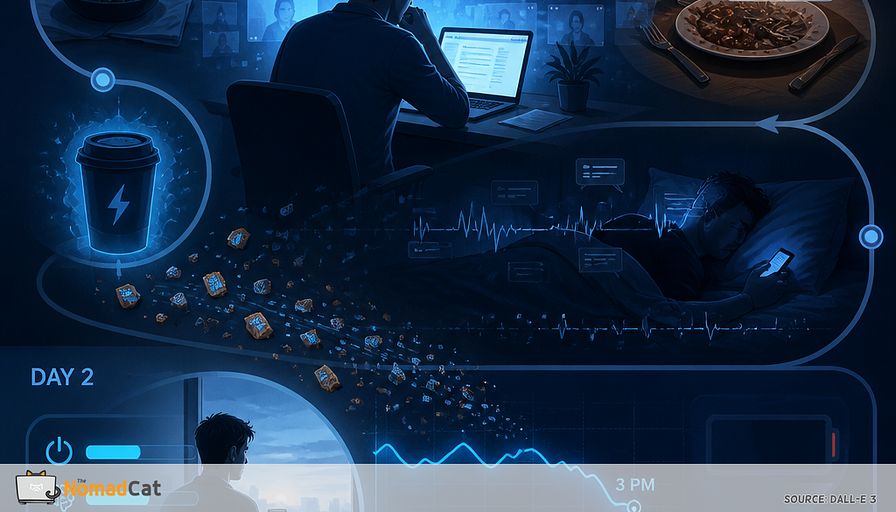
You know the day. Calendar wall, camera-on meetings, 10 hours at a desk, and lunch that turns into “later” until it becomes “whatever is fast.” Around 18:30 you patch it with something quick, maybe a late coffee so your brain keeps compiling. Then the next morning arrives and nothing adds up. Coffee feels mandatory. Hunger shows up late, then sharp. And somewhere around 15:00 the day drops off a small cliff.
I’ve done this in Beijing, then Berlin, and now Lisbon: laptop days where food becomes an afterthought and the invoice arrives tomorrow.
This article gives a name to that laggy pattern, not as a diagnosis, just as a debug label. Second-order hunger is the idea that today’s rescue inputs, skipped meals, desk snacks, late caffeine, late dinner, can throw side effects into the next day. Like shipping a hotfix at 23:30 and getting paged at 09:00.
You’ll get a simple 2-day model that fits desk life, without meal plans, macro targets, supplement stacks, or a sleep sermon. The focus is sequencing and tiny moves that survive meetings.
Along the way, it covers
- why your energy and cravings can look “random” when cause and effect are separated by a day
- the 3 phases that create the lag, day performance mode, evening recovery mode, next-day boot sequence
- the 3 quiet lag generators, late caffeine, dinner that becomes repayment, night snacking as decompression
- a no-app 60-second timeline to spot patterns without turning food into a morality play
- a cutoff plus cap rule for deadline weeks, so you reduce volatility instead of chasing perfect days
The goal is not to become a new person. It’s to make tomorrow a bit less noisy, with fewer swings and fewer surprise crashes. That alone is already a win, even if the calendar stays rude.
The second order hunger pattern at your desk
Why your energy bugs feel random
It feels random because the invoice often arrives tomorrow. When cause and effect are separated by a day, most people are bad at linking inputs to outcomes, especially with delays and noise in the loop.
This is not a diagnosis. Second-order hunger is a debug label. It means today’s rescue inputs, late coffee, skipped meals, desk snacks, late dinner, can send side effects into tomorrow. Think incident response. You ship a hotfix at 23:30, it looks stable, then you get paged the next morning.
Also, no meal plans. No macro targets. No supplement stacks. No sleep sermon. The focus is sequencing and small inputs that survive meetings. And neutral language on purpose. Rigid food rules can backfire, especially for anyone with an eating disorder history or a tendency toward rigidity. If that’s you, timing talk should be handled carefully, ideally with a clinician.
The useful model is a 2-day system, not “today only.” Caffeine runs on a longer timer than your calendar pretends. Food timing also has long timers. The post‑lunch dip often lands somewhere in the 13:00–16:00 window. When timers are long and variable, intuition often links symptoms to the wrong day.
The 2-day desk system without the guilt
3 phases that explain the lag
A simple model helps.
1) Day performance mode
Meetings stack, context switches multiply, and lunch becomes later.
2) Evening recovery mode
The only real free block. So food, caffeine, and decompression get squeezed here, under always-reachable pressure, aka telepressure (Slack that keeps tapping you after dinner).
3) Next-day boot sequence
You start the day with whatever stability you built last night.
Rescue inputs are emergency power, not a moral failure
Coffee, desk snacks, and a heavy late dinner are basically battery backup for knowledge work. They keep the service up during peak load. It’s not very elegant, but it keeps the service up. But like shipping a hotfix outside the freeze window (freeze window = no new changes late), they often push the problem to later, when feedback is harder to read.
Work signals that tomorrow will be noisy
This usually shows up first in outputs, not “motivation.” Common markers.
- Coffee urgency at boot. The day can’t start until caffeine loads.
- Mid-morning specificity cravings. Not hunger, but very precise “need something” requests.
- 15:00 crash amplitude. The dip is not a dip, it’s a drop.
- Tone or typo drift. More rereads, more small errors, more friction.
Not a diagnosis—just system wobble markers.
Why weekends can feel fine
Weekends often include real meals and breaks again. On meeting-wall days they vanish. Add after-hours messages and boundary creep, and exhaustion follows even if the job is “just a laptop.”
The 3 lag generators that quietly shift tomorrow
Late caffeine as calendar glue
In desk life, caffeine becomes scheduling infrastructure. You take it to survive back-to-back meetings, camera-on stillness, and 1 more block at 18:00. It works for alertness. But it runs on a longer timer.
Caffeine half-life is often cited around 3–7 hours and varies a lot. In controlled work, caffeine taken 6 hours before bed disrupted sleep. Even if you fall asleep on time, the night can get lighter and more fragmented. Sleep is a reliable bridge to next-day wobble.
A common timeline.
- Morning. Coffee becomes breakfast again and hunger is weirdly quiet.
- Noon. First real hunger arrives late and sharp.
- Evening. Lunch drifts, dinner grows.
Caffeine withdrawal can also show up as fatigue, which gets misread as “needs more coffee.”
What’s solid vs what’s fuzzy: evidence is strongest for sleep disruption from late caffeine. The rest is pattern logic, plausible but not settled. Practical link: if the night got lighter, the next morning often starts with “coffee feels non-optional.”
Dinner as a recovery event
For many adults, dinner is the biggest food moment of the day. In desk reality, it is also the first uncontested time slot. So it often ends up paying back a day built on coffee and frictionless snacks.
Timing and format both matter. Later dinners can shift next-morning markers even when food is controlled. And distracted meals tend to go with more later snacking. Marker: if you stand up and realize you don’t remember the last 5 bites, the stop signal probably arrived late. Netflix plus laptop is not evil, it just doesn’t close the loop. Attention is elsewhere, so the stop signal arrives late.
If dinner doesn’t close the loop, night snacking becomes the decompression patch. Then the morning can go 2 ways.
- Wake up flat, no hunger, coffee-only.
- Wake up snacky, with oddly specific cravings.
What’s solid vs what’s fuzzy: “later + more distracted” often correlates with a noisier next day, but individual response is all over the place, so single-day evidence is weak.
Night snacking as decompression
A clean definition helps people stop self-labeling. A lot of night eating in desk life is a few small rounds while scrolling, shipping the last thing, or answering quick messages. It works like decompression and transition. Not automatically loss of control.
Also, “eating at night” is not the same thing as binge eating. Binge episodes involve an objectively large amount and a sense of loss of control. Many desk patterns look more like grazing, small repeated amounts that may be compulsive or not.
Timing can still matter, even when amounts are small. Extending the intake window later often travels with later sleep. Sleep restriction can shift appetite regulation.
What’s solid vs what’s fuzzy: the sleep link is the cleanest part; evidence for “late grazing causes specific next-day cravings” is limited, so it’s safer to watch for general instability (boot feels fragile, cravings get oddly specific, the 15:00 dip turns into a drop).
A 2-day diagnostic that fits a calendar wall
The 3 questions that find the lag
This is a no-app, 60-second timeline. Tiny logs restore causality when intuition can’t. I like metrics (HRV, sleep), but for food timing this 60-second log beats another app.
1) When did caffeine end yesterday, relative to meeting blocks and bedtime
A simple anchor is that caffeine 6 hours before bed is safer for sleep, with big individual variability.
2) When did the last real eating episode end
Real means chewable and bounded, not a 2-hour trickle of bites.
3) Did dinner feel like recovery, or like incident response
Calm close vs open loop. “Distracted” here is observable: if you ate at the laptop and could keep going without noticing, the loop probably stayed open.
Example (filled in):
- Yesterday: last caffeine 17:30, bed 00:30.
- Last real food ended 22:15 (dinner + “just a few bites” later).
- Dinner felt like incident response (ate in front of laptop).
Desk-native markers for the next day
Quick scan at around 11:00 and 16:00.
- coffee feels required to boot
- mid-morning snack pull gets weirdly specific
- the 15:00 slump becomes a drop
- tone or typo drift shows up
Expect variability. That is the point. When feedback is delayed, subjective memory is unreliable, so neutral signals beat “how motivated am i.”
Quick safety note, then back to the desk pattern. Get medical advice if you have:
- fainting or confusion during low spells
- seizures
- repeated sweating + shaking that feels unsafe
-
persistent thirst + frequent urination
- unexplained weight loss
- recurring blurred vision
The cutoff plus cap rule that survives deadline weeks
Cutoff is an end marker, not a discipline test
In systems terms, this is shortening the tail. Pick 1 cutoff where new inputs stop after a work seam.
Examples.
- No new caffeine after the last meeting block.
- The kitchen closes when dinner ends.
Think freeze window (freeze window = no new changes late). After a certain hour, you stop shipping new variables so tomorrow’s incident report has fewer causes. It is stimulus control, not magic.
Be honest about what this can claim. Effective behavior change is usually multi-component. Evidence isolating a single cutoff rule is limited. So the standard for success is modest and practical.
Look for reduced volatility over the next 24–48 hours.
- less morning coffee urgency, or at least less “need it to boot”
- fewer mid-morning phantom cravings
- smaller 13:00–16:00 slump amplitude
- dinner feels less like repayment and more like an actual stop point
And when the day is hostile, judge it by fewer swings, not perfect adherence.
Cap for deadline nights
A cap means if you break the cutoff, you break it once, as a unit. It prevents repeated small rounds that stretch the window. It also reduces the odds of chasing fatigue with more caffeine when withdrawal noise is in the mix.
Choose units that are clear and boring.
- 1 yogurt
- 1 sandwich half
- 1 bowl of cereal or soup
- 1 plate of leftovers, then done
- 1 snack plate in a small dish, not the bag
Often, a small food cap is less sleep-expensive than another late coffee. Caffeine can improve vigilance when you’re tired, but late doses trade against sleep, even when taken 6 hours before bed in controlled settings.
Keep it frictionless. Telepressure and meeting creep mean “just cook” is usually a fantasy with good branding. This is not virtue. It’s damage containment so the next day is quieter.
Second-order hunger is a useful debug label for desk life when the problem shows up a day late. If lunch keeps slipping, caffeine runs long, and dinner turns into repayment, tomorrow’s boot sequence starts wobbly. Then the “random” stuff appears. Coffee feels required, cravings get oddly specific, the 15:00 dip becomes a drop, and even your tone gets a bit sharp.
The fix is not a perfect plan. It is a 2-day view and a few small controls that survive meeting walls: a short log to restore causality, a cutoff to shorten the tail, and a cap so deadline nights don’t turn into five mini inputs. Most of the time, the first knob is just earlier caffeine or a cleaner dinner stop point—and tomorrow gets quieter fast.
You might be interested by these articles:


Calendar-compressed eating and the crumbs then dinner day

The friction tax that turns lunch into coffee and a 16:00 crash

Fixing the 15:00 crash with a 10 minute buffer before the dip

Fuel debt is the hidden source of tab pinball and sharp replies

The 11:00 desk dip behind your typos and tab pinball

VR: Reshaping Remote Work and Collaboration

Making minimalist routines flexible with trigger points