Abstract:
The article tackles the common “desk butt” glitch where, after long stretches of sitting through back-to-back meetings, you stand up and your legs feel like they’re running a loading screen—hamstrings grab, the low back does the push-off, your stride behind you feels oddly short, and your glutes seem “offline” for the first minute—arguing this is usually a context-and-pattern problem rather than weakness, laziness, or permanent damage. It explains that hours of hip flexion plus low movement variability (made worse by camera-on stillness and mental-load bracing) can leave the body in a stabilize-first mode so, when you stand, the muscles already “online” (hamstrings and low back) take over hip extension while glutes “boot” late, creating noisy but competent compensation that stretching may temporarily soothe without changing who does the work tomorrow. Instead of a full workout plan, the piece offers a practical, in-between-calls debugging approach: run two quick seated checks for stability input (feet actually supported vs tucked/hooked) and asymmetry drift (crossing legs, one hip forward, leaning to one armrest), then use a 20–30 second “patch” at real-life seams (end of call, before stairs, after sending an email)—a split-stance stand with ribs stacked over pelvis, a small weight shift plus an exhale to reduce unnecessary trunk co-contraction, and an immediate walk to A/B test whether the first steps feel more normal. To keep it from becoming a new hobby, it recommends tracking one “boring” metric for seven days—“steps to normal” after standing—along with whether the seam happened, while also listing clear stop rules (progressive weakness, numbness/tingling, bowel/bladder changes, escalating night pain, systemic signs, trauma) and noting other potential causes that warrant real assessment if symptoms are sharp, progressive, or neurological.
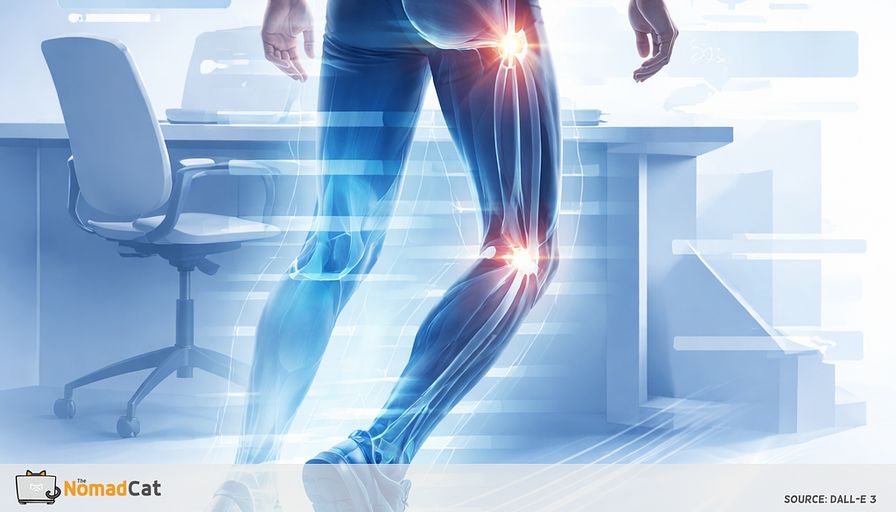
You know the moment. A meeting ends, you stand up, and your legs run a short loading screen before they agree to function. Hamstrings grab. Low back does the push-off. Your stride feels weirdly short behind you. And for the first minute, your glutes feel like they are still offline.
If you are doing 10-hour desk days with back-to-back meetings, desk lunch, and work that spills into the evening, this will sound familiar. And if you are skeptical of apps, trackers, and perfect plans that assume you have spare time lying around, same. This is for the real in-between moments.
I’ve done this as a French guy bouncing between Beijing offices, Berlin remote years, and now Lisbon since 2023—same calendar pressure, different chairs, same “why do my legs feel weird for 30 seconds?” moment.
This article is for that exact bug report. Not a chair review. Not a stretching sermon. Not a workout plan that assumes you have 45 free minutes and a perfectly timed lunch. It is a practical map of where the work goes right after sitting, plus a tiny test you can run in real life, between calls.
Here is what you will get:
- why glutes can “clock out” after long hip flexion without it being some permanent failure
- a simple work allocation view of hip extension, so hamstrings and low back stop doing unpaid overtime
- quick seated checks that take 5 seconds and explain a lot about the first steps after standing
- a 20 to 30 second “patch” you can plug into existing seams like end-of-call and pre-stairs
- 1 boring metric to track for 7 days, so this stays a debug tool, not a new hobby
- clear stop rules for when it is not just desk stiffness and deserves real assessment
If workouts are going fine but transitions feel glitchy, that is not you being “weak” or “lazy”. It is usually a context problem. The body runs the pattern it has been rehearsing all day. The good news is the fix can be equally unglamorous, and equally fast.
The desk butt paradox in 30 seconds
The moment your body files the bug
You end a call, you stand up fast, and the first 10 seconds feel like you just switched to a different firmware. The calendar is still screaming on the wall, your water bottle is untouched, Slack is blinking, and your legs do this tiny loading animation before they agree to walk.
- hamstrings do a little grab
- low back does the push-off
- your stride behind you feels short
- glutes feel absent for the first minute
That first minute matters. For a lot of people, the walk pattern shifts right away after sitting and then smooths out a few minutes later. So you can be strong in workouts and still get brief glute silence right after sitting. Transfer from drills to real tasks is often limited and very context-dependent.
This is a map of where the work goes, plus a tiny test that fits a real calendar.
Why glutes clock out after sitting
The fast mechanism without anatomy class
Sitting is 2 ingredients mixed for hours.
- deep-ish hip flexion
- very low movement variability
Desk work also quietly rewards stillness. On camera-on meetings, people freeze a bit to look composed and think clearly.
Stabilize-first mode
Under mental load, low-level muscle activation and low-variation postures can stick around.
Then your system goes into stabilize-first mode. Low-level trunk tension becomes the default, like a chassis that stays stiff even when the road is smooth. “Co-contraction” is one way the body does this: tightening muscles on both sides at once to feel more stable.
When you stand up, the first steps recruit whatever is already online. After hours in hip flexion, hip extension is not the move you have been rehearsing. So hamstrings and low back tend to clock in early while glutes show up late.
Important nuance. This is usually not a permanent failure. Those changes often fade after a few minutes of walking, which is why it is easy to ignore until it repeats 5 times a day, 5 days a week.
A work allocation map for your backside
Hip extension has a team and someone is doing unpaid overtime
When the main engine is late, the system reroutes.
- Glutes are the main hip-extension engine for walking and stairs when things are smooth.
- Hamstrings help, but also act like brakes and fine control when the leg swings through.
- Low back is the stabilizer and transfer layer, not supposed to be the primary get-me-upright motor.
Most people do not need a stronger back. They need the back to stop doing the glutes’ job on the first steps.
It works, but it is noisy
If glutes are slow to join the first steps after hip flexion, hamstrings and low back take more of the job because they are already awake. It gets you moving. It just tends to feel grabby and inefficient.
Compensation is not damage. It is competence under constraints.
Hamstring tightness is often workload, not length
This is why stretching feels good but does not always change tomorrow. Tight hamstrings after sitting often means hamstrings were over-recruited to do emergency hip extension and braking on the first steps, not that the muscle suddenly became structurally short.
Stretching is not the villain. It is just solving a different layer.
Stretching can also turn down the alarm fast. Range can improve quickly because tolerance changes. So yes, it can feel better in 60 seconds and still not change who does the work at 09:30 the next day.
Aim for earlier glutes, not a deeper stretch.
Debug signals you can log without becoming a posture person
2 seated checks that take 5 seconds
Support is 1 axis. Symmetry is the other.
Base of support
Are the feet tucked under the chair, 1 foot hooked on a caster, or barely touching the floor? Not bad posture—more like missing stability input. A quieter base often means a noisier trunk later, because the trunk has to do more stabilizing.
Asymmetry drift
Even if feet and hips look fine, asymmetry sneaks in on long calls.
- cross-legged for 40 minutes
- 1 hip always forward
- leaning to the same armrest
Repeated asymmetry can train 1 side to stabilize more all day, then you get the predictable “this side gets tired first” pattern.
End of day clues that predict tomorrow’s first steps
A common cluster:
- urge to stretch hamstrings even if you already stretched at lunch
- low back feels busy after a short burst of walking
- stairs feel weirdly hamstring-heavy for the first flights
Treat it like a state bug that repeats around transitions and then fades, not a permanent label.
The 20 to 30 second patch that survives a meeting day
Seams beat reminders on a calendar that eats itself
In practice, prompts can help, but timers often fire mid-thought and get swiped away.
Seams already exist.
- end of a call
- before stairs
- before leaving for lunch
- after sending a big email
Very short breaks can still help—mostly because they interrupt the “same position for an hour” problem without demanding a new schedule.
A split stance stand that aims at the first steps
Stand up at the desk and take a split stance, 1 foot half a step back. Both feet point forward. Stay tall, ribs stacked over pelvis. Hands lightly on the desk if needed.
The point is to reintroduce hip extension context after sitting, not to activate something forever.
Stop if there is pinching in the front of the hip or sharp back discomfort.
Then do a small weight shift and pair it with an exhale, then walk immediately.
- Feel: shift until the back-leg hip feels like it opens a little, with a light back pocket squeeze
- Avoid: hamstring cramp, big low-back arch, or turning it into a stretch contest
- Then do: take 10 to 20 normal steps right away and check if your stride behind you feels less short
Why this shape. Many people notice their stride stays shorter for the first minute after sitting. And if your trunk has been doing that low-level “hold steady” thing all day, a longer exhale is a simple way to let some of that bracing drop so the next steps share load a bit better.
Treat it like a quick A/B check, not a guarantee.
Make the patch real life, not a ritual
Use it right before the task that triggers the bug.
- Before stairs: 1 split-stance shift per side, then 5 slightly longer steps on flat ground and go.
- Before picking up a bag: heel-heavy stance, 1 long exhale, then lift and walk. The point is to reduce unnecessary trunk stiffness, not brace harder.
- Before a brisk start: do the micro sequence and walk for 60 to 120 seconds, thinking let the leg go behind me without adding a big low-back arch.
If standing is politically complicated, add seated variability during long calls. Every few minutes, slide 1 foot a bit forward, then switch, with tiny weight shifts. It keeps hips from being parked in 1 angle for 60 minutes. Low variation keeps the same low-threshold motor units on for too long. Small shifts rotate the work.
A boring metric and basic guardrails
1 metric for 7 days
Track 1 thing so it stays a debug tool, not a new hobby. I’m the kind of person who can get lost in numbers when “the data stops looking good,” so this stays intentionally small.
Use steps to normal after standing up, because the sitting hangover mostly lives in the first 1 to 2 minutes and then fades.
Example log line: Steps to normal: 20, 12, 8
Keep a tiny 2-field log.
- Seam happened: yes or no
- Steps to normal: number
7 days is enough to see if repeated seam interrupts are changing the pattern. It is also too short to pretend it is strength gains.
Stop rules and when it is not desk butt
Stop the experiment and get assessed if any of this shows up.
- progressive weakness
- persistent numbness or tingling
- bowel or bladder changes
- major night pain escalation
- fever or other systemic signs
- symptoms after trauma
Even without red flags, posterior thigh pain after sitting can come from a few common buckets—like nerve irritation from the low back, a cranky hamstring tendon near the sit bone, or deeper hip-area irritation that mimics hamstring tightness. Treat it as a symptom pattern, not a label. Mild, repeatable transition-based stiffness can be tested with exposure tweaks. Sharp, progressive, or neurological symptoms deserve proper clinical triage.
If your workouts are fine but the first minute after a meeting feels glitchy, it is rarely a character flaw. It is just the body running the pattern it rehearsed for hours in hip flexion. When glutes boot late, hamstrings and low back take the ticket and do overtime, so the first steps feel short, grabby, and a bit wrong.
Most of the time the “bug” is not your training. It is the 30 seconds right after you stand up.
You might be interested by these articles:


The 15 second unclench that fixes your first steps after desk days

Your hips are booting up after sitting fix the first 60 seconds

Your feet are shrinking under the desk and your 18:00 steps notice

That 18:00 behind knee bite is not your hamstrings its your desk day setup

The 6pm ankle reboot after a 2 hour statue block

Revolutionizing Training with VR

Mastering GDPR Compliance in Serverless Computing for Startups