Abstract:
The article explains why, after long stretches of desk work (think 27 tabs open, an overlong call, and lunch eaten at the keyboard), standing up can make your hips and low back feel like they move “as one piece,” like a suit with a stuck zipper—an annoying stiffness that usually fades within 20–60 seconds and is therefore easy to dismiss or mislabel as simple “tightness.” Instead of blaming permanently short hip flexors or prescribing a doomed stretching plan, it frames the first 3–10 “robotic” steps as a brief recalibration window: circulation shifts (including heavy legs from venous pooling), temporary guarding/bracing and altered trunk–pelvis timing, and reduced “glide” between tissue layers can make movement feel chunky until a little motion restores normal coordination. The deeper culprit is a “missing-variability” desk day—hours of unchanging pressure points, minimal shear and angle changes, low-level muscle holding, and breath/bracing drift (often amplified by camera-on stillness, stress, and remote-work routines)—so the most effective fix is not heroic stretching but small, frequent, low-drama inputs that match what’s missing. It offers desk-friendly micro-actions that don’t look like workouts (tiny pelvic shifts and longer exhales, gentle contract-relax heel presses, small seated rotations, or a quick stand “boot sequence” with micro knee bends and weight shifts plus a few steps), anchored to natural “seams” in the day like hitting Send or leaving a call, and recommends a deliberately boring 7-day A/B-style test: pick one symptom metric (e.g., rate the robot-step feeling 0–10), do one 10–30 second micro-action about three times daily at a consistent seam, and log once per day—keeping intensity very light and watching for red-flag symptoms—so the stand-up transition stops feeling like a software glitch without turning the workday into a fitness project.
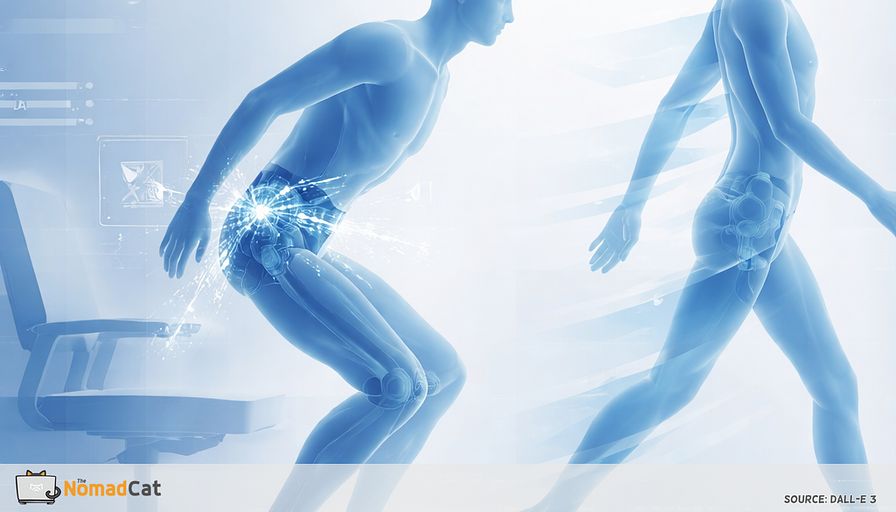
You sit down to clear 1 thing. Then it is 27 tabs, a call that ran 12 minutes long, and lunch that became a keyboard snack. Everything feels fine… until you stand up and your hips and low back move like 1 piece. Like you are wearing a suit with a stuck zipper.
It is not dramatic. It is just annoying. And it usually fades in 20–60 seconds, which makes it easy to dismiss, or to blame on being “tight” and promise a stretching plan that dies by Wednesday.
This article is for that exact moment. The purpose is simple:
make the first minute after standing feel less weird, without turning your workday into a fitness project.
Here is what is coming
- Why the first 3–10 steps can feel robotic, and why it is often closer to a short-lived “guarding” setting than a permanent flexibility problem
- What changes fast after sitting, including circulation effects and that heavy-leg feeling that clears with walking
- Why “tight” is often the wrong label, and how reduced glide between layers can make everything feel chunky for a few reps
- The missing-variability problem of desk days, pressure, shear, low-level muscle holding, and bracing drift
- A small, desk-friendly menu of micro actions that do not look like a workout, plus a boring 7-day A/B test to see if they actually help
No posture shame. No heroic fixes. Just small inputs that match the real issue, and a way to track whether the stand-up transition stops throwing errors.
The suit that locks when you hit Stand
The first 10 steps after a long sit
After a long desk block, everything can feel… fine.
Then you stand up and suddenly the hips and the low back move like 1 single piece, like you are wearing a suit with a stuck zipper.
It is not dramatic. It is just weird. And it often shows up at the transition, not during the sitting. Desk time does that. Once you are deep in work, sitting long stops being a choice and becomes the default (Davis & Kotowski, 2014; Grunseit et al., 2013).
Then 20–60 seconds later it eases enough that most people ignore it. If it clears in the first 30–90 seconds, that is a clue, not a personality flaw.
A few fast things change when you start moving again. Circulation is 1. Venous pooling is part of it. Legs can feel heavy after sitting and often feel better after walking (White et al., 1998).
What people tend to notice is pretty consistent
- 3–10 short, slightly robotic steps
- a torso that stays a bit held at first, then stops guarding
- stride length that opens up without thinking about it
- breathing that goes from shallow to more normal
- ankles that feel tight for a moment, then loosen with motion
Why the first minute feels like a software glitch
What changes fast after sitting
That stuck, then fine pattern is real.
The easy story is “hip flexors got short.” Clean. Satisfying. Often incomplete.
Right after prolonged sitting, people often walk with extra trunk stabilization and changed trunk-pelvis timing, basically moving a bit more as 1 block (Callaghan & McGill, 2001). In plain language, the system adds some guarding—extra bracing—then it usually backs off once walking continues. The biggest differences show up early and often ease within the first few minutes.
Hip extension can drop after sitting. That is plausible. But the evidence is more mixed than the trunk-guarding findings. Being picky here matters. Otherwise people spend weeks chasing a hip-flexor stretch when the more consistent issue is temporary coordination plus bracing.
Treat it as a recalibration window
A practical way to read the first minute is this.
After stillness, the body runs a short protective configuration, then recalibrates as load and motion come back. Many measured changes fade within roughly 1–3 minutes of walking in lab setups. The catch is that when this “one long sit → one weird stand” pattern repeats day after day for months, the annoyance becomes a feature of your desk life, not a one-off glitch.
So that first minute is more like a quick reinitialize than a verdict on your flexibility, your chair, or your entire life.
Tight is often the wrong word
When layers stop sliding, everything moves together
Right after a long sit, it can feel like the hamstrings or hip flexors shortened. Another explanation is less dramatic.
When different tissue layers glide less relative to each other, movement can feel chunky. End-range shows up earlier and the brain labels it as tight—which is annoying, because “tight” sounds like a real diagnosis.
A basic example is bending forward to pick something up. The first hinge can feel blocked, like the back and pelvis are glued for 2–3 reps, then it becomes normal again.
This reduced-glide idea is not random. In the low back, imaging work suggests differences in how well the layers slide in some pain conditions (for the curious: “thoracolumbar fascia shear strain”) (Langevin et al., 2011), and that the sliding changes when muscles switch on (Tucker & Hodges, 2012). Different context than desk stiffness, yes. Still: “layers sliding” is a real variable, and it matches that very desk-real moment where the first hinge feels glued.
Practical implication: don’t hunt for a heroic stretch. Restore sliding with small load changes and a bit of motion, then let the system do what it does.
Skip the hydration drama
It is tempting to say fascia “dried out” after 3 hours in a chair. It sounds neat and simple, but it does not hold up well. So don’t chase water hacks; chase 20 seconds of movement.
A safer framing is that immobility changes fluid exchange in connective tissue and can shift how slippery things feel. If the system is not moving, it can take a bit of motion to feel normal again.
Small inputs beat heroic fixes
In tech terms, the body is not broken. It is running with fewer inputs and a more conservative default.
When the missing signal is micro-movement and position change, the fix that matches it is often small and frequent too. Not a 12-minute stretching session you will never do between meetings.
This lines up with simple ergonomics advice. HSE Display Screen Equipment guidance pushes regular breaks and changes of activity rather than hunting for 1 perfect posture. CCOHS puts it bluntly. The best posture is the one that changes often (HSE DSE guidance; CCOHS).
Desk time is a missing-variability problem
The 4 inputs desk days quietly remove
Static pressure is only half the story. The other half is shear and angle variety, the little changes that keep sensation and movement online.
1) Pressure change
On desk days, the same contact points get the same message for hours. Sit bones into the chair. Forearms into the desk edge. Feet into the same patch of floor. When pressure barely changes, it stops being information and becomes background noise.
2) Shear and layer sliding
In walking, every step is tiny load changes plus tiny shear between tissue layers. In sitting, many joints live near 1 angle and do not need to slide much. Static postures should be interrupted (ISO 11226)—meaning not “buy a new chair,” but “change angle or pressure on purpose, briefly, and often,” like the 10–30 second micro actions later in this article. This matches what gait labs see after sitting. Trunk and pelvis timing gets more en bloc at first.
3) Low-level variability in muscle activity
Desk work removes natural alternation between on and off in trunk and shoulder muscles. You get long periods of low-level holding. Not heavy effort, just constant. That background activation is 1 reason people feel stiff without feeling tired.
4) Breathing and bracing drift
Camera-on stillness, precision work, and do-not-move-while-you-think moments push people into more co-contraction. Sometimes it is as small as holding breath while writing a sensitive email. Respiratory maneuvers can change trunk motor control and stiffness settings (Hodges & Gandevia, 2000). Mental stress is linked with higher neck-shoulder EMG in computer work contexts (IJmker et al., 2007).
Remote work can make all of this more likely without any drama. Fewer incidental steps. Fewer room changes. Fewer small transitions that used to force posture changes. Many people saw step counts drop and sitting bouts get longer during WFH periods.
The practical implication is simple. Stretching harder at 14:00 is often the wrong lever because the missing thing was not length. It was frequent tiny change.
Why stretching harder rarely wins
Stretching can change how a joint feels in minutes. Range of motion often increases quickly after stretching, and a big chunk of that short-term change looks like tolerance—your nervous system being less alarmed at end range—more than instant tissue lengthening (Kay & Blazevich, 2012; Magnusson et al., 1996).
So yes, the relief is real. It often behaves more like a nervous system permission update than a fast rebuild of the hardware.
After 4 hours of low-variability sitting, 1 hard hip flexor stretch is like pushing 1 big patch to production and hoping it fixes a recurring outage. Prolonged sitting discomfort tends to climb with time, which is exactly what frequent interrupts are meant to blunt (Beach et al., 2005).
Also, intensity escalation is a common failure mode at the desk. If the first stretch worked yesterday, people pull harder today, then wonder why it feels spicy tomorrow.
Desk-friendly fixes need low friction and low drama. Microbreak research keeps landing on what fits real workflow: brief, low-disruption breaks that do not wreck focus (Galinsky et al., 2007).
The 2 minute input tweak that makes standing less weird
A small lubrication budget
Tiny movements that change contact, angle, and load for 10–30 seconds can be enough to bring back the glide signal you lost while sitting. No gear. No workout. No leaving work mode. Just shift, reload, redistribute for a moment.
A useful mental model is a 2-minute lubrication budget spread across the day. Not a timer. Not a perfect schedule. More like small background syncs that stop the system from getting stale. And “lubrication” here is not mystical: it’s pressure change, a little layer sliding, and a small drop in bracing via a longer exhale.
Small, frequent interruptions can reduce discomfort and fatigue compared with 1 long uninterrupted block, for example 1 minute of walking every 30 minutes (Dutta et al., 2014) and break schedules such as 5 minutes per hour (Balci & Aghazadeh, 2004).
Track outcomes that match the real problem, not abstract mobility numbers
- Startup steps after standing, rate the robot steps feeling on 0–10 once a day
- Board-back at 18:00, how often the trunk feels like 1 piece when you get up
- Ease of first stand, whether the first 20–60 seconds clears faster than usual
Micro actions that unglue desk mode
4 fast options that do not look like a workout
If the legs feel heavy or glued, start with a chair move that changes pressure without standing (same pooling/heavy-leg effect as above)
- slide the pelvis forward and back a few cm
- tiny left right shift between sit bones
- add 1 longer exhale
If the torso feels like a board, use a light contract relax instead of a deep stretch
- extend 1 leg slightly, heel stays down
- gently press heel into the floor for 2 seconds, then relax
- 2 reps each side, effort around RPE 2–3
If it feels more in the mid back, bring back small ribcage motion
- tiny seated rotation around 5–10 degrees with an exhale
- return
- repeat other side
When standing is possible, use a simple boot sequence
- stand
- micro bend knees 2 times
- shift weight heel to ball 2 times
- sit back down
- optional, add 10 steps
Even short light walking breaks have strong support in sitting interruption protocols (Dunstan et al., 2012).
Where these fit without adding a new habit
Timers are cute until the day explodes. Seams survive better because they remove the “when should I do it” decision.
Useful seam examples that are socially safe at a desk
- after clicking Send
- after leaving a call
- after exporting a file
- when a page loads
- when switching tasks or tabs
- when standing up for water
- when a build finishes
This framing fits a systems and metrics mindset. It is small, observable, and free of posture shame. It also fits the reality of mostly-remote work, workations across Europe on bad chairs and worse desks, and the “why is it midnight again” habit of pushing one more thing. And if your early warning sign is that quiet upper-back tightness that creeps in, well—this is the kind of tiny input that helps before it becomes A Thing. My wife still says “sit straight” and it still lasts about 3 minutes.
A boring 7 day A B test for desk stiffness
This is an experiment, not a plan. The goal is to see if pressure change plus a bit of shear reduces that weird first minute after standing.
1) Pick 1 outcome metric that matches the real symptom.
2) Pick 1 seam that already happens about 3 times per day.
3) Pick 1 micro action that takes 10–30 seconds and is mostly invisible.
4) Do it only at that seam for 7 days. Keep the rest of the day the same.
5) Log the metric once per day in 5 seconds.
Single-item 0–10 scales are common and usable for field tracking (Hawker, 2011).
If nothing changes after 7 days, that is still useful. It suggests a different bottleneck may dominate this week, sleep debt, workload intensity, chair setup, or a separate condition.
Intensity guardrails and stop rules
Keep effort around RPE 2–3 out of 10, mild discomfort at most, and it should settle quickly rather than ramping across the day.
Stop and get checked if any of these show up
- sharp or shooting pain that travels down the leg, or new weakness
- numbness or tingling that persists rather than fading with movement
- symptoms that clearly escalate day to day despite keeping intensity gentle
Keep it boring, keep it frequent, and treat the stand-up transition like your log file.
If your day is screens, calls, and lunch that happens with 27 tabs still open, that weird first minute after standing is not a character flaw. It is often a short-lived guarding setting plus low-variation sitting, not a permanent “tightness” problem. The encouraging part is that the input can match the issue. Small pressure shifts, a bit of gentle shear, a longer exhale, 10 steps, done at a natural seam, can be enough to make the stand-up transition feel less like a software glitch.
Keep it boring. Keep it light. Track 1 simple signal for 7 days and see if the robot steps fade faster, without turning your workday into a fitness project.
You might be interested by these articles:


The 15 second unclench that fixes your first steps after desk days

Your feet are shrinking under the desk and your 18:00 steps notice

Why your first steps after sitting feel broken

Why desk pain hits right after you stop working

Your 18:00 stiffness is a config bug fix it with micro-variability

Scenario analysis made simple for tech freelancers facing income swings

Navigating the New Era of Remote Work Tech