Abstract:
The article argues that long desk days don’t simply make you “sit” so much as they quietly erase whole categories of movement—rotation, side-bend, hip angle changes, deeper breathing—by locking you into one repeated geometry (hips folded, hands forward, eyes near, tiny head turns) until those unused options feel untrusted, so you can feel fine during work but get a “bug report” around evening when real life suddenly demands a twist to check a blind spot, reach into a back seat, or grab something overhead. Framing this as “range deprivation” rather than damage, it explains stiffness as a protective routing choice where the nervous system borrows motion from the neck, ribs, or low back when neglected ranges haven’t been visited, making symptoms feel random and not necessarily proof you’ve structurally “lost” range. Instead of posture shame, chair upgrades, or a perfect-workstation quest, it proposes a deliberately low-effort, calendar-proof approach: run a 20-second, low-intensity range “audit” at natural seams (after a meeting block or before standing) using four quick checks (small seated trunk rotation, small side-bend with an exhale, tiny seated hip angle shift, and a low reach-behind preview), then apply a 30-second “refeed” of variability (10 seconds each of gentle rotation, side-bend with exhale, and hip angle change) to reduce end-of-day creakiness and prevent the neck and low back from doing “unpaid overtime.” It also recommends tracking just one real-world output for a week (like how smooth the first blind-spot check feels), notes that the author’s own metrics-minded instincts (physics background, HRV/sleep/calorie tracking) can tempt over-measurement that becomes its own problem, and closes with clear red-flag symptoms that warrant assessment rather than self-experimentation.
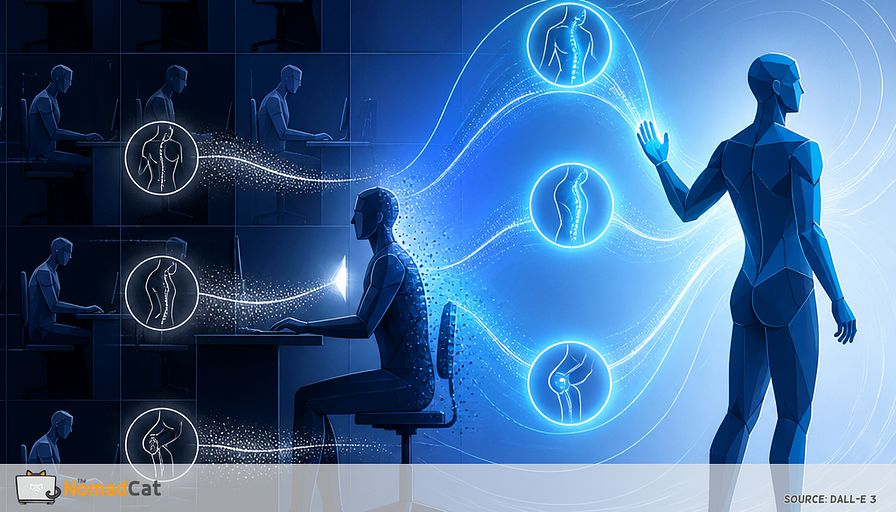
A long desk day doesn’t just “make you sit.” It quietly deletes whole categories of movement.
Not in a dramatic way. More like a UI slowly hiding options you didn’t click for 6 hours. Hips stay folded. Hands live forward. Eyes stay near. The head rotates in tiny increments. Breathing gets smaller because there is a meeting. Then at 18:10 you reach into the back seat, check a blind spot, or grab a bag, and suddenly the body files a bug report.
This article is here to give that pattern a cleaner explanation, and a low-effort way to interrupt it without turning your calendar into a second job. No posture shame. No chair-shopping quest. No “perfect workstation” fantasy.
Here’s what you’ll get, in practical terms
- A simple model for why desk work feels fine while you’re doing it, then complains later when real life asks for different angles
- The idea of range deprivation, meaning less “damage” and more missing options by the end of the day
- Why stiffness can be a cautious routing choice, not proof you “lost range” or got structurally worse
- A quick 20-second range audit you can run at natural seams in the day, like after a meeting block
- A 30-second “refeed” that brings back a bit of rotation, side-bend, and hip angle change before the neck and low back start doing unpaid overtime
If your day is 10 hours of calls, desk lunch, and workouts that keep getting postponed to “later,” this is built for that reality. Small changes. Repeatable. Slightly boring on purpose. And usually enough to make the end of the day feel less creaky and less surprising.
The desk day deletes movement categories
Desk work is one geometry, repeated
A desk day is not just sitting. It is the same shape, copied and pasted for hours, until it becomes invisible. One angle. One reach distance. One breathing volume. Feet narrow under the chair. The head turns in tiny degrees. Breathing gets quiet because there is a meeting.
Ergonomics advice is boring for a reason. A lot of guidance, like NIOSH, keeps coming back to the same theme: variation and short breaks matter more than hunting for 1 perfect posture. Your setup can be “fine” and you’ll still drift after 2 hours. Even with a decent setup, posture drifts with time (Callaghan & McGill). So instead of arguing about “good posture,” it helps to name what the desk day quietly removes.
Range deprivation is missing options, not damage
Range deprivation is when the menu of available movements shrinks across the day, without alarms. Desk work is a constraint: it keeps selecting the same few solutions, so the others stop showing up by evening (Newell’s constraints model, if you want the fancy label).
In work terms, it is like endpoints going dark behind a feature flag. The app still runs, just with fewer routes. In body terms, “desk mode” still works, but the repertoire gets smaller. Later, a normal task can feel louder than it should. Repeat that pattern most workdays for months, and the “default routes” start to feel like the only routes.
Why it often complains after 18:00
During deep focus, the system runs a stable configuration and filters small signals. Call to doc to call, it feels fine because nothing asks for new movement categories.
Then the task ends, attention drops, and real life requests something slightly different. Grab a bag. Twist to reverse the car. Reach into the back seat. That mismatch is when stiffness, pinches, or guarded movement can show up. It’s the exact moment you think: “Seriously? I was fine all day.”
The bug report comes after shutdown.
Breaks help, not because they are magical, but because they interrupt the same exposure pattern. Studies on microbreak-style schedules often show reduced discomfort with frequent short interruptions (Balci & Aghazadeh; Galinsky et al.). In practice: fewer “hot spots” in neck/low back by the last meeting, not a miracle posture fix. Sustained positions can also produce same-day tissue creep and reflex changes in the spine (Solomonow et al.), which may be one contributor among many to the “why now” feeling, without pretending it explains everything.
What this model is not
It is not posture shame. Not “you are weak.” Not a chair-shopping quest. Not a demand for a perfect workstation before anything improves.
It is a predictable output of long, unvaried input. Like running 1 workload profile all day and acting surprised when a different service times out at 18:20. OSHA and UK HSE DSE guidance land on the same unsexy fix: short, frequent changes of activity and task variation.
That matters because it makes the problem testable inside a real workday, and often reversible in small steps.
When normal moves feel strange
The everyday tell is in the transitions
Those moments feel random, but they follow a simple rule.
Unvisited ranges feel less trusted.
You feel fine at the desk, then a normal move comes and it’s suddenly cautious.
- Reverse the car and rotate to look behind
- Check a blind spot and the neck does a weird 2-step
- Reach a high cupboard and the ribs pop up with the arm (overhead reach is a whole-chain job, not just shoulder)
- Step into pants and you choose the safe side first
- Put on socks and you pull the foot up like it’s heavy
- Take a quick lateral step around a chair and the body pauses to organize itself (adaptive stepping is coordination-demanding)
Your body is not dramatic. Just under-tested.
Guarding is a routing decision, not a verdict
This is why “I feel tight” is not the same as “I lost range.” When a range has not been visited all day, the nervous system can treat it like an untested deployment. Even without pain, it may choose the conservative rollout and reroute motion somewhere else.
Hodges and Tucker’s model is useful here because it isn’t 1 single pattern. It is redistribution under perceived threat: the system shifts work toward the places that feel safer today, not the places you would pick on paper. Too little variability can make normal tasks feel harder than they should.
Stiff does not automatically mean shortened
Stiffness is real, but it is not reliable proof that tissues shortened.
Stretching research also suggests range changes are often about stretch tolerance more than dramatic tissue stiffness changes (Kay & Blazevich). So a weird-feeling self-check after work does not mean you are broken. It may mean the system is running cautious mode.
Borrowing motion makes the pain map messy
Borrowing is smart load sharing until it gets pricey. Most actions are multi-joint by design, so the system can move work around without breaking the outcome. It is cost control, not morality. Like moving traffic away from a slow service.
After a long desk block, routing gets biased, and the cheapest path becomes the only path.
If one joint won’t contribute, another will volunteer — and it’s usually the one you least want doing overtime.
Typical desk routes that show up later
- If hip extension has been offline all day, you often see more low-back extension and some hamstring gripping to stand tall
- If rib rotation has been quiet, you often see more neck rotation and upper-trap effort to look over a shoulder
- If scapula-on-rib motion is not cooperating, you often see trunk extension or rib flare to get the arm overhead
Desk days do not only make 1 spot stiff. They change routing, so the complaint can land somewhere else and feel random.
Use an error budget, not perfection
Desk stiffness can show up in different places in different people. Same exposure, different borrowing patterns, depending on history, workload, and constraints.
So symptom location is a weak clue. Diagnosis hunting often turns into a browser tab collection, not a fix.
A more useful frame is an error budget.
The aim is not perfect posture for 3 minutes. It is fewer spikes and a faster return to normal when the day ends and real life starts. Trends matter more than drama. For that, you need a tiny check that detects what went missing today, without turning your calendar into a second job.
The 20 second range audit at work seams
A workable option is to run a quick audit at seams, not on a timer. End of a meeting block. After sending a doc or PR. Before standing up.
Timers work until the day gets real, and then they become your small enemy. Breakpoints are often less disruptive for resumption than random pings (Bailey & Konstan; Iqbal & Bailey). It also matches boring ergonomics guidance: frequent changes of activity.
Keep it deliberately boring. Yes, it’s a bit silly. But it works.
- Use about 20% effort
- No forcing, no long holds
- The question is which option feels a bit offline today
Informal self-checks are noisy and easy to cheat with compensations. That is fine. The point is repeatability, not degrees.
A range can feel weird at 17:40 and fine again after dinner, without anything changing structurally.
This is also where the data-brain gets slightly offended. The author studied fundamental physics, tracks HRV, sleep, and calories, and could absolutely build a spreadsheet for shoulder rotation like a quarterly KPI. But for desk stiffness, a tiny log scan for anomalies is often more useful than running benchmarks every time.
Here are 4 quick checks that match what desk days usually remove.
The 4 checks that catch missing ranges early
Small rotation preview
Rotation is often the first movement category a desk day deletes, because everything is forward and square.
Stay seated. Keep the pelvis heavy. Gently turn the chest a small amount left, then right. Notice if the neck wants to lead, or if 1 side feels blocked. Keep it binary.
Cue: imagine the belt buckle stays pointing forward while the ribcage turns.
Small side-bend with an exhale
If rotation feels asymmetric, the next commonly missing option is side-bend. Let the ribs soften down 2–3 cm to one side, then the other, paired with a slow exhale so it doesn’t turn into bracing practice.
What not to do: don’t shrug the shoulder up to fake range.
Also don’t over-interpret sensation. ROM can change from tolerance and threat level, not just mechanics (Kay & Blazevich).
Tiny hip angle change without standing
Not a stretch, just changing the hip story for 5 seconds.
Slide 1 foot slightly forward, keep the other closer, and shift a little weight so the pelvis finds a new angle without leaving the chair. Keep it tiny. Notice whether the low back braces right away or the front hip grips.
Low reach-behind preview for the shoulder
Reach 1 arm slightly back and low, like aiming for a jacket pocket, then swap sides. Notice if the neck hikes, ribs flare, or the trunk extends to help right away.
It is only a preview, not a test. But it can hint that shoulder blade and ribcage coordination is a bit offline after a forward-only day (Ludewig & Cook).
If any check feels offline, the fix is usually not a new program. It is re-feeding that option at the next seam, at low effort, before the body starts borrowing from the neck or low back again.
The 30 second range refeed that survives your calendar
The best microbreak is the one that survives your calendar. It’s the moment you un-hide 3 movement options before the UI decides you don’t need them.
Microbreak studies most consistently show reduced discomfort and fatigue with short, frequent breaks, often without a performance cost (Balci & Aghazadeh; Galinsky et al.). Hard ROM proof at the 60-second-or-less dose is thin. The success metric here is smaller end-of-day noise, not new range.
The 3 moves in 30 seconds
10 seconds rotation.
Stay seated, pelvis heavy, and turn the ribcage a little left and right for 2–3 small reps each way. Sternum follows. Neck stays quiet.
10 seconds side-bend plus exhale.
Soften the ribs down 2–3 cm to one side while breathing out, then switch sides. It should not feel like cranking a stretch.
10 seconds hip angle change.
Slide 1 foot a bit forward, tiny weight shift, then switch. Keep the low back quiet. Treat it as variability, not a hip flexor stretch.
To keep it sustainable, treat it as an on-demand patch, not a quota. No streaks, no perfect schedule, no new admin job.
Measure it without turning it into a second job
Pick 1 output and keep it stable for 7 days. PSFS-style task anchoring works well for this (Stratford et al., 1995).
1) Steps after standing until walking feels normal
2) Smoothness of the first blind-spot check
3) Guardedness on the first overhead reach
Pick 1 only.
Your mood, sleep, deadlines, and caffeine can move a pain number up or down with zero mechanical meaning. A consistent real-life task is usually a cleaner comparator.
Keep logging boring.
- 1 note per day
- Same time
- Same prompt
- Either 0–10 for that 1 task, or a simple yes or no
If tracking starts increasing anxiety or obsessive scanning, drop it. For metrics-minded people, overtracking can become the bug, not the fix.
Guardrails that keep this safe
Desk-linked stiffness is common. But some patterns are not self-experiment territory.
Get assessed if you have
- Sharp pain that is getting worse
- Numbness, tingling, new weakness, or dropping things
- Night pain that keeps worsening or doesn’t change with position
- Bowel or bladder changes
- Fever, unexplained weight loss, feeling generally unwell
For everything else, the main rule is intensity. Do less than you think. No forcing.
Interpret results like an engineer, not like a judge. Repeatability beats intensity. If the refeed reduces end-of-day spikes, keep it as a small patch. If it doesn’t, that is still useful info. Another constraint may be louder right now: sleep debt, workload density, too many back-to-back calls.
Sleep is the brutal variable, especially when desk work goes past midnight. Some days the best win is simply noticing the first upper-back tightness signal and shipping a small patch early, before the system starts borrowing.
Most desk discomfort isn’t from sitting itself; it’s from the first real-world twist that asks for rotation, side-bend, or hip extension after a day of one geometry. Seams beat timers, low effort beats hero reps, and the goal is just to keep more options available at 18:10 than you had at 08:50. For most people it’s not the desk that hurts — it’s the first real-world twist that proves what went missing today.
You might be interested by these articles:


Your feet are shrinking under the desk and your 18:00 steps notice

Why your seatbelt reach fails after a mouse heavy day

Your watch logged the workout but your shoulders still filed a bug report at 18:00

Your 18:00 stiffness is a config bug fix it with micro-variability

Why your after work stretch keeps losing to your desk day inputs

Based In Western Europe

Elevating Data Analysis with R