Abstract:
The article explains that many “sudden” afternoon cravings in screen-and-meeting-heavy desk days aren’t a willpower failure or even true hunger, but a repeatable “thermostat problem” where sitting still in a slightly cold microclimate (drafts on the neck, under-desk airflow freezing shins and feet, cold window/wall surfaces acting as heat sinks, or vertical temperature gradients) pushes the brain to seek the fastest relief—often “edible heat” like warm, sweet coffee—especially when it coincides with the common 14:00–15:00 circadian dip; because that quick relief trains the habit loop, it can lead to repeated caffeine/sugar dosing that rescues the afternoon but “steals from the night” by harming sleep and amplifying next-day cravings. Instead of changing your whole diet, the piece recommends a low-drama, falsifiable 3-day “thermal debug”: when an urge hits, do a 10-second check (“Am I cold?” and “Would something warm fix 30% of this?”), add simple context tags (e.g., vent on neck, meeting room, hands/feet cold, window seat), and if cold clusters with urges, try a 2–5 minute warm-up before eating—hot water/herbal tea/broth, adding a layer early, warmer socks/closed shoes, wrist/ankle/neck coverage, moving away from vents or exterior walls, or using a non-electric lap blanket—while avoiding overcorrecting into a “desk sauna” or fighting facilities. It also flags when temperature is likely not the cause (persistent/new heavy fatigue or systemic symptoms, chronic sleep debt and late caffeine cycles, stress/snack cues, or genuine under-fueling), framing the goal as neutral comfort and earlier pattern recognition so the vending machine doesn’t become your “IT department.”
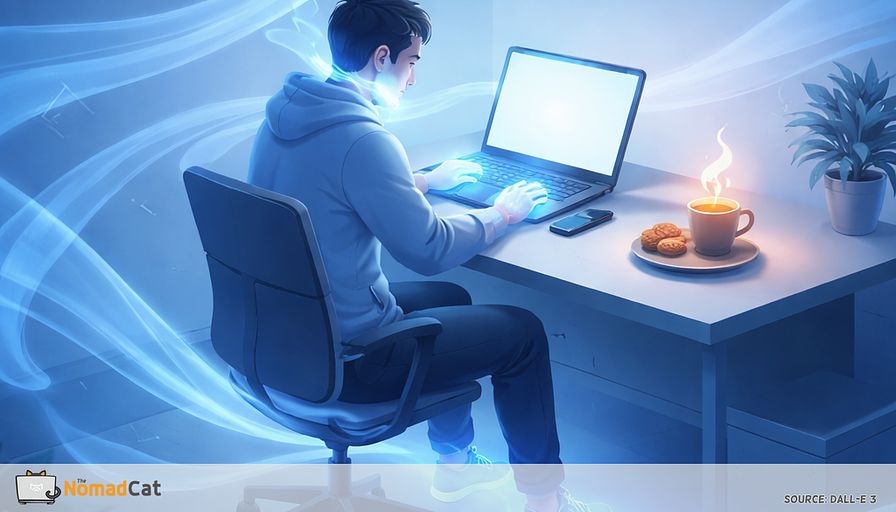
The day is normal until it isn’t. You’re in a meeting room that’s “set to a reasonable temperature,” but the air hits your neck like a polite punishment. Hands go cold. Feet follow. You keep working anyway, because obviously. Then 15–30 minutes later, your brain starts filing urgent tickets for warm coffee, something sweet, maybe both. Not because you’re chaotic. Because your system just changed inputs.
If your days are screens, meetings, desk lunches, and you keep telling yourself you’ll move “later”, this will sound familiar.
This article is here to name that pattern so it stops feeling like a willpower problem. I’ve done this across offices in Beijing, then Berlin, and now Lisbon: same setpoint, different drafts. When you’re stuck still for hours and the microclimate around your desk is slightly off, food can become the fastest way to buy warmth and focus. That’s the thermostat problem. And yes, the thermostat on the wall can be telling the truth while your body is still uncomfortable.
What you’ll get here is practical and low-drama:
- How to spot cold desk cravings and separate them from actual hunger
- Why the setpoint lies and how drafts, cold surfaces, and under-desk airflow do most of the damage
- The predictable loop between cold, the 14:00–15:00 dip, and “edible heat” like sweet coffee
- A simple 3-day thermal debug that fits inside real meetings (no calorie spreadsheets)
- Small fixes that don’t require arguing with facilities or turning your desk into a sauna
- When it’s probably not temperature and other causes deserve the blame instead
The goal isn’t to become a person with perfect habits. It’s to notice the loop early enough that you can change state with a 2–5 minute warm-up, before you’re standing in the kitchen line telling yourself, again, that you’re “snacking for no reason.”
When the thermostat becomes a snack trigger
The day looks normal until it doesn’t
This usually isn’t a dramatic freeze. It’s the slow mismatch between sitting still and a bad microclimate: a diffuser aimed a little wrong, cold air pooling under the desk, a chair near glass that steals heat quietly.
If that pattern feels familiar, it helps to name it so you can spot it faster next time. This is the thermostat problem at desk level. It’s a mismatch between stillness and microclimate, not a discipline failure. It’s also the moment you think, “Seriously? I’m doing this again,” and miss the simpler explanation: your body is asking for comfort, not a personality rewrite. Comfort standards like ASHRAE 55 make a boring but useful point: “air temperature” alone doesn’t predict comfort when drafts and cold surfaces are involved.
Before blaming temperature for everything, do a quick check to separate cold-comfort urges from actual hunger. Call it cold desk cravings. It often has a predictable signature.
- The urge shows up abruptly after getting cold or sitting still
- You want warm and often sweet or caffeinated things
- Hands or feet feel cold even if the room seems fine
- Snacking doesn’t really land and you still feel unsatisfied
- It happens even when meals were normal
- The urge drops quickly if you warm up, even before you eat
Often, true under-fueling looks different. It tends to build with time gaps, high activity, or intentional restriction. It feels more global and less tied to one room. Cold-driven comfort seeking is more like a step function. You enter the cold room, you stop moving, your fingers cool down, and suddenly warm carbs look like a very good idea.
The promise here is simple. No new nutrition system required. Treat temperature like an input variable, run a short debug, and see if the cravings reduce without “cookie patches”.
Why the thermostat reading lies
What you feel is not the setpoint
A thermostat measures air in some polite spot on the wall. You are not sitting there. Air movement alone can make a “reasonable” number feel sharp, especially on the neck and around the ankles. Quick self-check:
- If your neck feels cold but your torso is fine, look for a vent that aims slightly wrong
- If your shins feel cold, check for under-desk airflow you forgot existed
Even without a draft, the room can feel cold if the surfaces around you are cold. This is the window-seat problem. The air might be ok, but the glass or outside wall pulls heat from you. Think of cold surfaces as a silent heat sink. So yes, seat location can matter more than the building setpoint.
Then there is the classic split where your head is fine and your feet are freezing. Buildings can have vertical temperature gradients. In real offices, under-desk zones get punished by supply air, leaky facades, and cold air settling. Hands and feet also get a heavy vote in overall comfort, which is why cold fingers can derail the whole afternoon.
This is also why the “some people are always cold” debate never ends. Individual variability is normal. The practical way out is local control and small tweaks. Layers, moving away from the window, blocking the under-desk draft. Not arguing about the “correct” temperature.
Cold chair plus tired brain is a predictable loop
Sitting quietly changes the whole heat budget
Sitting produces less heat than moving. Obvious, but it matters more now because desk days removed the tiny transitions. Fewer hallway walks. Fewer accidental stands. The same room can feel fine at 10:00 and unpleasant at 10:30 once you’ve been still.
The 14:00 dip is real, and cold makes it louder
Right around 14:00–15:00, a lot of people hit a circadian low point. It can show up even when meals are controlled. So no, it’s not always “you ate pasta.”
Cold doesn’t create that dip. It can amplify it. You now have 2 channels of friction at once:
- sleepiness
- discomfort
When the system wants relief, it will pick the fastest levers available at a desk. Food and caffeine are one click away.
Why sweet coffee feels like heat
Edible heat is the quick patch where a warm, sweet, caffeinated drink gives comfort and stimulation in one move. It’s not irrational. It’s efficient. Many people find caffeine improves vigilance, especially when the task is monotonous and the room is not helping.
The problem is not the first dose. It’s the loop that can follow:
- Cold or the 14:00–15:00 dip shows up, and coffee plus sugar looks like the shortest path to functioning
- Relief happens fast, which teaches your brain this is a good button to press
- Later, another low point arrives, and if caffeine is wearing off, re-dosing starts to feel “necessary”
Late caffeine can keep the loop running
If cold is what starts the loop, caffeine is often what keeps it running. Late-day caffeine can protect the afternoon and then borrow from sleep. Timing and individual sensitivity matter a lot.
Sleep loss also tends to make next-day snack urgency louder for a lot of people. This is why protecting sleep is often the highest-leverage way to reduce “snack emergency” feelings. Not because you failed. Because the system is now biased toward quick relief.
Temperature is not the only driver. Stress, visible snack cues, and highly palatable foods can overpower hunger signals even in a perfectly comfortable room. Meal composition matters too. Temperature doesn’t replace any of that. It just explains why some days the same snack shelf feels 10x louder.
A 3 day thermal debug that fits inside meetings
The 10 second check when the urge hits
Run this only when the snack or coffee urge feels urgent, like “now or i will lose my mind on this spreadsheet”. Keep it event-based. Memory is a creative writer.
Two binary questions are enough:
- Am I cold right now yes or no
- Would something warm fix 30% of this yes or no
Tags that explain the cold not the food
If you want the data to be useful, add 2–3 context tags that explain why you were cold. I treat it like logs: tag the vent, the room, the time, then move on with your day. Pick a few:
- Vent on neck
- Under desk draft
- Window seat or cold wall
- Fan on
- Meeting room
- Hands cold or feet cold
- Long focus block 60+ min
No calorie counting. No “what did i eat”. The goal is not to become a part-time nutrition spreadsheet. It’s to catch a pattern you can actually act on.
What counts as a win after 3 days
Success here is boring. That’s good. Over 3 days, look for reduced urgency and less autopilot, especially in the 13:00–16:00 window:
- Fewer urgent snack moments even if you still snack
- Fewer reflex coffees just to feel normal
- Less irritability around 14:00–15:00
- When you do eat or drink, it feels deliberate
Try to keep meals the same during the test. Otherwise you change 5 variables and learn nothing.
How to read the pattern without overfitting
If most urges cluster with cold yes or prefer warm yes, the thermostat problem is probably real. If urges happen when you’re neutral or warm, temperature is less likely the main driver.
A simple rule that stays falsifiable:
- If cold clusters with urges then warm-up first
- Else look at fuel, sleep, stress, cues
Stacks are where good intentions go to die. A classic stack is cold meeting room + monotonous task right in the circadian low + snacks in view. Nothing wrong with you. Just too many inputs pushing the same direction.
Also keep one boring possibility on the table. You were simply under-fueled, and sweaters don’t fix that. A minimal test is to add planned calories for 24–72 hours without changing the room and see if urgency drops.
Warmth before food
The 2 to 5 minute warmth step
When the urge hits, add a speed bump. If you feel the reflex snack or coffee impulse, try 1 warmth move for 2–5 minutes, then reassess. This is diagnostic, not moral.
Warm drink options that keep warmth and stimulation separate:
- Hot water
- Herbal tea
- Broth
If drinks are not available, clothing and local warming work surprisingly well, especially if they are ready before the craving is online. Keep 1 desk layer within reach and put it on at the first chill, not 30 minutes later when snack brain is already making plans. High-leverage zones tend to be wrists, ankles, feet, and the neck if drafts hit the collar.
If your crash is predictable, it can be easier to preload warmth rather than react at 15:00. Add warmth about 60 minutes before your usual window. A warm drink, an extra layer, or just moving away from the vent or cold wall.
Do it without breaking office rules
Desk heaters and heating pads are often restricted. The safety logic is boring but real. In many cases, non-device options are simply easier and create less drama.
Most of the time, you can reduce cold sensation by changing airflow exposure, not by changing the building setpoint:
- Sit away from direct vent flow, especially if it hits neck or shins
- In meeting rooms, avoid the seat under the diffuser if you can
- If you hot-desk, do a 10-second scan for windows and exterior walls before you settle
If relocation is limited, local warming on hands, feet, and neck is the next best lever:
- Warmer socks that actually block airflow
- Closed shoes instead of office slippers
- Wrist coverage long sleeves
- Light scarf if drafts hit the collar zone
- Fingerless gloves if your workplace culture allows it
- A non-electric blanket on the lap for under-desk cold
One guardrail matters. If fatigue is persistent, heavy, or new, temperature is not a satisfying explanation. Sleep debt, under-fueling, and medical issues can sit under the same symptom.
When it is not the thermostat
Red flags that are not an office problem
Weeks of heavy fatigue, a new drop in function, or systemic symptoms should not be explained away as “my meeting room is cold.” Unintentional weight loss, fever or night sweats, or shortness of breath or chest symptoms are signals to take seriously.
Sleep and caffeine can dominate the whole graph
If sleep is regularly short or fragmented, cravings and crashes are sadly logical, even in a perfectly comfortable room. Late-night work makes every other knob harder to tune. Caffeine can become the patch that creates the next bug:
- late caffeine → worse sleep → next-day cravings
Under-fueling is a different failure mode
Under-fueling and restrictive dieting deserve their own branch. In a real energy deficit, cold sensitivity and stronger hunger can show up together. If warmth reduces discomfort but hunger stays pushy, it’s worth treating “am i simply not eating enough” as a serious hypothesis.
The goal is neutral comfort not max heat
Avoid overcorrecting into a desk sauna. Too cold is distracting. Too warm can make you sleepier, especially for monotonous work. The target is boring on purpose:
- neutral
- acceptable
Keep the loop not the guilt
The loop is usually repeatable. Cold microclimate plus low movement creates a need signal. The desk brain selects edible heat. Relief shows up. Then a later dip or sleep tax appears, and the loop becomes a habit.
The win is noticing it early enough that a 2–5 minute warm-up can change the state before food becomes the only button left. Treat temperature as one input in the system. Not a story that explains everything. And definitely not a character flaw.
If your desk days are long, meetings stack, and movement gets postponed until “later,” it makes sense that cravings show up like support tickets. Sometimes it’s not hunger. It’s a cold microclimate plus low movement, and your brain reaches for the fastest fix, edible heat.
The useful shift is treating temperature as an input, not a personality flaw. Run the 10-second check when the urge hits. If “am i cold” is a quiet yes, try warmth first for 2–5 minutes. A layer, warmer socks, moving away from the vent, or a hot drink can change the state fast. Then decide about food on purpose, not on autopilot.
And if warmth doesn’t move the needle, good: it points you toward sleep, fuel, stress, or snack cues instead of guessing. Most of the time, the “snack emergency” is a comfort bug, not a character flaw.
You might be interested by these articles:


Your 15:30 snack urge is usually a boredom bug not hunger

Why your inbox makes you snack and how to break the loop

When stress turns lunch into a 16:30 invoice

The 90 second gap after calls that sends you to the fridge

Ambient sugar is why your afternoon feels underfueled anyway

Quantum Computing Adoption Challenges

Boost startup agility with R for real-time data processing