Abstract:
The article explains why end-of-day stretching feels like an immediate fix for desk-related stiffness—neck and shoulders “glued,” a belt-tight low back, heavy legs that suddenly announce themselves when you stand up—yet the same discomfort reliably returns the next day, often at predictable transition points like first steps, quick turns, or the “11:00 neck dump” after a second meeting. Its core argument is that the problem is usually not “bad flexibility” but low movement variety and prolonged “desk mode” (hours of hip flexion, low rotation, narrow reaching, near-vision focus, shallow breathing and subtle bracing), so a single heroic stretch at night acts like a fast patch (like wiping the counter while the tap is still running) rather than a config change to the inputs that keep reloading symptoms. To make progress, it proposes tracking two simple outputs—how you feel immediately after stretching versus whether stiffness remains predictably timed the next day—and running a 7-day experiment that accumulates just 60 seconds of light movement before 15:00 using “seams” (meeting ends, hitting Send, page loads) instead of reminders: briefly change hip angle, add a small torso turn, and do one longer exhale to drop bracing, with a “camera-boring” seated fallback on low-autonomy days. It also warns how people accidentally turn this into a new project (more intense stretching/rolling, making microbreaks look like fitness, overtracking, all-or-nothing thinking) and includes a practical red-flag checklist (e.g., progressive weakness/numbness, bowel/bladder changes, saddle numbness, fever/systemic illness, cancer history, significant trauma) for when to stop self-experimenting and get evaluated, alongside a personal note from a metrics-minded, physics-trained French author who has lived a late-night desk life across Beijing, Berlin, and Lisbon and even tracks sleep/HRV with a Polar H10—yet finds the least glamorous micro-movements still work best.
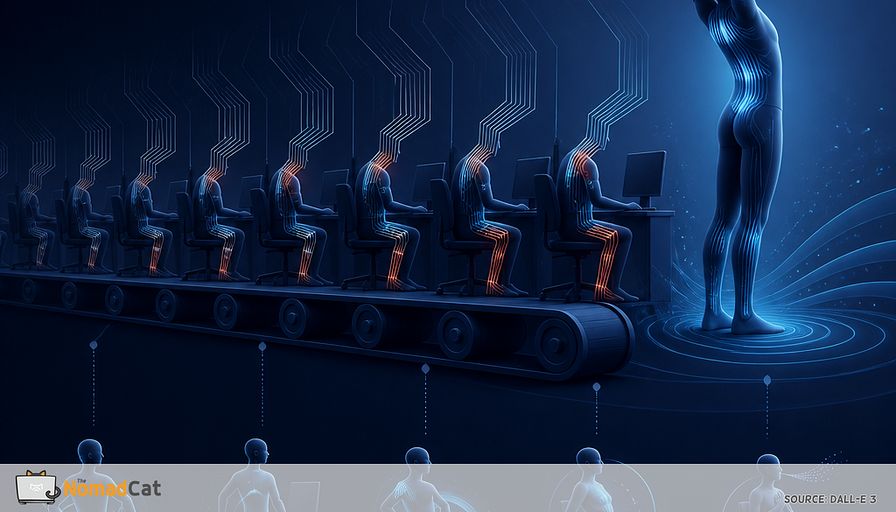
The laptop closes. You stand up. And somehow your body feels like it just paid a bill you didn’t agree to. Neck and shoulders stuck. Low back tight like a belt. Legs heavy for no good reason. Nothing dramatic happened. The day just shows up all at once when you change position.
That’s why the after-work stretch feels so convincing. It works fast. A few big moves, maybe a quick roll on the floor, and the “too tight” alarm drops immediately. Relief is real. The annoying part is the pattern. Tomorrow, the same stiffness often comes back on schedule, usually right after the 2nd meeting or the first long block of camera-on stillness.
This article is about that gap. Why end-of-day stretching can feel like the fix while the workday keeps reloading the same problem. And what tends to work better when the real issue is not “bad flexibility,” but low movement variety across a long desk day.
Here’s what will be covered.
- Why stiffness spikes at transitions like standing up, first steps, and quick turns
- What stretching changes quickly and what it usually does not touch during a 10-hour sit-heavy day
- The habit loop that makes relief beat prevention, even when prevention is the upstream lever
- A simple way to track “is this working” without turning it into a new project
- A 7-day experiment built around 60 seconds of movement before 15:00, using seams like meeting ends and page loads
- A short red-flag list for when it’s smarter to stop debugging alone and get evaluated
The point is not to shame evening stretching. Keep it if it helps. The point is to stop asking 1 late stretch to cancel 10 hours of the same inputs. Small, boring changes during the day tend to do more than heroic effort at night. And yes, that includes days where time and autonomy are basically jokes.
The stretch that feels like paying the invoice
The moment the day shows up in your body
And somehow the body feels older than it did 5 minutes ago. Neck and shoulders a bit glued, low back belt-tight, legs weirdly heavy. The funny part is that nothing new happened. Transitions just make the signal obvious.
Rewind 10 hours and the invoice was already accumulating.
How a normal desk day removes movement without asking
It’s rarely “bad flexibility.” It’s exposure. A desk day removes movement while still looking like a clean calendar.
- Meetings stack and you stay camera-on still
- Breaks start to feel optional, like a luxury item
- Lunch happens at the desk because just 1 more thing
- Being visibly away can feel risky, so you stay available
- After lunch comes low energy, stiff neck, tight shoulders, that familiar low back tightness
A bit of guilt shows up too. Like this should be avoidable. But desk-related neck and back symptoms often stick around or keep coming back, which makes the whole loop extra annoying.
So the evening stretch wins for a simple reason. It works fast.
Why the after-work stretch always wins
You log off. You do the big couch stretch, the hamstring pull, the chest opener. Maybe a few minutes on a foam roller if it’s around. It feels great. Not magical, just immediate.
After work is the easiest slot. It’s private, convenient, and nobody needs to approve it. And stretching often changes how a position feels quickly, so the sensation shifts fast. Like hitting refresh on a browser tab.
Then tomorrow arrives. The same stiffness shows up again right on schedule.
Relief is real and still not the fix
What stretching changes fast
Stretching tends to quiet what is loudest in the moment. The “too tight” alarm drops. The position feels less threatening. Breathing settles, shoulders come down, the face stops doing that grim concentrated thing.
That relief is real. Quick range-of-motion changes are often more about increased tolerance than actual tissue length changes, which is exactly why it feels like proof.
And then you feed the system the same inputs the next day.
What stays untouched during the workday
A long stretch at 22:30 doesn’t automatically change the next 10-hour desk day.
You still get long hip flexion, low rotation, narrow reaching. You still get “precision-mode” bracing under mental load. The subtle jaw clench, shallow breathing, low-level muscle activation that never fully turns off.
When the day has low variation and few interruptions, discomfort tends to accumulate. When posture and movement keep changing, it usually doesn’t build the same way.
A clean analogy is wiping the kitchen counter while the tap is still running.
Patch versus config change
A nightly stretch can be a patch. It clears the error message without changing the code path that triggers it.
Increasing movement variety during the day is closer to a config change. Active microbreaks are simply more consistent for shifting exposure than a single end-of-day state change.
A personal note, because this is not abstract: I’m a metrics-minded, physics-trained french guy who has spent most of adult life at a desk. I can forget to eat, drink, or move. And still, the most useful change is the least glamorous one: tiny variation, earlier.
A practical test is to look for logs, not vibes.
Two outputs that tell the truth
Track 2 separate outputs.
- Immediate effect
- Do you feel better right after stretching
- Predictability
- Does the same stiffness show up tomorrow at the same time
If the second one never changes, the inputs are still winning even if the first improves.
Keep it transition-based. Transitions are where signals spike.
- First steps getting out of bed
- A neck dump at 11:00 after the 2nd meeting
- End-of-day discomfort ratings
The habit wins because feedback is rigged
Relief beats prevention on timing. Evening stretching happens when the brain is finally off duty and discomfort is loud. Relief lands fast, so the system tags the stretch as the solution. Movement variety during the day pays later, and delayed rewards get discounted, even when they are the real upstream fix.
Work also makes movement feel expensive. At home, nobody watches. No meeting gets derailed. At work, movement can feel like a small social risk, a visible break in “being on.” So it gets pushed into personal time, even when personal time is already thin.
When the effect fades, intensity creeps in
The stretch feels great until it doesn’t feel as great. So people go longer, deeper, harder. Or add more tools.
That impulse makes sense. If the lever worked yesterday, pull it harder today. The catch is that quick effects often fade within minutes to under an hour. Aggressive stretching or rolling can add soreness or irritation without changing the desk-day monotony that reloads the problem.
This is learning, not a character flaw
This isn’t stupidity or lack of discipline. It’s a normal habit loop.
Cue. Behavior. Relief. Repeat.
Remove the moral layer and it becomes… debugging. Not “why am i like this,” but “what signal is my system responding to.”
Desk stiffness is mostly a mode problem
Getting stuck in desk mode
Desk stiffness is often less “my muscles are permanently short” and more “my system is stuck in one state.”
A long day trains a narrow set of positions and demands.
- Lots of sitting
- Low rotation
- Not much stepping
- Constant near-vision
- Subtle bracing that comes with focus
You get efficient at desk mode. Then normal life shows up and switching becomes expensive.
That quiet tightness that builds until it forces you to move is a pretty normal output of low variation. Load keeps concentrating in the same places. The system stays lightly switched on.
Why the signal spikes at transitions
It also explains why stiffness doesn’t feel dramatic while you’re sitting, then hits when you change state.
Standing up. First steps after a long call. Reaching fast for a bag. Turning the head to check something behind you.
Transitions create peaks in coordination and load. After hours in one configuration, the ramp is steep. The start-up feels rough.
Often the problem is not sitting in isolation. It’s the abrupt switch demanded immediately after sitting.
The useful implication for a busy schedule
The win condition becomes more configurations across the day, not more intensity at night.
Brief, light microbreaks are often the most consistently helpful input for desk discomfort. And you can test it with your own logs: if the 11:00 neck dump stays on schedule, you’re still running long unbroken blocks.
Keep the evening stretch if it helps. Let it be comfort. Just don’t ask it to do the whole job.
A quick two-bucket sanity check
Bucket A
A common exposure pattern looks like this.
Symptoms peak after work, then soften after a few minutes of walking or gentle movement. They fade by morning or after 10–30 steps.
That pattern is often reversible and variable.
Bucket B
Experimenting should pause.
- If things keep worsening instead of fluctuating
- If pain is severe and unrelenting
- If you are woken at night by severe pain that does not settle
- If symptoms progressively spread
- If there are clear neurologic changes like new weakness or numbness
This is less panic and more “this deserves evaluation.”
A small red-flag list worth remembering
Not a diagnosis list. Just a stop-debugging-alone list.
- History of cancer
- Significant trauma or high fracture risk
- Progressive, objective weakness or numbness
- New bowel or bladder changes, especially urinary retention
- Saddle numbness
- Fever or feeling systemically unwell
Night pain alone is common and not very specific. It matters more in combination.
A 7 day redirect that fits in a real calendar
Keep the stretch and change what you expect from it
Evening stretching can stay. It helps you downshift and takes the edge off fast.
Just downgrade its job. Relief is such a strong reinforcer that it’s easy to over-credit it for what is really a workday exposure problem. If your “predictability” output never moves, the upstream inputs are still the main driver.
Pick 1 success metric only. Not flexibility. Not discipline.
- End-of-day urge for a big stretch
- Or the sharpness of a specific transition spike like first steps or the 11:00 neck dump
One check. Heavy tracking dies fast.
The 60 seconds before 15:00 experiment
For 7 days, accumulate 60 total seconds of movement before 15:00. Not all at once.
Use seams instead of reminders. After hitting Send. When a meeting ends. During a page load, a build, an export. Keep it boring, almost invisible.
Here’s what it can look like in a real morning: meeting ends at 10:58. Before you click into the next tab, split stance for 15 seconds. One gentle turn each side. One long exhale. Then you sit back down and nobody noticed anything.
The menu stays tiny. Each seam is just one small configuration change.
-
Change hip angle for 10–20 seconds
- Stand in a split stance or put 1 foot slightly forward and shift weight
- If standing is not possible, slide forward on the chair or sit a bit deeper
-
Add a small torso turn
- Rotate gently left then right, like checking behind you
-
Do 1 longer exhale
- One slow exhale to drop low-level bracing
This looks too small. That’s the point. It targets what tends to work best in desk contexts.
The goal is movement variety during the day, not chasing intensity at night.
On zero-autonomy days, do the same idea seated and keep it camera-boring.
Change sit depth. Cross and uncross legs. Tiny pelvis shift. Small turn. Then 1 longer exhale.
Meetings and visibility are real barriers. The fallback matters.
Adjust the system defaults.
How this turns into a new project
The 4 predictable ways it breaks.
-
Trying to earn relief at night
- Harder stretching or more aggressive rolling can add soreness without touching upstream exposure
-
Making microbreaks look like fitness
- If it looks theatrical, it triggers permission friction and impression management
-
Tracking everything
- Dashboards, reminders, streaks, checklists add logging load and choice overload
-
All-or-nothing thinking
- Missing 1 seam doesn’t ruin the day
- 20 seconds still counts as uptime
- Relief at night is fine while the small upstream inputs are what change tomorrow
Evening stretching isn’t the villain. It’s just a fast patch for a system that’s been running the same input for 10 hours. That’s why the “too tight” alarm drops right away, yet the stiffness often returns on schedule when the day is built from long, unbroken blocks.
The bigger lever is movement variety during the day. Not more intensity at night, but small configuration changes upstream. A 60-second total before 15:00, tucked into seams like meeting ends and page loads, can be enough to change exposure without turning it into a new project.
Keep tracking simple. Immediate relief is nice. Predictability is the real log.
And if symptoms escalate, spread, or come with clear red flags, stop debugging alone and get evaluated.
The first transition that spikes is usually the one you can change with the smallest seam.
You might be interested by these articles:


Your hips are booting up after sitting fix the first 60 seconds

Your 18:00 stiffness is a config bug fix it with micro-variability

Your watch logged the workout but your shoulders still filed a bug report at 18:00

Your feet are shrinking under the desk and your 18:00 steps notice

The 18:30 waistband invoice after back to back calls

Why one-line messages get results in tech

Smart Farming with Robot-Integrated Precision Agriculture