Abstract:
The article explains a common, quietly accumulating desk-day pattern where end-of-work bloating and low-back pressure suddenly become noticeable around “18:30,” framed as the body delivering a “late-day invoice” after hours of back-to-back calls, desk lunch, and performative stillness on camera that suppresses internal signals until attention drops. Instead of treating it like a personal flaw or chasing perfect posture, it suggests “debugging the exposure”: notice early “log files” like subtle belly-bracing, shallow high breathing, jaw/shoulder tension, untouched water, tucked feet, and the big relief-sigh when a call ends, then use simple boundary-based “seams” (send, hang up, kettle on, page loads) to interrupt sameness. The practical fix is intentionally unglamorous and optics-safe—often a short walk beats stretching because it changes hip angle, rotation, breathing rhythm, and the stillness loop at once, and a repeatable 30-second seam move (shift one hip angle, do one long quiet exhale without a bigger inhale, add tiny pelvic rocks or weight shifts) done 3–6 times a day can shrink the “invoice” without turning into core work, posture policing, or a late rescue. A metrics-minded anecdote warns against over-instrumenting the experiment (turning it into a research project with wearables), recommending a single 0–10 bloating rating at 19:00 and then stopping, while emphasizing clear red flags—blood in stool, weight loss, worsening pain, fever, vomiting, severe constipation, obstruction signs, anemia/family history risks, or new bowel/bladder or saddle/leg neurological changes—where you should abandon self-experiments and seek medical care.
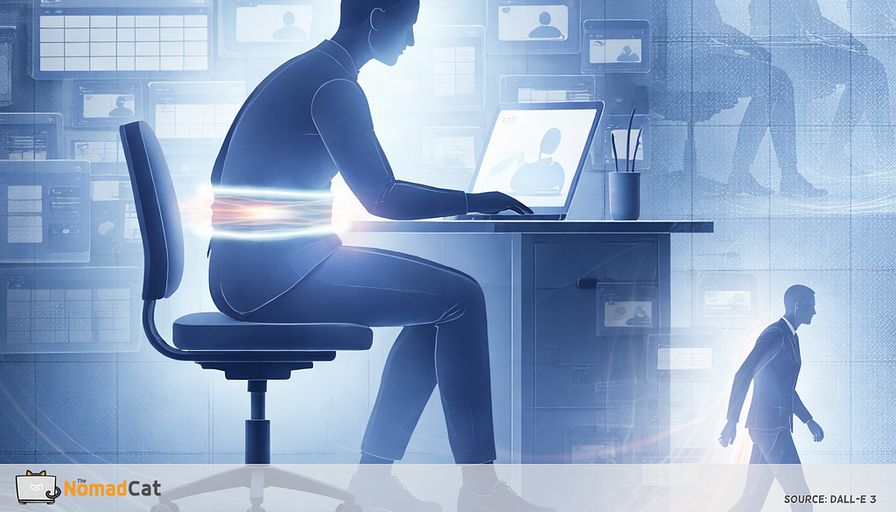
At 18:30 the calendar says “normal day.” Your body disagrees.
You stand up after back-to-back calls, lunch at the desk, maybe 1 too many “quick” edits, and suddenly the waistband is negotiating. The lower belly feels squashed. The low back adds a bit of pressure. Nothing dramatic, just annoyingly consistent. And because nobody pauses a meeting to announce their jeans are filing a complaint, it stays private. So it starts to feel… normal.
This article is for that specific, boring pattern. More like debugging a desk-shaped setup that builds quietly, then shows up when attention drops and the work boundary hits.
Here’s what will be covered, in plain terms that fit a meeting-heavy day.
- A simple mental model for why symptoms can “appear” after work even if the inputs were stacking up all day
- Early signals to notice before the waistband moment, so it’s not always a late rescue mission
- A plausible pressure and posture explanation that does not require perfect posture or a standing desk budget
- Why a short walk often beats stretching, because it changes multiple variables with zero planning
- A 30-second “seam” move you can use at natural boundaries like send, hang up, kettle on
- When to stop running experiments and get checked, including clear red flags
The goal is not to become a posture person, or to add another system to manage. It is to make the invoice smaller with small, repeatable changes that survive real workdays. Debug the exposure, not your identity.
The late day body invoice
The 18:30 waistband moment
The timing is annoyingly consistent. Noon is ok. Sometimes even 15:00 feels normal. Then somewhere between 17:30 and 20:00, bloating and low-back pressure shows up. Which is rude, because your body acts like it worked overtime on a day you barely moved. Relief often comes from boring things like standing to refill water, a short walk on an audio-only call, or moving around the kitchen.
It also hides well. Nobody pauses a meeting to announce their jeans are negotiating. So you keep sitting still, and the pattern stays private and therefore “normal.” A helpful way to look at it is that the invoice arrives when the load drops. Once attention releases, signals become harder to ignore. And long sitting bouts are a normal part of desk work, and hard to break up.
Why it stays invisible on a workday
The invoice effect when the boundary hits
Use the invoice effect as a mental model. During heavy focus, the brain prioritizes task signals and pushes down background stuff, including internal sensations. So the system can look stable while the warnings just do not surface. Then a boundary happens. A call ends, the laptop closes, dinner starts, and the queued alerts arrive at once.
Remote work adds another layer: camera-on with senior people (or clients) makes “still and agreeable” feel like part of the job, even when your body wants to move.
Camera on means performative stillness
This is a pattern explanation, not a diagnosis tool.
In camera-on meetings, many people slide into performative attentiveness. That often means less fidgeting, fewer posture changes, fewer micro-pauses to stand. Self-view can work like a mirror and make you monitor yourself more. There is also the constant effort of looking engaged. Even without perfect movement data comparing camera-on vs camera-off, the setup makes extra stillness likely. And static sitting loads the body.
Debug the exposure not your identity
Late-day bloating or pressure can have many drivers. Meals, hydration, constipation patterns, reflux, stress, sleep, plus medical causes. The point here is narrower and more boring. A very common desk-shaped exposure can stack up quietly, then become noticeable when attention drops.
Treat it like debugging.
- “What conditions existed for 8 hours” is often more useful than “what is wrong with me.”
- If symptoms are new, severe, progressive, or come with red flags, skip experiments and get checked.
Next are the early log files, the small signals that show up before 18:30.
The early log files
Signals before the waistband does
If you want something more objective than “my jeans are hostile,” look for signs of a no-break day. The early signs are often not pain. More like quiet bracing that passes as normal work face.
- Belly held in while reading, writing, or waiting to speak
- Breathing that stays high and shallow, with barely any movement down low
- Jaw lightly tense, teeth almost touching for no reason
- Shoulders creeping up while the cursor moves 2 millimeters
- The big sigh that feels like the first breath of the day
- A weird relief when the call ends, like the body was on hold
Also watch simple proxies that your day lost its seams.
- At 16:00 the water glass is untouched
- Feet tucked under the chair like a nervous bird
- Pelvis feels glued to the seat
- No twist, reach, or stand for 90+ minutes, yet the calendar says productive
That last one is how step counts drop when life gets tight. Remote work can delete the incidental steps that used to happen by accident.
1 privacy-safe self-check is to notice what happens when evaluation is in the air. Unmuting, sending a message, reading a tense thread. Tiny actions, but they often carry an “I’m being assessed” charge. The body answers with tension before the mind labels it as stress.
A plausible pressure model for desk days
Sitting is a shape you repeat
Sitting is not just “not exercising.” It is hours in the same hip angle, often with the pelvis tucked under a bit, and the low abdomen held in a fairly constant position. Duration matters, but sameness is often the bigger variable.
When the container stays in one shape, the inside gets fewer natural nudges to move along. So “nothing happened” can slowly become “something feels stuck.” Changing position changes pelvic tilt and which muscles stay “on”—mechanically, that part is not controversial.
Remote work can amplify this by removing incidental movement. Many people never fully got their old baseline back once the commute disappeared.
Quiet bracing and smaller pressure cycles
Breathing is not a performance here. It is part of how pressure normally shifts in the trunk, and desk work can flatten that shift.
Quiet bracing is low-level tightening during attention and evaluation.
- belly slightly held in
- ribs barely moving
- trunk “on” while the legs do nothing
Shallower breathing means smaller pressure changes, which can add to that end-of-day “worked but didn’t move” feeling. This is a plausibility model, not a proven Zoom-day mechanism.
1 common overcorrection is doing big deep breaths to “fix” it. If it turns into hyperventilation, you can get lightheaded or tingly. And for some people, more breathing effort can mean more air swallowing and more bloat. If breathing drills make things worse, drop them. In real life, the fastest reboot is usually boring movement.
Why a short walk works better than stretching
Walking changes 4 variables at once
Walking is a multi-input change with almost zero thinking required.
- opens the hip angle
- adds gentle trunk rotation
- brings back rhythm from steps and breathing
- breaks the performative stillness loop
That also explains the timing. Symptoms can feel like they appear after work, but attention load is a good suspect for why they were simply less noticeable earlier. A short walk at the boundary is a fast A/B test.
- If 5 minutes of walking noticeably changes the compressed feeling, posture, bracing, and static sitting were probably contributing.
- If nothing changes, other drivers may be louder that day.
And yes, meals, reflux timing, and normal within-day GI swings are real. So not every 18:30 moment is the chair’s fault.
If you only do 1 thing: 5 minutes of walking at the first boundary after work.
The 30-second seam that de-compresses the abdomen
A seam-based patch, not posture correction
This is not “sit straight” advice. It is a seam-based patch you run at boundaries that already exist. Information-only advice rarely survives a real calendar. Cues do.
Use seams like these. No timers. No habit app.
- you hit Send
- you leave a call
- a page loads
- the kettle starts
- you stand up to plug in the laptop
The goal is boring. More position changes per hour around the pelvis and lower abdomen.
Step 1 change one hip angle
While seated, slide 1 foot a little forward, even 10 to 20 cm. Or if standing, put 1 foot slightly ahead like a tiny split stance. Subtle and optics-safe.
Target is different shape, not better shape.
Step 2 1 long quiet exhale
Do 1 longer, quiet exhale, without taking a bigger inhale first. Think “let the air leave,” not “pull more air in.” Stop if you get lightheaded, tingly, or notice air gulping.
Less effort is the lever.
Step 3 micro-motion, not a stretch
Add 2 small pelvic rocks, or a gentle side-to-side weight shift. Millimeters. If it looks like exercise, it’s too big.
What working looks like
Success is just a smaller invoice, not perfection.
- waistband pressure eases faster after work
- evening bloat feels less sharp, not necessarily gone
- a short 5-minute walk starts feeling helpful again
If you like numbers, keep it simple. A single 0 to 10 rating at 19:00 for “bloating or distension” is enough. If it needs a spreadsheet, it usually dies by Wednesday.
A tiny A/B test that fits a meeting-heavy day
Use the seam move 3 to 6 times on one meeting-heavy day. Compare it to a normal day where you forget it. Track 1 rating, then stop.
A note from someone who tends to over-measure
With a physics background and a very metrics-friendly brain, it’s easy to over-instrument everything. There’s a Polar H10, a Decathlon watch, and suddenly a 30-second seam becomes a research program—especially after years at desks in Beijing and Berlin, and now Lisbon. My wife (trainer/nutritionist) calls it out faster than my metrics do. Keeping the test small is the whole trick.
The 3 ways this gets accidentally worse
Failure mode 1 turning it into core work
If it becomes effort, you lost. The seam dies the moment it turns into “engage the core.” If you feel more bracing, it’s the opposite of the goal.
Failure mode 2 using it only as a late rescue
Doing it only once the waistband is already negotiating at 18:30 is like restarting a laptop after it crashed and took the document with it. Better is small repetition at seams, so compression does not fully build.
Failure mode 3 posture overcorrection
Trying to “sit straight” for 3 minutes usually turns into posture policing, fatigue, then giving up. There is no single perfect position. Configuration matters, and variability matters more.
When to stop debugging and get checked
GI alarm features that are not a desk pattern
The seam trick is for mild, repeatable, end-of-day compression patterns. Not for anything that escalates, persists, or comes with alarm features. This part is here to reduce uncertainty, not to make you catastrophize a normal desk pattern.
Get medical advice if you have things like
- Blood in stool or black, tarry stools
- Unexplained weight loss
- Persistent or worsening abdominal pain, especially if it wakes you at night
- Fever with GI symptoms
- Persistent vomiting or inability to keep fluids down
Obstruction style clusters need urgent care
If there is no stool and no gas, plus marked distension and vomiting, treat it as urgent. Not an end-of-day bloat experiment.
Low back plus bowel or bladder changes
Mild low-back pressure that lifts after a walk can fit the desk compression story. But any new bowel or bladder control change is a different category and needs urgent assessment.
Urgent signs include
- New trouble starting urination or urinary retention
- New urinary incontinence
- Bowel incontinence
- Numbness in the saddle area
- Progressive leg weakness or numbness, especially on both sides
Most people who recognize the 18:30 waistband pattern probably have something reversible and very unglamorous going on. Lots of sitting, lots of stillness, a bit of bracing, plus normal GI variability. The skill is keeping the experiment small, and knowing when to stop being clever and hand it to a clinician.
If your day is 10 hours of calls, desk lunch, and “one last edit,” the 18:30 waistband negotiation is not a personality flaw. It is often just delayed feedback. The inputs stack quietly. Long sitting bouts, performative stillness, shallow breathing, tiny bracing, then the moment work ends the invoice finally prints.
The useful part is how unglamorous the fix can be. Don’t become a posture person. Add seams. A 30-second hip-angle change, 1 long quiet exhale, a few millimeters of motion, repeated 3 to 6 times, plus a short walk when you can, is a real test that fits a packed calendar. Track 1 simple 0 to 10 check at 19:00, then stop.
And keep the escape hatch. New, severe, or progressive symptoms, or red flags, mean drop experiments and get checked.
Usually it’s send, hang up, kettle on, page loads. The seam is already there.
You might be interested by these articles:


Your feet are shrinking under the desk and your 18:00 steps notice

The 30 second range refeed that stops the 18:10 bug report after desk days

Your hips are booting up after sitting fix the first 60 seconds

The 15 second unclench that fixes your first steps after desk days

Why your after work stretch keeps losing to your desk day inputs

Routines that spark creativity and balance work with passion

Debugging the 18:40 crash between work and movement