 Gilles Crofils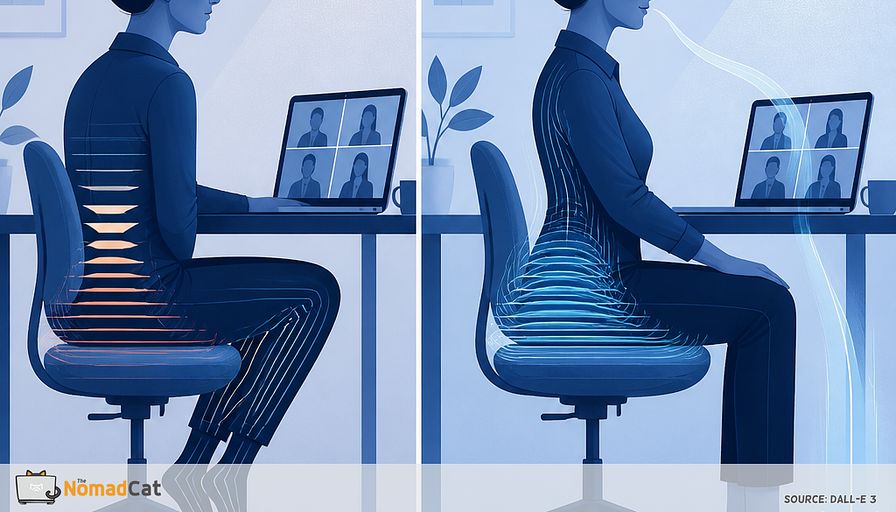
You stand up from the desk and only then notice it. Legs still. Knees maybe glued together. Feet tucked back like they were hiding. The chair did not just support you, it kind of held you. Or you held it.
That is not a character flaw or a “bad posture” personality test. A lot of this is a normal stress reflex showing up in office clothing. Not panic. More like social evaluation and high-cost work, where being still reads as being competent. Video calls, sensitive writing, a tense Slack thread, a live screen share where silence feels loud. Nothing is “wrong,” but the system quietly buys stability with tension.
This article is here to name that pattern without making it dramatic, and to give you a small tool that fits inside a real calendar. Not another program. Not a posture sermon. More like a tiny state change you can run at moments that already exist.
What you will get, specifically
- A clear explanation of the chair-gripping reflex and why it shows up during judged-output work
- The common “locked pelvis” pattern and how it can push motion into the low back during stand-up transitions
- Quick signals you can spot without scanning yourself like a lab experiment
- A 10 to 15 second micro pause called the anchor drop, designed to be invisible on camera and easy to abort
If the desk day has been ending with that familiar invoice, low-back tightness, hip pinch, waistband pressure, weird stiffness when you finally move, this is a practical way to debug the input upstream. Small, low-friction, and aimed at the seam where the body switches modes from don’t-move to move-now.
The chair gripping reflex at work
A desk trigger, not a body flaw
You finally unhook from the desk and stand up, and only then notice you were basically clamped to the chair, like a laptop stuck in low‑power mode. That quiet clamping is often a reflex. The body tries to stay steady when the stakes feel real, not because you are built wrong.
A big driver is social evaluation. Not danger. Just the sense that someone, or future someone, will judge the output. Stress research calls this social-evaluative threat (Dickerson & Kemeny, 2004), meaning: your body reacts a bit like you’re being graded, which is why you can tense up even when you’re physically safe.
Work moments that flip it on
The reflex shows up in boring, normal work situations where being still reads as being competent.
- Deadline mode with no slack
- A performance review paragraph or board-deck slide where every word can be misread
- Negotiation in chat where response time feels like status
- Camera-on calls and self-view
- Live screen-share or demo where silence feels loud
A simple way to catch it is to check right after a high-cost task. You hit send, close the tab, and only then notice your legs have not moved for 20 minutes.
This is different from generic sitting. Sitting is the exposure. Bracing is the amplifier.
Ergonomics guidance is consistent on 1 thing. Long static postures are the risky part, and chasing a rigid “correct posture” is not the goal.
What the body is stabilizing when nobody is looking
Stability purchased with tension
Under pressure, the system buys stability with tension. Most people recognize the obvious versions, jaw clenched, shoulders up, hand welded to the mouse. The same logic can slide downward, especially during long seated focus when the chair already gives the pelvis a lot of contact and compression.
There is also this annoying desk feature. The harder the thinking gets, the quieter the movement gets.
The locked pelvis pattern
A common non-clinical pattern during desk focus can look like this.
- Lower belly quietly drawing in
- Pelvic floor holding without awareness
- Inner thighs doing a small amount of work, knees staying close
- Glutes relatively offline
- Breath getting smaller, more chest than belly
None of this needs to be dramatic to matter. Low-level co-contraction (multiple muscles quietly tensing at once) can increase trunk stiffness. Helpful in the short term, but it changes how load and movement are shared.
Then you stand up. If the pelvis stays a bit guarded, the low back may borrow motion to get the job done.
Memory hook. If the pelvis stays braced, the low back often becomes the flexible spare part during transitions.
Why more holding is not always the answer
Pelvic health guidance is pretty clear that conservative management can include awareness, relaxation, and coordination, not only strengthening, especially when overactivity is part of the picture. In desk terms: sometimes the issue is not “weak,” it is “stuck on.”
That does not mean every desk worker is “overactive.” It just supports a useful point.
Always holding more is a questionable default. A better log file is whether the system can both engage and let go when the task changes.
Quick log files you can spot without thinking too hard
Under the desk signals
Do not scan your body like a lab experiment. Look at your base of support. When the system wants stability, the under-desk footprint often gets smaller and more locked in.
- Feet tucked back under the chair instead of planted
- Legs tightly crossed, or ankles hooked around chair legs
- Knees drifting inward, thighs quietly squeezing
- Perching on the chair edge like you are about to stand, but never standing
- Pressing down into the seat, as if the chair needs to be convinced
These are normal focus positions. They also match how desk days actually work.
Breath tells during precision work
A useful proxy for bracing is the breath getting smaller. Not dramatic. More like upper chest doing everything and the exhale never quite finishes.
It can show up as tiny breath-holds while typing a careful message. Research linking stress and respiration patterns supports that breathing often shifts under load (Boiten et al., 1994; Grassmann et al., 2016), which matters here because a smaller, “held” breath often travels with a more held trunk.
The stand-up seam
Standing is a fast mode switch. The system has to go from stabilize and don’t move to move and carry weight in about 2 seconds.
Common tells right after sitting include an immediate low-back arch to feel upright, the belly still feeling switched on, or a front-hip pinch that feels more like compression than stretch.
Often it is not damage. It is just a transition demand arriving faster than the holding pattern can shut off.
Why the invoice shows up after work
Focus hides signals until the seam. When the task is high-stakes or evaluative, output gets priority and internal noise gets turned down.
Then the task ends and the bug reports appear.
- hitting send
- leaving a meeting
- export finished
- laptop close
- standing up to pee
Microbreak evidence suggests short, frequent breaks can reduce discomfort without wrecking performance (Wendsche & Lohmann-Haislah, 2017). The occupational health logic is blunt. Reduce exposure during the exposure, not only after.
Reality check. Desk professionals get paid to ignore basic signals. Stillness reads as competence. There is a line in that mode between “focused” and “basically disconnected.”
People sit through hunger, thirst, and weird foot numbness because they are in judged-output mode and the body is not the KPI. The invoice just shows up later, usually at the seam.
The author can work a full day without eating, drinking, or moving, and knows now that is not a superpower. It is learned work mode after years at a desk in Beijing, Berlin, and now Lisbon. It also got worse on workations across Europe on bad chairs and worse desks, because the input got messier while the stakes stayed the same.
Reminder systems also fail for a simple reason. People habituate. The pop-up becomes wallpaper. And honestly, most of us click it away like it is spam.
The anchor drop micro pause
What it is
It’s a quick downshift: you let go of extra bracing before you stand, so hips and low back do not pay later. Think of it like a state change, not a shape you must hold.
Use it only at seams that already exist
No timers. No new system to manage. Run it only at seams that already happen anyway.
- after hitting send on a tense message
- when a meeting ends
- when a build export finishes
- right before standing up for water or the bathroom
Event-based cues tend to survive real calendars better than frequent prompts. They also avoid notification wallpaper.
Keep it invisible and abortable
Optics-safe. No dramatic breathing. No visible posture performance on camera.
Abortable. If it cannot be interrupted instantly mid-sentence, it is too expensive.
The 10 to 15 second sequence
1) Ungrip the seat
Let both sit bones feel heavier and a bit wider. Stop the quiet perch. Often just changing pressure distribution is enough to reduce low-grade gripping.
2) 1 long quiet exhale
No big inhale first. Let the lower belly soften on the exhale for about 2 seconds.
3) Tiny heel pressure shift
Gently load heels for about 1 second, then release. Almost nothing. Just reminding the system it has a base so the pelvis does not need to do security work.
Optional if knees are always clamped. Let the knees drift about 2 cm apart for 1 breath, then return. Treat it like an A/B test, not a universal fix.
A boring 7 day A B test
Pick 1 transition metric
Desk discomfort is slippery if the metric is a vibe tracked all day. Better signal is a small output measured at a seam.
Pick 1 and score it at the same transition each workday.
- Steps to normal after the 1st stand after a long block
- Hip pinch on 1st stand at around 18:30, yes or no
- Waistband or low-back pressure at 18:30 on 0–10
Run the anchor drop at 2 seams per day
Do the anchor drop at 2 reliable seams per day for 7 workdays. Not more.
If it becomes “whenever you remember,” it becomes a personality test, not a test.
If you miss a day, do not make it up. That just smears the signal.
Read it like a systems person
If there is no change after 7 days, that is still data. Either the micro-tool is not the limiting factor, or the chosen metric is too noisy.
If it helps on high-stakes days but not calm ones, that suggests it is targeting stress bracing, not generic sitting.
If things get worse, or symptoms do not match the desk pattern at all, stop tinkering.
Guardrails
Mistake 1 is turning the anchor drop into performative breathing. Big inhale, dramatic sigh, breath hold, then anxiety about doing it “right.” Extra monitoring can amplify odd breathing patterns.
Mistake 2 is swapping one brace for another, replacing grip the chair with sit straight forever. Ergonomics guidance stays boring on this. Static loading is the problem, not failing a posture exam.
Mistake 3 is saving it for evening. Stretching can feel great, like clearing logs after an incident, but it does not change the upstream input.
When to stop self experimenting
Desk tweaks are for desk patterns. If the signal stops looking like a desk pattern, I’d stop tinkering and get it checked.
Red flags include
- Progressive numbness or weakness
- Saddle-area sensory changes
- New bowel or bladder changes
- Severe pain rapidly worsening or not settling with rest
- Fever, unexplained weight loss, or feeling systemically unwell with back pain
If symptoms are not linked to desk exposure and transitions, or trend worse over weeks, that is usually a sign this is no longer a simple desk debug. Debugging works when the bug is reproducible.
If your desk day ends with that familiar invoice, stiff low back, hip pinch, waistband pressure, or the weird robot steps after you stand, it is not automatically a “posture problem.” Often it is a work reflex. Being still reads as competent, so the system buys stability with tension, especially during judged-output moments like camera-on calls, sensitive writing, and tense chat threads.
The useful part is you do not need a new program to debug it. Watch the signals under the desk. Smaller breath. Feet tucked back. Knees quietly glued. Then use the seam. The anchor drop is 10 to 15 seconds at moments that already exist, so it survives real calendars. Run the boring 7 day A/B test with 1 transition metric and treat the result like data, not identity.
Seams are where this whole thing becomes visible: the send button, the meeting end, the 1st stand after a long block.


