Abstract:
The article explains a common “stand-up glitch” many desk workers get after long, high-pressure days—where you look fine on camera but, when you finally stand, your body feels like it’s running a bad boot sequence: a front-of-hip pinch, short first steps, and the low back “volunteering” to push off until things normalize 10–30 steps later. Its core message is that it’s not just sitting time that matters but “sitting state”: deadlines, camera-on focus, and precision work can quietly keep you in a low-level brace (tight jaw, shallow/held breathing, belly braced), making the trunk stiff and hips “parked” in flexion so stretching gives only a brief “refund” before the same problem returns. Instead of a big posture overhaul, it proposes a small A/B-testable fix: use jaw and breathing as subtle state markers (teeth touching, the big post-email sigh), then run a 15-second “unclench-to-stand” patch right before standing—teeth slightly apart, one quietly longer exhale without a bigger inhale, feel feet contact with a tiny shift, then stand and take two slightly longer steps—triggered at natural “seams” like hitting Send or leaving a meeting. To see if it works without turning life into a dashboard, it suggests a deliberately boring 7-day debug with one quick metric (e.g., steps to normal, hip pinch yes/no), notes common failure modes like turning it into deep breathing or effortful posture, and emphasizes safety boundaries and red-flag symptoms that should override desk hacks.
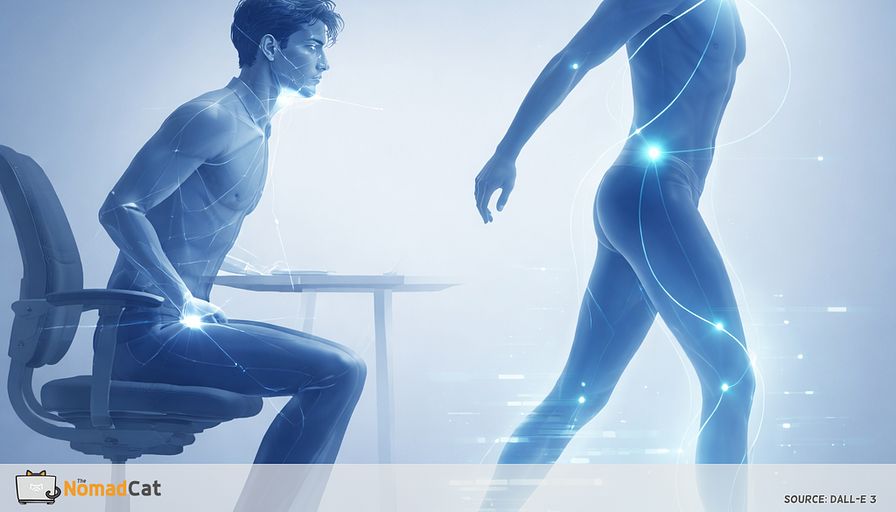
You know the setup. Chair, screen, camera angle, meetings stacked like bad Tetris. Lunch at the desk. Work quietly leaking into the evening. On video you look fine, because of course you do.
Then you stand up, and your body files a complaint.
It is not always dramatic pain. More like a weird boot sequence. A front-of-hip pinch. Short steps. The low back doing the push-off because the hips feel late to the meeting. And after 10 to 30 steps, things often behave again, like nothing happened. Which is maybe the most annoying part.
This article is for that specific glitch. Not the posture morality story, not a 45-minute program, not a new personality. The point is simpler. On high-pressure desk days, the body can sit in a low-level brace without you noticing, and that state can matter as much as sitting time. So stretching gives a quick refund, then the same invoice shows up tomorrow.
What you will get here is a small, testable patch you can run right before standing, plus a way to log what is happening without turning your notes app into a dashboard.
We will cover
- why deadlines and camera-on focus can flip the stabilize switch even in the same chair
- why hip stiffness often shows up after the work is done, not during it
- why stretching helps briefly but does not always change the pattern
- 2 quiet signals to spot bracing early, using jaw and breathing as simple state markers
- a 15-second unclench-to-stand sequence and a boring 7-day debug to see if it actually helps
If you are skeptical of coaching vibes, good. Treat this like an A/B test. Keep the claims small. Keep the experiment smaller. The goal is just fewer glitchy first steps, not a perfect body or a new hobby.
For context: I’ve done the same laptop-and-meetings thing across Beijing, Berlin, and now Lisbon. Different cities, same camera-on intensity, same weird first steps after.
The stand up glitch
It shows up after the work is done
The work ends, your nervous system doesn’t.
Then you stand up and that is when the complaint arrives.
Under cognitive load and time pressure, people often carry extra non-task muscle activity without noticing it. And in some office-worker research, work stress and people stuff line up with pain reports surprisingly well—sometimes better than hours-sat. So this is not automatically a chair morality story.
The first steps feel like a bad boot sequence
You stand and get a front-of-hip pinch, like the joint is blocked. Stride is short. The low back does the push-off because the hip feels late to the meeting. Sometimes it is not even painful, just stiff and uncooperative.
For many people it normalizes within the first 10 to 30 steps. If hip extension is limited or delayed, the system often borrows motion from the pelvis and low back during sit-to-stand and early walking. Think boot sequence, not diagnosis.
Why stretching feels like a refund that expires
The usual fix is stretching. You get a small refund, then the same invoice shows up tomorrow.
Stretching can improve range of motion short term, but it does not always change first-step stiffness or sit-to-stand discomfort in a reliable way. A lot of the quick change is probably nervous system tolerance, not instant tissue change.
Instead of adding a bigger program, it helps to ask what changes on high-stakes days. Same chair, same hours, different state.
Pressure makes you brace
Deadlines flip the stabilize switch
The glitch often shows up more on days with evaluation pressure and precision work, even if the chair and schedule are identical. Conflict email. Deadline writing. Spreadsheet accuracy. Camera-on listening. Quick edits before sending.
Mental load and time pressure can increase background muscle activation and reduce real rest time. You’re pushing hard and not getting relief is the plain version.
Sitting time is not the same as sitting state
2 hours of relaxed work can look like shoulders down and small movements. 2 hours of do not mess this up work can look like jaw tight, breath shallow, almost no micro-rest. Same sitting time, different body bill.
This is not posture religion. Prolonged sitting can create small, reversible range-of-motion changes. But stress often tracks pain more reliably than sitting duration alone.
A small A B test right before you stand
The promise here is modest. A tiny downshift placed right before standing, so the first steps start from a less braced system.
Treat it like an A/B test, not a belief system. Some studies on microbreaks in computer work show small comfort gains without performance loss, but results vary.
The jaw to pelvis map
Jaw holds that spread everywhere
During long focus, desk micro holds often show up at the face first. You might only notice on release that your teeth were lightly touching or lips were pressed. Not dramatic, just constant enough to feel normal.
This does not prove a straight line from jaw to hip. But it works as a state marker. Teeth apart is a decent switch because jaw muscle activity is higher with tooth contact and drops closer to baseline when teeth are apart. Tongue position is less clear, so it deserves less confidence.
Jaw-related behaviors can show up alongside broader pain patterns, not just the face. But the jaw posture story is not clean either. So keep claims small. Use the jaw as an indicator that you are in stabilize mode. It’s not a big thing, but it adds up, really.
Breath holding stiffens the trunk
The desk pattern is usually small breaths, cut-short exhales, then one big sigh after the email is sent. That sigh is a clue.
A slightly longer exhale can shift state within seconds, so a short downshift can happen without a 10-minute protocol.
Bracing and breath holding also increase trunk stiffness. Great when you need stability, like lifting. Annoying when it runs while you scroll.
If that stiffness stays on for 90 minutes, the next transition asks for hip extension fast, with no warm-up reps. A simple chain often fits what people report.
- trunk stays braced and ribs and pelvis move less
- hips stay parked in flexion with fewer tiny returns toward extension
- when standing, the system borrows extension elsewhere, often pelvic tilt and low back extension
Evidence is pretty solid that breathing patterns and bracing change trunk stiffness and coordination. What is scarce are direct experiments that tweak jaw or breathing patterns and then measure hip mechanics in the first steps. So treat it as a working hypothesis.
Log files before you stand up
Signals you can catch without a mirror
Treat it like reading logs. One signal is noisy. A cluster is useful.
- jaw noticed only when it releases
- big sigh right after sending
- belly held in during focus
- worse after camera-on meetings
- stretch helps briefly, then returns
If it flips fast with context, that leans state more than tissue. Guarding can change tolerance and perceived range quickly.
2 meeting safe probes
No one notices.
- Are your teeth touching right now
- On the next exhale, can it be 20% longer without a bigger inhale
Do not force big breaths. Deep breathing can backfire for people prone to hyperventilation-type symptoms, so keep it small. Teeth apart is the cleaner cue anyway.
The unclench to stand patch
The 15 second patch
If you want to test it, try it right before standing.
- Teeth apart by 1 to 2 mm. Lips soft. Do not force tongue position.
- 1 quiet longer exhale. No big inhale. Let ribs drop a little. Keep it subtle, especially if bigger breaths make you lightheaded or buzzy.
- Feet find the floor. Heel and ball contact. Tiny left-right shift, just enough to make contact clearer. Not theater.
- Stand and test 2 steps. Take 2 slightly longer steps. Not a lunge. Just a bit more normal stride on purpose.
If the first 10 to 30 steps normalize faster, you found a lever. If not, log it and move on.
Where it fits in a messy desk day
Use seam triggers, not timers.
- right after clicking Send
- when a meeting ends, before Leave
- before standing for water or bathroom
- after closing a tab cluster
If then plans tend to work better than vague intentions in messy real life.
If you are about to stand, then teeth apart plus 1 quiet longer exhale.
Think of it like adding idle time to a CPU so it does not throttle later. Sustained low-level activation with poor rest gaps has been linked to later pain in work muscle-activity research, but the exact dose-and-response is messy.
A 7 day debug that stays boring
Pick 1 metric
If you’re going to track anything, track just 1 thing for 7 days. Under 5 seconds to observe.
- Steps to normal after standing
- Low back volunteers in the first 60 seconds yes or no
- Front of hip pinch on first steps yes or no
Daily measures need to be simple or they die fast.
What counts as a win
A win is not zero discomfort. It is fewer glitchy first steps, or faster normalization, on average across the week.
If the number drops in a way you actually notice in real life, that’s a win.
Keep the log tiny
- checkbox seam done yes or no
- value 1 steps to normal or rating 0 to 10
No spreadsheet. If the log starts to look like a dashboard, it becomes the problem.
Failure modes
When it turns into deep breathing
Common fail is bigger and bigger breaths. Correction.
- exhale a bit longer without a bigger inhale
Overbreathing can trigger dizziness or panic-like symptoms because CO2 drops.
When posture becomes effort
If the fix adds effort, it is probably reinstalling the original bug. Soften, do not stack.
When nothing changes anyway
If nothing moves after 7 days with correct timing, check basic confounders.
- seat height extreme low or high
- an acute flare week
- high fear or guarding overwhelming small cues
- a real mobility limitation needing a different lever
A quick mechanics control is a slightly higher chair for 1 day and re-test. Sit-to-stand mechanics are sensitive to seat height.
When to stop debugging
Red flags beat desk hacks
If these show up, skip experiments and get checked.
- progressive weakness
- persistent numbness or tingling
- bowel or bladder changes
- major trauma
- unexplained fever or weight loss
- severe unrelenting pain
Keep it boring and safe
This piece is for common desk-day stiffness and the sit-to-stand glitch, not for diagnosing discs or anything dramatic. If symptoms escalate, or the weekly trend is not improving, the rules change.
If the first steps feel sharp, catching, or unstable, skip the 2 longer steps part and just stand normally. The patch should feel easier, not like a dare.
If jaw cueing turns into a side quest, get proper evaluation if there is locking, bite changes, tooth pain, persistent jaw or temple pain, or painful clicking with catching. Avoid aggressive jaw stretches or DIY mouthguards. Keep cues light, reversible, and optional.
The core idea is fewer minutes per hour in that braced state, not forced looseness. If the cue increases anxiety, makes breathing feel weird, or ramps up symptoms, drop it.
If your day is chair, screen, camera-on, and lunch next to the keyboard, the weird part is how fine you can look while your body quietly braces in the background. Then you stand up and get the boot-sequence steps. Hip pinch, short stride, low back volunteering for the job, and 10 to 30 steps later everything acts normal again. Rude.
The key takeaway is that sitting time is not the full story. Sitting state matters. Deadlines and evaluation pressure can keep the jaw tight and the breath small, which can keep the trunk stiff and the hips parked until the moment you need them.
So keep the fix boring. Use the 15-second unclench-to-stand patch, and run the 7-day debug with 1 simple metric. High-pressure days don’t just add hours. They change the state you stand up from.
You might be interested by these articles:


Your feet are shrinking under the desk and your 18:00 steps notice

The 20 second desk handshake that stops pain from showing up after you log off

Your posture is not broken your attention is running the brace

Why desk pain hits right after you stop working

The 30 second range refeed that stops the 18:10 bug report after desk days

Navigating Indoors: How Augmented Reality is Revolutionizing Your Experience

Thriving in Europe's diverse markets with localized BI strategies