
Abstract:
The article explains why “18:30” after a long desk day often triggers a predictable “dinner choice collapse,” where hunger suddenly spikes, the body feels stiff and overworked, and dinner stops being a real decision and becomes whatever the lowest-friction default is—typically a delivery app reorder driven by glossy photos, ranked lists, bundles, and pre-selected add-ons. It argues this isn’t a willpower or character flaw but a system-under-load problem caused by a day of micro-decisions, constant context switching, and delayed body signals, leaving evening-you with too little bandwidth to weigh tradeoffs; in that state, “reorder” becomes the opt-out default your past self installed. The piece reframes dinner as “tomorrow’s energy budget” that can affect sleep and next-day appetite/caffeine dependence, then proposes “configuration not discipline” fixes: pre-commit before decompression (a quick “shutdown commit” when the last meeting ends), keep weekdays intentionally boring with just Default A/Default B, and rely on low-effort fallback meals built around a protein anchor and fiber anchor that take ~15 minutes (e.g., yogurt/cottage cheese bowls, microwave grains with beans and bagged salad, eggs/tofu with frozen veg, rotisserie chicken with microwave carbs and pre-cut veg). To stop apps from winning by default, it recommends adding “digital friction” (remove apps from the home screen, log out, disable promos, delete tempting favorites, even rename the folder “18:30 autopilot”), and using a small “bridge snack” if dinner is far off—eaten sitting down with no screens for five minutes—so urgent hunger doesn’t hijack the evening, reflecting the author’s candid note that when he works past midnight, his tired brain becomes especially easy for apps to hack.
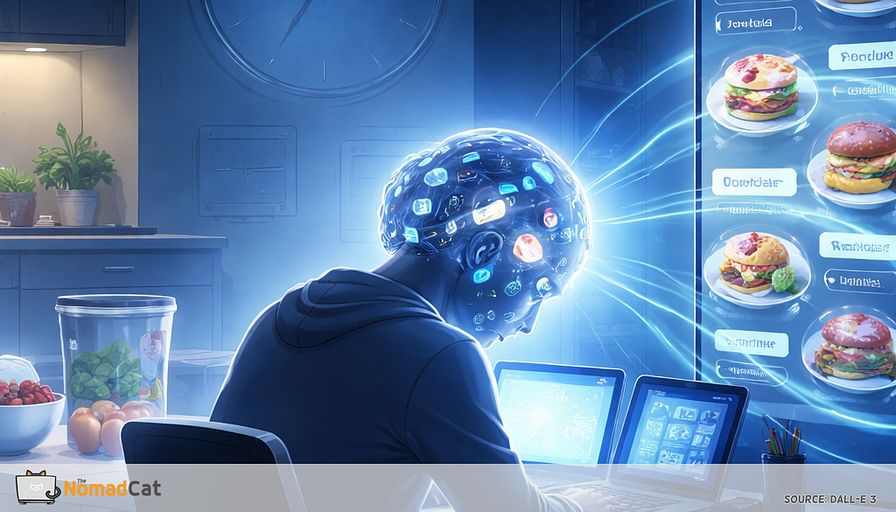
18:30 is a weird hour.
The last meeting ends, the room goes quiet, and suddenly the body files 12 bug reports at once. Neck stiff. Shoulders up. Lower back slightly angry. Slack still open in a tab because of course it is. Hunger was basically silent all day, then it shows up like a notification you can’t mute.
And dinner stops being a decision. It becomes a default.
If that sounds familiar, this article is here for two things: name what’s happening, and help you install a few simple defaults so the app does not end up choosing for you when your brain is out of bandwidth. Not perfect eating. Not hero discipline. Just fewer evenings that feel like autopilot you did not approve.
What will be covered, in plain terms
- What the 18:30 choice collapse looks like and why it feels so annoying
- Why desk work breaks decision quality through micro-decisions, context switching, and delayed hunger
- How delivery apps win late in the day using frictionless reorders, ranked lists, photos, and bundles
- Why dinner is less “one last thing” and more tomorrow’s energy budget
- How to choose a default before 18:30 chooses for you, using low-effort fallbacks, a quick shutdown commit, and a small bridge snack when needed
The framing here is simple. This is not a character issue. It is a system under load. Your brain has been running hot since 9:00, and at 18:30 it starts making everything feel harder than it should. The goal is to tweak the setup so dinner requires fewer decisions right when decision-making is at its worst. Small changes count. Especially on weekdays.
The 18:30 choice collapse
What it looks like at 18:30
At 18:30, dinner often stops being a decision and becomes a default. Not because you don’t care, but because choosing feels like work.
- Scrolling delivery apps just to look
- Reordering the usual without thinking
- Standing at the counter eating from the bag
- Snacking while deciding, then ordering anyway
- Adding sides because they are pre-selected
- Eating with phone in hand, not noticing much
When attention is low, people simplify. Defaults get accepted because opting out costs effort. Desk life adds a twist because the default is often whatever has the lowest friction at 18:30.
This is not the same as the 15:00 crash where caffeine enters the chat. This is later. Decision quality tends to drop the longer you have been awake, and sleep restriction makes it worse. The food environment also gets more persuasive right when work constraints lift.
A useful framing is not willpower. It is a system under load. Slack triage and meeting pivots are not nothing even if you were seated for 10 hours.
A quick signal checklist
The signals cluster because they point to the same bottleneck.
- Opening the app, closing it, reopening it
- Switching between 3 places, choosing none
- Searching healthy then sorting by popular
- Adding items, deleting, rebuilding the cart
- Reordering because reading feels like work
- Eating snacks while deciding what to eat
- Feeling annoyed by having to pick at all
That annoyance is data. Not moral data, just logs.
Why desk work breaks dinner decisions
Micro decisions and context switching
A desk day is not 1 big decision. It is hundreds of tiny ones. Tabs, tickets, pings, calendar reshuffles, wording edits, quick replies, the 3rd re-prioritization of the same task. Each choice is small, but the pile-up trains speed over nuance.
By evening, tolerance for tradeoffs is gone. Under cognitive load, people lean more on what feels good right now. Food apps are built for that state.
- Big glossy photos
- Popular tags
- Bundles that remove thinking
If someone spent the day doing high-friction thinking, that burger photo at 19:00 is speaking the brain’s tired language.
When the calendar loosens and the body shows up
Many workdays are designed to postpone basic signals. Meetings stack. Cameras stay on. Lunch becomes bites between tabs. Water becomes a thought. Then 18:30 arrives and everything deferred gets processed at once.
Hunger at 18:30 is often delayed hunger, not a sudden failure of discipline. Relief changes the meaning of food in that slot too. For some people, food is a downshift button. For others, stress kills appetite and they forget to eat until they are shaky. Both patterns are common.
Evening you is not the same decision-maker as late morning you.
Why delivery apps win when your brain is done
Infinite choice that feels like freedom
After a 10-hour desk day, an app menu can look like relief. No dishes. No planning. Just options.
The catch is that “options” quietly turns into comparing, second-guessing, and scrolling. And at 18:30, your attention is not in a generous mood. The interface is busy, you are tired, and it becomes weirdly easy to spend 12 minutes deciding and still end up with the same reorder.
The persuasion stack that decides for you
Once the menu is long enough, the interface starts doing the deciding. Ranked lists become a steering wheel.
- Recommended lists
- Popular and trending tags
- Big photos
- Bundles and combos
- Limited-time promos
- Add-ons at checkout
- Free delivery over €X thresholds
No conspiracy theory needed. It is mostly salience. Under fatigue, salience wins.
Reorder is the default you installed yourself
The strongest default in a delivery app is your past self. A 1-tap reorder is an opt-out default you created by ordering the same thing 5 times.
Reordering at 18:30 is not laziness. It is effort reduction at the exact moment your brain is running on empty.
Dinner is tomorrow’s energy budget
Dinner feels like the last small decision of the day. It is rarely small. It is closer to a scheduler that decides how tomorrow will run.
A common loop looks like this.
- Lunch gets delayed or under-sized because meetings
- 18:30 arrives with low decision bandwidth and loud hunger
- Convenience wins, often heavier, later, faster
- Sleep gets shorter or more fragmented for some people
- Next morning appetite turns weird, muted or urgent
- Coffee patches the gap
- Caffeine later in the day becomes more likely, which can reduce sleep even when taken 6 hours before bed
If you have ever started the next day slightly foggy, a bit puffy, and already behind on patience, this is one boring reason why.
Sleep restriction also tends to push intake upward in lab studies. Late or heavy meals are not automatically a sleep problem, but they can matter when sleep is already fragile, especially for people with reflux or discomfort.
The point is not rules. It is predictability.
Choose the default before 18:30 chooses for you
Pre-commit beats planning
A default dinner is not meal prep and it is not a new personality. It is a low-decision fallback you can repeat without thinking too hard.
Think circuit breaker, not perfect architecture.
The key is when the decision happens. Choosing at shutdown is usually easier than choosing after decompression turns into screens and snacking.
- If the last meeting ends, then dinner is decided
- If the laptop lid goes down, then the fallback is already selected
To know if it works, watch outcomes that are not weight-based.
- Less app opening, closing, reopening
- Less snack-while-deciding then still ordering
- More dinner is done and eaten within 10 minutes of shutdown
- Less next-morning coffee urgency that feels like emergency IT
What a good default dinner looks like
A reliable default dinner has simple design specs. This is not perfect science; it is just what tends to keep evenings stable when decision bandwidth is low.
-
Protein anchor because higher-protein dinners often keep you full longer
-
Fiber anchor because fiber tends to make the “still hungry” loop less intense
- Low-friction assembly because a plan that takes 45 minutes is not a default
A practical heuristic for many adults is 25–40 g protein at dinner. Not a law, just a range that often makes the evening more stable.
Meals that usually fit the ≤15 minutes active requirement:
- Greek yogurt or cottage cheese plus berries plus oats or high-fiber cereal plus nuts
- Microwave grain pack plus canned beans or lentils plus bagged salad plus olive oil or salsa
- Eggs or tofu scramble plus frozen veg mix plus wholegrain toast
- Rotisserie chicken or smoked fish plus microwave potatoes or rice plus pre-cut veg plus sauce
Some nights will still be delivery. Fine. The point is on-call, not purity.
Small anti collapse tactics that feel like config, not discipline
Make weekdays boring on purpose
Weekdays are a special environment. Tired, hungry, time-boxed, preference uncertainty high. This is when fewer options often beats flexible choice.
A simple setup is Default A and Default B. Boring is a feature when decision bandwidth is low.
Digital friction helps. Also: adjust for real life—shared household accounts, work phones you can’t modify, partners who order too, whatever. Do the version you can actually keep.
- Pin 1 acceptable reorder and delete old favorites that reliably spiral
- Remove delivery apps from the home screen
- Log out after each order so reorder is never 1 tap
- Turn off promo notifications
- Rename the folder something honest like 18:30 autopilot
- Disable saved payment for that app only if possible
Friction is usually bad when it blocks you. Here it is pro-you because it buys a few seconds for the do i actually want this process to reboot.
The 2 minute shutdown commit and the bridge snack
A practical tactic is the shutdown commit. Before closing work, decide dinner in writing or place the order while the brain is still in make decisions mode. Do it before one last email.
If dinner will be 45–90 minutes away, a bridge snack helps. A small boring stopgap right after arriving home reduces urgent hunger and the snack hunt. It is not glamour, but it works.
- Greek yogurt or cottage cheese plus fruit
- A bowl of soup with extra frozen veg added
- Carrots and hummus, or an apple plus a handful of nuts
A simple boundary helps it stay a bridge.
- Eat it sitting down
- No screens for 5 minutes
Distracted eating tends to increase intake in the moment and later. Screens erase the i ate memory so the system keeps searching.
The author bias here is not heroic. I live in Lisbon, I often work too late, and the evening version of me is easy to hack by apps. Also, my wife is a fitness trainer and nutritionist, so I get gently reminded that “decide earlier” is not a personality trait; it is a setup. The setup is doing the damage, not some missing virtue.
If 18:30 keeps turning dinner into a default you did not choose, it is probably not a willpower problem. It is the predictable result of a long desk day full of micro-decisions, context switches, delayed hunger, and an app designed to win when attention is low. The fix is mostly configuration. Pick 1 or 2 fallback dinners that take 15 minutes, decide earlier than you think, and use a small bridge snack when the gap is too long. Add a bit of digital friction so “reorder” is not the only button left with enough energy to press.
Dinner is not just the last task. It is tomorrow’s energy budget and sometimes sleep quality too. The best default is the one you can still repeat on your worst weekday.
You might be interested by these articles:


Too many micro decisions is why 16:00 snacks get weird

Fuel debt is the hidden source of tab pinball and sharp replies

The 3 to 6 minute food commit that stops desk day grazing

Second-order hunger and the next-day crash on meeting-wall days

The 3 minute exit handshake that stops the dinner cliff after deep work

When stress turns lunch into a 16:30 invoice

Leveraging Big Data for Business Optimization




