
Abstract:
The article explains that when constipation, bloating, or a “missing urge” reliably tracks with desk-heavy workdays, the cause is often less about diet or supplements and more about what a packed calendar quietly removes: movement variety, frequent posture changes, and relaxed abdominal breathing—especially during on-camera meetings where people unconsciously “armor” their belly to look composed, leading to late-day tight-waistband feelings and sudden urgency once work pressure drops. Rather than prescribing a new protocol, it offers a practical “desk-day model” and a 5‑second “system log” check (is the belly soft or braced, is breathing flowing or held, are hips locked) plus tiny micro-movement “patches” that hide inside real work seams (after clicking Send, leaving a meeting, while a build/upload runs) to “unfold plus exhale” and restore small mechanical inputs across the day; it suggests tracking one boring signal (like waistband pressure at 19:00 or whether urge appears before 16:00) for 7–14 days to look for smaller extremes, not perfection. It also includes personal admissions about mistaking not eating/drinking/moving all day for efficiency and about the author’s bias toward over-self-debugging, and it ends with clear guardrails—red-flag symptoms (e.g., blood/black stools, weight loss, anemia, severe pain, inability to pass stool/gas, new changes after 50, family history of CRC/IBD) that should stop experiments and prompt medical assessment—plus a simple script for describing the work-linked pattern to a clinician.
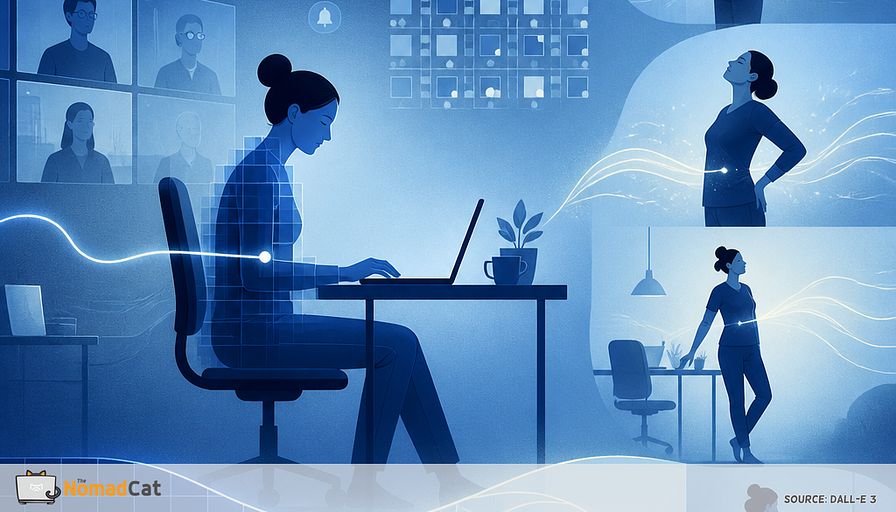
When desk focus rewires the urge
If your workday is a clean block of focus, it can look impressive on paper. Slack quiet. Tabs under control. Meetings stacked like Tetris. Then there’s one annoying detail. Your gut goes quiet until late afternoon. No urge. No warning. Just… nothing.
A lot of people go to the usual fixes. More fiber. More water. Magnesium. Another probiotic that promises a new personality. But when the pattern follows your calendar more than your grocery list, a less dramatic explanation often fits better. Desk days change the inputs in boring ways. Long sitting. Very little movement variety. Abdomen held tight during camera time. Attention glued to tasks, so internal signals get pushed down the priority list.
This article is a practical model for that situation: desk-heavy days in otherwise typical adults who notice constipation, sluggishness, or that tight waistband negotiation by 19:00. Next: the boring signature that tells you it’s the calendar.
Here’s what you’ll get, without turning it into a 2nd job
- The common signature of desk-day constipation, so it stops feeling like a character flaw
- Why food tweaks often miss the main variable when the trigger is your work structure
- A simple 5-second “system log” check for motion and bracing
- Small micro-movement patches that can hide inside real work seams, not perfect schedules
- Basic stop rules for when it stops looking like a desk pattern and needs a proper check
The point is not perfection. It’s noticing the pattern, then changing 1 or 2 low-effort inputs that your day quietly deleted. Small, boring changes. The kind that survive a packed calendar.
The workday pattern that feels oddly consistent
You are in the middle of a high-focus block. Slack is quiet. Coffee is there. Then you notice something that should be in the background log, but isn’t. There has been zero urge to go since the morning. No drama. Just missing data.
Long desk work is low-variation and long sitting. Discomfort tends to rise the longer you stay parked (Waongenngarm et al., 2020). Add attention on top. When the brain is busy with external tasks, awareness of internal signals can drop (Herbert et al., 2007; Pollatos & Schandry, 2004). So the urge disappearing can be an attention and exposure effect. Not a moral failure. Not automatically a medical crisis.
If it keeps showing up the same way, check if the timing is also weirdly consistent across your week.
Quick tells that it’s the calendar, not your character
Desk-day constipation often has a boring signature.
- No urge most of the workday, then sudden urgency later
- Smaller, harder stools on workdays compared to off days
- Feeling compressed after long meeting blocks
- Belly feels tight by the end of the day, waistband starts negotiating
- Weekends, errand days, or travel days look more normal
- The moment work pressure drops, signals suddenly come back online
Bowel frequency has a wide normal range. The point isn’t daily or you failed. It’s the pattern match across days.
What this article is and is not
This is about desk-heavy days in otherwise typical adults who notice constipation, sluggishness, or distension that tracks with work structure. It’s not an IBS guide. It’s not a supplement list. It’s not a diet protocol.
Also, the evidence is uneven. Many microbreak studies don’t even measure gut outcomes. Still, it’s possible to eat well and still get desk-day constipation because the missing inputs can be mechanical and attention-related.
There’s also a guardrail section later. Because self-debugging has limits.
Food tweaks feel logical but miss the main variable
The debugging mistake most desk workers make
The default troubleshooting tree is predictable. More fiber. More water. Magnesium. Probiotics. Then maybe cutting dairy, then gluten, then joy. But if the problem keeps snapping back to workdays, it starts to look like a debugging mistake. We keep tuning small knobs while ignoring the input that actually changed.
The missing piece is usually boring. Tiny motion inputs and pressure shifts that used to happen without you noticing.
Short experiments also lie. Week to week variability is real. A 7-day test can look like progress or failure depending on sleep, stress, random meetings, or just Tuesday.
Desk days delete small motion and pressure shifts
Treat it less like a food problem and more like a distribution problem. Gut movement seems to like regular small changes across the day, not only a workout at 07:00 and then 10 hours in the same shape. Even if meals are identical, the day’s physical inputs are not.
Evidence-wise, this is not a promise. It’s a low-risk A/B test with a plausible mechanism.
A check that feels like a system log
The 5-second state check
A quick cue is the seam question. Is the belly free or armored.
On camera days, a lot of people unconsciously hold the abdomen in to look composed. If that sounds abstract, use physical proxies.
- Waistband pressure creeps up without a big meal
- Breath held on clicks, sends, or tricky messages
- Feet hooked or tucked, pelvis locked in place
- Big relief sigh when the meeting ends
These are decent proxies for 2 invisible inputs.
1 is motion variability. Desk work flattens it (Mathiassen et al., 2003): fewer small shape changes like standing up, rotating the torso, or changing hip angle.
2 is attention. When your brain is busy with meetings, internal signals like urge get deprioritized (Herbert et al., 2007; Pollatos & Schandry, 2004).
The goal isn’t perfect awareness. It’s catching the state early, before the late-day backlog shows up.
A non-alarmist model of what sitting deletes
Hip extension disappears and the abdomen stays folded
In normal life, a day includes dozens of small unfold moments. Stand to grab water. Walk 20 steps. Shift angles without thinking. Desk days remove that.
The issue isn’t “bad posture”. It’s duration. Long sitting with low variation piles up (Waongenngarm et al., 2020). On remote days, transitions vanish because everything is in the same 2-meter radius. It can be a very productive day, and still be a physically empty day in the background-maintenance sense.
A single workout can fail to touch the workday pattern. Exercise has more consistent evidence for constipation than microbreaks, but how much distribution across the day matters is still not fully clear.
Breathing gets smaller and bracing becomes the default
Meetings change breathing in a predictable way. Breaths get shorter. The chest does more work. There are little breath holds when the mic icon lights up.
That sets up a common confusion: tight waistband does not always mean more gas. Sometimes the belly looks bigger because your breathing and bracing pattern changed during a long, “be still and look normal” day—not because there’s extra volume in there (Accarino et al., 2009; Barba et al., 2015). Not a reader diagnosis. Just a reminder that shape and pressure can be control patterns, not only food outcomes.
If bracing is part of the pattern, the smallest fix is often a downshift. A longer exhale. A brief allowance for the belly to soften.
Why the signal shows up late
Deep focus makes the gut easy to ignore
This is why the signal often appears only when you stand up or a meeting ends. Attention is a limited budget. When the task is demanding, the brain filters more internal noise. In plain desk terms: your brain is spending its budget on the meeting, so the urge gets muted (Herbert et al., 2007; Pollatos & Schandry, 2004).
Workday version is simple. You do 4 hours with barely a posture change, then you get up and suddenly notice compression, gas, or the urge that was missing. It’s not always that the urge is late. Sometimes awareness is.
Camera days add stillness and pressure you did not sign up for
Video calls have an etiquette. Stillness reads competent. Fidgeting reads distracted. So people stabilize.
- Shoulders get quiet
- Abdomen gets held in a bit to look composed
- You sit “nice” instead of moving
Even if you don’t feel anxious, optics can push you there.
Stress can modulate gut movement, and effects vary a lot by person. So a meeting-heavy day can plausibly change bowel timing even if food and water are unchanged.
Put it together and the calendar link stops feeling mysterious. Long bouts of sitting plus low movement variety plus more being-watched time can push signals later. Errand days quietly restore transitions, so things look normal again.
Micro-movement patches that hide inside work seams
The unfold plus exhale patch
This is the smallest version that still changes the input. The goal isn’t stretching and isn’t core work. It’s to unfold the folded shape and drop low-grade bracing, done at an event boundary your brain already recognizes as “task ended” (Zacks et al., 2007).
Keep it quiet and boring. Think plausibility test, not proven fix. Microbreak studies do suggest brief breaks can reduce fatigue and discomfort without hurting performance (McLean et al., 2001; Kim et al., 2017).
- Stand up or scoot to the front edge of the chair
- Put 1 foot slightly forward to change the hip angle
- Do 1 longer exhale and let the belly soften
- Shift weight left to right 2–3 times while reading
Where to attach it so it survives real calendars
Timers fail for a predictable reason. They interrupt.
Seams are cheaper.
- After clicking Send
- After leaving a meeting
- After pushing a commit or starting a build
- While an upload runs
- While the kettle or microwave runs
- When a tab closes and the next one opens
- After plugging in the laptop
This is close to reliability engineering. Manual interventions work better when they trigger on known events, not random timestamps.
A small personal note, because it matters for bias. I can work a full day without eating, drinking, or moving, and I used to treat that like efficiency. Now I treat it as a missing warning signal, not a feature—how you say… not so clever.
Measurement that does not turn into a second job
Pick 1 signal and keep it boring
Pick 1 metric for 7 to 14 days. No spreadsheet tab.
- Waistband pressure at 19:00 rated 0–10
- Normal urge before 16:00 yes or no
- Evening tightness same, better, or worse
Frequency alone is blunt. A single repeatable signal beats a perfect log that gets abandoned.
Gut symptoms bounce around even when nothing important changed. Treat 7 days as a pilot. Extend to 14 if needed. If tracking makes the whole day feel medical, it’s fine to stop.
Early wins tend to look like smaller extremes. Less late-night urgency spike. Less belt argument by late afternoon. Not perfect timing every day.
Stop rules that beat stubborn debugging
When this is not just a desk-day pattern anymore
The desk model is a hypothesis, not a permission slip to self-test forever. If the pattern stops looking reversible or starts escalating, it deserves a real check.
A personal note, because it matters for bias. I can talk myself into treating weird signals like noise because I like data and systems. That is exactly when guardrails help—and also when it’s easy to avoid the appointment because you don’t want “a thing” on your record.
Stop the experiment and get assessed if any of these show up.
- Blood in stool
- Black tarry stool
- Unexplained weight loss
- Anemia symptoms or fatigue
- Fever with gut symptoms
- Persistent vomiting
- Severe or worsening pain
- Marked distension with pain
- Can’t pass stool or gas
- New change after 50
- Family history CRC or IBD
These show up across guideline-style lists. Hamilton et al. (2005) is a good reality check that blood in stool and anemia symptoms or fatigue aren’t in the wait-and-see category.
If constipation is new for you, or a clear change in your normal pattern, and it persists for about 2–3 weeks, it’s reasonable to get it assessed sooner if any red flag appears.
How to describe it without sounding like a forum thread
“This started when my workdays got more meeting-heavy and more seated.”
“It’s noticeably worse on workdays and better on weekends.”
“The urge shows up later, and stool form changed too.”
“No blood, no weight loss, no fever, no vomiting.”
If it helps, use 1 shared vocabulary term like the Bristol Stool Form Scale (Lewis & Heaton, 1997). Keep it minimal. The goal is clarity, not turning your calendar into a lab notebook.
Small fixes can be enough. And sometimes the correct fix is simply to stop guessing.
If your gut only goes quiet on desk days, that’s useful data, not a personality defect. The pattern usually isn’t your groceries. It’s what the calendar deletes: long sitting, low movement variety, and that sneaky on-camera bracing that keeps the abdomen “armored” until 17:00.
The fix doesn’t need a new protocol. A 5-second system log helps you catch belly bracing and stuck breathing early, then you patch the input with tiny seams that already exist—after Send, after a meeting, while something loads. Track 1 boring signal for 7 to 14 days and look for smaller extremes, not perfection.
If weekends fix it, your calendar is part of the mechanism.
You might be interested by these articles:


The 30 second range refeed that stops the 18:10 bug report after desk days

Your feet are shrinking under the desk and your 18:00 steps notice

Your 18:00 stiffness is a config bug fix it with micro-variability

Your remote day is missing 60-second cardio spikes

Your bladder is following your calendar on camera days

AI's Revolutionary Role in Modern Medicine

The AI Woke Police vs. The Irony Brigade: Can Robots Understand Sarcasm?




