Abstract:
The article argues that the strangest part of remote work isn’t being busy, but being busy while staying physically “stuck” for hours—same chair, stacked video calls, lunch within reach—so your mind runs hot while your legs never shift gears, creating a “metabolically flat” day. It names the missing ingredient “cardio punctuation”: the tiny 30–180 second bursts of faster breathing that used to happen automatically (hurrying because you’re late, taking stairs, carrying a bag) but get engineered out when work becomes clicks instead of transitions, even as stress still arrives via email, deadlines, and being watched on camera. Drawing on guidance that activity doesn’t need to come in 10‑minute blocks and research showing brief walking breaks can improve same-day glucose/insulin compared to uninterrupted sitting, it reframes the problem as distribution rather than totals—why you can still hit step goals or do a morning workout yet crash with a disproportionate 15:30 fog, notice “meeting breathing” after back-to-back calls, or feel oddly energized late at night once you finally move. The proposed fix is a small, testable “config change,” not a new system: use unavoidable workflow seams (the Join-button buffer, kettle/microwave time, export/build time, file sync lag) to insert discreet, no-sweat bursts like a brisk room loop, a quick stair touch, or carrying a book while pacing, guided by a talk test and stopped instantly if needed. Because movement can feel like reputational risk on camera, it suggests low-drama scripts (“camera off 60 sec, still listening”) and emphasizes flexibility for disability, pain, neurodiversity, or post-viral conditions, then recommends a one-week debug with a simple daily “flatness” rating—success measured in small wins like less fog, fewer cold-leg moments, and a calmer downshift after calls.
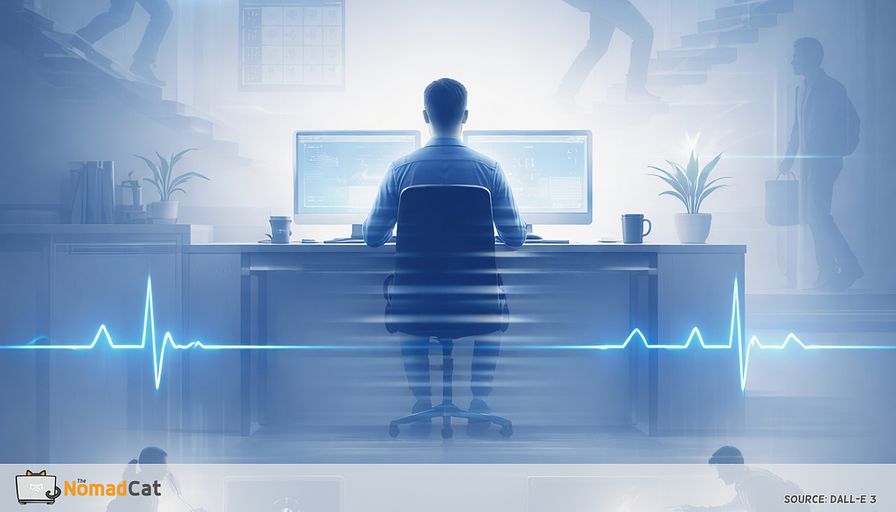
The weird part of a remote workday is not that it’s busy. It’s that it’s busy while your body stays in the same gear for hours.
A missing ingredient is often something smaller than a workout. Call it cardio punctuation: tiny 30–180 second bumps that used to happen without planning anything.
- walking fast because you’re slightly late
- stairs when the elevator is slow
- carrying a bag from the car or metro
Remote work deletes a lot of that by design. Less friction, fewer transitions, less accidental breathing harder. Stress still arrives anyway, by email and cameras and deadlines, but the movement throughput goes to near zero. Cause, effect, result. The day becomes flat.
This article stays on three things:
- what disappeared (those tiny spikes)
- where to put 30–120 second spikes back into a normal remote day
- how to do it on-camera without making it weird
Not a grand lifestyle overhaul. More like a tiny config change you can test for a week, and keep only if the logs look better.
A day without cardio punctuation
When arriving became a click
The day starts in the same chair, same screen distance. Keyboard, trackpad, coffee cooling, calendar already red. A meeting opens, then another stacks on top. Water glass is there, untouched, like a prop. Lunch happens 30 cm from the laptop. The body never really changes gear. The brain runs hot, the legs stay on standby.
After a few years of desk-heavy work (Berlin and Lisbon in my case), this is also when the “upper back is turning into stone” signal shows up, even on days that look calm on paper.
That flatness has a missing ingredient, and it is smaller than a workout. Call it cardio punctuation.
These are tiny 30–180 second breathing bumps that used to happen in a normal day. Not exercise. Just built-in variability. For example:
- walking fast because you’re slightly late
- stairs when the elevator is slow
- carrying a bag from the car or the metro
Even official guidelines moved on here. The 2018 US update and WHO 2020 no longer require activity to come in 10-minute blocks, which is a quiet way of saying small bursts still count.
Remote work is unusually good at deleting them. Efficiency removes friction. Less friction means less walking. Then stress still arrives anyway: emails, deadlines, cameras. But movement throughput does not.
Fewer transitions. Fewer intensity spikes. A kind of metabolically flat day.
This matters because sedentary time is not just “lack of exercise” in the background. The American Heart Association frames it as its own risk factor (Young et al., 2016). And even when moderate-to-vigorous activity reduces some risk, very high sitting time still shows up as its own issue in large analyses (Ekelund et al., 2016). Not a panic thing. Just a systems thing.
Gear shifting is a practice effect
Upshift and downshift need reps
Remote work adds a twist. Stress often arrives through talking and being watched, not through moving. The body is asked to perform while staying still.
Think of it like a laptop stuck in low-power mode while the CPU keeps spiking. Without small upshifts, you get fewer chances to come back down.
Breathing is one of the fast channels here. It reacts quickly to emotion and arousal (Boiten, 1998), and mental load can change it too (Wientjes, 1992). This is why you can feel wired and flat at the same time.
Camera work makes quietly braced feel normal
Video calls are a predictable trap. You might catch yourself taking shorter, more controlled breaths, sometimes holding air while someone else speaks.
Speech itself reorganizes breathing into a managed pattern (Hixon, Weismer, Hoit, 2014). Evaluative pressure is a known stressor in lab setups (Kirschbaum et al., 1993). Add the extra load of being on camera (Bailenson, 2021), and the day can become a long “don’t move, don’t look weird” stretch. This is normal human behavior, not a defect.
Small breaks still work
It is tempting to say a 60-second burst fixes everything. No. But a plain, boring model works fine. Think in logs rather than magic buttons.
What’s solid:
- When sitting is broken up with frequent brief walking bouts, same-day glucose and insulin responses improve versus uninterrupted sitting (Dunstan et al., 2012). That’s why a 60–90 second brisk loop during kettle time isn’t silly—it’s the same pattern.
- In at least 1 protocol, distributed short breaks beat a single longer session for blood sugar after meals (Peddie et al., 2013). Meaning the 15:30 fog can be less brutal even if your step count is fine.
So yes, your day can write stress logs all morning, while forgetting to write any clearance logs. Then at 18:30 you’re tired, but not calm. Somehow both.
Bugs you notice before you call it a problem
The 15:30 fog that does not match the workload
Around 15:30, the energy drop can feel disproportionate. Same projects, same inbox, same brain. Yet the body feels unplugged, like stale air in a room. It can happen even if you trained in the morning.
This is the annoying part of the “active couch potato” idea. A single workout can coexist with a very flat workday, because the missing input is often distribution, not totals (Young et al., 2016). One big entry in the morning, then 8 hours of zeros.
The post-call realization that you did not really inhale
After back-to-back calls, you mute yourself and suddenly notice you have been doing “meeting breathing” all day. Short inhale, controlled exhale, repeat. Like you were trying to be polite with your lungs.
Speech reshapes breathing (Hixon, Weismer, Hoit, 2014). Add camera-on stillness and self-monitoring pressure and it can feel cramped (Bailenson, 2021). Not dramatic. Just… a bit ridiculous, also.
The evening wake-up that arrives at the wrong time
If the first real movement of your day happens late, your system can “wake up” exactly when you want it to downshift. Cold hands, stiff hips, flat mood all afternoon. Then you finally walk around at 21:30 and suddenly you have ideas, appetite, maybe some restless legs.
Prolonged sitting can reduce leg vascular function, and light walking breaks can blunt that drop in controlled studies (Thosar et al., 2015).
If this pattern is new, severe, or comes with red-flag symptoms, get it checked. But for many desk humans, it’s just the system doing exactly what you configured.
Step goals miss the shape of the day
You can hit 8k–12k steps, or do a clean 45-minute session, and still reach 18:00 with that flat “why am i like this” feeling. The reason is often clumping.
Workout at 07:30. Then 6 hours seated with calls and Slack. Then maybe a short walk later. Total movement looks fine, but the day still contains long uninterrupted sitting. The AHA frames sitting as its own behavior, not just “no exercise” (Young et al., 2016). And device-data suggests sporadic moderate-to-vigorous activity can still “count” when total MVPA is accounted for (Saint-Maurice et al., 2018).
Work analogy: one big deploy in the morning doesn’t prevent small production errors all day, especially when you’re staring at logs for hours (and yes, this is the kind of thing that stuck with me from CTO-type weeks in Berlin). What helps is distributed monitoring and tiny corrections before the system accumulates garbage.
Still, it’s not honest to blame every 15:30 fog on missing movement. Sometimes it’s sleep debt, food timing, light, or plain stress. A quick reality check can be as dumb as rating sleepiness on something like the KSS scale, just to see if the “problem” is simply fatigue (Åkerstedt & Gillberg, 1990). This article is only adjusting one knob.
Replace the missing spikes using dead time
A seam you can’t argue with
Use dead time that already exists and can’t be negotiated away. Timers look clean on paper, then “not now” friction kills them. Better is a seam already inside the workflow.
Pick 1 or 2 seams and stick to those. The most reliable one is often the weird little gap after Zoom/Meet opens—those 20–40 seconds where you’re early, nobody’s talking yet, and you’re just… waiting to be perceived.
Other seams that work:
- export or build time
- kettle or microwave time
- waiting for a file to sync or upload
- walking to fetch water you already need
The goal is 30–120 seconds of noticeably faster breathing. No sweat. Normal clothes. You can stop instantly.
Two quick tests:
- Talk test. You can talk, but you do not want to sing.
- Sweat test. If you would worry about your shirt on camera, it was too much for a work seam.
Pick 1–2 moves only. Too many options becomes admin work, and admin work is how this dies in week 2. Think software scope creep. The fancy version ships never.
If you like data, treat it like a configuration change you can test. Change 1 input, then observe basic logs for a few days. Less 15:30 fog, fewer cold-legs moments, or just meetings that feel less braced. No grand spreadsheet needed.
Intensity without exercise examples
Stair touch
- 1 flight up and down, or 20–40 seconds of step-ups on the bottom stair while waiting to join
- use the handrail, scale pace down
- stop if red flags show up like chest pain or dizziness
Brisk loop
- walk doorframe to far room and back for 30–90 seconds at a pace that changes breathing
This is the basic sitting-break idea that works in lab protocols (Dunstan et al., 2012).
Carry plus pace
- pick up a book or water bottle and do the same loop
It’s micro-loading, not strength training. Discreet too. It looks like you are just moving something.
Slightly late simulation
- finish notes, do a 45-second brisk walk, then click Join
- if needed, camera off for the first 10 seconds to avoid the caught-breathing feeling (Bailenson, 2021)
Meeting buffers like 25/50-minute norms create this seam without changing your calendar.
Make movement reputationally safe
Moving on remote calls can feel like reputational risk. Not insecurity. Just rational incentive design plus full visibility. With camera-on, you get extra self-monitoring load, which Bailenson points at (Bailenson, 2021).
So the solution is not “be brave”. It is to reduce ambiguity.
Low-drama scripts:
- “1 min stretch, still listening.”
- “Camera off 60 sec, back soon.”
- “I’m going audio only for a minute.”
- “Quick posture change, keep going.”
If someone can’t move, or doesn’t want to, that’s fine. Space, disability, neurodiversity, caregiving, pain flare days, all real. Options and privacy beat forced sameness. A posture change, a seated shift, or just resting eyes can be the break. No explanation needed.
One-week debug with boring guardrails
Keep it 1 week and low-tech. If you want a sanity check, pick one moment late afternoon and rate the “flatness” quickly (0–10), then move on. Fog arriving 30 minutes later is a win.
If you like numbers, a chest strap like a Polar H10 (or even a basic Decathlon sport watch) makes it obvious when you hit “faster breathing, still no sweat”: heart rate bumps a bit, then drops fast when you stop.
Keep intensity submaximal using the talk test. Stop if any red flags show up: chest pain or pressure, dizziness, fainting or near-fainting, unusual shortness of breath, or symptoms that get worse. If you have a condition that makes exertion unpredictable, scale way down and keep it to gentle position changes unless a clinician has cleared more.
Remote work didn’t make you lazy. It just removed the tiny spikes that used to keep the day from going flat: the late walk, the stairs, the bag carry, the in-between movement you never scheduled.
The fix doesn’t need to be a new program. It’s often enough to add a few 30–180 second bursts back into seams that already exist: the little buffer before you click Join, kettle time, build time. A brisk loop, a stair touch, a quick carry. Fast breathing, no sweat, stop anytime. Small inputs, better logs.
Most days, the easiest seam is the 30 seconds before you click Join.
You might be interested by these articles:


Audio first gives your body permission to move on remote days

Micro-exits for remote days that keep your body from timing out

Your legs are timing out in remote work bring back the missing standing layer

Remote work made your day flat and your joints noticed

Put your meetings on legs and stop the 18:00 rib grip

The 18:00 throat scratch from camera on stillness and missing swallows

Boosting Office Morale with Mental Health Apps