Abstract:
The article argues that long remote-work days can feel surprisingly physical—tight ribs, braced shoulders, stiff neck, and a “can’t get a full breath” sensation—even when the calendar looks calm, because remote work preserved constant talking while stripping out the tiny, incidental walking that used to accompany office communication. It names this missing “transport layer” and proposes “ambulatory speech”: attaching small posture or location changes (as little as 6–20 steps) to speaking so your body isn’t forced to deliver hours of conversation in one seated, slumped shape that can mechanically limit ribcage expansion and mimic stress signals, a problem worsened by camera-on self-view (which subtly rewards freezing) and mute-button turn-taking (which can prompt breath-holding and rushed speech). Instead of adding workouts or elaborate routines, it recommends simple configuration swaps—stand for the first sentence when you’ll talk longer than half a minute, do “doorway delivery” by walking 6–12 steps away for longer explanations, pace for summaries but sit for screen-based precision, and treat muted listening as “move permission” with tiny steps or heel raises—along with socially neutral scripts (“I’m going to stand for this bit”) and a small post-meeting boundary ritual (say one closure sentence, then take 10 steps away and back) to give the body an “exit event.” The piece emphasizes keeping movement boring and gentle, trying one change for seven days with a simple 18:00 check-in on breathing or bracing, and flags red-flag symptoms (e.g., chest pain, dizziness, wheezing, rapidly worsening shortness of breath) that should bypass workplace tweaks.
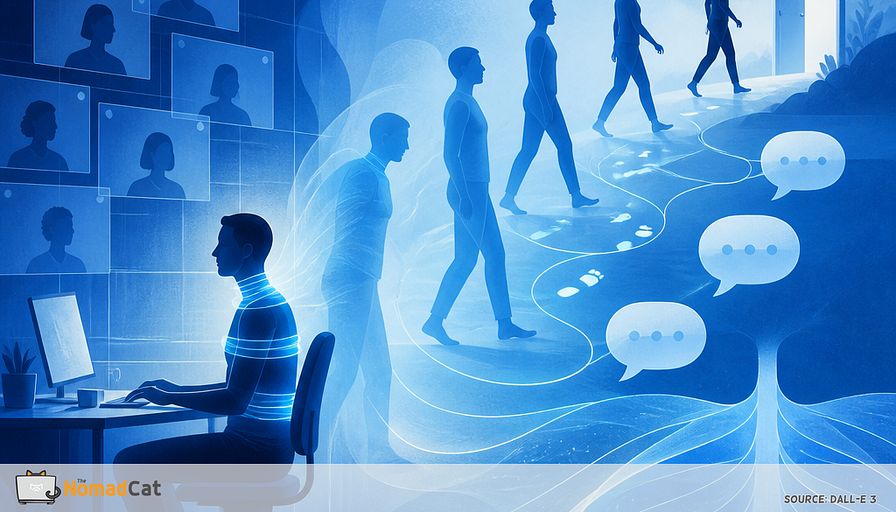
A 10-hour desk day can feel weirdly physical even when nothing “physical” happened. You finish a run of meetings and somehow end up with tight ribs, braced shoulders, a stiff neck, and that small annoyed feeling of not getting a full breath. On paper, it looks like a calm day. In the body, it logs like load.
If your days are back-to-back calls, desk lunch, and work that leaks into the evening, none of this is surprising. There is not a lot of room for extra “healthy habits.” Small changes that fit inside the day matter more than perfect plans.
I’ve done the desk thing across cities—Beijing, Berlin, now Lisbon—and the pattern is oddly consistent. The calendar can look clean, and still the upper back and rib tightness shows up like a quiet receipt at the end of the day.
This article is about a missing layer in remote work that most people never name. Office talk used to come with movement baked in. Doorway clarifications, corridor updates, walking into a meeting room while finishing a sentence. Remote work kept the talking, but quietly removed the walking.
A simple frame helps. Ambulatory speech means talking while changing posture or location, even 6 to 20 steps. Not “exercise.” Just the tiny transport layer your day used to have. When that disappears, speech gets delivered in the same seated shape for hours, and posture tends to drift the longer you stay at the computer. Video calls also reward stillness. Head in frame, shoulders quiet, self-view watching you like a little mirror that never blinks.
What you’ll get here is a practical way to put words back on legs without adding more routines to an already full calendar. We’ll cover
- why seated talking can make breathing feel smaller than it should
- how camera-on culture and mute mechanics nudge people into freezing
- 4 small swaps that reattach movement to speaking without turning meetings into a fitness project
- simple guardrails and safety notes so this stays doable, and not socially weird
The main idea is not motivation. It’s configuration. If the system keeps rewarding stillness, the fix is often to change the defaults a little, not to add another thing to “be good at.”
The missing walking layer in remote talk
Speech used to have legs
Office talk used to come with a built-in transport layer. You clarified something in a doorway, half turned, already moving. You gave a quick update in the corridor. You kept talking while walking into a meeting room. None of that counted as a break. It was just how words moved through the building.
Remote work keeps the talking, but the movement got edited out by the format: calendar blocks that start and end hard, mute buttons that reward waiting, and camera framing that rewards staying still.
A simple label helps. Ambulatory speech is talking while changing posture or location, even for 6 to 20 steps over about 20 seconds. It is not exercise. It is a movement trigger that adds variety to a day that would otherwise stay in 1 shape.
Remote work replaces that with seated speech inside a webcam rectangle. The setup is stable by design. Head stays in frame. Shoulders stay quiet. Hands stay near keyboard and mic. Camera-on culture also adds self-monitoring pressure. Bailenson (2021) describes reduced mobility and the mirror effect of self-view as part of what makes video calls tiring.
Without speech-triggered posture change, you lose dozens of tiny upright shifts that used to happen without scheduling anything. Now the body stays parked through the communication load, and posture tends to drift with time-on-task during computer work (Straker & Mathiassen, 2008).
Why it hides in plain sight
The annoying part is that the signals overlap with real stress, so the body’s message gets misread.
- Rib tightness by late afternoon
- “Can’t get a full breath” in the chair
- Voice fatigue despite “not talking much” on paper
- Neck and upper back feel braced
Those sensations can resemble anxiety, but they can also show up on calm days. A useful frame is a false alert from a noisy sensor. If the ribcage is mechanically constrained, urgency-like breathing signals can show up without an emotional cause.
This is also plausible mechanically. Prolonged posture patterns are a known pathway to discomfort during desk work (Straker & Mathiassen, 2008). Slumped posture reduces thoracic expansion—meaning your ribs don’t open as easily when you inhale (Kera & Maruyama, 2005). Posture can also affect breathing performance (pulmonary function), with slumped sitting generally worse than erect (Lin et al., 2006).
So the usual fixes can be slightly off-target. People add a breathing routine or more cardio, but the hidden variable is delivering speech in the same compressed posture for hours. Speech is not quiet breathing. It has different respiratory demands and coordination.
Before adding more to an already packed day, it often helps to change the workday input first.
Why seated talk makes breathing feel smaller
The desk shape is not neutral
After 6 hours at a laptop, the default shape is rarely upright and free. It is a small collapse into thoracic flexion, head drifting forward, shoulders rounding in. This is common, even with a good chair and good intentions. Straker and Mathiassen (2008) describe time-on-task posture drift as a normal pattern. The issue is exposure.
That shape matters because the ribcage is the moving frame for breathing.
If you want one tiny “do this now” lever: stand for your first sentence the next time you speak for longer than a quick yes/no, then sit back down.
Comfortable capacity shrinks in a slump
In slumped sitting, the ribcage has less room to expand. Thoracic expansion is measurably reduced compared with more upright sitting—again, plain version: your ribs have less space to open (Kera & Maruyama, 2005). People still breathe, obviously, but the comfortable capacity for a bigger breath shrinks. So “take a full inhale” can feel weirdly expensive. Lin et al. (2006) also report posture-related differences in breathing measures, with slumped sitting generally worse than erect.
Then add speech, which is breathing with tighter timing. If the trunk is fixed, some control can shift upward into neck, jaw, and upper chest effort.
It also explains why a light meeting day can still cost you. It is not only meeting count. It is how much speaking got delivered in 1 shape, with no transitions between blocks.
Why remote meetings reward stillness
Self view turns movement into a risk
Camera-on creates a performance loop. Self-view is a mirror you can’t fully ignore. Bailenson (2021) includes self-view and nonverbal overload as part of why video calls can feel draining. Movement starts to look like “too much” movement. The easiest way to avoid sending signals is to freeze.
Mute changes timing and tension
Mute adds friction to conversation timing. This part is more observation than science: I notice I sometimes hold my breath while waiting for a clean slot, then speak too fast once I unmute.
A quick self-check: if you only realize you’re inhaling right as you hit unmute, that’s the pattern.
No transition means no cooldown
Meeting density also removes the free buffer offices gave you. No walk while wrapping up. No doorway summary. Just a hard context switch while the body stays in the same chair.
Put your words on legs without adding breaks
4 swaps that reattach movement to talking
The goal is not fitness. It is a small configuration change that keeps slump-speaking from becoming the default.
1) Stand for the first sentence
If you are going to speak for more than 20 to 30 seconds, stand for the first sentence. Keep it short, 10 to 30 seconds, then sit again if you need the screen.
2) Doorway delivery
For parts of meetings where visuals are not needed, pick a spot 6 to 12 steps away. Walk there, deliver the explanation, walk back.
- Spot: 1 clear target 6 to 12 steps away
- Trigger: long answer or context setting
- Return: back to desk for details
Predictability matters more than distance. Also make it very safe. No cables, no rugs, no surprises.
3) Walking summaries
Use pacing for recaps, narrative context, or “here is what happened since last week.” Then sit for precision work like screen share, numbers, or decision tables. Keep intensity low enough that talking stays easy.
4) Mute time equals move permission
While muted and listening, steal back movement almost invisibly.
- 6 to 20 small steps in place
- 10 heel raises
- slow weight shifts left to right
This targets the constraint: long stretches of being completely still.
Make it socially non-weird
Not every meeting is a good sandbox. The point is to lower friction, not to become “the standing person.” A few neutral scripts help.
- “I’m going to stand for this bit.”
- “Going audio 1 minute to summarize.”
- “Still here—just pacing.”
A simple safety map keeps the habit deployable.
Safer
- internal updates
- 1:1s
- planning sessions
Less safe
- interviews
- high-stakes client pitches
- dense live debugging
A small camera tip also reduces the freeze response. Hide self-view if the platform allows it. Self-view behaves like a mirror, and mirrors tend to pull attention.
Use speech as your boundary
After clicking Leave, it is easy to instantly tab into the next thing. The meeting ends cognitively, but the body does not get an exit event. Bracing and context can linger like a process that never quit.
So manufacture a tiny exit that costs almost nothing.
If the call ends, then go off-mic, say 1 closure sentence, and take 10 steps away from the desk and back.
Example 1. “Decision is X, next step is Y, owner is Z.”
Example 2. “No decision, next step is to gather A and review on Thursday.”
Treat it like an if-then rule, not a mood.
A practical way to test this without turning your week into a spreadsheet is 7 days, 1 change, 1 readout.
- Pick 1 rule only. Stand for the first sentence of any contribution, or use doorway delivery for any explanation longer than 60 seconds.
- Pick 1 daily readout around 18:00. Either a 0 to 10 rating of upper chest or upper back bracing, or a quick yes/no on whether a full breath feels available in your usual desk posture.
Success looks boring. Less predictable tightness. Easier downshift after calls. Fewer big sighs when the laptop closes. “No change” is also useful data. It usually means the bottleneck is elsewhere, not that you failed.
Guardrails that keep this practical
Keep movement gentle and boring. Use the talk test as the throttle. If you can’t talk normally while moving, it is too much for this purpose.
Some symptoms should bypass all desk tweaks.
- chest pain or pressure
- dizziness, near-fainting, or fainting
- wheezing
- new severe shortness of breath, or rapidly worsening shortness of breath
If pacing is not available, the same principle still works with smaller inputs.
- perch on the front edge of the chair for 30 to 60 seconds, then sit back
- shift weight left-right slowly while muted
- switch 1 foot slightly forward, then switch sides after 20 to 30 seconds
- turn the chair a few degrees away from the screen during listen-only sections
If even steps are limited, create an exit via orientation change. Rotate your torso away from the screen and look far for 10 seconds, then come back. It acts as a tiny transition cue.
Sometimes the real constraint is not discipline. It is permission and norms. That is workplace design, not a personal defect. Attach movement to speech, not to motivation.
A 10-hour desk day can look calm on the calendar and still land in the body like a heavy file download. The missing piece is often not more exercise or another breathing drill. It’s that remote work kept the talking and quietly removed the tiny walking that used to come with it.
Ambulatory speech is a simple fix because it doesn’t ask for motivation. It asks for a small default change: stand for the first sentence, deliver the long answer 6 to 12 steps away, pace for summaries, use mute time as move permission, and take a 10-step exit after calls so your body gets a clear “meeting ended” signal.
When it works, it’s almost disappointingly subtle: the day feels less compressed, and you stop needing those end-of-day sighs to feel like you can breathe.
You might be interested by these articles:


Video calls kept the talk and killed the movement

Remote work stole your hallway breaks and your neck feels it

Turn hard 1:1s into stand up calls not camera statues

Make movement non-narrative on video calls

Audio first gives your body permission to move on remote days

Tech Innovations: When a Star Is Born

Your 1st 45 minutes are training your 02:00 brain so change the input order