Abstract:
The article explains why a remote workday can look highly productive yet still end with an “18:00 invoice” of stiff neck, tight shoulders, and jaw fatigue: beyond simple lack of movement, meeting-heavy remote work removes the office’s constant “free” micro-variation (quick hellos, tiny clarifications, walking-and-talking, small laughs and “mm-hm” sounds) and replaces it with long stretches of muted, camera-still self-monitoring that subtly changes breathing and muscle tone, leaving the ribs, throat, face, and upper traps in a half-braced state. It argues that common desk-fix advice (posture, steps, long breathing routines) often misses this silence variable, noting even blood pressure protocols rely on quiet because talking measurably changes physiology, and it identifies telltale signs like a locked ribcage, low-grade headaches, “face tired” after calls, teeth hovering together, and frequent swallowing or throat-clearing (with guardrails to seek care if symptoms are severe or persistent). Instead of timers that fail mid-meeting, it offers a deliberately “boring,” meeting-proof approach using event triggers—if you join a call, soften the jaw and allow one quiet exhale; if you unmute, speak on an easy exhale rather than a held breath; if you leave, do a brief off-mic “audible exit” like a gentle sigh or hum while taking a few steps; if you send a Slack message, drop the shoulders and exhale once—plus small, low-visibility options like a single standing sentence, a “doorway breath switch” at a threshold, or quietly saying “done/next” off-mic, all framed as tiny transitions that restore lost inputs without turning your day into a performance or a new personality.
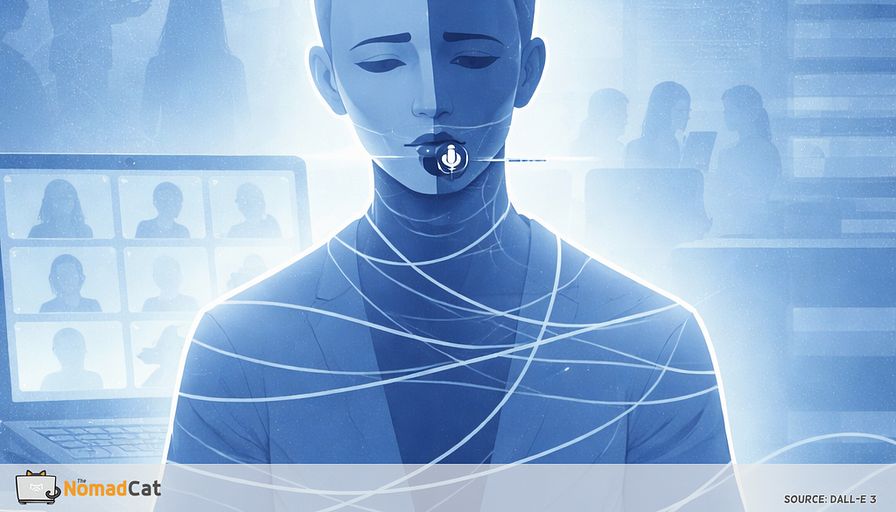
A remote day can look perfect in the logs. Meetings stacked. Tickets moved. Slack replies fast enough to look alive. And somehow, at 18:00, the body sends a weird invoice anyway. Stiff neck. Tight shoulders. Jaw doing that thing. And the face still stuck in “professional mode” like you forgot to take it off.
It’s easy to blame “not moving enough.” Sometimes that’s true. But on call-heavy days, another variable is doing a lot of work in the background. Remote work quietly removed a whole layer of small inputs that office days gave you for free, and video calls add their own small tax. You end up spending hours trying to look like you are listening, watching your own face, and staying mic-clean.
I’ve spent most of my adult life at a desk, first in Beijing, then Berlin, and now Lisbon. The early signal for me is boring: upper back and neck get tight before I even notice I’ve been bracing.
This article is here to name that pattern without making it dramatic, and to give you a few small fixes that actually survive real calendars. Not a new personality. More like adding tiny transitions back into the system so you don’t spend 2 hours of silence on 1 continuous breath-hold.
Here’s what we’ll cover
- Why “productive” remote days can still end with tension that feels overpriced
- What office days used to provide automatically, without scheduling it
- How mute etiquette and video stillness change breathing and muscle tone
- The common signs that give it away, especially in jaw, neck, and upper traps
- A meeting-proof approach using event triggers instead of timers
- Simple micro-actions you can do before, during, and after calls, with safety guardrails
If your workday already bleeds into evenings, and exercise keeps losing priority battles, this is built for that reality. The goal is not perfect posture or heroic discipline. It’s small inputs, placed where they’ll actually run.
The silent desk contract
How a “productive” day ends oddly tense
A remote day can look clean on paper. Calendar full, tickets moved, Slack flying, camera on for the “important” calls. If you’ve ever done those workations across Europe on bad chairs and worse desks, you know the vibe: you can be “fine” all day and still pay for it at night.
You keep the hot mic risk low. So you don’t really exhale. You don’t do the small laugh. You don’t even mumble “ok” to yourself because why broadcast that.
Then it’s 18:00 and you feel this tight, held thing in the chest and neck. Like the body spent the whole day trying not to exist too much.
If that sounds familiar, it’s not just “move more.” Office days gave you a bunch of accidental inputs that remote work removed. Staying still and monitoring yourself becomes part of the job.
What office days gave you without asking
Remote work didn’t only change where you work. It changed the shape of the day and deleted the in-between moments.
In an office, communication is fragmented and verbal by default. Proximity creates small, fast interactions that don’t need a meeting invite. You get tiny vocal and movement reps without thinking about it.
- quick hellos when you pass someone
- 10-second clarifications
- talking while turning a chair, walking to a room, grabbing water
- stairs, corridors, and the “walk to a meeting room” you never scheduled
- small laughs that break the “professional face”
- little “mm-hm” and half-sentences that still count as sound
None of this is exercise. It’s just constant variation. Remote tends to compress all that into fewer, more formal moments—so you lose both movement transitions and voice transitions, and the bracing can run continuous. Either you are “on stage” in a meeting, or you are silent and typing.
The missing layer most desk fixes ignore
A lot of desk fixes focus on posture or steps. Those matter. But on meeting-heavy days, a different thing is missing.
You are physically muted for hours.
Less voice. Less breath timing variety. More “hold still and don’t make noise.” The practical goal is not perfect breaks. It’s reintroducing tiny transitions that survive real calendars.
Why silence makes your body brace
Stillness becomes the “engaged” signal
On video, moving less can look like paying attention more. Under even mild evaluation, stillness becomes a social strategy. Not dramatic. Just practical.
So you freeze a bit. Shoulders up. Jaw ready. Face camera-safe.
Then there is the part nobody notices because it is too boring to notice.
Speech is a built-in breathing scheduler
Talking forces structure onto breathing.
Quick inhale before a sentence.
Long controlled exhale while you speak.
Small pauses that naturally end a cycle.
A plausible mechanism is: when speech drops out for hours, you lose those automatic boundaries. In practice it can feel like the ribs, throat, and face stay half-ready, like you might unmute any second.
Mute etiquette cuts out the small sounds you normally leak
When muted, lots of people suppress tiny noises that would be invisible in an office. Not because they are wrong. Because the tools make them feel loud.
Common casualties
- audible exhales
- little sighs
- small laughs
- “mm-hm” backchannels
- muttered “ok, got it”
Add a full day of that and yes, some people end up with the 18:00 neck and jaw invoice.
A nerdy validation that silence is a real variable: blood pressure protocols literally ask you to sit quietly and not talk, because talking reliably shifts the reading. Talking is a strong input. That’s good news. It means small changes can matter without turning your day into a project.
The pattern that gives it away
Often the giveaway is that the discomfort feels a bit overpriced for what actually happened physically.
Common signals on call-heavy days
- neck and upper trap tightness that ramps up even if you stood up a few times
- shoulders creeping up while you type, then staying there
- low-grade headache vibe late afternoon
- ribcage feeling “locked”
- fatigue that feels more like tension than sleepiness
- a weird “face tired” feeling after meetings, even if you barely spoke
Jaw and throat signals can show up early.
- teeth almost touching most of the time
- tongue pressing up like it’s trying to help
- more swallowing or throat-clearing than usual
This is common. Not catastrophic. Also it’s worth avoiding strong labels like “you are clenching” as a diagnosis. If jaw symptoms are persistent, worsening, or paired with locking or strong pain, getting checked is reasonable.
Replace silence with tiny transitions
Event triggers beat timers
Timers fail in a predictable way. The reminder pops while you are mid-sentence, on camera, or trying to look like you are listening. So you ignore it. After a few rounds your brain files it under spam. Then you get guilt as a bonus feature.
That is not a discipline problem. It is trigger incompatibility.
Event-based cues are lighter because the world hands you the trigger.
If-then plans for meeting days
Use if X happens, then Y.
If you join a meeting, then soften the jaw and let 1 quiet exhale happen before you speak.
If you unmute, then start with a small inhale and speak on an easy exhale, not a held one.
If you leave a meeting, then do 10 seconds of audible exit off-mic.
If you send a Slack message, then drop the shoulders and do 1 slow exhale.
The actions need to be small enough to be meeting-proof.
Audible exits and breath transitions
An audible exit is 10 to 30 seconds where sound comes back into the system after a long muted stretch. Not a performance. More like a small human noise that tells the ribs, jaw, and throat ok, we are not in statue mode anymore.
A breath transition is the smallest possible chapter break. 1 easy inhale. 1 longer exhale. Done.
These are tokens you insert so 2 hours of silent bracing doesn’t run uninterrupted.
Make it camera boring
On video, everything is legible. A shoulder roll looks like impatience. A long exhale looks like you are “over it.” Even looking away for 2 seconds can be misread.
So the trick is not confidence. It’s interface design.
Pick micro-movements and micro-sounds that are
- visually boring
- interruptible
- reversible in 1 second
- doable without explaining yourself
Optional low-drama permission statements, only if they reduce friction
- “I’m here, just standing 1 minute.”
- “Audio only 30 seconds.”
- “Camera off briefly, still listening.”
One tooling note that can matter. Aggressive noise suppression can clip low-level sounds and make the audio feel gated. That sometimes trains people to be extra quiet. The goal isn’t loud breathing. It’s allowing a normal exhale sometimes when you are off-mic.
A small menu for call days
Before you speak
Before clicking Unmute, try 1 longer, quiet nasal exhale under 3 seconds, then click. The point is to reduce the little pre-sentence brace, not to do breath drills at work. (And if you forget: fine. Next time.)
If you want variation without anything visible, change position for 1 sentence.
The standing sentence
Deliver the first or last sentence of your contribution standing, then sit back down. Not a standing meeting. Just 1 sentence that gives your ribs and neck more options.
On mute, once per agenda item, do a mouth reset.
- unclench the jaw by 1 to 2 mm
- soften the tongue
- swallow once
Treat it as a posture interrupt, not a diagnosis.
Right after you leave a call
After clicking Leave, do 1 audible sigh or soft hum for 5 to 10 seconds while walking about 10 steps. Keep it gentle. No dramatic dumping of air.
If sound feels awkward, use a location boundary.
Doorway breath switch
After any call, walk to a threshold and take 1 slower comfortable breath there. The point is a reliable chapter break plus a position change. In tiny apartments, the threshold can be 2 steps.
Seated exit version
After you leave, roll the shoulders once, exhale gently, then say 1 short word off-mic like “done” or “next.” Yes, talking to yourself is apparently normal now.
Guardrails so it stays safe and non-performative
No force rule. Keep breathing small and comfortable. Avoid long holds. Avoid chasing “deep.” If anything feels worse, return to normal breathing and make the next try smaller.
Stop and seek care if there is chest pain or pressure, severe dizziness, faintness, or breathlessness that feels unusual for you.
Working looks boring. It often shows up as faster recovery, not constant calm.
Boring outcomes that count
- less end-of-day upper trap invoice
- less jaw fatigue after calls
- shoulders dropping faster after you click Leave
- if you track it: after a meeting wall, your heart rate comes back down faster on your watch/chest strap (I’ve seen it on a Polar H10; not science, just a decent sanity check)
A last systems note, slightly self-deprecating because it’s true. It can look like “focus” to be silent and braced for hours. It’s not a superpower. It’s missing inputs.
Treat this as a small spec change, not a personality rewrite.
If a remote day ends with a stiff neck and a tired face, it is not proof you “didn’t move enough.” Often it is the silent desk contract: hours of being muted, staying still on camera, and keeping the mic clean can leave the ribs, jaw, and shoulders stuck in a half-ready mode. Office days used to sprinkle in tiny voice and movement reps for free.
The invoice isn’t moral failure. It’s missing transitions.
You might be interested by these articles:


When desk focus puts your breathing on mute

Why video calls wreck your neck after you hit Leave

Make movement non-narrative on video calls

Remote work stole your hallway breaks and your neck feels it

Micro-exits for remote days that keep your body from timing out

Work better by matching your boundaries to your energy

Better boundaries for happier tech freelancing