Abstract:
The article explains why video calls often trigger a distinctive “post-call symptom dump”—tight traps, neck and temple pressure, dry mouth, a tired jaw and strained voice that appear right after you hit Leave—arguing this isn’t “bad posture” or aging but a predictable stress-and-control loop caused by constrained movement, heavy self-monitoring, social evaluation, and high cognitive load that quietly raises background muscle activity even in low-force desk work. It highlights how the body braces most in “evaluation mode” moments (waiting to unmute, disagreeing with someone senior, negotiating, being watched while you work), and it adds a key, often-missed driver: jaw and throat bracing (teeth nearly touching, tongue pressing up/back, tight lips, a “small” throat, shallow chest breathing, swallow/throat-clear loops) that can recruit neck and shoulder stabilizers and even contribute to headache-like sensations through jaw–neck coupling. Using a “debugging” metaphor and a personal aside about years of late-night desk work across Beijing, Berlin, and Lisbon (plus a fitness-trainer/nutritionist spouse whose “sit straight” advice lasts three minutes), it recommends spotting quick “log files” at reliable boundaries (mute/unmute, camera on, hitting Send) and applying a subtle, meeting-safe 10–20 second reset—create 1–2 mm of space between the teeth, soften/widen the tongue, and do one slow exhale—aimed at reducing tension spikes and shortening recovery rather than achieving a perfect, tension-free body, while also noting gentle breathing stop-rules and clear symptoms that warrant medical or dental evaluation instead of more cue-tweaking.
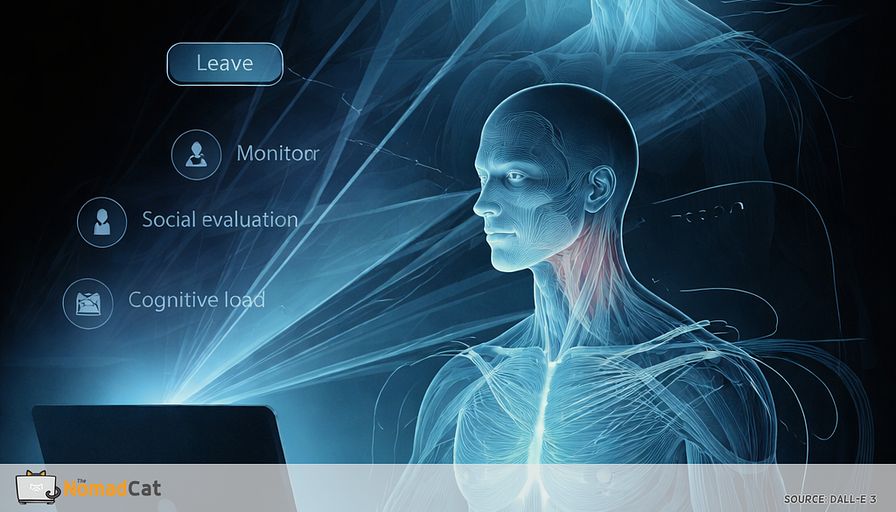
You hit Leave and suddenly your body files a bug report.
Traps inflated. Jaw tired like you were chewing deadlines. Dry mouth. Temples a bit loud. The weird part is the timing. During the call you look mostly fine. Then the second it ends, everything shows up at once, like the meeting was holding the tab open in the background.
This article is here to make that feel less mysterious and more debuggable. Not with posture guilt or “just get a better chair” advice, but with a plain cause-and-effect model for why video calls can leave you cooked even when you never lifted anything heavier than a laptop.
What you will get, specifically
- Why calls create a specific fatigue cluster, and why it is often about self-monitoring and constrained movement, not “you aging badly”
- Why high-stakes moments trigger bracing, and why social evaluation tends to hit shoulders and breath first
- How cognitive load alone can increase neck and shoulder activity, even in low-force desk work
- The sneaky part many people miss, jaw and throat bracing that quietly drags the neck and traps along for the ride
- A fast, meeting-safe 10 to 20 second “jaw plus exhale” patch that fits real calendars and does not require perfect awareness
- What progress actually looks like, plus basic stop rules and when it is smarter to get checked than to keep tweaking cues
If your days are 10 hours of screens, desk lunch, and calls that keep multiplying, the goal here is not to add another system to manage. It is to reduce the spikes and shorten recovery, with small adjustments that still work when the stakes are high and the camera is on.
Calls make your body weird
The post call symptom dump
The delay is the clue. Your system stays in “performance mode” until the call ends, and then it dumps the backlog all at once.
Traps inflated. Neck shorter. Temples a bit loud. Jaw tired like you were chewing deadlines. Dry mouth. Voice slightly cooked. It arrives right when the call ends, like the meeting was holding the tab open in the background.
This is not just you “aging badly” or failing at posture. Video calls can create a pretty specific fatigue mix. Bailenson (2021) points to things like constrained mobility and self-monitoring. Translation: seeing your own face makes you micro-correct, which keeps the holding pattern running.
Better gear can help, but it often misses the main load. Meetings reward stable gaze, controlled voice, and a competent face. To pull that off, the body uses low-variation holding patterns. Less movement means more sustained low-level muscle activity. That can stack up into discomfort over time.
A good chair can reduce gravity load. But the bigger tax in many calls is control under social pressure: face, voice, breathing, micro reactions (Bailenson, 2021). So yes, even with great lumbar support, shoulders still try to crawl toward the ears.
What changes for you: if the call demands “look normal,” your body often picks stillness and bracing as the cheapest way to deliver it.
High stakes is where the body starts bracing
When you feel evaluated the shoulders hear it first
It shows up in “evaluation mode” moments.
Waiting to unmute while everyone looks at your face. Disagreeing politely with someone senior. Negotiating a number with a calm voice. Writing something careful while someone watches your cursor.
Social evaluation is a reliable stress trigger, especially when judgment is possible (Dickerson & Kemeny, 2004). The result is often a quiet brace. Neck, jaw, shoulders, breath get more controlled.
So the tension often tracks social risk more than meeting length.
Cognitive load can tax the trapezius even with zero lifting
Mental load alone can increase neck and shoulder muscle activity during low-force seated work, including the upper trapezius (Waersted & Westgaard, 1996; Visser et al., 2004).
Example: you are screen-sharing a spreadsheet while answering questions fast. You freeze your torso, keep your head extra steady, and “hold” your shoulders so your voice stays calm and your cursor doesn’t jitter.
In plain language, the brain asks for precision and self-control. The body reacts by turning up background tension to feel more stable. Do it long enough and later you get the classic traps feel cooked, jaw feels overused.
Stillness tolerance is not discipline it is delayed feedback
Most people do not notice in real time. They notice at the boundary.
The author has spent most adult life at a desk, first in Beijing, then Berlin, now Lisbon, often past midnight. It is possible to work a full day without eating, drinking, or moving. Not a superpower, just muted signals. (Also a wife who is a fitness trainer and nutritionist, who says “sit straight”, and it lasts about 3 minutes.)
I can do a full day without eating or drinking and only realize it when the call ends. Not toughness. Just a bad notification system.
The useful signal is often not pain. It is upper-back tightness that builds quietly until it forces movement. When stakes are high it shows up earlier and grows faster. That tells you the problem is not only the chair. It is also the moment the brain decides it must look competent.
The mouth brace that steals your neck
The ready pattern you do not notice
A helpful debugging detail is that jaw “rest” is usually more relaxed than your default on a tense Tuesday.
When the system is in ready mode it often looks like this
- teeth hovering 1 mm from touching, or lightly touching between sentences
- tongue pressing up and back
- lips tight, corners pulled in, polite face even when nobody is funny
- throat feeling smaller, like you save the voice “for later”
- breathing higher in the chest, smaller and quieter
- swallow or throat-clear loops while listening
- you only notice it when it stops and suddenly the face feels wider
This is not a diagnosis. It is a common stress pattern. Reviews link psychosocial factors more consistently with awake bruxism-type behaviors than sleep ones, with messy measurement caveats (Manfredini et al., 2011; Melo et al., 2018). In office life, “awake” often means “while Slack is open”.
At rest, teeth are typically not touching. Many orthodontic textbooks describe a small natural separation at mandibular rest (often called freeway space). If tooth contact is your default while reading email, that is not neutral. That is work.
A simple check is to let the jaw go heavy for 2 seconds. If the teeth separate, you were likely holding them together. If nothing changes, fine. No need to turn it into a personal project.
Now connect the dots. Jaw and neck are more coupled than people expect. When the mouth braces, nearby muscles that help stabilize head and neck can join in (Armijo-Olivo et al., 2006). Calls add another layer because voice is social. Even muted, many people keep the larynx “ready”, like a browser tab pinned in the background.
So sometimes “my neck is tight” starts in mouth and throat, not the chair. You are not only sitting. You are performing competent human.
Jaw and neck are one system
The clamp spreads because the rig needs stability
Clamping the jaw for precision tends to stiffen the rest of the rig to keep output clean. Like tightening one bracket on a camera tripod and suddenly the whole head feels less free. Reviews on cervical spine and the stomatognathic system describe these associations and co-activation patterns (Armijo-Olivo et al., 2006).
The confusing part is that the sensation does not always show up where the clench starts. A jaw clamp can get reported as temple pressure, “headband” tightness, upper neck ache, or a vague headache-y fog.
Breathing can stack on top. Under stress, breathing often shifts up into the chest. When that happens, accessory inspiratory muscles in the neck tend to do more work. Add jaw bracing and now multiple inputs ask the same neck region to stay online.
So the practical play is early detection.
Your early warning log files
A 30 second scan that works on real calendars
You do not need perfect awareness. You need 3 to 5 signals you can spot fast.
Common ones
- teeth touching while reading
- tongue glued to palate back
- lower lip pulled in
- mouth corners held tight
- micro smile frozen on camera
- frequent swallowing loop
- throat feels small
- jaw tired like gum
Video calls add extra self-monitoring and nonverbal load (Bailenson, 2021). The best moments to catch the clamp are specific boundaries. Waiting to unmute. A tense Slack thread. A doc review with an audience. Trying to look friendly on camera.
Delayed awareness is expected. The brain prioritizes the social and cognitive task, then the body sends the report after the tab closes. The skill is not constant monitoring. It is a tiny detection loop at reliable boundaries.
A simple checkpoint is mute to unmute. If the mic state changes, do a 2-second scan of teeth and tongue.
The cause-and-effect chain is usually something like this
1. social evaluation raises arousal (Dickerson & Kemeny, 2004)
2. arousal tightens breathing patterns
3. jaw and throat co-contract for voice and face control (Armijo-Olivo et al., 2006)
4. neck and traps stabilize the head under load (Visser et al., 2004)
So the shoulders feel like the problem, but upstream input is often mouth and breath.
The 10 to 20 second jaw plus exhale patch
A meeting safe micro script
This aims for subtle changes that do not look weird on camera.
1) Let the teeth separate about 1 to 2 mm
Not a big jaw drop. Just back to normal rest, where teeth are typically not touching. Do less than you think.
2) Let the tongue go wide and soft
Not jammed up and back. Options that are usually fine
- heavy on the floor of the mouth
- tip lightly on the front palate if that is already natural
Some people reference “ideal” oral rest posture. Treat it as a gentle reference, not a rule.
3) Do 1 slow exhale
A bit longer than the inhale. Nose if possible, or softly through the lips if the nose is blocked. Keep it easy. No counts, no performance.
Slow breathing can shift stress markers, and a longer exhale is a quick downshift signal that many people can do in public (Zaccaro et al., 2018; Lehrer & Gevirtz, 2014; Laborde, Mosley & Thayer, 2017). If you can only do one thing without being seen, make it the exhale.
Now just notice what the shoulders do. Do not order them around. They do not take feedback well.
Use the interrupts you already have
Attach the patch to built-in boundaries
- join call
- camera on
- mute
- unmute
- leave call
- hit Send on a delicate message
This piggybacks on events that already happen, instead of adding a new task. If/then cues tend to stick better than motivation (Gollwitzer & Sheeran, 2006).
Keep expectations honest. This is not deleting tension forever. It is reducing spikes and shortening recovery. Microbreak research in desk work is fairly consistent that short breaks can reduce discomfort and fatigue with little to no performance cost, even if protocols vary.
What progress looks like and basic safety notes
Progress is fewer spikes not a perfect body
Progress is boring.
Shoulders come down faster after a tense call. Temple pressure shows up less often. Jaw feels less chewed at 6 pm. Breathing is easier while listening and the voice feels less strained. The goal is not zero tension. It is smaller spikes and faster recovery, like reducing error rate, not achieving perfection.
Keep the breathing gentle and use stop rules
Subtle is the point. No forcing, no long breath holds, no hyperventilation-at-the-desk energy.
Stop if there is dizziness, tingling, lightheadedness, visual weirdness, or a panic-y spike. These can be signs of over-breathing. Returning to normal breathing is already a good move.
When to get checked instead of tweaking cues
Some symptoms are not a “meeting brace” problem.
Consider getting checked if there is
- jaw locking or catching, or you cannot open normally
- persistent facial numbness or altered sensation
- severe headache with neurological symptoms like vision changes, speech issues, new weakness, confusion
- progressive weakness or coordination issues in an arm or hand
- significant radiating pain, especially with numbness or worsening function
- steady worsening week to week instead of the usual “eases when I move” pattern
- new symptoms after trauma or a dental procedure that do not settle
(For clinicians and classification nerds: DC/TMD and ICHD-3 exist for a reason; headaches have many causes, and jaw involvement is not universal.)
Micro changes are for the common meeting brace pattern. Anything escalating or neurologic is not a posture problem to outsmart.
If your day is 10 hours of screens, desk lunch, and calls that multiply like bugs, the weird post-call symptom dump is not a character flaw. It is often a predictable loop. Social evaluation ramps you up, cognitive load keeps you still, and the body pays with low-level bracing in jaw, throat, neck, and traps. That is why it can hit hardest right after you click Leave.
The useful shift is treating it like debugging, not “fixing posture.” Look for early log files (teeth touching, tongue pinned, tiny breath), then use the meeting-safe patch. 1 to 2 mm of space between teeth plus 1 slow exhale. Small, boring, repeatable. Progress is fewer spikes and faster recovery, not a perfect body.
Most people notice a trigger moment pretty reliably. Mute-to-unmute, disagreeing politely, or right after Send are common ones.
You might be interested by these articles:


The 18:00 throat scratch from camera on stillness and missing swallows

Muted all day and your jaw pays at 18:00

Your posture is not broken your attention is running the brace

The 20 second desk handshake that stops pain from showing up after you log off

Your mouth is idle on camera days and your neck pays at 20:00

Rails 6: Revolution in Web Dev Scalability

Social Tech Ventures and Their Impact