Abstract:
The article explains how desk-based, accuracy-focused work quietly “edits” your breathing long before you notice it, creating a subtle low-power feeling that often only becomes obvious when you stand up, yawn, or take the first real sigh of the day. Rather than blaming posture or prescribing a heroic breathing routine, it frames the problem as reduced variability: during long focus blocks people unconsciously take small inhales that stop early, cut exhales short, hold their breath around precise actions like clicking or hitting “send” (even after rewriting a message multiple times), and settle into an overly regular rhythm; as rib motion shrinks—often helped along by common screen setups like low laptops, slightly off-center dual monitors, or cradling a phone—neck and upper traps start doing background stabilization, leading to board-like upper-back stiffness that peaks after work when attention releases and the body “rebounds.” Sighing is treated not as a bad habit to eliminate but as a useful signal that the system has gotten too rigid, and the practical fix is a microbreak plan that fits real work: 10–30 seconds at natural boundaries (before/after send, page loads, builds finishing, unmute, switching typing to reading, closing tabs, end of meetings) to finish a longer, quiet exhale (with a brief end pause to let ribs and jaw soften) and add tiny chair-based rib movements (small side-bends or rotations) to restore options. Success is intentionally “boring” (fewer mid-afternoon sigh emergencies, less shoulder creep, less need for aggressive evening stretching, maybe tracked with one simple end-of-day stiffness rating), and the article ends with clear stop rules urging medical evaluation for red-flag symptoms like chest pain/pressure, sudden unexplained shortness of breath, fainting/dizziness, new wheeze, or distress that feels medically concerning.
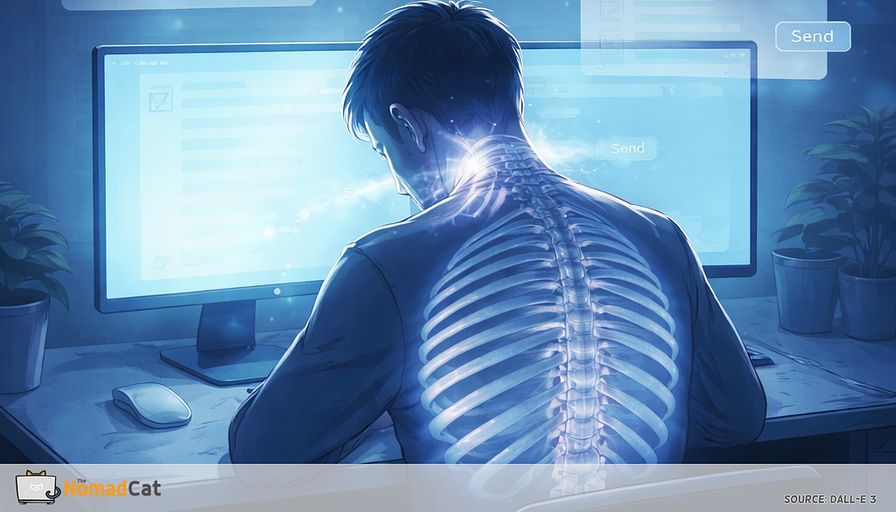
The day feels normal until it doesn’t.
You sit down, the cursor blinks, the room goes quiet in that familiar office way. You get 2 solid hours, you ship a few things, meetings happen, lunch is… whatever was closest. Then you stand up or reach for your bottle and notice it. Your breath got smaller. Not dramatic. Just oddly insufficient, like the system has been running in low-power mode.
If that sounds familiar, this article is for that exact pattern. I’ve done this for years: Beijing offices, then 6 years in Berlin, and now Lisbon—often past midnight—on chairs that were never designed for 10-hour accuracy work. Not a posture lecture. Not a heroic breathing protocol. More like a quick debug of what desk work quietly does to breathing and shoulders when the task rewards stillness and accuracy.
Here’s what you’ll get as you read on
- The small “desk breath” signatures that show up during focus blocks, before you notice them later
- Why sighing can feel weirdly perfect, and why it’s more useful as a signal than a thing to eliminate
- How a quieter rib cage can push the neck and upper traps to do background work all day
- The screen setups that shrink rib motion options without any stress story required
- A simple plan built for real work, 10 to 30 seconds at a time, using boundaries that already exist like “before send” and “after send”
- Clear stop rules for when this is not a desk problem and it’s time to get checked
The goal is not breathing perfection. It’s variability. More small rib movement inside the work block, so your shoulders don’t have to keep volunteering for a job they never applied for.
The desk breath you barely notice
A normal day with a weird soundtrack
Then you stand up for a meeting or reach for your water and notice you need a bigger breath than expected. Like the system was running in low-power mode. Sometimes it shows up as a yawn that arrives out of nowhere, or the first real sigh of the day.
This timing is not random. Under mental load, body signals get pushed down the list. It can feel like nothing is happening until you stop. And across months and years of desk days, small things stack quietly, then become obvious later.
Nothing hurt. The breath just got smaller.
If you catch that pattern once, the next step is noticing the tiny signature it leaves while you are still working.
- A small inhale that stops early
- Lips pressed together, or slightly open mouth
- An exhale that never really finishes, so the next inhale starts mid-way
- A neat little breath hold right before a click, then release after the click lands
- Another micro-freeze right before sending a message you rewrote 3 times
- Shoulders doing a subtle up-and-forward creep
- A breathing rhythm that gets oddly regular
Those micro-pauses syncing with computer actions are not just in your head. Breathing suppression around precise mouse actions has been observed in lab settings, and higher mental load is linked with more rigid, less variable breathing. The “known” part is that focus + precision tends to make breathing smaller and more regular. The gap is what tiny breathing tweaks alone do for neck/shoulder outcomes—especially anything that claims a perfect inhale/exhale ratio.
Often the first complaint is mechanical. Upper back feels a bit board-like. Tightness sits under the shoulder blades like a stuck drawer. Then a yawn happens and it feels like someone opened a small window in the rib cage. Sighing also tends to increase with time-on-task in attention research, which fits the idea that the body uses it as a simple regulation move when things get too rigid.
A useful frame is systems, not morality. Stillness often equals accuracy at a desk, so the nervous system chooses stability. Chasing 1 perfect posture tends to disappoint because there is no single ideal position you can hold all day. The practical target is variability, not perfection.
Why sighing feels weirdly perfect
Sighing is your system changing gears
That ahhh moment has a simple logic. Under load, breathing often becomes more regular and constrained. A sigh is like a watchdog process that shows up when the system gets stuck. Treat it like a log entry that says breathing has been on rails for a while.
The biology is simple even if the feeling is dramatic
When breathing becomes small and metronome-regular, the system sometimes inserts a bigger breath to change state and bring back variability. Sighing is linked to dedicated circuitry involved in these state shifts. Translation: it’s the system kicking itself out of a loop.
What this is not
This is not going to claim that 1 magic inhale-exhale ratio fixes desk shoulders forever. The evidence for precise ratio claims is thin. It is also not saying sighing is bad and must be eliminated. The practical move is treating the urge to sigh as information.
Also, if the goal is less neck and shoulder irritation, movement tends to have stronger support than breathing alone when the break is only 10–30 seconds.
When ribs go quiet and shoulders step in
Your rib cage is built for small movement all day
The rib cage is not a rigid box. It’s more like an accordion with hinges, built to expand and recoil in a few directions every few seconds. The useful part is not memorizing anatomy words. It’s remembering that breathing is also movement.
Small desk breaths have a specific signature. The inhale is modest. The exhale is often cut short. The next breath starts before the ribs fully return. Over time, the thorax can start to feel like one piece because it visited fewer positions, not because it is broken.
Microbreak research supports the idea that small, frequent changes can reduce discomfort in desk work. When the rib cage stops being an easy-moving base, other muscles quietly volunteer.
Why the neck and upper traps get busy during low force work
If the rib cage moves less, the shoulder blades sit on a quieter platform. Then background stabilizers in the neck and upper trapezius often do more low-level work to keep the head and shoulder area steady, especially when the task rewards precision.
Research in ergonomics and psychophysiology shows mental or psychological load can increase upper trapezius activity even without heavy lifting. Accessory breathing muscles can also get more involved when the usual pattern is constrained. Real days are messy, so cause and effect stays humble, but the handoff makes sense.
The screen posture that steals your rib cage options
Stillness is the feature not the bug
Look at a typical screen setup and you see the same geometry. Arms reach forward. Head drifts forward. Trunk sits in mild flexion. Eyes lock onto a bright rectangle.
It rewards stillness because stillness makes the cursor behave and the words stop jumping. The issue is not just neck angle. Rotation and side-to-side shifts disappear, and with them a lot of casual rib motion you would normally get for free.
Common versions look like this
- Laptop on a table with the screen too low
- Dual monitors but the main one slightly off center
- Phone trapped between shoulder and ear while typing
Flexion changes breathing in a measurable way
Slumped sitting has been shown to reduce spirometry measures compared with more upright sitting. It does not need a stress story. If the ribs start from a more collapsed position, there is less room to expand before you hit the end of available motion. Thoracic posture can also change the pattern of expansion, not only the amount.
A flexed thorax changes where the shoulder wants to sit
Changing thoracic posture alters how the shoulder blade moves. If the rib cage is held quiet and forward, the shoulders often feel like they need to park a bit higher to keep the arms useful, and the neck becomes the bracket holding it all together.
The quiet build-up often shows up later. Discomfort tends to rise over hours and peak after work in workplace studies, which matches what many desk-heavy people recognize.
Why it shows up after work
The post-task rebound
During deep focus, the brain does triage. Signals from the body get pushed down the list because the work has the CPU. This matches attentional analgesia research, where attention pulled into a task reduces pain reporting and related brain activity, even when the input is still there.
Then the task ends and the system changes state fast. You stand up, walk to the kitchen, lean back, and suddenly the thorax wants to expand again. If the rib cage has been moving less, that expansion work doesn’t disappear. It gets redistributed. The neck can assist, but it’s not subtle about it.
So yes, feeling it after can mean you were too still and too small-breathing during, and now the logs flush when the process ends.
The win is a few extra rib positions before 6pm, not a perfect breathing style.
Micro moves that bring ribs back online
Let the exhale do the first job
A huge desk inhale often recruits the shoulders because the quickest way to get more air is lifting the top of the rib cage. The less glamorous first move is finishing the exhale so the ribs can drop and stop forcing the neck to help.
If you’re into metrics: slower breathing often shifts marker-level stuff like HRV in reviews. That’s not the same thing as proof it fixes shoulders, but it’s a useful hint that “small change, big system” is real.
A 10 to 20 second exhale that does not look like anything
Do two quiet nose inhales. On each exhale, make it slightly longer and let the ribs drop.
- At the end of the second exhale, pause 1 beat—just long enough to feel the ribs soften down and the jaw let go.
Define success in a boring way. Typing feels a little lighter through the shoulders for the next minute.
This is not meditation. It’s basic maintenance for a system that went too still.
Add a rib nudge you can do in the chair
For neck and shoulder discomfort, the evidence is stronger when breaks include movement, even if the break is only 10–30 seconds. Think of it as giving the rib cage a little range back, not fixing posture.
Two chair-friendly options
- Side-bend: on the exhale, let the ribs slide 1–2 cm to the right, then back to center on the next inhale. Keep it tiny. Do 2–3 breaths.
- Rotation: on the exhale, rotate the sternum a few degrees to 1 side, then return to center. Desk work steals rotation all day, so even a small dose helps.
Use boundaries that already exist in your work
Boundaries beat reminders because they already happen. Pairing a cue with an if–then plan is one of the more reliable findings in behavior research, and knowledge work is fragmented enough that you get plenty of natural edges.
Boundary anchors that do not need an app
- Before send
- After send
- Page loads
- Build finishes
- Unmute to speak
- Switch typing to reading
- Close a tab
- End of a meeting
For 7 days, aim for 2 longer exhales per hour attached to any boundaries above. A good week is more rib movement variety, not more discipline.
How to know it is working and when to stop
Progress signals that stay boring
Look for fewer system complaints by the end of the day, not a miracle fix.
- Fewer need-to-sigh moments by mid-afternoon
- Less shoulder creep while typing or scrolling
- Less urge to do an aggressive upper-back stretch at 7pm
If you like data, keep it minimal. Pick 1 metric for 7 days.
- 0–10 end-of-day upper-back stiffness rating
- If you already wear a Polar H10, don’t overthink it—just note whether your worst end-of-day stiffness lines up with your longest meeting block.
If you are a metrics person, the discipline is not adding more numbers.
Early warning signs and clear stop rules
Early log files
- Frequent sighing that clusters late in a long focus block
- Tension headaches after hours of screen accuracy work
- Throat tightness sensation that lingers outside calls
- A deep breath that feels uncomfortable mainly at the end of the day
Stop rules that are not negotiable
Not everything that feels like tight breathing is a desk issue. Stop experimenting and get medical evaluation for things like
- Chest pain or chest pressure, especially if new or severe
- Sudden unexplained shortness of breath
- Dizziness with near-fainting or fainting
- New wheeze or breathing distress, especially if speaking full sentences is hard
- Panic-like symptoms that feel medically concerning and you are not sure what is happening
Desk work doesn’t just bend the neck. It quietly edits the breath. Under focus and precision, breathing gets smaller, more regular, and a bit frozen around clicks and “send”. Then the rib cage goes quiet, and the shoulders and upper traps start doing background stabilization like unpaid interns.
The fix is not perfect posture or a heroic breathing protocol. The bet is variability: tiny exhales that actually finish, plus a small rib nudge in the chair, repeated inside the work block. 10 to 30 seconds, tied to boundaries that already exist like before send, after send, page loads, unmute.
If it works, it stays boring. Less shoulder creep. Fewer late-day sigh emergencies. And clear stop rules remain non negotiable when symptoms feel medical.
Most days, “before send” is the only break that actually exists. So I use that.
You might be interested by these articles:


Muted all day and your jaw pays at 18:00

Your posture is not broken your attention is running the brace

Micro thaws for the camera on freeze desk day

The 30 second range refeed that stops the 18:10 bug report after desk days

Why video calls wreck your neck after you hit Leave

Thriving in the Gig Economy Landscape

Calm mind tense body why desk bracing breaks your 03:00 sleep