Abstract:
The article explains why difficult 1:1 video conversations can feel exhausting even when you barely move: as soon as a topic turns delicate, the medium nudges you into a “camera-safe statue” mode—hands hidden, shoulders neutral, face centered like a passport photo—because video stacks constant self-monitoring, sustained gaze, and self-view while stripping away the small, tension-releasing movements and angled, side-by-side geometry that offices provided for free (walking to a room, turning toward a whiteboard, pacing a few steps). Without those built-in pressure valves, stress concentrates in the jaw, shoulders, and breath, and then lingers after you click “Leave” as perseverative replay loops, amplified by the lack of any physical transition or scene change. Drawing on research themes behind video-meeting fatigue (and noting limits in direct seated-vs-walking studies), the author—who has spent desk-heavy years across Beijing, Berlin, and Lisbon and recognizes upper-back tightness as an early warning signal—argues the solution is not a fitness regimen but a “container” redesign: choose the least-still format that still fits the conversation (standing, camera-off, audio-only walk), use simple scripts to make it socially smooth, and add tiny movement proxies like a two-minute doorway start, a “standing difficult sentence” rule, or a 60–90 second post-call “walk back” (stand, cross a threshold, look far, return) to help the body go offline. The piece also adds practical guardrails—privacy for sensitive topics, safety while walking, and alternatives when movement or multitasking would harm comprehension—so participation stays inclusive while reducing the stress tax of on-camera posture.
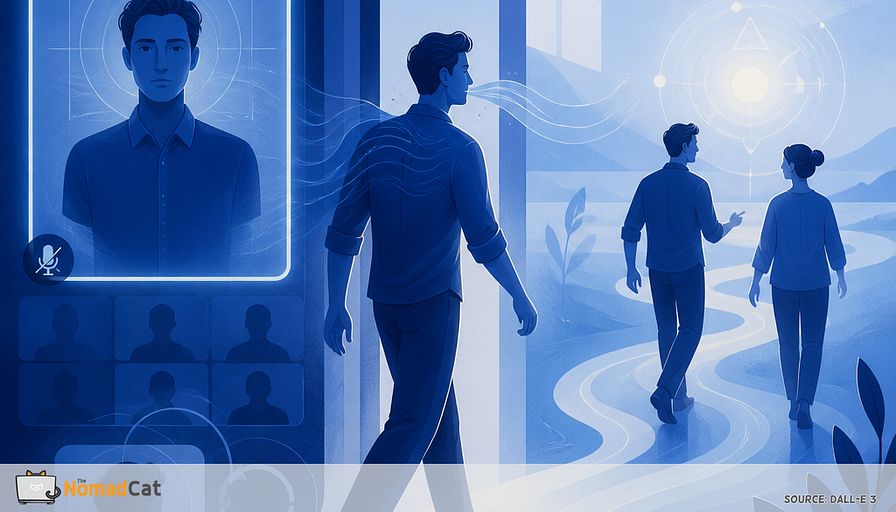
A hard 1:1 on video has a weird effect. The first 5 minutes are normal, then the topic turns delicate and suddenly you’re sitting like a “camera-safe” statue. Hands disappear. Shoulders go neutral. Face stays perfectly centered in the rectangle, like a passport photo that must keep its job.
This article is about that moment, and why it feels so draining even when you barely moved. The point is not to shame anyone for having a stiff neck after 6 calls and a desk lunch. It’s to explain the system bug. Video calls quietly push self-monitoring and constant gaze, while removing the low-stakes movement that used to bleed off tension in an office. When the call ends, your body often stays online anyway.
What you’ll get here is a practical way to change the container of hard conversations without turning your day into a fitness project. We’ll cover:
- Why “performance posture” shows up on camera, and why it costs more energy than it looks
- What the office used to give for free: small movement, angled orientation, a walk back that stopped replay loops
- A simple selector for choosing the least-still format that still works: standing, camera-off, audio walk
- Low-friction scripts and tiny movement proxies that fit inside real calendars
- Guardrails for privacy, safety, and situations where walking is a bad idea
Small adjustments count. Not because they make you a better person. Because they change the inputs to the stress loop, and your shoulders stop taking meeting minutes.
Hard talks on camera
Hard topics now happen in performance posture
A normal 1:1 starts fine. Then the topic turns delicate, and you hit that statue moment. Hands drop out of frame. Shoulders lock into “neutral.” You manage your face like it has a job to keep.
That stiffness is not you being dramatic. It’s a normal effect of the medium. Video calls pile up self-monitoring, constant gaze, reduced mobility, and self-view in one loop. One practical fix that maps directly to this: hide self-view by default for hard 1:1s, so you’re not talking while watching yourself talk.
In an office, the same conversation rarely had this front-facing geometry for the full duration. You shifted. You half-turned. You walked to a room. You looked at a whiteboard.
On video, you often sit still, brace your torso so your head stays stable in frame, and do polite little eyebrow management like it’s a product roadmap. It looks fine. It costs more energy than it should.
So the loss isn’t “exercise.” It’s the loss of a built-in pressure valve. Offices gave posture variety for free. Remote work removed the low-stakes movement wrapper, so tension concentrates in the face, shoulders, and breath. Then the “after” can linger. You leave the call, but your system stays online.
That lingering is the replay loop. The stressor ends, but your brain keeps running the scene anyway. In a physical office, the walk back often interrupted that loop. Remote has no doorway, no corridor, no different light. You click Leave. Same chair. Same posture. Same Slack.
The movement you lost
Movement as a pressure valve, not a fitness thing
Call it whatever you want. It’s simply low-intensity movement and posture variation while talking, so tension can drain without anyone announcing a “break.”
In an office, this happened all the time.
- You paced 3 steps while searching for words
- You shifted weight during disagreement
- You stood at a whiteboard and gave your shoulders a micro-exit
This matters because low-level muscle activation with not enough recovery is a common setup for discomfort. The usable version is simple: every 10 minutes, take 10 seconds to drop your shoulders, unclench your jaw, and change your position. No stretching program. Just a tiny interrupt.
Same hard topic, better container.
Side by side reduces the duel feeling
It’s not only movement. The geometry changes too. Face-to-face gaze can turn a delicate point into a duel. Side-by-side or angled orientation lowers the intensity while keeping the conversation serious.
The frame shifts from opponent across the table to 2 people looking at the same problem.
Rhythm helps re-alignment happen
When people move a little while talking, the rhythm can do quiet work. After a tense point, shared motion is one small signal that you’re still on the same side.
What we know and what we do not
Direct studies that compare seated versus walking for the same difficult conversation are limited, and movement also changes physiology in ways that can muddy simple comparisons.
What is solid: evaluative speaking reliably creates stress responses, and small container changes are low-risk to try. When tension has nowhere to go, it tends to park in the shoulders, jaw, and the replay loop.
When tension cannot go anywhere
Bracing is the default in seated high stakes talk
You stand up from the call and your shoulders come with you, 2 cm higher. Jaw a bit locked, breath a bit small, feet tucked under the chair like they might be judged. Your body behaves like something happened, even if it was “just talking.”
Psychosocial stress can drive muscle tension, especially around neck and shoulders. Add camera etiquette and you remove the micro-movements that normally puncture that activation. The risk factor is not 1 “bad posture.” It’s an always-on baseline.
Breathing is one of the first places this shows up. Standing can give the ribs and diaphragm a cleaner working space than slumped or overly rigid sitting. Standing is not a confidence trick. It’s just fewer constraints when you need a steady voice.
I’ve done most of my adult life at a desk, from Beijing to Berlin to Lisbon. The first log line is always the same: upper-back tightness arrives quietly. Then my wife reminds me to sit straight, and it lasts about 3 minutes. Annoying, but useful as an early warning signal.
Replay loops are often a container bug
Remote work removes the natural fade-out that used to interrupt replay. After a tense seated call, the brain keeps running the simulation. You rewrite the sentence. You draft the better version. You imagine the next reply.
That’s not a personality failure. It’s a normal way stress extends beyond the event. Over time it can also show up later, like tired-but-wired at bedtime.
What helps is the thing that tells your brain the meeting is over. It gets harder when nothing changes around you. A tiny movement boundary often does more than it deserves.
Light movement is also one of the simplest levers because a short bout can improve mood and reduce state rumination. Intensity matters though. Keeping it light-to-moderate is usually a safer bet than turning it into a mini punishment session.
A simple selector for where the talk should live
Choose the least still format that works
Before sending the invite, decide where the conversation should live in the body. Rule of thumb: pick the least still format that still supports the goal.
Options that often beat the default:
- Stand for the call
- Audio-only walk
- Camera-off
This is not moral discipline. It’s designing around reduced mobility, one of the key video-fatigue mechanisms.
Then adjust the channel richness with a light hand. Some topics need more warmth and nuance, and video can help. But video “richness” has a tax in self-monitoring and performance posture.
A practical compromise:
- With strong ties, audio can be rich enough
- With newer or fragile ties, try 5 minutes camera-on to land tone, then camera-off to remove the mirror
If conflict risk is high, reduce face-to-face intensity to lower the duel vibe. Side-by-side walking, or even standing camera-off, keeps seriousness while removing constant staring cues.
A quick matrix you can actually use
-
Exploratory, messy thinking
- Audio-only walk if privacy allows
- Walking can help idea fluency; 10 to 20 minutes at an easy pace is enough
- Keep it light. The point is thought, not steps
- Audio-only walk if privacy allows
-
Sensitive feedback or conflict
- Standing for both parties, or audio walk if both have private space
- Upright posture helps breathing mechanics when delivering the 1 sentence you are avoiding
- Removing self-view and hyper-gaze can reduce pressure
- Standing for both parties, or audio walk if both have private space
-
Decision and alignment
- Video can help when cues matter, but it does not need to be all-or-nothing
- A low-friction boundary is 60 seconds to arrive standing, then sit, then 60 seconds to leave standing
- Video can help when cues matter, but it does not need to be all-or-nothing
-
Status updates
- Lower the default cost to protect the rest of the day
- Camera optional, and accept that not every sync needs your face in HD
- Lower the default cost to protect the rest of the day
One caution: if the call is number-heavy or technically dense, walking can hurt comprehension because your brain has less bandwidth while walking. In that case, stand still, or pace only during the easy parts.
Low friction movement proxies
Walk and talk without making it weird
If both people are willing, the smallest proxy is a 2 minute doorway start.
- Join audio only
- Stand or pace near a door for 2 minutes
- Sit once the tone is set
It stays realistic inside a packed day and counters the reduced-mobility load.
For the side-by-side feeling without leaving the apartment, try a shared indoor walk. Both switch to audio only and walk in parallel at home for the tense part. Less gaze. Less intensity. A bit more rhythm.
For the exact hard line, use a standing difficult sentence rule:
- Stay seated for listening if needed
- Stand 20 to 60 seconds before you say it
- Deliver the sentence
- Sit right after
To make this socially workable, scripts beat willpower:
- “I’m going to turn camera off for a minute to focus on audio and take notes. Still here.”
- “Camera off so I can pace while we cover the tricky part. I listen better like this.”
After the call, the missing piece is a micro walk back so the thread actually ends.
Recreate the missing walk back in under 90 seconds
Offices did something boring and effective. After intensity, you moved, saw different things, and the meeting started to fade without needing a mental speech. Remote skips that scene change.
A simple discharge loop:
- Stand up
- Cross a threshold (door or hallway counts)
- Look far for 10 to 20 seconds (window or balcony is fine)
- Return and sit, then touch the next task
This is the one I use on days when I’ve done too many calls at the same desk and my shoulders are already writing a novel by mid-afternoon.
No timer needed. The repetition is the point. Breaking the loop quickly reduces the runway for replay to keep activation alive.
If you like data, measure it lightly so this doesn’t become another dashboard:
- A daily 18:00 0 to 10 stress rating
- A daily 18:00 0 to 10 jaw or shoulder tension rating
Optional. The goal is just confirming the container change is doing something.
Guardrails for privacy, safety, and access
If the topic is sensitive, treat walking outside as a data leak risk. Prefer indoor pacing, headphones, no speakerphone, and assume recording or transcription may exist.
Even with privacy solved, safety and cognitive load can still bite:
- Pause at crossings or stairs
- Avoid noisy routes for hard topics because listening in noise increases effort and reduces comprehension
Movement must never be mandatory or exclusionary. The principle is state change with equivalent participation, not walking specifically. Alternatives that keep the same thread-switch effect:
- Change rooms for 60 seconds
- Turn your body 45 degrees away from the screen and hide self-view
- Stand in place if possible, or go camera off while staying seated
Stop rules so this stays low risk. If dizziness, near fainting, panic spikes, or pain worsens, stop and adapt. The point is less stillness, not a new identity.
That camera-safe statue feeling is not a personality issue. It’s a container issue. Video pulls you into constant self-monitoring and gaze, then removes the small movements that used to bleed off tension in an office. So you click “Leave,” but your shoulders keep taking notes, and the replay loop keeps running in the same chair, same light, same Slack.
The fix is pleasantly unglamorous: pick the least-still format that still works. Stand for the hard sentence. Go camera-off for the tense section. Take an audio walk if privacy and safety allow. And give yourself a 60 to 90 second walk back after, even if it’s just crossing a doorway and looking far.
The goal is just to stop turning every delicate sentence into a passport photo.
You might be interested by these articles:


Make movement non-narrative on video calls

Audio first gives your body permission to move on remote days

After you click Leave your brain needs a boundary not another tab

Put your meetings on legs and stop the 18:00 rib grip

Remote work stole your hallway breaks and your neck feels it

Serverless Computing: Revolutionizing Enterprises

Next-Gen Serverless Computing Insights