Abstract:
The article argues that on meeting-packed desk days, food can feel “expensive” not in money but in context because stopping to eat forces a mode switch that charges a “friction tax”—the real cognitive and social cost of losing your place mid-thread, returning to a Slack backlog, risking being seen chewing on a camera-on call, and reassembling attention after interruptions (amplified by modern telepressure and constant responsiveness). Because the workday punishes clean breaks, people predictably default to “pause-safe” fuels like coffee, mints, bars, and liquid calories, even with good intentions, and the piece highlights early pre-hunger warning signs such as reread loops, typo spikes, tab pinball, slow restarts, and low-grade irritability, followed by a common pattern where lunch fails, drinks fill the gap, and the real hunger bill hits around 16:00 and again at night. Instead of prescribing perfect nutrition, it reframes fueling as a systems problem: reduce restart cost with a “zero-restart” protocol (2–4 minutes, no reheating/utensils, low odor/mess) that includes water, a quick chewable protein-leaning option (e.g., skyr, cottage cheese, cheese stick with grapes, eggs, nuts, roasted chickpeas, jerky), a one-line pre-commitment of the next work step to ease re-entry, and a clear done signal (close/wrap/wipe/move food out of sight). The article suggests a 3–5 day debug log focused on simple outcomes (fewer panic coffees after 14:00, less 16:00 fog, less edgy tone, less urgent dinner) while noting that if nothing improves, basics like sleep debt, late caffeine (with a rough 6-hour-before-bed cutoff), stress-altered appetite, or medical factors may be the real driver, with explicit safety guardrails for serious symptoms or eating-disorder/diabetes risks.
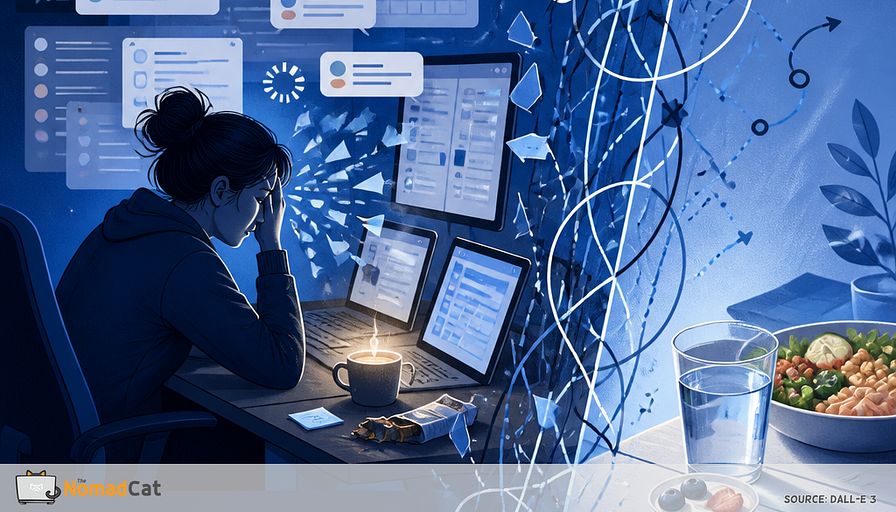
A desk day can make food feel weirdly expensive.
Not money-expensive. Context-expensive. You are mid-thread, mid-tab, mid-Slack, with 2 meetings stacked so tightly there is not even enough time to hate them properly. I’ve had plenty of those days in Berlin, and I still hit them now in Lisbon: the day looks “full” on paper, but it also feels like you’re never allowed to fully leave your chair.
In that setup, eating is not a nice break. It is a mode switch. And mode switches come with a re-entry fee.
This article puts a name on that fee: the friction tax. It is the small but real cost of stepping away and then trying to get your brain back to the exact place it was 6 minutes ago. Not just “where was I,” but also the Slack backlog, the camera-on risk, the half-finished sentence, the feeling that being unavailable is somehow… suspicious.
From there, it explains why desk work keeps selecting the same fuels, even with good intentions.
- Why coffee and snackable foods win on hard calendar days, because they are pause-safe and meeting-safe
- The early signals that show up before you call it hunger, like reread loops, typo spikes, tab pinball, and low-grade irritability
- The predictable pattern where lunch fails, liquid calories fill the gap, and the real bill lands at 16:00 and again at bedtime
- A simple “zero restart” fueling protocol designed around restart cost, not food halo
- A 3 to 5 day debug log to see if friction was actually the bottleneck
- When it is probably not friction at all, and the boring basics like sleep debt and late caffeine are running the show
The goal is not perfect eating. It is getting your inputs to behave inside a schedule that does not leave clean gaps, so the default stops being coffee plus stubbornness.
the friction tax model
Why eating feels expensive in desk work
Tabs everywhere, Slack pings, 2 meetings that ate the only empty hour, and an email thread that “needs” an answer right now. The cost is not the chewing. It’s the moment you stand up while you’re mid-sentence in a doc or halfway through editing a ticket, and you know you’ll pay for that interruption twice: once to stop, once to re-enter.
Knowledge work is naturally fragmented, with people switching activities frequently (González and Mark, 2004). Add the macro trend that meeting time has reportedly tripled since 2020 (Microsoft Work Trend Index 2023), and the day has even fewer clean gaps. Practically, this means lunch has to be shard-proof: something that still works when your “break” is 9 minutes, not 30.
When responsiveness becomes the norm, stepping away feels risky. Barber and Santuzzi (2015) call this telepressure.
The restart invoice is not 1 thing. It is a bundle.
- Thread loss: you come back and need 10 to 30 seconds to rebuild “where was I” (Trafton & Monk, 2007).
- Bad timing: pausing mid-step costs more than between steps (Monk, Trafton & Boehm-Davis, 2008).
- Visibility risk: a camera-on call starts in 3 minutes, and being seen chewing feels like the wrong kind of memorable.
- Re-entry overload: you return to a Slack backlog and attention keeps leaking to unfinished stuff (Leroy, 2009).
So the desk selects fuels that are pause-safe, camera-safe, and context-safe. Not best nutrition, best compatibility. Coffee, mints, bars, bananas, nuts, sweet drinks. Convenience is a stable motive in food-choice research (Steptoe et al., 1995; Glanz et al., 1998). Caffeine also improves alertness and vigilance (Smith, 2002), which makes it an easy patch.
A credibility constraint matters. The pieces are supported, but the full calendar-to-snack chain is rarely tested end-to-end in real workers. Field metrics on “time to resume” can include detours and task chains, not a pure brain reload timer (Mark, Gudith & Klocke, 2008). Treat the strongest part as: interruptions create a real resumption cost, especially when you break at a bad moment. Treat the softer part as a working model: that this cost plus visibility/reachability pressure is what pushes you toward coffee-and-snacks.
what restart tax looks like in your work
Signals you can see without tracking food
Around 11:47, the calendar looks “fine” and the stomach is quiet, so everything must be fine too. Then the work starts leaving fingerprints. Not dramatic. Small quality leaks that show up before you label it as hunger.
- Reread loops: reading the same paragraph 3 times and still not trusting it.
- Typos and micro-errors: small mistakes in emails, variable names, Jira updates, “wait what did I just send”.
- Tab pinball: switching tabs like you are searching for a missing thought.
- Slow starts: opening the doc and needing 2 to 5 minutes just to “enter”.
- Mild irritability: the Slack ping feels louder than it should. Hunger and irritability correlate in sampling studies (MacCormack & Lindquist, 2017).
Mental work can also push later intake up without any moral story attached to it (Chaput et al., 2008). So the day may look controlled at noon and then collapse at 17:30. These are logs, not flaws.
Lunch feels like stolen time because attention is still paying interest on unfinished threads. Leroy (2009) calls this attention residue. It is basically a background process you did not quit. 1 boring mitigation helps: make a simple plan for the next step. It reduces interference from unfinished goals (Masicampo & Baumeister, 2011).
There is also a social layer. In a reachability culture, being “available” is part of how competence is read. Telepressure makes breaks feel reputationally expensive even if nobody says it out loud (Barber and Santuzzi, 2015). The cues are tiny but real: the green dot, the camera-on meeting, the fast reply expectation—and that small moment where you angle your face away from the webcam so nobody clocks the bite.
the predictable failure signature
Coffee as the work compatible boot sequence
Caffeine is genuinely useful, and that is part of the trap. Coffee is 1-handed, fast, and it does not require a boundary. So it becomes default fuel while inbox triage starts and meetings land. Smith (2002) supports why it works short term.
When mornings are meeting-heavy, that patch can displace water and food for hours. Mild hypohydration is linked to worse fatigue and lower vigor in controlled studies, even when cognition effects are mixed (Armstrong et al., 2012; Ganio et al., 2011). So someone can feel awake but not good, and treat that as normal desk-day grind.
Lunch fails because the window is dirty
Midday becomes a scheduling problem, not a hunger problem. The clean window keeps getting shaved into shards. A 12:00 to 12:30 slot becomes 12:07 to 12:19 because the 11:30 runs over and the 12:30 starts early. Somehow the only safe moment is always 4 minutes from now.
Liquid calories show up for mechanical reasons. Drinks do not force a full mode switch. But liquid calories often lead to weaker “payback” later than solid calories—people don’t reliably eat less afterward to compensate (DiMeglio & Mattes, 2000). Thick vs thin matters. Whether your brain files it as a beverage or a meal matters (Almiron-Roig et al., 2013). So the drink can be perfect at 12:18 and show up again as real hunger at 15:30.
Even when solid food exists, the environment punishes “real meal” properties.
- low odor
- low mess
- minimal prep
- 1-hand compatible
- fast cleanup
- shelf-stable and food-safe
This is not pickiness. It is the setup.
The 15:00 fix and the sleep invoice
Between 15:00 and 17:00, the demand is rarely “a meal.” It is “make my brain sharp again, now,” with an exit option. Underfueling stacks, irritability becomes more likely, and the hand reaches for low-restart levers. Caffeine. Sugar. Pauseable snacks.
The catch is that the same tool that sharpens now can steal sleep later. Caffeine taken 6 hours before bedtime can disrupt sleep duration and efficiency (Drake et al., 2013). A cautious rule of thumb is avoiding caffeine within about 6 hours of bedtime, noting some people need longer.
When obligations finally release, real hunger shows up with urgency. Meal skipping and earlier under-eating commonly lead to later compensation. Dinner can feel like a cliff instead of a choice. Not lack of discipline at night. A chain of small missing inputs earlier.
the friction ladder for desk compatible fuel
Ranking food by restart cost not health halo
Under load, the selection rule becomes simple: does this let me keep working without paying re-entry. That is why the same defaults keep winning even with good intentions. Convenience is measurable and stable (Steptoe et al., 1995). Small changes in friction and placement shift what people pick (Hollands et al., 2019). If different fueling is the goal on hard days, the system usually needs a restart-cost change, not a motivation speech.
Bottom rung is ultra-low friction and meeting-compatible.
- coffee
- mints, gum
- sweet drinks
- thin liquid calories like juice or a quick shake
Coffee gets chosen because it helps alertness (Smith, 2002). Thin liquids often do not buy much satiety. Thick liquids and “this is a meal” framing tend to behave differently than “this is a drink” (Almiron-Roig et al., 2013).
Middle rungs are low interruption, low mess, easy to pause, and visible for hours. Bars, candy, nuts, crackers, dried fruit. These drift into grazing because they are unitless and always within reach. A single bar has a boundary. An open bag does not. Packaging and portion cues shape intake (Hollands et al., 2015).
Top rung is “real meal” food that requires a context switch. Utensils, reheating, plating, cleanup. Cleanup sounds trivial until it stacks with re-entry anxiety. Resumption lag is a real cost even when interruptions are short (Trafton & Monk, 2007). Lower friction first, and the discipline story often shrinks by itself.
the zero restart fuel protocol
Setup defaults that survive real calendars
This section is intentionally boring. My wife is a fitness trainer and nutritionist, and she has a talent for making the “right thing” look embarrassingly unromantic: fewer heroic plans, more defaults you can repeat when the day is rude.
Water is included for a boring reason. It is the cheapest “am I just running low” check.
Constraints that make this actually survivable on a bad calendar:
- About 2 to 4 minutes total from standing up to back at the keyboard.
- Default to no reheating, unless you know you truly have a clean block.
- Default to no sink-required utensils (if it needs a fork and a wash, it tends to not happen).
- Low odor.
- Low crumbs and low mess.
- Minimal cleanup: 1 napkin, 1 wrapper, done.
- Water included: 250 to 500 ml.
- Desk-legal food: practical basics like yogurt, nuts, fruit, cheese, or a simple protein option.
Step A pre commit the re entry
Before the first bite, write 1 line for what you will do when you come back. This kind of “park the goal” cue can improve resumption after an interruption (Trafton et al., 2003). Simple planning reduces mental noise from unfinished stuff (Masicampo & Baumeister, 2011).
Examples.
- “Add 3 bullets to the intro and stop.”
- “Reply to Alex with option B and 1 sentence why.”
- “Rename the variable and run tests.”
- “Open ticket 1842 and write the reproduction steps.”
This does not make the break perfectly calm. It just contains the work thread. It is basically an if-then plan in plain clothes (Gollwitzer & Sheeran, 2006).
Step B fuel
Eat 1 low-mess chewable thing plus water in 2 to 3 minutes. No amounts prescribed, just something consistent. Higher-protein snacks tend to increase satiety and reduce hunger compared with lower-protein alternatives in controlled work (Leidy et al., 2011).
Options that often fit.
- Greek-style yogurt or skyr cup
- Cottage cheese cup
- A cheese stick plus grapes
- Hard-boiled eggs
- A small handful of nuts
- Roasted chickpeas or edamame
- Tuna or salmon pouch with crackers if odor is acceptable
- Jerky or biltong
Step C done signal
An explicit endpoint.
- Close the container or throw away the wrapper.
- Wipe hands and keyboard area if needed.
- Move remaining food out of sight and reach.
- Return to the pre-committed next action line.
A lot of eating is automatic and cue-driven, especially when food is visible and effortless (Marteau, Hollands & Fletcher, 2012). Boundaries like package size matter (Hollands et al., 2015).
This is not nutrition perfection. It is paying down restart cost once per day so the default does not have to be coffee plus willpower. Lower restart cost, and better inputs become the path of least resistance.
a 3 to 5 day debug log
A minimal scoreboard that is hard to game
Not calorie tracking. Not weight. Just boring signals that show up in a 10-hour desk day.
Over 3 to 5 days, useful shifts look like this.
- Fewer panic coffees after 14:00
- Fewer kitchen laps that are really search behavior
- Less 16:00 rereading where nothing enters
- Less edgy tone in tiny moments
- Dinner feels less urgent
- Less flat fatigue in the afternoon
The 2 line check.
Protocol today (Y/N)
16:30 state (steady / foggy / snacky / edgy)
Optional upgrade: use KSS 1 to 9 or fatigue NRS 0 to 10.
If the pattern shifts quickly, friction was likely the bottleneck. If nothing moves, do not escalate complexity yet. It just means the bottleneck is elsewhere.
when restart friction is not the problem
If the crash happens even on a low-meeting day, suspect the basics before blaming restart cost. Sleep debt, late caffeine, or plain underfueling can dominate. Caffeine can also steal sleep if it lands too late. A rough cutoff around 6 hours before bed fits the evidence, and some people need earlier (Drake et al., 2013).
Stress can also edit hunger signals. Appetite can go up or down depending on the person and the stressor (Adam & Epel, 2007; Torres & Nowson, 2007). “Not hungry” under pressure is not proof the tank is full.
Safety guardrails: if symptoms are heavy or persistent, stop running food experiments and get proper input. Red flags include persistent severe fatigue, dizziness, near-fainting or fainting, significant unintentional weight loss, and any situation where an eating-disorder history could be re-triggered. If insulin or sulfonylureas are in the picture, skipping or delaying meals can increase hypoglycemia risk and should be aligned with a clinician (CDC; NHS; ADA Standards of Care 2024).
The model stays narrow. It is for common desk-day drift where fueling keeps losing to the calendar. The win is boring stability in a hostile schedule, not perfect eating.
Desk days do not just steal time, they add a hidden fee. The friction tax is that re-entry cost when you step away, then have to rebuild the thread, face the Slack backlog, and show up “available” again. No wonder coffee and snackable foods keep winning. They are meeting-safe, pause-safe, and they do not trigger a full mode switch.
The useful shift here is treating fueling like a system problem, not a discipline problem. Watch for the early error logs (reread loops, typo spikes, tab pinball, irritability), then lower restart cost with a simple protocol: pre-commit the next action, eat something chewable plus water in a few minutes, close it out, and go back in.
Most days, the biggest lever is not finding better motivation. It’s making “real fuel” require less restart than another coffee.
You might be interested by these articles:


The 3 to 6 minute food commit that stops desk day grazing

The 3 minute exit handshake that stops the dinner cliff after deep work

Second-order hunger and the next-day crash on meeting-wall days

Your calendar is giving you jetlag and lunch keeps missing the handoff

Coffee #2 should not be lunch

How sharp opening lines boost your LinkedIn profile as a tech independent

Smoothing freelance income with rolling-average models