Abstract:
The article explains why long, uninterrupted deep-work “tunnels” can make hours disappear and leave you resurfacing at 15:30 or 17:00 with a backlog of ignored body signals—dry mouth, tight shoulders, a slight headache, jaw clenching, rereading lines, a sharper tone in messages—because heavy cognitive load creates time blindness, screens mask internal cues, and deep work lacks natural transition hooks like meetings. It distinguishes this “hyperfocus hangover” (the day had space, but you didn’t surface) from lookalikes such as calendar-crushed missed lunches, stress-driven snacking, or distracted “desk lunches” that don’t register, and argues the solution isn’t a new app, perfect plan, or ideal meal but a tiny boundary placed exactly at the moment you come up for air. The proposed fix is an “exit handshake” done before opening email/Slack or “checking one thing”: drink water (about 250–500 mL) and eat one quick, chewable “anchor” snack (e.g., yogurt + fruit, cheese + crackers, hummus + carrots, a half sandwich, edamame, nuts + fruit), using repetition and simple desk setup to make it the default and prevent the evening “dinner cliff” and 21:30 crash that often leads to “rescue coffee” and a sleep-disrupting caffeine loop. Framed as a systems problem rather than a discipline failure—illustrated by the author’s own desk-bound life from Beijing to Berlin to Lisbon—the piece also notes guardrails for people for whom meal timing is safety-critical (e.g., insulin-treated diabetes, pregnancy with glucose issues) and advises backing off if rules start to fuel rigidity or eating-disorder patterns.
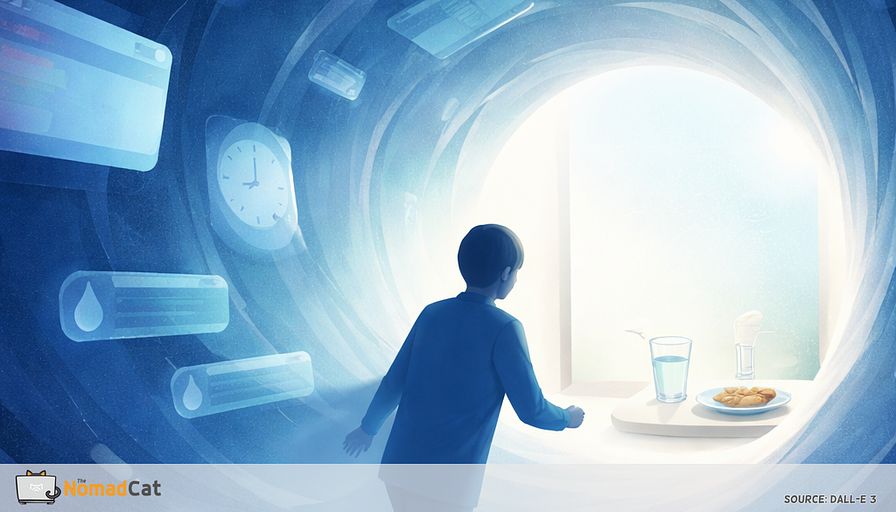
You sit down with 1 doc open, a dataset lurking in the background, and 20 tabs you’ll “close later.” No meetings. No one interrupting. Just that quiet tunnel where the next tiny problem is always 5 minutes from solved.
Then you look up and it’s 15:30. Or 17:00. And time feels mildly offensive, like it stole a few hours while you weren’t watching.
If this is your normal, it’s not just “bad planning.” Under heavy cognitive load, time estimation gets sloppy, and when attention is locked on the screen, the brain logs less of everything else.
Hunger and thirst don’t vanish. They queue.
- You don’t notice them until you resurface
- They arrive all at once (not politely)
- They come with friends: dry mouth, tight shoulders, a slight headache
- Your messages get shorter for no good reason
- Dinner turns into a cliff, and “rescue coffee” shows up with its own side effects
This article is about that moment when you come up for air, and how to make it less expensive.
You’ll get a simple map of what’s happening during deep work (time blindness, cue masking, missing transition hooks), a quick way to tell hyperfocus hangover apart from lookalike problems like stress-snacking or calendar-crushed days, and a small boundary that still works when you’re in the tunnel. The core idea is not a new plan, app, or perfect meal. It’s a tiny “exit handshake” that creates a seam, so refueling happens before email, Slack, or “just checking one thing” quietly restarts the loop.
Small inputs. Low drama. Better evenings. That’s the whole point.
When you come up for air
The resurfacing moment
Here’s the bug: if your attention isn’t pointed at time, time doesn’t get logged properly (Zakay & Block, 1997). Same reason “I’ll check Slack for 1 minute” is fiction.
A common output of that tunnel is what you can call hyperfocus hangover. You finish a long focus block and only then notice the body has been quietly offline.
It’s not a character flaw. It’s closer to a system state change. Attention is pointed outward, so internal signals get pushed down the queue.
The “bundle of delayed alerts” is pretty consistent:
- Dry mouth, suddenly noticeable
- Cold hands on keyboard
- Tight upper back “hello again”
- Small headache behind eyes
- Rereading the same line twice
- Jaw clenched for no reason
- Shorter tone in messages
- Everything feels oddly heavy
- Hunger arrives late and loud
- Thirst shows up after hunger
A useful model is simple: the signals didn’t disappear, they queued.
That queue sets up the evening chain. You under-fuel during the day, then the first break triggers urgent, fast calories. Dinner becomes a cliff, not a meal. Then often a second wave around 21:30, when the brain remembers it’s still running on fumes and starts negotiating.
And yes, the “rescue coffee” can feel like a reasonable patch. The cost is boring but real: caffeine even 6 hours before bed can disrupt sleep (Drake et al., 2013). Poor sleep also tends to increase next-day caffeine reliance (Clark & Landolt, 2017). Congrats, you found a loop.
Why hunger stops working during deep work
3 mechanisms that mute appetite cues
Time blindness is the obvious one. In hyperfocus, “after this section” turns into a little while(true) loop. Deep work also removes the usual markers (walk to a meeting, lunch break, someone asking a question), so the day compresses in memory (Block, Hancock & Zakay, 2010).
Then you get the annoying part: the more “in it” you are, the less the body gets a vote. The screen becomes the whole world, internal signals lose the competition, and sitting still removes physical prompts that normally trigger eating and drinking. Caffeine can also muddy appetite cues for some people, though effects vary.
Finally: deep work doesn’t come with built-in seams. Meetings create them. Deep work is seamless, so eating has nowhere to stick. If eating is supposed to happen, a boundary has to exist even when work feels urgent.
Short breaks reduce fatigue and discomfort in desk work (Kim, Park & Niu, 2017). The broad map is strong. Direct “deep work leads to lower intake” studies are still thin.
Similar problems that need different fixes
A quick differentiation map
Some “missed lunch” is calendar-compressed: meetings and external demand block you, so you end up with secondary eating (snacking while working) because time pressure pushes meals out.
Hyperfocus hangover is different. Access was there. You just didn’t surface.
If the day had space but you still missed food, then solve “surfacing” (a seam), not “scheduling” (a plan).
Stress-driven snacking is another lookalike. It tends to happen during the pressure moment. And responses vary a lot: some people eat more, some less (Steptoe, Lipsey & Wardle, 1998; O’Connor et al., 2008). This is why generic advice can feel fake.
Pattern Trigger Timing What to change Inbox snacking stress, interruptions, hassles during the stress reduce friction for better options, add a non-food pause Hyperfocus hangover sustained concentration + time blindness after you resurface add a hard seam that forces refuel before re-entryThere’s also the “desk lunch didn’t register” case: you technically ate, but it was token bites while reading a thread you already hate. Distraction can affect regulation and later intake partly because the meal is poorly encoded in memory (Robinson et al., 2013). Not magic. Just missing logs.
So the intervention needs to be small, repeatable, and placed exactly at the seam.
The exit handshake
A boundary that still works when you are in it
When the deep-work block ends (natural stop, or a timer), run a tiny exit handshake. The power is the order: fuel happens before you reopen the world.
1) Water
2) 1 chewable anchor
Total: 3 to 4 minutes. Boring by design.
It’s basically an if-then rule, and those tend to improve follow-through compared with vague intentions (Gollwitzer & Sheeran, 2006), including in food-related behaviors (Adriaanse et al., 2011).
The handshake happens before email, messages, “just checking one thing,” or starting the next block. Because “just 1 message” is rarely 1 message. It restarts the tunnel.
This is not “lunch.” It does not need to be correct, pretty, or macro-perfect. The aim is to lower urgency so later choices stay choices, not a vending-machine incident. Missed days happen. Occasional lapses don’t zero out habit formation (Lally et al., 2010).
If the day is truly seam-free, manufacture a soft ending. Many people tolerate 75 to 120 minute blocks with a gentle end cue (timer, calendar nudge, playlist ending) better than aggressive buzzing every 25 minutes. If you already wear a watch, use its timer—no new app, no extra ceremony.
What to eat and drink in 3 minutes
Desk anchors that prevent the dinner cliff
The anchor is the minimum effective dose. Small enough that it doesn’t feel like “now we stop everything,” but big enough to change the next 2 hours.
A simple template is “carb + protein.” Carbs are fast fuel. Protein makes it stick. This aligns with mainstream sports nutrition guidance (Thomas, Erdman & Burke, 2016) and controlled snack work where higher-protein afternoon snacks improved appetite control vs lower-protein alternatives (Douglas et al., 2013).
First packet is water. Then something chewable that doesn’t explode over a keyboard.
-
Water 250 to 500 mL (first, not “after this email”)
- Yogurt or skyr + fruit
- Milk or soy drink + banana
- Cheese + crackers
- Hummus + carrots or cucumber
- Half sandwich (whatever is available, no ideology)
- Protein shake + fruit
- Edamame (salted is fine)
- Small leftovers (yes, even cold)
- Nuts + a piece of fruit (keep it small, or it becomes dinner-by-accident)
Pick 2 to 3 you can repeat. Repetition is the trick because it removes decision load right when the brain is coming out of the tunnel.
Coffee can stay. It just needs a rule so it doesn’t quietly replace food.
Moderate coffee contributes to fluid intake for habitual drinkers (Popkin et al., 2010; Killer, Blannin & Jeukendrup, 2014). The issue is substitution: when coffee becomes the only input, the body still invoices you later. If a “rescue coffee” is happening, pair it with the chewable anchor by default, and keep an eye on timing (Drake et al., 2013).
Defaults that survive deadline weeks
Choose once then stop negotiating at 17:00
I’d pre-pick 2 to 3 anchors you can tolerate even when you’re “not hungry” and slightly annoyed at the concept of being human. Keep them boring and morally neutral. Boring works.
This targets a real planning failure: in the moment, urgency changes what seems reasonable, and people mispredict that shift when they plan in a calm state (the hot-cold empathy gap; Loewenstein, 1996).
Placement beats intention when Slack is loud
Make the right choice physically easier than the wrong one.
Before: you end a block, think “i’ll grab something after i reply,” open messages, and 45 minutes later you’re still there with nothing in the system.
After: you end a block, the water is visible, the anchor is in the drawer next to the laptop charger, and the handshake happens before you re-enter the noise.
This is choice architecture applied to your own desk. Small environment tweaks can shift selections without extra willpower (Thorndike et al., 2012/2014). It’s not about being “disciplined.” It’s about making the default the path of least resistance.
A systems lens instead of guilt
The framing helps: this isn’t a motivation problem. It’s a missing boundary.
The author has spent most of adult life at a desk, from Beijing to Berlin and now Lisbon. It’s possible to work a full day without eating or drinking and call it “focus.” It’s not a superpower. It’s just a missing seam in the system. When my sleep data looks bad, the first thing I check now is not macros. It’s whether I went 6 hours with basically no water.
Guardrails
When not to treat this as a casual experiment
For most desk people, this is annoying, not dangerous. But meal timing is safety-critical if any of these apply:
-
Diabetes treated with insulin or sulfonylureas (hypoglycemia risk)
-
Pregnancy, especially with glucose issues
-
Adrenal insufficiency
-
Frail older adults (dehydration, falls, undernutrition risk)
-
Children and adolescents
And some symptoms are a clean stop sign for DIY desk protocols:
- Recurrent dizziness, fainting, chest pain (needs clinical evaluation)
- Severe new fatigue that sticks around
-
Unintentional weight loss (about 5% in 6 to 12 months)
Also: if any “debugging” starts to push toward rigidity, rule escalation, or old eating-disorder patterns, step back and get support (NICE NG69; APA guidance). Structure should reduce chaos, not create a new thing to obey.
If food rules feel edgy, a softer variant is: water only, then a 2-minute pause before reopening email. Stability and safety beat protocol compliance.
If your days disappear into a tab-filled tunnel, the problem is rarely “discipline.” It’s missing seams. Under load, time gets fuzzy, body signals get muted, and you only notice the backlog when you resurface with dry mouth, tight shoulders, and a dinner-sized emergency.
The fix here stays small on purpose. Add a simple exit handshake at the end of a focus block: water first, then 1 chewable anchor. 3 to 4 minutes, no perfect lunch required. That tiny boundary lowers urgency, reduces the late-day crash-and-snack pattern, and makes coffee a choice again instead of a patch. It also protects the evening from turning into a second shift.
Most days don’t need a new plan. They need a seam you can’t argue with.
You might be interested by these articles:


The 3 to 6 minute food commit that stops desk day grazing

Your calendar is giving you jetlag and lunch keeps missing the handoff

The 90 second gap after calls that sends you to the fridge

The dinner cliff when the laptop closes and your brain demands food now

Fuel debt is the hidden source of tab pinball and sharp replies

Your breaks keep getting deleted by the calendar

A boring support stack for indie freedom that survives bad weeks