Abstract:
The article explains how a busy “desk day” can keep producing output while quietly deteriorating because high cognitive demand is being financed by delayed, fragmented, or liquid-only eating—creating “fuel debt” that doesn’t always feel like hunger but shows up first as rising latency and friction (more rereads, typos, staring at the cursor, “tab pinball,” and a subtle drift toward sharper-than-intended Slack tone), then “charges interest” later when dinner becomes whatever has the lowest friction and decision-making collapses into defaults like delivery-app refreshing. Using a systems-maintenance, non-guilt framing (like skipping upkeep while background processes keep running), it argues that coffee and drinkable calories can patch functionality without clearing the debt because solids and chewing provide a clearer satiety “stop signal,” so the practical solution is a tiny, realistic “minimum payment” of chewable food inserted before predictable spike windows (camera-on blocks, deep work sprints, the 15:00–18:00 stretch), measured by output-based logs rather than body metrics (fewer rescue coffees, fewer phantom kitchen laps, fewer rereads, fewer “oops sorry” follow-ups, and a dinner that feels like a choice). It also offers a quick 15-second diagnostic—whether you trust your brain to write a clear paragraph in 10 minutes and whether any normal food sounds OK versus only something very specific—plus guardrails that fatigue may require medical attention (especially with hypoglycemia risk) and that any approach that increases anxiety or rule-stacking should be stopped.
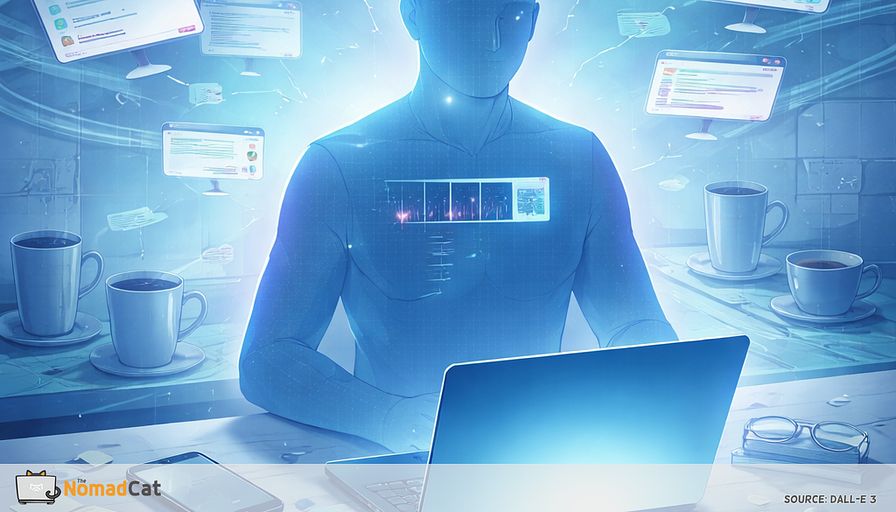
It is weird how a desk day can keep “working” while quietly getting worse.
At 11:30, the calendar is stacked with 25-minute meetings. Lunch becomes coffee. Then half a sandwich while the other hand is still typing. You still ship. You still answer Slack. And yet, later, the system gets noisy. A typo here. A reread there. A reply that is technically fine, but somehow sharper than you meant.
This article is about that pattern, without making it a discipline story. I’ve done it across Beijing, Berlin, and now Lisbon—same pattern, different timezone.
The idea is simple. When cognitive output stays high but food inputs get delayed, broken up, or replaced by liquids, you start running a kind of fuel debt. It does not always feel like hunger. It shows up first as latency. More restart costs. More “why am I staring at this cursor” moments. And then the interest hits at 19:30, when dinner turns into whatever has the lowest friction.
Here’s what you will get as you keep reading.
- A clear model for fuel spend vs fuel debt, using systems language instead of guilt.
- The early signals that show up in your work logs before you notice hunger, like micro-errors, tab pinball, and tone drift.
- Why coffee and drinkable calories can patch the day but still leave the debt sitting there.
- A fast 15-second diagnostic that works even when appetite is muted.
- A “minimum payment” approach that fits inside a real schedule, with simple chewable options and output-based ways to check if it’s helping.
- A few guardrails, because sometimes fatigue is not a snack problem.
The goal is not perfect meals or a new system to manage. It is to make the day steadier with the smallest possible input, so late-day you is not forced to run the whole operation on defaults.
The fuel debt model
A desk day held together with patches
Under stress, regular meals are often the first thing that gets postponed. That is normal. The problem is mechanical: once intake gets delayed or fragmented, the cost shows up later as latency—more rereads, more restart costs, and more “why is this simple thing taking effort” moments.
Fuel spend and fuel debt
Fuel spend is the simple case. Intake roughly matches output, so the day runs without heroics.
Fuel debt is when output stays high while intake becomes fragmented, liquid, or delayed. Coffee for breakfast. No time for lunch. A late snack that is more random than planned. In systems terms, nothing is morally wrong here. The body is just being asked for consistent cognitive work without consistent inputs.
Fuel debt also grows quietly because hunger is not a reliable alert. Stress can blunt appetite for some people, while for others it pushes toward more palatable foods later (Adam & Epel, 2007). Add deep focus and hours pass without noticing basics. Add caffeine and timing cues get delayed again. So the first symptom is rarely “I’m hungry.” It is “my brain is taking longer to load.”
The trio that keeps debt silent
- Stress and time pressure shifting routines
- Deep focus where hours disappear
- Caffeine that keeps you functional while masking timing
Remote work can be strangely risky. The body is still, the brain is loud, and the kitchen is 5 meters away and somehow inaccessible.
Once debt is in place, the problem is interest. Not just bigger hunger later. More decision friction, lower patience, and defaults winning. Late-day you does not choose the lowest-quality option because of a lack of discipline. Late-day you chooses the lowest-friction option because everything else feels like another ticket in the backlog.
A tech analogy makes it stick. Fuel debt is like running background processes while skipping maintenance. The system still boots. Deploys still happen. But latency rises, small errors multiply, and eventually the machine starts throttling. Lapses and variability show up before anything dramatic happens (Lim & Dinges, 2010).
The signals hiding in your work logs
Cognitive errors show up first
Before hunger becomes obvious, interest often appears as restart costs and micro-errors in the work artifacts you already have. Task switching has measurable penalties. Interruptions add resumption lag because the brain has to reload the goal (Altmann & Trafton, 2002). So if you’re hunting for “the first symptom,” it’s not hunger—it’s reload time.
In desk language
- Rereading the same paragraph 3 times
- Tab pinball across 6 tabs and forgetting why tab 2 is open
- More typos and small syntax mistakes
- Slower starts on simple tasks like a 3-line reply
- Staring at the cursor after a ping
- Double-checking everything because confidence is lower
Fuel debt does not announce itself. It just raises the cost of getting back into the work, over and over.
Tone starts drifting
Once cognitive friction is up, social behavior can get sharper around the edges. Sleep loss reliably worsens mood including irritability (Pilcher & Huffcutt, 1996). So it is not surprising when replies get shorter and patience in meetings thins out.
It is often subtle. The message is technically correct, but it lands with unnecessary heat. Later, reading the thread feels like meeting a slightly meaner version of yourself.
Urgency behaviors look like escape attempts
When interest kicks in, urgency leaks into small actions. Hunger is associated with more anger and irritability in daily life (MacCormack & Lindquist, 2019). Mechanisms are debated, and simple fuel stories can be too neat (Kurzban, 2010). Still, the desk pattern is familiar.
Work-native urgency often looks like
- Coffee as a permission slip for 1 more hour
- Opening the fridge, nothing looks right, closing it
- Wanting 1 very specific thing, not food in general
- Snacking while still deciding what the meal is
- Refreshing delivery apps like they are a calendar invite
The evening penalty is mostly default drift
Late day, fuel debt collects at dinner. Not because dinner is weak, but because dinner happens when choice bandwidth is already spent. Decision quality often drifts across long sessions and improves after breaks, in ways that look like defaulting (Danziger et al., 2011).
So the evening loop is predictable. Grazing while deciding. Ordering the same safe option because it has low cognitive cost. Snacking after dinner because dinner happened too late and too fast to register. Not a moral failure at 20:30. Earlier debt, showing up as defaults.
Liquid patches do not clear the debt
Liquids are convenient, and sometimes they are all that fits between 2 meetings. But as payment, they often do not register the same way solids do. In controlled comparisons, drinkable calories tend to produce weaker satiety and poorer compensation later than solid foods (DiMeglio & Mattes, 2000).
Solids are not magic. They are input with a clearer stop signal. Chewing, texture, and time spent processing matter for satiation (Robinson et al., 2014). Practically, a yogurt with a spoon or nuts you actually chew often lands differently than the same calories in a drink.
This is not anti-shake ideology. Liquids can be a smart tool when the calendar is hostile. The catch is when the day becomes only liquids and fragmented bites, so satiety never really closes and snack urgency stays online. If the logs still show tab pinball, sharp tone, and delivery app refreshing at 19:30, treat the drink as a patch and add 1 chewable, boring anchor.
The framing here is debugging, not food rules. If you like observable outputs, the truth source is what shows up in the day’s logs, not what a meal is supposed to mean.
A fast diagnostic and a minimum payment
The 15 second check
Most desk fueling advice assumes you notice hunger, then behave like a calm adult with 25 minutes free. A better check is operational. More like reading error logs.
- If you had to write a clear paragraph in 10 minutes, do you trust your brain?
- Would any normal food sound ok, or only something very specific?
- Decision rule: If both answers look bad, treat it like a small incident. Pay a minimum amount now, because waiting usually hands the decision to defaults later when friction is higher.
Minimum payment experiment
Define the experiment like this. Install 1 small chewable intake before your most common spike window, when meetings or deep work make eating feel expensive. This is the regular-meals idea, shrunk until it can survive reality.
I like boring metrics and boring logs, because they argue less than intentions.
Common windows
- Before a camera-on block where you know you will not stand up
- Before a deep work sprint where interruption costs are high
- Before the 15:00 to 18:00 stretch where 1 more thing tends to happen
Rules
- Chewable. Liquids can help, but they often do not register like solids (DiMeglio & Mattes, 2000).
- Has an end marker. Otherwise it becomes invisible grazing.
- Small enough for chaos. No meal prep empire. No tracking apps multiplying like rabbits.
Simple options that usually work
- Nuts plus fruit
- Yogurt plus something crunchy
- Half a small sandwich
Success metrics are output metrics, not body metrics. Run it for 5 workdays and watch boring logs.
- Fewer rescue coffees taken for focus, especially late day
- Fewer phantom kitchen laps
- Fewer rereads per paragraph before pressing send
- Less sharp tone in messages, or fewer oops sorry follow-ups
- Dinner feels more like a choice and less like an app default
Guardrails
Fuel debt explains a lot of desk weirdness, but it is not a universal key. If fatigue is severe, persistent, or paired with red flags, get a proper medical assessment rather than trying to snack-engineer your way out of it.
Be careful if you have a history of low blood sugar, especially if you take diabetes meds like insulin or sulfonylureas—changing meal timing or “just adding a snack” can affect blood sugar in ways that are worth handling with a clinician.
Stop rules beat stubbornness. Stop if the experiment increases anxiety, compulsion, or rule stacking. A method that makes your week worse is a failed method.
Small payment. Lower interest. Less chaos later.
Desk days rarely fail with a dramatic crash. They fail with latency. More rereads, more tab pinball, a reply that is correct but weirdly sharp, and dinner turning into whatever has the lowest friction. The useful shift here is dropping the discipline story and treating it like systems maintenance. When output stays high and intake becomes delayed or mostly liquid, fuel debt grows quietly, then charges interest late day as decision fatigue and default drift.
The fix does not need perfect meals or another app. A small chewable minimum payment placed before the usual spike window can lower restart costs, reduce rescue coffees, and make the evening feel less like an emergency deploy.
Most people can spot the earliest signal in their logs: the day still “works,” but the reload time starts creeping in.
You might be interested by these articles:


The 3 to 6 minute food commit that stops desk day grazing

Second-order hunger and the next-day crash on meeting-wall days

When stress turns lunch into a 16:30 invoice

The 3 minute exit handshake that stops the dinner cliff after deep work

When lunch turns into a drink and your afternoon still crashes

Breaking the portfolio plateau for tech minimalists

Space Tech Innovations Transforming Everyday Life