Abstract:
The article explains that the common 2–5 p.m. slump many desk workers experience—brain fog, typos, irritability, “random kitchen laps,” and escalating coffee urgency after a 10-hour day packed like Tetris with camera-on meetings—is often a predictable outcome of work conditions rather than a lack of nutrition knowledge. It argues that being “watched” triggers frontstage behavior: people adopt “performance-proof fueling,” treating food and water as professional risks (chewing on camera, loud wrappers, crumbs, bathroom breaks, or getting caught mid-bite) and relying on coffee as “insurance,” sometimes even avoiding fiber or water to keep their bodies quiet and predictable. Stress can temporarily mask hunger and create a wired, overclocked feeling during high-stakes blocks, but because the work is sedentary and remote work removed incidental movement, the rebound hits later when the alert state fades—often right in that 14:00–17:00 window. The proposed fix is not a lifestyle overhaul but a small, permission-aware system change: run a five-day experiment adding a low-odor, low-mess, familiar pre-call “stabilizer” (e.g., yogurt/skyr, cheese plus fruit, banana with nuts, a hard-boiled egg, a small half-sandwich, edamame, or a known-tolerable protein bar—while avoiding new fiber/sugar-alcohol surprises like chicory root) timed to fit “meeting physics” (during the last slide scan, audio check, or an initial camera-off moment). Instead of tracking calories, measure outcomes through work outputs—rereads/typos, tone drift, kitchen laps, and whether dinner feels like an emergency—while noting guardrails for medical red flags, diabetes/pregnancy-related glucose issues, or eating-disorder history, and adjusting next with earlier caffeine, a short post-lunch walk, or more solid/protein at lunch if needed.
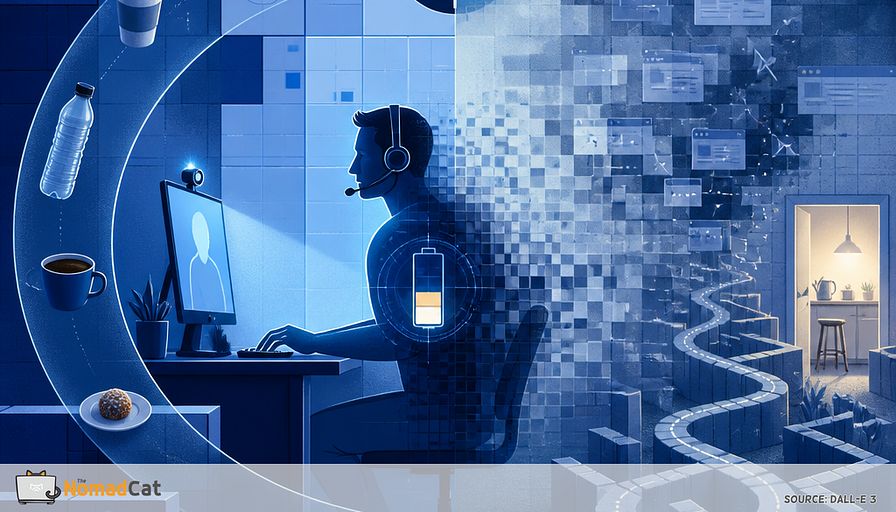
You know the pattern. A 10-hour desk day, a calendar that looks like Tetris, and at least 1 camera-on block where you suddenly act like food and water are liabilities. Coffee is fine. Chewing is suspicious. Water is “later” because bathroom timing is a whole operational risk. Then 15:00 hits and your brain starts throwing errors. Fog. Typos. Irritability. Random kitchen laps. And a vague sense that you should be better at being a person.
I’ve had versions of this across bad chairs and worse desks in Berlin, and now in Lisbon on mostly-remote days where work can drift late.
This isn’t really a nutrition knowledge problem. It’s a work-conditions problem. When you’re being watched, you do “frontstage” behavior. You manage the performance. Eating turns into what this article calls performance-proof fueling, where the goal is not a great lunch, it’s avoiding anything that could make you look unprofessional or disappear mid-sentence.
Here’s what you’ll get in the pages ahead:
- Why the 14:00–17:00 crash is often predictable, not random
- The 3 fears that drive weird pre-meeting food rules like avoiding water, fiber, or anything “messy”
- How to tell if your real bottleneck is lack of minutes or lack of permission
- A small pre-call stabilizer experiment that fits meeting physics, not an app-based lifestyle fantasy
- Simple ways to track results using work outputs like rereads, tone drift, and coffee urgency
- Guardrails for when this is bigger than a desk tweak and it’s time for medical help
The point is not to become a different person. It’s to change the system where your most high-stakes meetings quietly decide your afternoon energy policy.
When being watched changes what you eat
The calendar block that rewrites your rules
You are fine. Then that 90-minute block gets closer. Camera-on, someone important, decisions being made in real time. Suddenly food and water feel… risky.
You delay a sip because you might need the bathroom. You avoid anything that could get stuck in your teeth. You keep your mouth empty “just in case,” and you stay camera-ready like being visibly human is a small professional mistake.
The crash later is often the bill for that risk math: optics, interruption risk, and bathroom risk.
It’s possible to work a full day without eating, drinking, or moving, and for a long time it can look like efficiency, until the costs show up, especially late-day focus and sleep.
There’s a simple name for this: frontstage behavior (the “on stage” version of you). When the room is watching, you manage the performance. And when your day is high-demand and low-control, you end up making choices that look weird on paper but feel rational in the moment.
“Performance-proof fueling” is when eating becomes less about hunger and more about reducing the chance of brain fog, stomach noise, awkward chewing, or a mid-meeting disappearance.
It’s not “skipping meals” as a moral thing. It’s choosing inputs that feel low-risk for reputation and output in the next 60 minutes. It’s basically a pre-flight checklist, just for Zoom.
- No food before big meeting
- Coffee as insurance
- Avoid water, avoid bathroom
- Nothing “messy” on camera
- Skip fiber to stay quiet
- “I’ll eat after if time”
- Only familiar “safe” foods
The logic isn’t crazy. Athletes do a version of this too: before performance, they stick to familiar foods and avoid anything likely to cause stomach surprises. The desk-work version is just constrained by different rules: you can’t disappear, you can’t chew loudly, and you can’t gamble on your gut right before someone asks you a question.
Meeting density is one thing: you truly have no minutes. Performance-proof fueling is different: minutes exist, but the perceived cost of eating or drinking (optics, interruption risk) feels higher than the cost of underfueling.
Once you name it, the timing stops looking random. It tends to show up in a predictable 14:00–17:00 window.
Why the crash clusters between 2pm and 5pm
Why the timing is not random
Stress doesn’t just make you “feel stressed.” It pushes resources into output mode, fast, like your body got a priority alert and assumed you were about to move.
Within the hour, stress chemistry can push more glucose into the blood and crank up arousal. In normal language: you feel switched on, even if you didn’t eat.
The catch is you’re usually seated, jaw clenched, not sprinting.
So that extra fuel has nowhere obvious to go, and the wobble tends to show up later when the alert state fades.
The desk makes it worse. And remote work removed a lot of accidental movement that used to soak up some of that mobilized fuel: walking to meeting rooms, stairs, grabbing water. Now it’s tab-switching and back-to-back calls with no gap.
A small break helps in a very boring way: if you can get a short walk or even 5 minutes of standing after lunch, it often shows up first as fewer rereads and less “why am i snappy” at 16:00.
So the day becomes a trade:
- Short-term certainty now (empty stomach, coffee, minimal water)
- Volatility later (fog, cravings, irritability, kitchen laps)
That’s not a character flaw. It’s a scheduling bug plus a monitoring problem.
The 3 fears behind performance-proof fueling
Optics fear
Optics fear is the tight loop of chewing on camera, swallowing noises, crumbs in beard territory, coffee breath, a loud wrapper, “sorry i’m eating,” or even the idea that someone thinks you are not serious.
So the default becomes foods that disappear. But invisible is not the same as adequate. Liquids tend to signal fullness poorly compared with solid food, and less chewing and texture often means weaker “i’m fed” signaling—so you “handled lunch” with a latte, then at 16:00 you’re rereading the same email three times and wondering why your brain feels like wet cardboard.
Interruption fear
Interruption fear is not “i don’t have time to eat.” It is “if i start eating, someone will ask me a question mid-bite and i’ll lose my place.”
Responsiveness becomes the performance signal. Anything that slows reaction time feels risky, including lunch.
Bathroom fear sits here too. It can be operational, not dramatic: people choose an empty stomach and coffee over fullness, reflux, or surprise urgency that forces a mute-and-disappear moment.
Body uncertainty fear
A lot of people have unpredictable guts. On high-stakes days, many reduce fiber, volume, and even water to keep things quiet and predictable.
A useful framing is to treat the meeting block like a mini event where familiarity beats perfection. The objective is stability now and fewer extremes later, not dietary purity.
The clock map behind the 2pm–5pm crash
A simple timeline you can spot without tracking
T-120 to T-0: anticipatory stress can blunt appetite. Skipping food feels weirdly easy, even clean. “Not hungry” is a common stress state, not a reliable signal that you are covered.
You can also get temporary clarity because fuel is being mobilized. It’s like a temporary CPU overclock. If you stay seated, you remove one of the best stabilizers: muscle activity.
During the stakes block, the controllable lever becomes caffeine. It’s fast, socially acceptable, and feels measurable, while food is uncertain and messy.
That insurance can come with trade-offs later: jitter in susceptible people, and bigger swings (more “wired,” then more “why am i dying”) for some people.
Then there’s the timing problem. If caffeine drifts late, sleep gets hit. A daytime performance strategy becomes a night-time recovery problem, and tomorrow shows up already annoyed.
T+0 to T+90: the rebound window. The meeting ends, adrenaline eases off, hunger comes back, and the brain starts asking for fast calories. The first kitchen lap happens almost on autopilot.
Cognitive load matters too. If the work was demanding, you can get a stronger rebound even when you didn’t move much. And glucose dips a few hours after meals can predict hunger and higher later intake. So even if lunch happened, a small or rushed lunch can still set up a predictable 2–4 hour later “urgent hunger” signal.
The giveaway pattern is timing: appetite quiet before, wired during, hungry and foggy after, usually landing right where your calendar stops being survivable.
How to tell what problem you actually have
A quick split between minutes and permission
In calendar compression, you literally cannot step away without something breaking.
In performance-proof fueling, time technically exists, but it feels like you do not have permission to be human while the room is watching.
A few counterfactuals that reveal the bottleneck
If the big meeting got canceled, would you eat within 10 minutes? If yes, you probably had time.
And if you notice you “dry-run” the next 60–90 minutes—avoiding water, avoiding food you’d normally eat, treating coffee like insurance—then it’s not a knowledge issue. It’s system behavior.
Three questions that are usually the most diagnostic:
- Do you avoid water specifically before watched blocks?
- Is coffee a deliberate pre-call insurance policy against brain fog?
- After the call ends, do you suddenly feel safe enough to eat?
The pre-call stabilizer experiment
A stabilizer that fits meeting physics
Instead of a “healthy lunch” project (which your calendar will ignore), treat this as a 5-workday test: add 1 small stabilizer before the first high-stakes block.
It’s a tiny curve change, not a personality change.
Form factor matters under optics rules. In general, something chewable tends to give more stable “i’m good for now” signaling than a drink.
Choose presentation-proof options you can repeat and that your gut already tolerates. Bonus points if it’s something you can finish in two bites and put away with zero wrapper drama:
- Small yogurt or skyr
- Cheese stick plus 1 fruit
- Banana plus a small handful of nuts
- 1 hard-boiled egg
- A small half-sandwich piece (boring is fine)
- Edamame
- A tolerable protein bar you already know
- Leftovers in miniature, if they are “quiet” foods
One warning that saves drama: be careful with a new bar loaded with new fibers or sugar alcohols right before a watched block. That is not the day to discover chicory root.
Anchor the stabilizer to something you already do so it doesn’t become another task:
- T-30 to T-10: when you open the deck and do the last slide scan
- T-10: while your reminder is yelling and you are “just checking audio”
- Right after Join: if you have 30–60 seconds camera-off at the start
Keep it low-odor, minimal crumbs, no sauce, no giant fluid bolus.
Coffee can stay, no problem. The only tweak is to avoid stacking extra caffeine in the hour before the call if the stabilizer is in, mainly to reduce jitter and swings in sensitive people. If sleep is already fragile, caffeine timing matters more than people want it to.
Measure it using work outputs
No calorie counting. Think log file, not diet tracker.
A simple 5-day note is enough: stabilizer yes/no, then during 15:00–17:00 check boxes for:
- rereads and typos
- tone getting sharper than intended
- coffee urgency
- kitchen laps
- whether dinner felt like an emergency
The goal is fewer extremes, not perfect energy.
Guardrails and edge cases
If symptoms are severe or medically complicated, this is not a desk tweak problem. Consider medical advice sooner rather than later if there is severe fatigue with dizziness or fainting, confusion, unintended weight loss, chest pain or shortness of breath, black stools or other bleeding signs, pregnancy-related glucose concerns, diabetes medications or insulin timing issues, or recurrent hypoglycemia.
If there is eating disorder history, rigid rules and tracking can backfire. Keeping this experiment non-numeric and optional matters. Stop if it makes your brain louder.
If the stabilizer does nothing, treat that as useful data. Common bottlenecks are sleep debt, late caffeine, or total under-fueling earlier because breakfast or lunch was too small.
Next simplest tests, if feasible:
- Move caffeine earlier and reduce late-day top-ups
- Add a 5–10 minute walk or short break after lunch
- Slightly increase lunch solids or protein on high-stress days
You are not trying to become a different person. You are changing a system where the most watched meetings currently decide your afternoon energy policy.
It’s possible to work a full day without eating, drinking, or moving, and it turns out that is not a superpower.
A 10-hour desk day and a calendar that eats your lunch is not a personal failing. A lot of the 14:00–17:00 crash is predictable once you notice the pattern: appetite goes quiet before the high-stakes block, coffee becomes insurance, water becomes “later,” then the rebound hits and your brain starts dropping packets.
The useful reframe is this: you’re not “bad at eating.” You’re managing optics, interruption risk, and gut uncertainty, so you default to “performance-proof fueling” that keeps you camera-ready but underfueled.
Most people notice the change first in tone drift or coffee urgency, not in hunger.
You might be interested by these articles:


Fixing the 15:00 crash with a 10 minute buffer before the dip

When stress turns lunch into a 16:30 invoice

The 11:00 desk dip behind your typos and tab pinball

When eating looks unprofessional and your afternoon runs on coffee

Your calendar is giving you jetlag and lunch keeps missing the handoff

Less but better how minimalist engagement boosts your LinkedIn impact

Finding balance with simple boundaries in a tech-filled world