Abstract:
The article explains why you can sleep 7–8 hours yet wake up feeling like a laptop that “installed updates” but never restarted—already doing incident response before coffee—arguing that the real issue is often not sleep duration but failed recovery caused by hyperarousal when your brain expects work to be reopened at any moment. It frames “socially reopenable” work (a single comment, a “quick tweak,” endless async re-litigation) as an open ticket that keeps your body half-online through low-drama signals like jaw tension, shallow breathing, and an automatic urge to check inboxes “just in case,” leading to night polishing that’s more insurance than ambition and morning scanning that resembles checking logs after a deploy. Instead of prescribing a perfect routine, it offers small, systems-minded tools: a 60-second revocability checklist (can one comment reopen “done,” can you defend done in one sentence, is the next touch time scheduled), a no-gadgets 2-day desk contrast test that measures morning monitoring rather than sleep scores, and a lightweight “closure contract” that makes one deliverable per day truly defensible by stating scope, next touch time/owner, and a legitimate reopen trigger. It also cautions that persistent or severe sleep symptoms (e.g., heavy daytime sleepiness, snoring/gasping, chronic insomnia) warrant proper screening and that any template that creates more work has failed, emphasizing that success should look boring: fewer background processes at night, less waking up already preparing your defense, and sleep doing recovery instead of running change control.
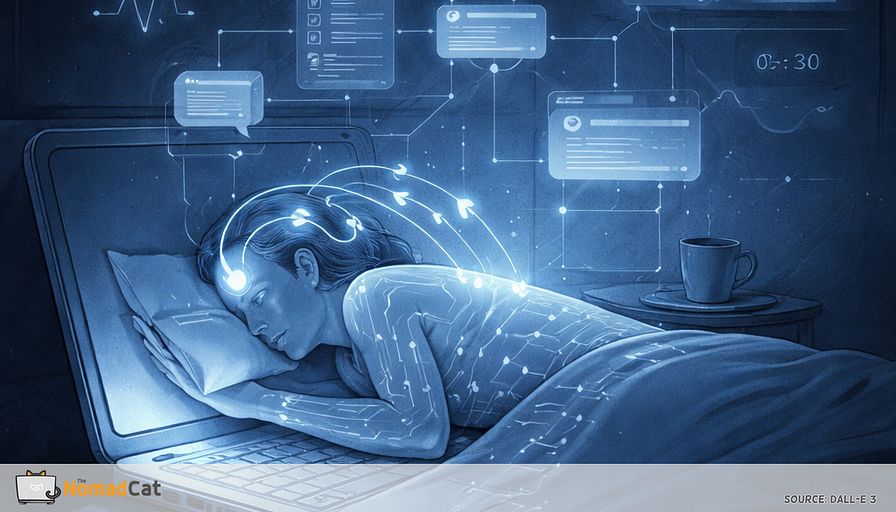
You can sleep 7 or 8 hours and still wake up like a laptop that “installed updates” but never restarted. Screen on. Fan quiet. And somehow you’re already firefighting before coffee.
That’s the problem this article is here to name and explain. Sometimes the issue is not sleep duration. It’s recovery. The system never fully goes offline, so the morning starts with monitoring, scanning, and pre-emptive fixing even when the night looked fine on paper.
A big culprit is work that can be reopened at any time with almost no friction. The comment. The “quick tweak.” The async re-litigation of something that was supposed to be done. When “done” is a soft suggestion, your brain treats it like an open ticket. And open tickets have a way of showing up at 03:00, or at 06:30 in the form of tight jaw, shallow breathing, and an urge to check messages “just in case.”
What you’ll get here is not a perfect evening routine, and not productivity theater. It’s a small, systems-minded set of levers that fit inside real desk weeks, including the 10-hour ones where work leaks into the evening and exercise loses the priority battle. I’m french, born in 1974, and I’ve spent most of my adult life at a desk—Beijing, then Berlin, now Lisbon. Some weeks are just messy like that, and the point is not to pretend otherwise.
You’ll see
- why sleep time and recovery are not the same thing, and how hyperarousal can keep the body half-online
- how socially reopenable work feeds rumination and morning monitoring loops
- a 60-second revocability checklist to spot what keeps getting reopened in your head
- a simple 2-day desk test with no gadgets, based on what you can notice in 10 seconds
- a lightweight closure contract that makes “done” more defensible without adding a whole new process
The goal is boring on purpose. Fewer background processes at night. Fewer “what did I miss” scans in the morning. And a better chance that sleep does its actual job, instead of running rework management.
When sleep does not apply at all
Sleep duration is not the same as recovery
You wake up after 7 to 8 hours and the pattern is the same as the “updates but no restart” morning: you’re technically awake, but not refreshed. It feels like you never really powered down.
That pattern has a name. Nonrestorative sleep is when sleep happens, duration can be fine, and you still wake unrefreshed (Ohayon, 2005). “Good sleep” is not only hours, it’s also how you function the next day. One useful framing is hyperarousal. Recovery stays light because the system never fully stands down (Riemann et al., 2010).
The hidden trigger is work that can be reopened
Often it’s not screens or a chaotic bedtime. It’s work that is socially reopenable.
The day can end on time. Notifications can be off. Still, the brain learned that nothing is truly closed. 1 comment can re-litigate yesterday. 1 “quick change” can invalidate the state.
The point is not “stop thinking”. It’s that your brain is reacting to reopen-risk.
Calm mind, vigilant body
Some people report a calm mind but run background monitoring in the body.
With hyperarousal, physiology can stay activated even when you don’t feel emotionally stressed (Riemann et al., 2010).
Look for low-drama signals
- jaw set without noticing
- shallow breathing at rest
- impulse to check messages or docs just in case
A 60-second revocability checklist
No tracker needed.
- Can 1 comment reopen yesterday’s “done” work
- Can you defend “done” in 1 sentence
- Is the next touch time clearly scheduled
This is a closure test. Next step clarity helps because it reduces the mental activation of unfinished goals (Masicampo & Baumeister, 2011).
A quick desk test with no gadgets
A 2-day contrast that stays honest
Measure only what you can notice in 10 seconds.
Day A do your normal end of day behavior.
Day B pick 1 deliverable and make it less revocable with a tiny closure block. Write what done means in 1 sentence, name the next touch time, park open threads into a short plan. Then stop.
Don’t score sleep. Look for differences in morning monitoring.
Morning monitoring checklist
- wake up and immediately scan for problems
- open laptop or inbox before coffee, almost automatically
- urge to preempt feedback with extra explanations
- feeling behind within 2 minutes of waking
- tight neck or jaw before you even stand up
- mental replay of what might be criticized
Labels optional.
A guardrail for real sleep problems
This is a hypothesis, not a diagnosis. If sleep is persistently bad, or daytime sleepiness is heavy, or there is snoring or gasping, proper screening beats “fix it with better closure”. Red flags include
- loud snoring or witnessed pauses
- gasping or choking at night
- insomnia that persists and wrecks daytime function
For chronic insomnia, insomnia/treatment/cognitive-behavioral-therapy-insomnia">CBT-I is widely considered first-line.
Why revocability keeps the system half online
Revocable work is output that can be invalidated, re-scoped, or socially challenged at low cost. Not “hard work”. Just work where done is a soft suggestion.
A single message can turn yesterday’s progress into “redo this with a different angle”. Now you are defending, rewriting, and doing it fast. That kind of low-friction invalidation keeps the mind cycling the concern and the body getting small stress pulses after the laptop is closed (Brosschot et al., 2006).
If you want an analogy, treat revocability like a wobbly Jenga tower: everything looks stable until someone taps one block, and suddenly you’re rebuilding the same structure again. Comments arrive async. Ownership is blurry. Reopening cost is paid by the person with the highest standards, not the person who typed “quick tweak?”. It is boring and common. A doc comment lands at 21:10 and suddenly the state is provisional again.
Sleep gets hit even when evenings are quiet because physiology reacts to what it expects. Anticipated demands show up in patterns like the cortisol awakening response (Fries et al., 2009; Kunz-Ebrecht et al., 2004). In practice, it can look like waking up already “on alert” before anything actually happened.
Unfinished-task activation adds another layer. A concrete plan reduces intrusive thoughts because it gives the brain a next state instead of an open loop (Masicampo & Baumeister, 2011). There is also evidence that simple list-making before bed can improve sleep onset, likely by offloading what needs remembering (Scullin et al., 2018).
How revocability leaks into your desk behavior
Over-explaining is often defensive engineering. The long Slack preface. The 14-line context message. The 6 screenshots to prove you already tried the obvious. It’s an attempt to pre-answer imagined objections so nobody reopens the topic tomorrow.
Irony. More context can increase surface area for critique. More entry points for “actually, what about…”. And because detachment matters for recovery (Sonnentag & Fritz, 2007), carrying that full context stack after hours blocks the off switch.
Night polishing is often insurance. Not ambition. Just removing hooks for reopening. It can look like productivity, but it behaves more like rumination.
The trade line is brutal and familiar
30 minutes tonight vs 3 hours tomorrow.
Morning scanning is not doomscrolling. It’s that reflex to check what changed overnight before you even stand up. Inbox first. Calendar check. Doc comments. Monitoring can feel reasonable but still trains the system to expect surprise.
Body signals often look neutral but keep you on. Jaw tight while reading a normal email. Shoulders creeping up. Breathing shallow. You’re functional, but touchy, like the system has 3 background processes too many.
Make done defensible without process theater
The 2-minute closure contract
This is a sleep-protection primitive, not bureaucracy. The goal is to make 1 piece of work per day feel truly closed, so your system stops running background checks at 06:30. (And yes, I know how this sounds; it is just a tiny line you leave for Future You.)
Keep it short so it survives a Tuesday and a 10-hour desk day.
State   Done as of <date/time>
Scope   Included <A>, excluded <B>
Next    Next touch <day/time> by <owner>
Reopen  Only if <trigger>
Example
State   Done as of Tue 17:40
Scope   Included intro + 3 options, excluded pricing and legal wording
Next    Next touch Wed 10:00 by Lea for approval
Reopen  Only if new data changes option ranking or Lea rejects scope line
The reopen trigger is the key. It makes reopening legitimate under evidence, not vibes. It also clarifies who decides what, without turning it into a power play.
If you measure anything, keep it symptom-based
- [ ] On waking, scan urge before coffee low / medium / high
- [ ] Mental reopening before laptop 0 / 1+
Feedback that ends at a real moment
The default failure mode is polite but lethal. “Thoughts welcome” creates an always-open queue with no end time, no owner, no definition of enough.
Use bounded asks and objection windows
- “Pick A or B by 15:00, otherwise I proceed with A.”
- “Objections by Wed 12:00, otherwise we ship this version.”
- “Decision owner is Sam. I’m input only on risks.”
Deadlines help because under time pressure people simplify decisions anyway, so better to make it explicit than chaotic. For example: you send a draft at 14:00 with “Pick A or B by 15:00,” you get a clean choice, and the thread closes. If you send it with “thoughts welcome,” you might get silence at 15:00, a vague “maybe” at 18:30, and then the 22:30 “quick tweak” that reopens everything right when you were trying to shut down.
You can also remove after-hours obligation without drama
- “No response expected tonight. I’ll pick this up tomorrow 10:00.”
- “I’m offline now. If urgent, call. Otherwise tomorrow morning works.”
Versioned decisions that stop silent rewrites
Versioning is how you escape infinite draft mode. V0 internal, V1 shared, V1.1 fixes. Done becomes a tagged checkpoint, not a fragile vibe. Changes still happen, but tagged states reduce chaos.
A 3-workday proof that still works in a brutal week
Day 1 is only spotting where done is undefined. Modern desk weeks are full of coordination churn and shifting priorities. So Day 1 is not fixing. It’s noticing.
Look for
- tasks that feel contestable tomorrow even if “finished”
- outputs with no acceptance criteria, only opinions
- threads with no clear owner, so everything becomes your problem by default
Days 2 and 3 apply the closure contract to 1 item per day. One item is the point. The system doesn’t need a grand shutdown routine. It needs repeated evidence that something can actually be closed.
The only success metric is less morning monitoring
- [ ] Scan urge before coffee low / medium / high
- [ ] Mentally reopened yesterday before laptop 0 / 1+
- [ ] Yesterday feels ended enough to not defend it in my head yes / no
When boundaries are not respected at all
Some orgs do not respect boundaries. You can turn off notifications and still get the 22:30 “quick tweak”. The move is usually not to negotiate culture at 22:30. It is to make your output clearer so reopening costs more energy for others too.
Clarity does not remove ambiguity, it schedules it. Use planned reopen. Put a next review date and next touch time in the artifact so uncertainty is not an overnight polling job.
One more risk is templates turning into bureaucracy cosplay. If it becomes theater, delete fields until it stops hurting.
A brutal test
If it creates more work, it failed.
Success looks boring on purpose
If sleep is severe or stays bad for weeks, work templates should not replace proper care. Success here is unsexy and visible upstream.
Look for
- less waking up already planning your defense
- less night polishing that is really insurance
- more tolerance for good enough for now
Within scope, keep the lever earlier in the pipeline. Make done real enough during the day so sleep can do recovery instead of running rework management. Sleep is not supposed to be your night shift.
If you’re getting 7 to 8 hours and still waking up already firefighting, the issue is often not bedtime math. It’s that recovery never fully starts because your brain treats work as reopenable. Soft “done” keeps a ticket open. Then you pay for it with rumination, jaw tension, shallow breathing, and that automatic inbox scan before coffee.
The practical levers here stay small on purpose. Notice revocability with the 60-second checklist. Run the 2-day desk test and watch for morning monitoring, not perfect sleep scores. Then make 1 deliverable per day less contestable with a tiny closure contract so “done” becomes defensible, with a next touch time and a real reopen trigger.
Over a brutal week, boring wins: closing 1 thing cleanly is often enough to stop the night from turning into rework management.
You might be interested by these articles:


At 03:00 your brain starts doing reputation management

Your workday ended but your brain is still on duty at 23:40

Your brain needs an off duty signal not an earlier bedtime

Your brain is still on call at 23:40 decision residue and sleep

After dinner no more invisible work so your sleep can actually power down

Transforming Customer Service with AI Bots

Why micro-masterminds work for solo pros like me