Abstract:
The article explains why many remote knowledge workers can fall asleep quickly yet wake around 5:00 a.m. with their minds instantly “resuming” the same document and unresolved decisions: the day ended without a credible end signal, leaving them in a “No-Done State” where work is highly revocable, “done” is contestable, and any thread can be reopened by a comment, scope shift, or late Slack message. Rather than blaming bedtime discipline or chasing elaborate evening routines, it argues the real lever is upstream system design—making closure real by creating a small daily “ship event” (a defensible state change like a decision note with rationale and owner, a draft sent with an explicit acceptance check, or feedback bounded to an A/B choice by a specific time) so tomorrow is simpler if nothing changes overnight. To prevent night “reboots,” it proposes a tiny “anti-reopen packet” (what’s true now, what’s not happening tonight, next touch time, reopen trigger) plus micro-boundaries that avoid vague deferrals and set after-hours expectations. The author, a French physics-trained tech worker who normally wants to measure everything with spreadsheets, emphasizes resisting more tracking in favor of reducing revocability, and offers a 2-minute, 3-day test—can you defend stopping in one sentence, and is tomorrow simpler because of what you shipped—while noting medical guardrails (e.g., CBT-I and evaluation for sleep apnea or severe impairment) when this isn’t the right fix.
You know the day. 10-hour desk stretch, meetings stacked like tabs, lunch at the keyboard, shoulders slowly climbing toward your ears. Work bleeds into the evening because it can. Remote work removes most of the accidental walking too.
You shut the laptop at a reasonable hour, the room is dark, and sleep actually starts fast.
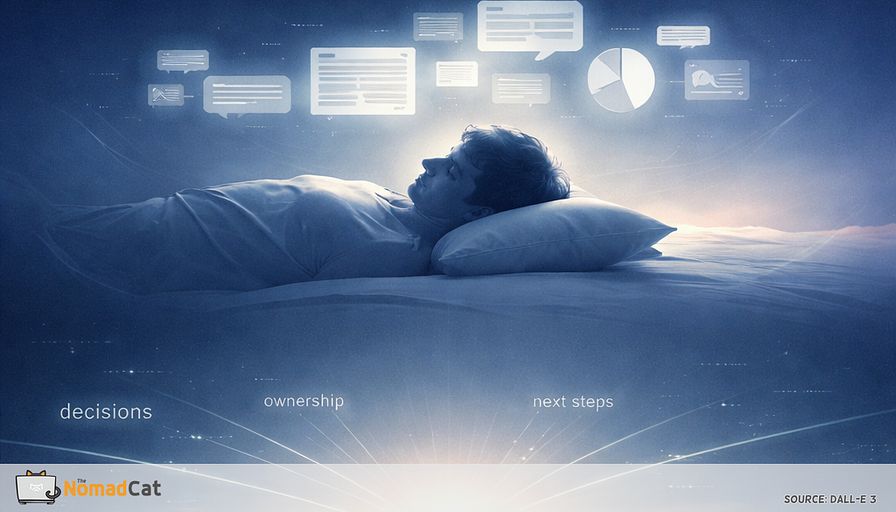
Then 5:00 hits. And your brain boots straight back into the same doc, the same half-decision, the same “quick thing” that is somehow still not finished. Not panic. Planning. Like an app resuming in the background before you even touch the screen.
If that sounds familiar, the problem is often not bedtime, or discipline, or a magical evening routine you do not have time for. It is that work ended without a real end signal. In knowledge work, reopening is cheap, decisions are revocable, and “done” depends on someone else’s taste or a late Slack message. So your brain keeps the thread warm, because it would be irresponsible not to.
This article puts a name on that pattern, the No-Done State, and explains why it tends to show up as light sleep, early waking, and instant work scanning. Then it gets practical and boring in the good way.
- What revocable work is and why it breaks closure
- The unfinishedness loop that keeps cognitive arousal running at night
- The upstream lever that helps more than another to-do list
- A simple daily ship event that creates a defensible stopping point
- A tiny anti-reopen packet and micro-boundaries that reduce night “reboots”
- A quick 2-minute test to spot when closure is missing, plus guardrails for when this is not the right fix
For context, i am french, born in 1974, physics-trained, and i work in tech, so yes, the reflex is to measure everything and build another spreadsheet. This piece is the opposite. Less tracking. More system design. Make “done” credible, reduce cheap reopenings, and let sleep stop being a KPI. Since 2023 i live in lisbon, and remote work removed the last accidental boundaries i had.
The no-done state in plain terms
Sleep that starts fast then reboots work at 5:00
You finally shut the laptop. The room is dark. The day is “over”. And weirdly, you fall asleep fast.
Then sleep stays light, breaks early, and you wake up too soon with a work thread already running. It is not panic. It is planning. Same chair, same doc, same half-decision. Just now in your head.
You do not need research terms to recognize the pattern, but they map cleanly: falling asleep fast, spending more time awake during the night, then waking earlier than planned. And when work rumination is running, sleep quality usually takes the hit.
If it sounds familiar, the daytime pattern that feeds it is usually visible before you even get to bed.
Before fixing anything, it helps to know what this is not.
- Not an on-call problem. Do Not Disturb can help, but it does not create closure.
- Not 1 giant life decision. This is usually many small revocable things.
- Not bedtime procrastination. You can go to bed on time and still wake early with instant planning.
- Not a personality flaw. When the day ends without clear endpoints, the mind struggles to disengage.
The simplest explanation is the No-Done State.
- You ship a lot, but you “finish” very little.
- You have 12 threads open and each one can be reopened by a comment.
- Decisions are technically made, but easy to undo, so your brain keeps them warm.
- “Done” depends on someone else’s taste, mood, or late-night Slack reaction.
- Your output looks real, but it lives in staging, not in production.
In the No-Done State, work produces artifacts, not closure, so your brain keeps the goal active.
Why knowledge work forgets to say done
Revocable work makes endings optional
Revocable work is work that can be reopened with almost no friction. So “end of day” becomes a suggestion, not a boundary. Once reopening is structurally easy, bedtime becomes the cheapest time to keep running simulations.
Common drivers are unglamorous.
- A stakeholder re-litigates a decision because authority and rationale were never recorded.
- Scope shifts without tradeoffs because changes happen, but nobody says what gets dropped.
- Ownership is ambiguous, so you become the default owner by gravity.
When reopening is cheap, the brain treats “done” as a temporary state, not an event.
Cheap reopening keeps the brain in planning mode
You do not need to argue about sleep stages to recognize the effect. Uncertainty stays actionable, so your brain stays ready to plan. Think RAM tabs that never got closed because any tab can become urgent again with 1 message.
The result is boring and familiar. You wake up with a near-complete email draft in your head, as if your brain did overnight change management.
Night planning is often not “overthinking”. It is the system reacting to a missing end signal.
When done is contestable, sleep can feel risky
Add social evaluation and it gets stickier. If “done” depends on someone else’s taste, and you cannot fully control the rules, stress can keep running after shutdown.
So the useful question is not “how do i relax”. It is where the lever is.
The lever is upstream
Your brain wants a stable commit
A private to-do list helps, but it is not enough when the work is socially revocable.
- Revocable work creates an unfinishedness signal
- Unfinishedness drives rumination and planning
- Rumination keeps your brain switched on at night
- Sleep shifts from solid to fragmented, with early waking
Offloading can help. A basic to-do list before bed can make it easier to fall asleep.
But No-Done is rarely about forgetting tasks. It is about tasks that can be reopened by other people tomorrow, for reasons that were not written down today. If the “plan” is only in your notebook, it is not a contract the team can respect.
So the practical goal is not a bedtime routine. It is a credible end signal you can point to.
Call it a ship event. A small, concrete output that makes stopping defensible and makes tomorrow simpler if nothing changes overnight. It can be “decision captured with rationale and owner” or “draft sent with an explicit acceptance check”. Think a lightweight Definition of Done boundary, not a heroic deliverable.
Ship something daily without faking progress
What counts as shipping
The trap is shipping noise. A ship event is a small state change future-you can point to tomorrow. Send, publish, commit, or post something that moved the shared system forward.
A simple test catches most fake ship events.
If your “update” mainly creates new questions, it is not shipping.
Example. “Draft is mostly done, thoughts?” is just an unfinished task in public.
A better quality check is even simpler.
If nothing changes overnight, tomorrow should be simpler because of what you shipped.
If not, shrink it or sharpen it.
Role-based ship examples that work in real desk jobs
If your work is analysis, ship a snapshot of what is true now, not a perfect model.
If your work is PM or program work, ship a decision note that creates memory and makes re-litigating harder.
- Decision: ______
- Status: proposed or decided
- Owner: ______
- Rationale: ______
- Next checkpoint: date and time
For analyst and data work, ship a current best answer with a clean handoff.
- Finding: ______
- Assumptions: ______
- Next question: ______
- Decision needed by: date and time
For design and content work, bound feedback so it cannot reopen the whole surface area.
- Option A: ______
- Option B: ______
- Question: pick A or B for X by tomorrow 15:00
If you manage people, shipping is often making expectations explicit so nobody has to keep guessing at night.
- What is true: ______
- What is not changing: ______
- Next update: date and time
When “done” is contestable, you feel it as tension: shoulders up, jaw tight, and a brain that keeps running even in the dark.
The anti reopen packet and tiny boundaries
A template that makes a ship message harder to reopen
Each field exists to block a predictable reopener, not to win debates. Think checklist energy, tiny prompts that reduce error loops.
- What is true now
- What is not happening tonight
- Next touch time
- Reopen trigger
Example
- What is true now: Draft sent, scope is A and B
- Not tonight: No more edits unless blocker appears
- Next touch: Tomorrow 10:30 after review
- Reopen trigger: If legal flags claim X
This is basically a stripped-down decision note you can point to later. If it feels heavy, shrink it. Do not expand it.
3 micro boundaries that reduce night reopen energy
When you must defer, do not defer vaguely. Vague deferral is reopen fuel.
Try lines like
- “Can do, tomorrow 10:30, i will reply here.”
- “Not tonight, ping me at 09:00 if still needed.”
Also make after-hours messaging expectations explicit so silence does not get interpreted as risk. Even 1 expectation line per channel helps.
Example. “After 19:00, i read slack tomorrow morning.”
Diagnose it fast and keep it boring
The 2 minute done state test
Run this for 3 days, not 3 weeks.
- Yes or no: can you defend stopping today in 1 sentence, without a long explanation
- Yes or no: if nothing changes overnight, is tomorrow simpler because of what you shipped
If both are no, closure is missing.
To keep it grounded, add 1 morning checkbox for 3 days.
- “Woke up booting into a status scan.”
Success is not a perfect sleep score. It is fewer resume mornings. Late meetings, heavy ping days, and other sleep disruptors exist, but they are different levers.
Guardrails and when this is not the right fix
If sleep is chronically broken, get proper help; this article is only about work-closure loops.
If any red flags are present, prioritize proper evaluation.
- Loud snoring, choking, or gasping at night
- Severe daytime sleepiness, especially safety issues like drowsy driving
- Persistent sleep problems with clear daytime impairment
- Mental health crisis signals or rapidly worsening symptoms
If your nights keep “reopening” the day at 5:00, it is probably not because you lack discipline or the perfect evening routine. It is because work ended without an end signal. Revocable work makes “done” contestable, so your brain keeps the thread warm, just in case.
The fix is boring on purpose. Ship 1 small, concrete state change each day. Capture the decision and the owner. Send the draft with a bounded question. Add a tiny anti-reopen packet so tonight stays closed and tomorrow has a clear next touch time. Then run the 2-minute test for 3 days and see if mornings stop starting with an instant status scan.
Less tracking, more system design. Sleep does not need to be a KPI. If you can name your main reopener, you can design the smallest block for it.
You might be interested by these articles:


Your workday ended but your brain is still on duty at 23:40

Your brain is still on call at 23:40 decision residue and sleep

Your brain needs an off duty signal not an earlier bedtime

At 03:00 your brain starts doing reputation management

After dinner no more invisible work so your sleep can actually power down

Building a quiet legacy in tech

How moving and remote work can quietly change your taxes and pension