 Gilles Crofils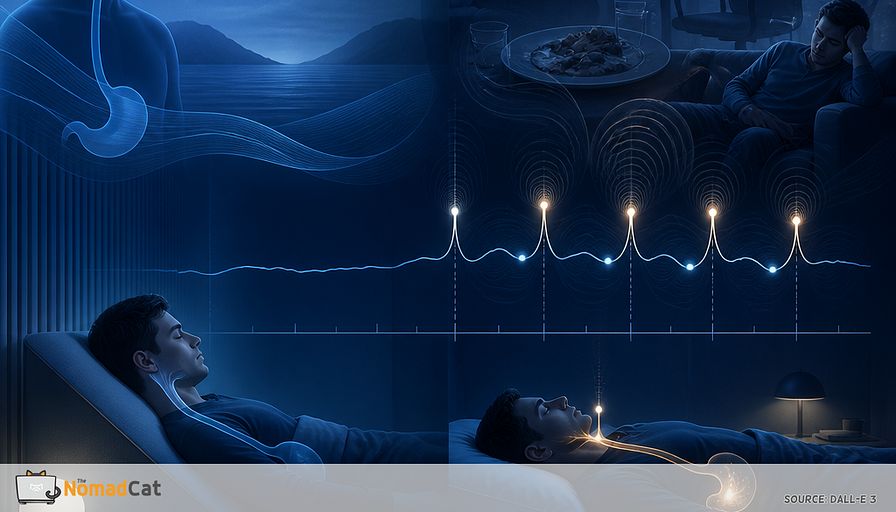
If your days are 10 hours of screens, meetings that swallow lunch, and a “quick” email check that turns into 90 minutes on the couch, bad sleep can start to feel like a personal flaw. Or stress. Or just… aging. And then a weird pattern shows up.
I was born in 1974 and I’ve spent most of my adult life at a desk—offices in Beijing, then Berlin, now Lisbon. Different cities, same basic geometry: long sits, late laptops, and dinner pushed later than it deserved.
You fall asleep fine. Clean shutdown. Then between 03:00 and 05:00, your night starts doing small reboots. 2–5 brief wake-ups. No drama, no obvious nightmare fuel, and often no classic heartburn either. Just lighter sleep in the back half, and a next day that feels like low battery.
This article treats that pattern like a system issue, not a moral failing. The goal is simple: help you spot when “random” wake-ups might be reflux showing up quietly, and what small, low-risk changes tend to give a quick signal.
Here’s what you’ll get, without the program energy.
- How silent reflux can fragment sleep even when there is no burning sensation
- The boring body “log lines” to notice during those wake-ups, like dry mouth, throat clearing, sour taste, morning hoarseness
- A quick reality check to separate reflux-like wake-ups from rumination insomnia, nocturia, or sleep apnea patterns
- Why desk life and late meals can act like a multiplier, with posture and timing doing more than food purity
- A 3-night debug plan using 1 lever at a time, especially position and a basic dinner-to-bed gap
- Clear guardrails for when to stop experimenting and get checked, especially if red flags show up
No perfection required. The target: fewer interruptions and better next-day function, using changes that still survive a real workweek.
The silent food plus chair tax
The 03:00–05:00 pattern
Then somewhere around 03:00 to 05:00, the night starts doing small reboots 2–5 times. Not dramatic. You wake briefly for no obvious reason. The second half of the night feels thin and easily interrupted.
That pattern matters because reflux can disturb sleep without a big, obvious heartburn moment. In research on reflux and sleep, the signal is often more time awake after you first fall asleep, and less solid sleep overall—not necessarily one long wake-up. Shaker et al. (2003, AJG) is often cited here because reflux is associated with more fragmented sleep and worse next-day function when it’s present.
If this sounds familiar, the next step is not instantly blaming stress. It is noticing what your body is doing during those wake-ups.
Small body logs to look for when you wake up
During those short awakenings, the useful signals are often boring. Think tiny log lines.
- Dry throat or dry mouth that wasn’t there at bedtime
- Throat clearing urge, like something is stuck
- Rough voice in the morning
- Mild nausea or unsettled stomach
- Sour or bitter taste, especially on waking
- Drip-like sensation in the throat without a cold
- Brief cough or a need to swallow a few times
Important caveat. These are common and not specific, especially throat symptoms. Throat-type reflux symptoms overlap with many other causes, so over-certainty is a trap. Still, sour taste, regurgitation cues, and consistent timing after lying down for hours can be higher-yield hints.
Quick rule-outs
This is usually not the classic work replay wake-up where your brain opens 27 tabs and you stay up 45–90 minutes. Not the clean nocturia pattern where peeing is the main event and then everything is solved. Not the obvious sleep apnea pattern with loud snoring, witnessed pauses, and gasping.
Instead it can look more mechanical. Back-half sleep fragments, with small throat and mouth cues, after you have been lying down for hours.
Desk life adds a multiplier. Late meals. Late laptop. And the chair-slump to couch-slump pipeline that quietly compresses the abdomen, then you go flat in bed.
Once the pattern is recognizable, skepticism usually turns into 1 question.
No heartburn does not mean no reflux
Silent reflux can look like normal sleep problems
Nocturnal reflux can be subtle. Some people get no burning but still get irritation, cough, swallowing issues, or micro wake-ups. Guidelines like the ACG guideline (Katz et al., 2022) support simple, low-risk first steps for night symptoms—things like raising the head of the bed and leaving a gap between dinner and sleep—before you turn your life into a spreadsheet.
This is not a diagnosis. It is pattern recognition.
The feedback loop that creates 4 small wake-ups instead of 1 big one
The back half of the night is naturally easier to interrupt. If you like systems language, think noisy interrupts.
A brief arousal can make reflux more likely. A reflux episode can trigger a brief arousal. So you get 2–5 small disruptions instead of 1 dramatic one. Nothing looks catastrophic. The total effect still wrecks your sleep.
Why it hits after 03:00 when everything seems fine at bedtime
The second half of the night is different in 3 boring ways.
- Sleep tends to be lighter and easier to fragment
- Reflux clearance gets worse because saliva and swallowing drop during sleep, and gravity stops helping when you are lying flat
- Position becomes high leverage
Late dinner, a day of chair compression, and then lying flat is a pretty efficient mechanical setup. That is why this often shows up after 03:00, not right at bedtime.
And desk work is how that setup happens without anyone “choosing” it. The 19:00 meeting that should have been 30 minutes, the late message you answer “quickly,” the last screen task that turns into another hour—suddenly dinner is late, you eat faster, and you go flat soon after.
A fast reality check before blaming dinner
Fast differential without playing doctor
Keep the self-test narrow and reversible. The goal is to pattern-match the texture of the wake-up.
- Rumination plus long awake time. You wake and your mind starts running meetings, Slack, and tasks. You stay awake a long time.
- Bathroom urge is the main event. You wake with a clear need to pee and it resolves after.
- Choking or gasping. Especially with loud snoring or witnessed pauses. If that’s in the picture, it’s often worth screening for sleep apnea before doing dinner detective work (AASM guidance: Kapur et al., 2017).
The sanity rule for self-testing
Watch for a fast response to position. This is not a diagnosis. It is a short, low-risk self-management bundle that guidelines generally tolerate when there are no alarm features.
What the result means either way
If changing position helps quickly, reflux moves up the list because lying-flat exposure can respond immediately to mechanical changes like elevation or side sleeping.
If nothing changes, that is also good data. It can save weeks of random food rules and push attention back to insomnia texture, nocturia, or sleep apnea risk.
Desk life builds a reflux friendly setup
Compression is the default setting
It is fair to ask if this is evidence or just office-chair poetry. The limits are real. But the mechanical model is simple.
A folded torso plus stillness is like a kinked hose. Calm day, bad geometry.
Observational work links sedentary behavior and sitting time with higher odds of reflux (for example Ning et al., 2021). That does not prove your chair caused your wake-ups. It does justify testing cheap levers before believing a big story.
Late food beats food purity
Even healthy food can still break sleep if it is late and large. A portable rule that matches common guidance.
- Finish the last substantial intake 2–3 hours before bed
It is not virtue. It is an interval. Lying down too soon removes gravity and sleep reduces clearance.
Desk schedules compress that interval by default. A big salad at 22:30 can still be a lot of volume plus liquid. Many people do better adjusting how much and how late before litigating individual ingredients like tomato or spice.
Why your brain blames stress
You wake up alert-ish without an obvious worry. The brain hates that. So it assigns a reason after the fact.
Reflux and arousal can reinforce each other. The wake-up comes first, then the narrative process spins up and starts writing logs about your job.
If you are metrics-minded, the temptation is to over-instrument everything. For this pattern, boring body logs often beat dashboards. Faster signal, less overfitting.
A 3-night test
A 60 second morning log that survives bad weeks
Skip sleep scores for this test. If you’re changing one variable, the scores often add noise and false confidence.
Use a tiny yes or no log each morning. Same 5 checkboxes, same order. 60 seconds.
- Dry throat or cough wake
- 2 or more brief wake ups after about 03:00
- Position relief, left side feels calmer or elevation helps
- Sour or bitter taste
- Morning hoarseness or drip feeling
Reminder again. These symptoms are common and not specific. This is only pattern collection.
A simple threshold so you do not overfit
If 2–3 items repeat on 2 of 3 mornings, treat it as a positive signal and test the boring levers first.
The A B test that teaches you something
Use 1 baseline night, then 2 nights where you change only 1 lever.
- Night 1 normal routine, just log
- Night 2 change 1 thing
- Night 3 keep the same 1 change
Position can show signal fast because it directly changes lying-flat exposure. Meal timing is plausible too, but day-to-day response can be less clean.
Position first then timing if needed
Pick 1, not both.
- Left side sleep as much as practical. Many studies find less nighttime acid exposure on the left side than the right.
- Head of bed elevation around 15–20 cm using blocks or a wedge. This is commonly recommended for nocturnal symptoms. Extra pillows often fail because they bend you instead of lifting the torso.
If you see fewer 03:00–05:00 wake ups or fewer dry throat wakes, that is useful signal. If not, test the dinner to bed interval next.
What not to measure
Skip sleep stages, HRV graphs, and full dashboards. Measure only what a human can notice at 05:00.
- Fewer awakenings after about 03:00
- Fewer dry throat or sour taste wakes
If nothing changes that still narrows the search
If position and a basic dinner to bed gap do nothing across 3 nights, reflux becomes less likely as the main driver. That is a win. Then it is rational to re-check other buckets: rumination insomnia, nocturia, and especially sleep apnea risk.
A clinician gets more value from a clean 3 night log than from a sleep score screenshot.
Small fixes that survive real workweeks
Timing without willpower theater
Late dinners still happen. When they do, a fallback beats a 12-rule diet spreadsheet.
- Most nights, keep the last substantial intake 2–3 hours before bed
The common failure mode is not pizza. It is volume plus timing.
- If dinner is late, shrink the portion and skip big liquid calories right before lying down
- If hunger shows up again, take 1 defined small unit, not a slow restart of digestion
Also watch the desk-worker trap. Grazing while working is an annoying UX bug. Avoid the accidental second dinner.
Posture fixes for the laptop taco
The amplifier posture is familiar. Curled couch, laptop on belly, shoulders forward, and you stay like this for 90 minutes because the meeting ran late.
A mechanical tweak for the last hour. Change geometry, not personality.
- Sit more upright after dinner
- Move to a table so the torso is less folded
- Loosen belt or waistband if it applies
Perfection is not the target. Just remove the most reflux-friendly shape during the worst window.
Guardrails and when to stop debugging
Red flags override experiments. Seek clinical evaluation rather than more tweaking if you have any of these, as highlighted in guideline pathways.
- Trouble swallowing, especially if new or getting worse
- GI bleeding signs, black stools, vomiting blood, or iron-deficiency anemia
- Unintentional weight loss
- Persistent vomiting
- Chest pain that needs cardiac exclusion first
Also some wake-ups are breathing events. If there is loud snoring, witnessed apneas, choking or gasping, or unsafe daytime sleepiness, prioritize screening rather than assuming reflux. A clinician may use a short questionnaire (like STOP-Bang) to gauge risk, and testing pathways are covered by AASM guidance (Kapur et al., 2017).
Time-box self-debugging. If symptoms persist after a few weeks despite timing and gravity changes, or ongoing OTC use feels necessary, it is time to talk with a clinician. Throat symptoms are non-specific, and hoarseness not improving within 4 weeks deserves evaluation.
The practical goal is not perfect sleep. It is fewer interruptions and better next-day recovery, using the smallest levers that actually fit your calendar.
If your nights keep doing those quiet 03:00–05:00 reboots, treat it like a system signal, not a character flaw. Silent reflux can fragment the back half of sleep without the classic burn, especially when desk posture, late volume, and lying flat stack the odds. The useful move is boring on purpose. Notice the small log lines like dry mouth, throat clearing, sour taste, morning hoarseness. Then run a short test that survives a real workweek, 1 lever at a time. Position often gives the fastest signal, then a simple 2–3 hour dinner to bed gap.
And if the levers do nothing, that is still good data. It narrows the search toward rumination insomnia, nocturia, or sleep apnea risk. Keep guardrails in mind for red flags.
If the logs stay boring and consistent, the fix is usually boring too.


