Abstract:
The article argues that many people under-drink on heavy meeting days not from ignorance or weak willpower but because back-to-back, camera-on schedules create a predictable penalty—drink now and you’ll need the bathroom 60–120 minutes later right when disappearing has real social and professional cost—so hydration becomes a risk calculation that turns people into “strategic sippers” and refill avoiders, fueling an afternoon crash of fog, headaches, irritability, and snacky “maybe it’s blood sugar” cravings that get patched with coffee (often not truly dehydrating) instead of fixing the constraint. Naming this pattern “meeting-wall dehydration,” the author (a physics-trained, metrics-minded desk worker who’s lived and worked across Beijing, Berlin, and Lisbon) frames it as a configuration bug: meeting density removes the transition moments where habits live, so “just drink more” fails without schedule slack. The proposed fix is a simple, non-branded system using if-then planning and a three-rule “bathroom-safe hydration protocol” that anchors 1–2 planned drink moments to calendar breakpoints and pairs them with reliable restroom access (treating refill-plus-pee as one “atomic” transaction), plus small meeting-design tweaks like 3–5 minute buffers, matter-of-fact “Quick bio break back in 2” scripts, and microbreak structures (silent write, async check-ins, switching slides) to make biology less punishing. It emphasizes measuring success by fewer late-day “error messages” rather than perfect intake, testing with a short micro-log, and includes clear medical guardrails and red flags where increasing fluids shouldn’t be DIY.
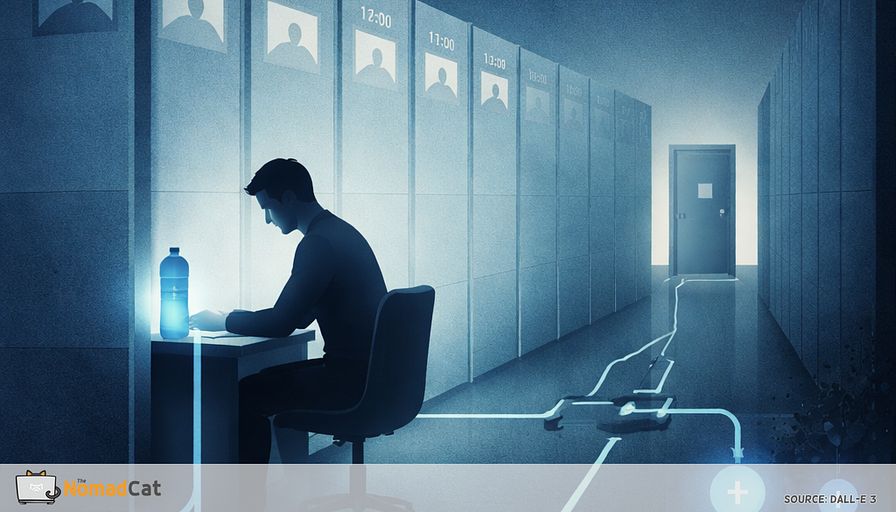
08:30 is still yours. Then the calendar sets like concrete and it’s 11:00 to 17:00 in back-to-back calls, camera on, brain on, body… not invited.
In that day-shape, drinking water stops being a simple health thing. It becomes a risk calculation. If you drink now, you might be paying for it in 60–120 minutes, right in the middle of the meeting wall. Bathroom access exists on paper, but the social cost is real. So a lot of people quietly become strategic sippers, refill avoiders, or “i’ll catch up later” types. Not because they don’t know hydration matters. Because the system punishes the behavior.
This article names that pattern, meeting-wall dehydration, and treats it like a config bug, not a personality flaw. You’ll get:
- A clear map of how meeting density turns into under-drinking, then into the afternoon crash (fog, headaches, irritability, snacky cravings that look like anything else)
- A simple mechanism for why “just drink more” fails when your schedule has 0 slack
- A practical fix using if-then planning and calendar anchors, without turning your day into a water-tracking side quest
- The bathroom-safe hydration protocol in 3 rules, built around predictable windows and reliable access
- Small ways to make meetings less punishing (buffers, microbreak structures, low-drama scripts)
- Guardrails and edge cases where this should not be DIY
No lifestyle branding. No perfect-habit fantasy. Just a boring little system change that makes hydration possible again inside a normal, overloaded workday.
Meeting wall dehydration
How it shows up in a normal workday
08:30 is still loose. You answer a few messages, maybe even stand up once. Then the calendar hardens and suddenly it’s 11:00 to 17:00 with meetings stacked like lego.
In that environment, drinking stops being a “health choice” and becomes a risk decision. Every bathroom break has a predictable social and scheduling cost. Once that day-shape is visible, the logic underneath becomes obvious.
Meeting etiquette adds an extra tax on top of physiology. The hidden rule is simple.
If you drink now, you’ll pay for it later.
Bathroom access is technically there, but disappearing is penalized, and the next “free slot” is uncertain. It’s like backpressure in a pipeline. If the output is constrained, you throttle the input to avoid overflow.
That’s why it helps to name the pattern so it’s discussable.
Meeting-wall dehydration is when meeting density quietly turns you into a strategic sipper, a refill avoider, or someone who keeps promising to “catch up on water later.” Direct studies that measure this exact desk pattern are still sparse, but the chain is solid enough to test with a small experiment instead of vibes.
Common triggers
- You’re on camera, presenting, and your face is basically the UI for “engagement.” You can feel the moment your attention splits: the meeting keeps going, and you’re calculating minutes like it’s a flight connection.
- You’re facilitating a tense client call and stepping away feels like dropping an on-call incident.
- You’re in a conference room at the far end of the office, wedged between people, and leaving creates a whole little scene.
Remote and office versions differ in logistics, but the constraint is the same. The cost is social-professional, not the distance to the bathroom. Rules can say “prompt access,” and culture can still train people to behave like access is allowed but not usable.
Permission beats knowledge
The meeting wall deletes the tiny transition moments where habits normally live. You can fully agree with “hydrate more” and still under-drink, because the environment penalizes the behavior, not the belief.
Under load, the system falls back to the least-punished default, like a buggy setting that keeps reapplying.
This is where simple if-then plans help (implementation intentions), in one line: if X happens, then i do Y (Gollwitzer, 1999). Studies suggest if-then plans improve follow-through (Gollwitzer & Sheeran, 2006).
A systems framing also helps because hydration talk often sounds like lifestyle branding. The claim here is narrower and testable.
Not “drink more.”
Create predictable windows so drinking doesn’t automatically schedule a problem 60–120 minutes later.
I have a physics background and a very metrics-shaped brain, so this lands better as configuration than morality. This is the same part of my brain that wants HRV charts and neat logs, even if the fix here is just 2 calendar anchors. I’ve also spent most of my adult life at a desk across Beijing, Berlin, and now Lisbon, and i can work a full day without eating, drinking, or moving, which sounds impressive until you notice the costs.
The loop behind the afternoon crash
Symptoms that look like anything except dehydration
In a desk day, mild dehydration often shows up as boring “random bad brain” stuff like:
- foggy reading and rereading the same paragraph
- slower writing and more typos than usual
- a mild headache behind the eyes
- irritability for stupid reasons
- restless fatigue that doesn’t feel like sleepiness
- snacky cravings that feel like “maybe it’s low blood sugar”
In controlled studies, around ~1–2% dehydration has been linked to more fatigue, worse mood, and more headache (Armstrong et al., 2012; Ganio et al., 2011). The annoying part is that these signals overlap with sleep debt, stress, too much screen time, and “this meeting could have been an email,” so the pattern hides in plain sight.
Then workplace economics kicks in.
Coffee and snacks are cheap fixes inside meetings. Bathrooms are not.
Coffee is usually not dehydrating for habitual drinkers in net terms (Killer et al., 2014; Zhang et al., 2019), so blaming coffee as the villain is often wrong. But coffee can increase urgency for some people, and it can mask the real constraint by keeping performance barely acceptable while the underlying problem is still “no safe windows.”
The 2-hour timing trap
After a big drink, urgency can show up within about an hour, and often lands in that 1–2 hour window. So “12:00 chug → 13:00 problem” is a very normal timeline.
If the calendar says 12:45–15:15 with no buffer, that window turns into a predictable stressor. The simplest workaround becomes “don’t drink now,” even if the body would prefer the opposite.
Then people over-correct after the block. Sometimes that means a large late-day fluid load, which pushes the cost into the evening.
If waking up to pee is already a thing for you, shifting more fluids earlier and reducing late-evening intake is a boring but effective lever. Not because evening water is “bad,” but because sleep is fragile and breaking it is a very reliable way to feel worse tomorrow.
Put together, it becomes a stable feedback loop until one default changes.
- Calendar pressure → delayed drinking
- Delayed drinking → afternoon symptoms
- Symptoms → coffee/snacks instead
- Coping → more anxiety about drinking
- Anxiety → more restriction
That’s why this is a scheduling constraint, not a willpower contest.
Now the fix: 2 safe windows, not constant sipping.
The bathroom safe hydration protocol
The protocol in 3 rules
Bathroom-safe hydration protocol (BSHP) means picking 2 hydration moments that are anchored to your calendar and paired with reliable bathroom access. The point is not constant sipping. It’s to drink when leaving is cheap, so you’re not creating a predictable 60–120 minute problem inside an immovable block.
-
Pick 2 hydration moments anchored to the calendar.
Example anchors that work in meeting land:- Right after the first recurring block of the day
- Right after lunch before the afternoon wall hardens
- Right after the last recurring meeting before the “one more thing” work starts
Pair each moment with reliable bathroom access (drink → restroom).
A simple if-then is enough: if a meeting block ends, then drink, then restroom.Bundle movement into 1 transaction to avoid repeated “getting up” costs.
Refill plus pee as a single transaction, like an atomic commit.
Microbreak evidence suggests short breaks reduce fatigue and increase vigor (Kim, Park & Niu, 2017), with recovery effects that are often positive or at least not harmful to performance (Wendsche & Lohmann-Haislah, 2017). Also, from a pure desk-physics perspective, standing up fixes more than hydration.
A practical tweak that reduces background decisions is to match bottle size to 1 planned window, so “empty” becomes the cue and you’re not doing anxious sipping all day.
Sanity clause: if the day is chaos, do 1 anchor, not 2. Better done than perfect.
Make meetings less punishing
If a calendar is allowed to run at 0% slack, it will eventually steal basic biology. A 3–5 minute buffer is not a luxury. It’s stability margin, like the bit of wet concrete you don’t step on, because you know it’ll harden.
In the mountains you can’t negotiate with gravity; at the desk we keep trying to negotiate with bladders.
Two boring places to start because they repeat
- Recurring 1:1s where ending on time is easy to enforce
- Weekly team syncs where the agenda already has a rhythm
A script that makes it normal
“Quick bio break back in 2.”
Matter-of-fact beats apologetic. Video meetings increase the pressure of being visibly present, so naming the break like it’s routine lowers the weirdness.
If you run the meeting, facilitation patterns can create cover without announcing “everyone go pee now.”
- 60 seconds silent write before discussion
- 2 minutes async check-in while people scan notes
- A planned switching slide each hour that signals a short pause
These also reduce the cognitive tax of hard context switches. Switch-cost and attention-residue work supports the idea that structured transitions make people less scrambled (Leroy, 2009).
Office days have one hidden advantage: walking between rooms is already a transition. It can be used as the combined transaction instead of becoming another hallway inbox sprint.
Signals and guardrails
Outputs that matter more than any hydration number
If BSHP is working, the win is fewer afternoon error messages, not perfect intake.
- fewer 14:30–16:30 headaches or fog (Armstrong 2012; Ganio 2011)
- less “i need coffee right now” urgency
- less sharp tone late-day
- less evening catch-up drinking
If you want more certainty, a 3-day micro-log is enough to spot a pattern.
Template
Day / anchors Y-N / 15:30 fog Y-N (optional add: “big meeting block Y-N”)
Yes it looks dumb. That’s the point.
Edge cases that should not be DIY
Most desk workers don’t need a medical protocol here, but a few constraints change the rules.
Quick medical constraints (appendix-style): do not increase fluids without medical guidance if you have
- heart failure
- advanced CKD or dialysis
- SIADH or a history or risk of hyponatremia
- meds linked with hyponatremia risk such as thiazide diuretics, SSRIs, carbamazepine, desmopressin
- cirrhosis with ascites (especially if hyponatremic)
When in doubt, check with a clinician first (Spasovski et al., 2014; Verbalis et al., 2007).
Red flags that mean stop experimenting and get evaluated
- fever or chills
- flank or back pain
- feeling very unwell
- visible blood in urine
- can’t pass urine or output suddenly drops a lot
- severe pelvic pain
For non-urgent cases, one counterintuitive point matters. Restricting fluids can concentrate urine, and concentrated urine can irritate the bladder and increase urgency signals. Dehydration also raises constipation risk, and constipation can worsen urinary symptoms. So the practical target is not more water. It’s normal hydration, better timed, without swinging between extremes.
Evidence honesty
Direct studies that join meeting telemetry, restroom avoidance, and hydration outcomes in one clean dataset are still limited, so parts of this are a mechanism chain. But it’s also not a heroic intervention. It’s water with a calendar invite. The intervention is simple: calendar-anchored fluids paired with reliable bathroom access, tested with a boring 3-day log, and stopped if red flags or medical constraints apply.
If your day is a wall of meetings, under-drinking isn’t a discipline problem. It’s a scheduling problem with a predictable penalty: drink now, pay later right when you can’t disappear. Once you name it meeting-wall dehydration, the fix gets boring in a good way.
The key moves are simple: stop relying on constant sipping, add 1–2 calendar anchors, and pair drinking with reliable bathroom access. Think of it like changing the default, not adding another task. The payoff is also practical: fewer afternoon “random bad brain” errors, less headachey fog, less snack-and-coffee patching, and less late-day catch-up that can mess with sleep.
Usually the bottleneck isn’t the 11:00–17:00 block. It’s the 0-buffer transitions that pretend biology is optional.
You might be interested by these articles:


The 3 minute exit handshake that stops the dinner cliff after deep work

Fixing the 15:00 crash with a 10 minute buffer before the dip

Performance-proof fueling and the predictable 15:00 crash

Calendar-compressed eating and the crumbs then dinner day

When lunch turns into a drink and your afternoon still crashes

Empowering Tech Ventures Through Support Hubs

Starting Small in Tech