 Gilles Crofils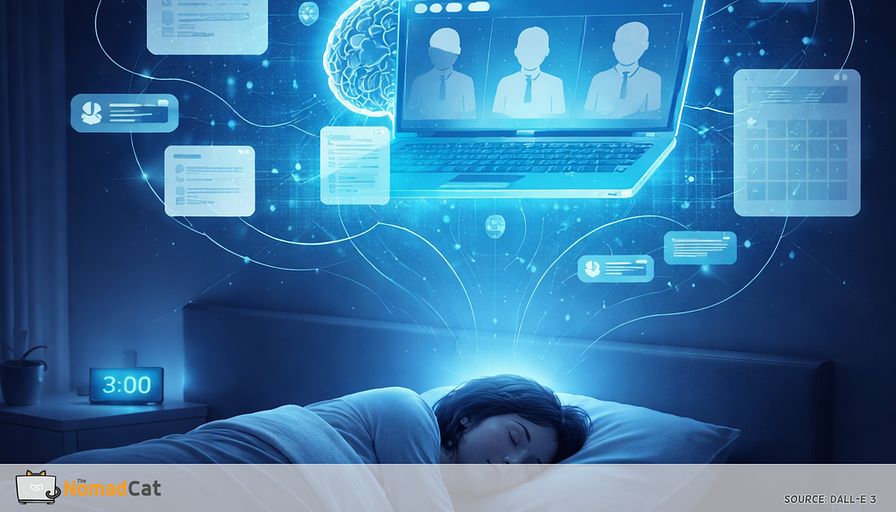
It is 03:00. Your body is clearly tired, but your brain just opened a meeting tab.
Not the classic can’t-sleep panic. More like a clean agenda that loads by itself. A doc you should rewrite. A Slack thread you should clarify. A reply you should send so you don’t sound sloppy tomorrow. And the annoying part is that it feels productive. Until it isn’t, and you are wide awake doing reputation management in the dark.
This is for that specific loop. The one that hits in the second half of the night, then shows up the next morning as brittle attention, zero patience for ambiguity, and emails that read like legal briefs. Not because you are “bad at sleep”. More because your system is doing exactly what it was trained to do when the rules are unclear and you feel evaluated. (I’m a French-born 1974 guy, living in Lisbon now, and this pattern tracks too well with late, cross-time-zone desk work—Beijing to Berlin to here—where “tomorrow” never fully sleeps.)
What you’ll get here is a practical map and a few small levers that don’t require sleep hygiene worship or a new personality. We’ll cover:
- what makes the 03:00 wake-up window so “work friendly” for the brain
- why the next day can feel like burnout when it’s often just poor detachment + communication friction, and how to label the loop in three mornings
- red flags that deserve screening before trying to DIY it
- a few interventions that contain the loop: a short daytime storage slot, a 03:00 capture rule that blocks scope creep, and a couple boring work-design tweaks that reduce rehearsal triggers
If your calendar is full, your evenings leak into “just one more thing”, and you have zero interest in being coached, good. This is more like reading the logs and changing a few settings than fixing your character.
The 03:00 work rehearsal loop
What it looks like when your brain opens a meeting tab at night
You wake in the second half of the night and the body is clearly tired, but the mind boots like a laptop on Monday. Not a foggy can’t-sleep moment. More like a structured agenda that appears by itself. Calendar slots, a meeting you need to survive, a doc you should rewrite, a reply you should send, a Slack thread you should clarify.
That structure is the clue. Later sleep is lighter and easier to interrupt, and those wake-ups are easier to notice and remember. So the brain gets a clean window to start “working”.
It also doesn’t feel like random dread. It’s closer to a social rehearsal. You are not solving the task, you are rehearsing how you will sound while being judged. Tone, credibility, objections, that small fear of looking sloppy. “How will I justify delaying X.” “What if they ask Y and I don’t have the number.” Social-evaluative threat is a real stressor, and work rumination is linked with worse sleep.
The loop feeds itself.
- Step one, simulate the scene
- Step two, notice a gap and create a task
- Step three, rerun the scene with the new task, find another gap
Like a background process spawning more background processes, quietly eating what’s left.
The day after looks like burnout but it is often communication friction
The morning signature is brittle attention
At the desk, the signal is not only sleepiness. It is brittle attention and zero patience for ambiguity. You reread the same Slack message 4 times. You add extra paragraphs “just to be clear”. You pre-defend a decision before anyone asked. You tone-check every email like it is going to court.
In plain terms: your brain never really clocked out, so it shows up the next morning already used up. That “can’t detach from work in your head” pattern is strongly tied to weaker recovery (Sonnentag and Fritz). Work rumination is also linked with next-day fatigue and poorer recovery (Querstret and Cropley, 2012). Also yes, suddenly grammar feels personal.
When evenings feel sharp and mornings feel like damage control
Confusingly, the evening can feel crisp. The brain is quick, ideas connect, and you might even feel productive. In the morning it’s damage control, second-guessing, and social caution.
This is the “too online at night” problem: once the mind engages, it doesn’t power down easily (the CBT-I framing calls it hyperarousal). It’s not only “lack of discipline”. It’s timing, cognitive arousal, and a brain that stays too awake when it should be off duty.
Quiet phone, loud tomorrow
It can happen even when your phone is quiet. Notifications off, screens away, still awake. The trigger is often tomorrow’s visibility event, not tonight’s workload.
A review with a manager. A demo. A doc that will get torn apart in comments.
The lived experience is simple: the felt need to be instantly responsive, or at least instantly defensible, keeps the brain on alert. That pressure to stay available is linked with poorer recovery and sleep (Barber and Santuzzi, 2015).
Before trying to fix it, it helps to label it with a small diagnostic that does not become a new bedtime hobby.
A three-morning check that stays practical
The 2 questions to ask at the first wake
The goal is not to diagnose anything at 03:00. It is to pick the right lever later, instead of throwing random fixes at the problem.
For 3 mornings in a row, do a fast label and stop there.
- Is my mind on a conversation or deliverable tomorrow
- Am I actually solving, or rehearsing how I will be perceived
If it becomes a full internal questionnaire, it usually turns into more wakefulness. Keep it boring, vraiment.
Red flags that deserve screening first
Some patterns are not a workflow problem and should not be DIYed.
- Loud snoring with choking or gasping, or someone sees breathing pauses (possible sleep apnea). STOP-Bang is a short screening questionnaire used to estimate sleep-apnea risk; if it flags you as higher risk, bring it to a clinician to discuss testing (Kapur et al., 2017).
- “Crawling” legs or an urge to move that is worse at rest and in the evening and relieved by movement (restless legs syndrome criteria).
- Heavy daytime sleepiness that is not just fatigue or irritability. The Epworth Sleepiness Scale (ESS) is a simple checklist that helps describe sleepiness severity; use it to put numbers on the problem when talking to a clinician.
Common and solvable. Just not always with the same tool.
Why it hits at 03:00 when desk work meets fragile sleep
The second half of the night is easier to interrupt
Toward morning, sleep tends to get lighter. REM episodes get longer, the circadian system starts pushing you toward wake, and sleep pressure is lower than it was at midnight. So awakenings are more likely, and more memorable, in that window.
In practice, this means a tiny thought can act like a wake command. When the system is already close to the surface, the “just check one thing” impulse can become a full boot cycle. Wake after sleep onset also increases across the night and with age (Ohayon et al., 2004).
Prediction and reputation management is the hidden job
A lot of knowledge work is evaluation-heavy and rule-light. The definition of done is vague, but the judgment feels sharp. A normal stakeholder meeting can read like a performance review to the brain.
So the brain hunts for the lowest-interruption slot to run the simulation. Daytime is chopped by meetings and context switches. Night becomes the only quiet block where it can run a premortem and compile talking points.
And desk-work culture has its own little traps: Slack ambiguity (“can you take a quick look?”), docs scored in public via comments, and demos where one glitch becomes a story. The brain treats those as reputation events, so it rehearses them at 03:00.
Morning biology can amplify the loop
Late in the night, cortisol is already rising toward habitual wake time, preparing the body for the day (Weitzman et al., 1971; Clow et al., 2010). That does not prove cortisol causes the awakening, but it helps explain why once awake, staying awake can feel unfairly easy—especially when tomorrow has a scoreboard attached.
Interventions that do not require sleep hygiene worship
Give rehearsal a daytime storage slot
Treat the problem like missing storage, not a pillow issue. When the brain can’t “save state” for a risky meeting or thread during the day, it tries to write the file at night, when sleep is fragile. So give it a tiny scheduled place to do that job while you are less breakable.
A common approach is to do it late afternoon, or right after the last meeting when the day stops being reactive. Keep it to 10 minutes, even if it feels too small. This matches constructive worry and worry-postponement ideas used in insomnia work (Harvey and Greenall, 2003).
Make the output deliberately boring, like a tiny incident report.
-
Top 1–2 risks tomorrow
-
3 bullets for the hard conversation
- your position
- your constraint
- your ask
- your position
-
The first move
- the first sentence you will say, or the first 09:30 action
- the first sentence you will say, or the first 09:30 action
Externalizing helps because the brain stops polling for “did we plan this” at bedtime. Scullin et al. (2018) found a short pre-bed to-do list can shorten sleep onset. Stop there.
A 03:00 rule that blocks scope creep
Containment has to be small enough that you will actually follow it while half-asleep. At 03:00 you can capture, but you cannot design.
Allowed
- Write a 1-line next step on paper
- Note a single keyword if you must
Not allowed
- Draft emails
- Plan a project
- Rehearse arguments beyond the first move
Paper beats mental storage for the same reason logs beat memory. Use an index card or any scrap paper. Write exactly this, one line only:
“If I’m thinking about X, tomorrow 09:30 I will do Y.”
Treat it as a containment tool, not a guaranteed return-to-sleep button.
A bounded closure script that ends the process
Then use a termination script. Not to feel calm. Just to stop the process.
“Not deciding now. Captured. Next state is 09:30.”
The trap is debating whether the thought is valid, solving it to earn sleep, or bargaining with yourself. Sleep effort is a known insomnia maintainer in CBT-I models.
Work design levers that reduce rehearsal triggers
Often the trigger is not “too much work”. It is too much ambiguity under evaluation. High-visibility meetings. Unclear owners. Conflict threads. Late requests that imply you’ll be judged tomorrow.
The upstream fix category is boring clarity, applied early enough that the brain doesn’t need a night shift.
- Add 1 line to the invite: “Decision needed and who decides.”
- Put “definition of done” in the doc header, even if it’s rough.
- Ask 1 agenda question that collapses uncertainty: “What would make this a no-go?”
- For demos: name an owner for “demo-ready by” and a 10-minute pre-check (data loaded, screen share tested, backup plan). No heroics at 23:30.
- For docs that get “torn apart in comments”: set a simple rule like “comments close by 17:00; unresolved items become a short list at the top with an owner + date.”
A useful outcome is not perfect sleep. It can be fewer long wake bouts, faster return to sleep even if waking still happens, and less morning damage control behavior like rereading Slack 4 times or writing emails like legal briefs. The framing is boring on purpose. Tweak system knobs, don’t add virtue.
If your brain keeps scheduling a meeting at 03:00, it is not a personality problem. It is a system doing reputation management when sleep is light and tomorrow feels judge-y. The pattern is usually rehearsal, not real problem solving, and it explains the next-day combo of brittle attention, zero tolerance for ambiguity, and emails that sound like contracts.
The useful moves are small and boring on purpose: label the loop for a few mornings, give it a tiny daytime storage slot so it stops trying to “save state” at night, capture one line on paper at 03:00 and block scope creep, then reduce upstream triggers with clearer agendas, ownership, and definition of done.
Some nights will still boot the meeting tab. The win is when it no longer gets admin rights.


