Abstract:
The article explains why you can follow the usual “good evening” routine—laptop shut, phone away, reasonable bedtime—and still end up in bed with tight shoulders, a clenched jaw, and a mind “compiling tomorrow,” arguing that this is usually not a discipline failure but a late-input problem: certain end-of-day inputs act as “stealth stimulants” because they add uncertainty, self-evaluation, or future simulation, keeping the brain online even without screens. It distinguishes screen effects (like blue light) from the cognitively activating “payload” of what you consume, noting that even calm, socially approved activities (a printed contract, a newsletter, a “quick” admin task) can create branching thoughts and reopenable loops. It names six common culprits—late-night new frameworks/tools that expand “surface area,” tone replay and social ambiguity, “reputation insurance” contingency drafting, tomorrow simulation via logistics checking, admin ambiguity (bills/insurance/forms), and reassurance checking (calendar/inbox/bank/weather)—and offers a lightweight fix for busy weeks: run a 60-second evening audit for a few nights by writing down the last new input and asking whether it reduced uncertainty or generated more, then adopt a rule of “no new surface area after dinner” (only do things that can credibly close tonight). Instead of adding a perfect routine, it recommends swapping in predictable, non-branching activities that give a “done” signal (packing, a short to-do list, familiar low-stakes media), allowing planning only when it yields a bounded one-line next action, and using simple if-then scripts to postpone loops (e.g., “Rewrite tomorrow at 10:00,” “First calendar check at 08:45”). Success is framed as less mental noise rather than perfect sleep metrics, with a brief 7-night test, plus a reminder that persistent or severe issues may warrant screening (e.g., sleep apnea) or evidence-based treatment like CBT-I.
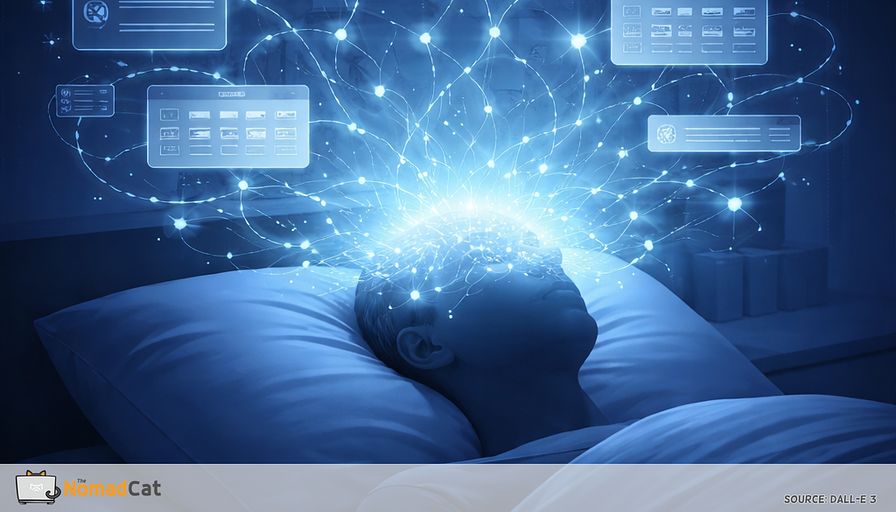
You did the “good evening” thing. And still, your brain acts like it’s in planning mode. Tight shoulders. Jaw clenched for no reason. You’re not exactly anxious… just mentally busy. Running tomorrow in the background like a build that won’t finish.
If that’s you, it’s rarely a discipline problem. It’s often a late-input problem. Some end-of-day inputs look harmless (even productive), but they quietly add uncertainty, self-evaluation, or “future simulation”—like a “quick” calendar scan, tone-checking a message draft, or opening an admin form. That’s the kind of mental payload that keeps the system online even after the screens are off.
I’ve spent most of my adult life at a desk, often past midnight—Beijing, then Berlin, now Lisbon—and I know the early signal: that upper-back tightness that builds quietly.
This article is here to help you spot those stealth inputs and make small changes that actually fit a packed workweek. You’ll learn:
- why “no screens” can still fail when the content is mentally activating
- what a “stealth stimulant” is, and the 6 common versions that keep people awake
- a 60-second evening audit to identify your personal culprit without a full sleep diary
- a simple rule for busy weeks (no new surface area after dinner) and what to do instead
- a few if-then scripts that move bedtime loops out of the critical path
No perfect routine. No extra system to manage. Just a cleaner handoff between “still thinking” and “sleep can run now.”
the bedtime gap that still feels busy
the clean evening that still ends in planning mode
And yet you’re tired without being sleepy, like the body wants to shut down but the brain is still compiling tomorrow. Upper back tight, neck a bit stiff, jaw doing that small clench you didn’t sign up for. You replay messages you didn’t even send. You scan tomorrow’s calendar in your head. You try to “close” 1 last loop.
If this feels familiar, it’s usually not lack of discipline. It’s often just low detachment: your brain keeps re-running work after work is over (Sonnentag & Fritz, 2007). And yes, it can show up even when you do the normal sleep hygiene things.
A more useful reframe is to treat it as a late-input problem, not only a screens problem. Some inputs are light and easy to digest. Others demand evaluation, prediction, or self-justification. Those keep the system online even after devices are off.
This matters because the next day rarely fails in a dramatic way. It fails with friction. Even modest sleep restriction can lead to cumulative attention lapses (Van Dongen et al., 2003) and it can hit executive control (Krause et al., 2017). At a desk, it often looks like:
- rereading the same paragraph 3 times
- more small errors and missed details
- slower decisions, more second-guessing
- sharper tone in messages than you intended
- “busy” work replacing real thinking
Sleep problems are also linked with presenteeism and performance costs in work datasets (Kessler et al., 2011). So what is keeping you awake when the obvious culprits are gone?
the quiet inputs that keep your brain online
what a stealth stimulant is
Turning off screens can help and still not solve it. A stealth stimulant is any late input that increases uncertainty, self-evaluation, or future simulation.
It can look calm, productive, even socially approved. That’s why it sneaks past your radar.
Think of it as quietly activating content. Not drama. Not adrenaline. Just something that creates new branches in your head. The unit to watch is not “the whole evening,” but the last few input episodes.
screens matter, but meaning can be enough
Yes, screens are a real pathway. Blue light can suppress melatonin (Brainard et al., 2001; Thapan et al., 2001). An eReader before bed can push your body clock later and worsen sleep versus print (Chang et al., 2015).
But there’s a second pathway that can keep you awake even with perfect “no screens” compliance: meaning. A printed book, a spreadsheet, or a “quick look” at a contract can still spike mental activation if it triggers evaluation and future simulation. You don’t need perfect evidence to test this: if a “calm” document makes you start forecasting tomorrow, it counts as stimulation.
If you like systems thinking, it’s debugging. The display (screen) is 1 variable, but the payload (content) can be the background process that won’t stop.
not a pager, just tiny open loops
Sometimes people are truly on-call. That pressure is real, and research calls some of it telepressure (Barber & Santuzzi, 2015). When teams reward instant replies, you don’t need to be on-call to feel on-call.
But a stealth stimulant is often not “my boss might text.” It’s “I left 7 tiny things unclear,” and the brain keeps re-indexing them.
More often than 1 giant life decision, it’s micro-ambiguities:
- a vague message draft
- a half-made decision
- an unanswered “who owns this”
- a meeting with no clear next step
None of it is catastrophic. It’s just reopenable. Evening rumination is strongly associated with sleep disturbance (Querstret & Cropley, 2012), and low detachment from work keeps showing up in the sleep literature (Wendsche & Lohmann-Haislah, 2017).
6 stealth stimulants that look harmless
1) new models late at night
Open-ended learning is a classic “looks healthy, feels responsible” trap. A newsletter, market analysis, or a sharp framework can expand surface area. You read 1 paragraph and suddenly you have 6 priorities to reconsider.
Unfinished goals tend to intrude until there is a concrete plan (Masicampo & Baumeister, 2011). And micro-optimizing has no natural endpoint, so your brain doesn’t get a credible “done” signal.
Common evening loops:
- a quick Notion cleanup that turns into taxonomy redesign
- “just 1” tool tutorial that unlocks 12 more settings
- habit planning that creates a new tracking spreadsheet
You may still fall asleep, but the mind keeps generating options. Not worried. Just busy in a quiet way.
2) tone replay and social ambiguity
Tone-checking is socially reopenable. You can’t really finish it because the outcome lives in someone else’s head. It looks like caring, but it’s also self-evaluation and threat scanning.
Social-evaluative contexts are strongly linked with cortisol responses (Dickerson & Kemeny, 2004). Not exactly what you want at 00:30.
3) reputation insurance
This is conflict avoidance work: pre-writing explanations, drafting contingencies, building “just in case” documentation so tomorrow can’t hurt you.
The body doesn’t care that it’s responsible. It reads it as threat monitoring and future simulation.
4) tomorrow simulation
Logistics checking turns bed into a staging area. You scan the calendar, check weather, rehearse route timing, and do a “quick prep” pass that somehow adds 3 more steps.
Planning can help when it reduces uncertainty instead of multiplying it. The problem is when it keeps opening branches.
5) admin ambiguity
Bills, insurance, budgeting, and forms carry vague risk. Vague risk is sticky. You open 1 tab and it becomes a decision tree with 8 branches, and none can be completed in 6 minutes.
6) reassurance checking
Calendar again. Inbox “just to see.” Bank account “quick look.” Weather again. The intention is certainty. The output is more branching, less done.
a 60 second audit that finds the culprit
a tiny evening input log
If evenings still feel busy after you did everything right, run a small debug log for 3 nights. Take 60 seconds after dinner or right before brushing teeth and write down only 1 thing:
- the last new input you consumed
Not everything you did. Not screen minutes. Just the last new payload.
This is deliberately lighter than formal sleep diaries (Carney et al., 2012). It’s not diagnosis. It’s a pattern-finder for overloaded weeks.
three questions that separate closing from generating
Once you have the last new input, classify it:
1) What was my last new input? (doc, message thread, book chapter, account login, conversation)
2) Did it reduce uncertainty or create surface area?
3) At lights-out, was my mind closing or generating?
You’re not judging yourself. You’re identifying which input type acts like a stimulant.
no new surface area after dinner
a rule that still works on busy weeks
A simple rule that targets the real arousal drivers:
After a chosen time (often after dinner), avoid any input that cannot be credibly closed tonight.
That includes paper, conversations, and “productive calm.” Shift real problem-solving earlier in the evening, and write down the next step so it stops bouncing around at lights-out. This is close to constructive-worry approaches (Carney & Waters, 2006).
My wife is a fitness trainer and nutritionist; she calls it “closing the loop” before you try to sleep.
Tech version: don’t open new tickets right before the maintenance window.
a yes list that gives your brain a done signal
Late evenings tend to go better when the activity is predictable, non-branching, or ends with a clear done signal:
- pack bag for tomorrow
- keys and wallet in place
- set 1 reminder
- 5-minute to-do list
- shower and basic grooming
- wash a few dishes
- light fiction re-read
- familiar low-stakes show
planning is allowed only if it closes
A practical definition: planning is allowed only if it reduces uncertainty in a bounded way.
One rule: 1 line next action. If it takes more than that, it’s probably surface area.
Template:
- “Tomorrow 10:00: send X the 3 bullet update.”
Plan-making reduces intrusions when it creates a concrete plan, not just more unfinished goals (Masicampo & Baumeister, 2011). Brief list-writing has been linked with faster sleep onset in a study setting (Scullin et al., 2018).
if then scripts for bedtime loops
The idea is postponement, not suppression. You are not trying to delete worry. You are moving it out of the critical path so sleep can run. CBT-style approaches use scheduled worry: you give the brain an appointment, so it stops freelancing at 00:30 (Hofmann & Smits, 2008).
-
Tone replay
- Captured. If this matters, I’ll rewrite it tomorrow at 10:00.
-
Calendar scanning and reassurance checking
- First check at 08:45. Not now.
-
Admin ambiguity and vague risk
- Next touch Saturday 11:00. One session.
Boring, yes. Often effective.
what “working” looks like
Treat success as less mental noise, not perfect sleep graphs. Useful signals:
- fewer bedtime idea explosions where 1 thought becomes 12 mini-projects
- less urge to “sort tomorrow” once you’re already in bed
- more nights that feel like 1 block of sleep
- fewer automatic checks for reassurance (calendar, inbox, bank, weather)
- less tone replay and fewer imaginary arguments after lights-out
If the pattern is severe or persistent, don’t force-fit it into an evening-inputs issue. This article is not a diagnosis. Loud snoring, choking or gasping, or strong daytime sleepiness can justify screening for sleep apnea (AASM guidance, 2017). For insomnia that impairs functioning, CBT-I is the evidence-backed first-line treatment (AASM guideline, 2017; Trauer et al., 2015).
If you’re doing the “good evening” checklist and still lying there with tight shoulders and a brain that won’t stop compiling tomorrow, it’s probably not a willpower issue. It’s input. The big shift is noticing that screens are only part of it. The payload matters. Anything that adds uncertainty, self-evaluation, or future simulation is basically a quiet stimulant, even if it looks responsible.
Keep it simple: identify the last new input, run the 60-second audit for a few nights, and test the rule of no new surface area after dinner. Then swap in activities that actually close loops, or capture a 1-line next action so your brain gets a “done” signal.
Most people have 1 repeat offender. Once you find yours, evenings get quieter without adding another routine.
You might be interested by these articles:


After dinner no more invisible work so your sleep can actually power down

Your 1st 45 minutes are training your 02:00 brain so change the input order

Thin sleep is a workday monitoring bug not a bedtime failure

At 03:00 your brain starts doing reputation management

Your sleep is thin because your brain is still on standby

Write desk health like software with degraded mode built in

Revolutionizing Medicine with Genomic Innovations