 Gilles Crofils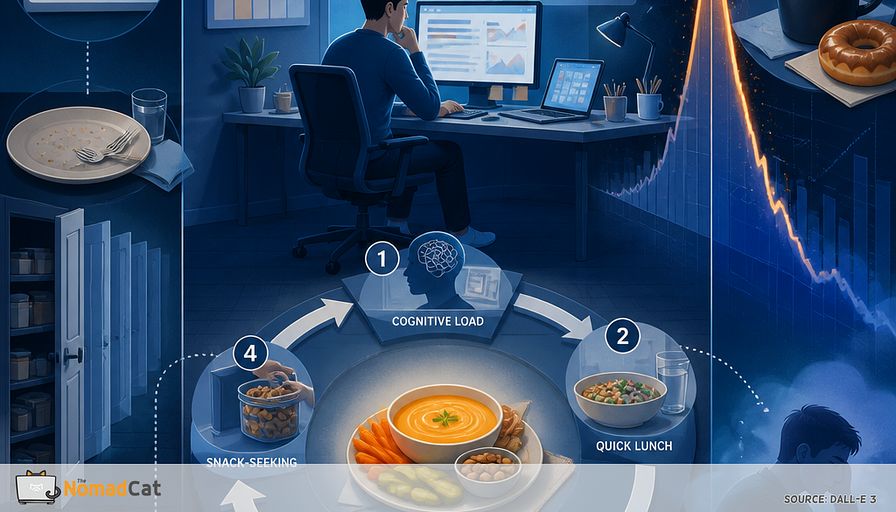
Lunch technically happened. The calendar even blessed it as a “break”. But it was 12 minutes, half a meeting, and you ate while answering messages like it is a normal human activity. Then 15:30 arrives and suddenly you are doing kitchen laps. Not exactly hungry, just searching. Something crunchy. Something sweet. Something that makes the brain stop refreshing the page.
If that sounds familiar, this article is for you. Not the polished version of you with a cute bento and a 45-minute pause. The real desk-day version, where the commute walk disappeared, the stairs are now 6 steps to the fridge, and “I’ll eat later” becomes a recurring calendar event. I did this for years between Beijing and Berlin, and I still do it in Lisbon: lunch turns into a calendar fiction the moment the afternoon fills up.
The point here is simple. A lot of afternoon snacking is not a discipline issue. It is a mismatch issue. Desk work pushes the brain into a state where food is used for relief and reward, not just fuel. So even when lunch was “enough,” it can still fail to close the loop.
You will get a practical model for what is happening, and a small way to test fixes without adding another system to your life. Specifically, we will cover
- Why desk work makes “wanting” louder even when energy needs did not change much
- 2 common desk patterns: unfinished-lunch seeking vs spike-then-slide snacking
- One small tool (a reward anchor) plus a 5-day debug loop to test it
If afternoons keep turning into low-grade foraging, this is a way to treat it like a feedback loop you can tune, not a personality flaw you have to fight.
The palatability mismatch model
Why enough food still fails at a desk
At a desk, “lunch” often means whatever fits between calls. Maybe it is a quiet wrap eaten one-handed while your camera is on. Maybe it is a protein shake because it is fast and nobody hears you chew. Then around 15:30, you are back in the kitchen doing laps, looking for “something”.
That pattern is boringly common in desk work. Mentally demanding tasks can push people toward more eating afterward even though the work itself didn’t burn much energy (Chaput et al., 2007). Add the early afternoon dip many people get, and it stops looking like a personal failure and starts looking like a predictable mismatch between work state and food state: your calendar stayed intense, but your lunch was built for “get it done quietly.”
The useful question becomes what system is driving the seeking.
A simple way to think about it is 2 overlapping systems.
- A steady “meal” system that mostly cares about energy and satiety
- A cue-driven “treat” system that cares about reward, relief, and learned associations
Under cognitive load, the treat system can get louder. So choices drift toward either dull food that never really closes the loop, or highly engineered snacks that close it too well and too fast.
Palatability mismatch is when the “reward” you got from lunch doesn’t match what your brain is asking for under load. Meaning: lunch was “enough” on paper, but it didn’t feel like a real stop.
- Under-reward: you ate “properly”, but it lands like wet cardboard. Wanting stays on.
- Over-reward: the input is intense and fast. You get a spike, then a sharper slide. Wanting comes back quickly and aims at “another one”.
A usable loop looks like this
Cognitive load + desk constraints → food selection drifts toward silent beige or fast reward → short relief → renewed seeking
Sometimes stress and poor sleep push the same direction: the “easy reward” options feel louder, and the afternoon turns into a snack-shaped coping tool. Also, sometimes the simplest explanation is still true: you just didn’t get enough total fuel at lunch.
The 2 mismatch signatures you can spot at your desk
Under-reward feels like an unfinished lunch
You ate a fast, functional lunch and technically it should be fine, but it does not close the loop. Your brain keeps scanning for something with more contrast.
Part of this is sensory-specific satiety (normal human thing, annoying name): your brain gets bored of one flavor fast, so a monotone lunch can leave an open tab that keeps asking for “different” (Rolls et al., 1981). Habituation is the same vibe: repeat the same flavor profile enough and it stops registering, then a new stimulus wakes it back up.
Desk signs tend to look like this
- Still scrolling delivery apps
- Adding “just 1 thing” to the grocery cart
- Opening the pantry like it changed in 10 minutes
If lunch feels unfinished and attention keeps hunting for “different”, that is usually under-reward, not under-discipline.
Over-reward is a spike then a slide
This is the opposite problem. Too much reward too fast. A sweet coffee drink, a pastry, the office candy bowl, the “free” delivery side that was never part of the plan.
You get a short lift, then 60 to 120 minutes later the fog is back and wanting is online again, even if hunger is not. This is not a diagnosis, just a pattern that shows up a lot in desk environments where the easiest “break” is sugar + caffeine.
Your outputs are the early warning logs
Desk life is good at hiding body signals. Work artifacts are louder.
- Rereading the same paragraph
- Tiny typos and miscues
- Slack tone gets sharper
- Kitchen laps on autopilot
- Coffee feels urgent
- Snack drawer opens “by mistake”
- Dinner becomes a cliff
These are logs because they are observable. You do not need to debate if you are “really hungry”. You can just notice the drift.
And you can map them to the 2 patterns:
- If the log is “delivery app scrolling after lunch” or “pantry open again,” that usually tracks under-reward (lunch didn’t feel finished).
- If the log is “coffee feels urgent” after a sweet snack, that’s often over-reward (spike, then slide, then you’re trying to climb out).
A simple decision rule
- If search stays on, suspect under-reward
- If spike then slide, suspect over-reward
If both happen depending on the day, that is normal. Workload, stress, and sleep pick different defaults.
Desk constraints that manufacture the mismatch
Meeting optics turn lunch into a sensory filter
The desk has invisible rules. They are not written by nutrition science. They are written by Slack and social friction.
- No loud crunch on a call
- No smell that becomes the team topic for 20 minutes
- No reheating roulette and microwave politics
- No sauce that can reach the keyboard
- One-handed bites because the other hand is typing
- No plates, no cutlery, no sink situation
- Bonus rule for remote work, no camera-off chewing like a goat
So the feasible menu collapses into quiet beige solids or liquid calories, especially when eating is compressed or combined with other tasks. Liquids also tend to be less satiating than solids in reviews, so the “just drink something” lunch choice is often a trap door (Almiron-Roig et al., 2013).
Format matters more than people want to admit. Chewing and oral processing are part of the stop signal. When lunch is a silent upload, the system often keeps waiting for a “done” notification.
Urgency forces fallback mode
When urgency is high, choice bandwidth collapses and the environment picks for you, like a system dropping into fallback mode. The default route is either fast reward or silent beige because both are low-friction under stress.
The implication is simple. The fix should not require a perfect week. It should still work on messy days.
The reward anchor that keeps afternoons boring in a good way
What a reward anchor is
The goal is not excitement. It is calibration.
A reward anchor is 1 sensory contrast you attach to an already-existing lunch or planned snack, in a desk-legal way, so the eating event has a clear endpoint.
Pick 1 channel
- Crunch like carrots, nuts
- Acid like pickles, a bit of vinegar salad, citrus if it works for you
- Warmth like a small soup starter
- Savoriness like olives, a salty broth
This leans on simple mechanisms. Contrast helps close the “need something different” loop. Chew and longer oral processing also tend to make food feel more “done” than liquid or ultra-soft formats.
Rules
- Pick 1 contrast
- Keep the same choice for 5 days
- Add it without adding new complexity
Under-reward days often need a small signal at the end so lunch feels finished. Over-reward days often need a stabilizing signal earlier, so the sweet coffee or pastry does not become the peak reward event that trains the whole afternoon around cues and wanting.
Placement rules that match your mismatch
For under-reward, attach the anchor to the end of lunch or the end of the first planned afternoon snack. The point is a clear sensory endpoint so “different” stops pinging attention.
For over-reward, place the anchor before the usual treat window. It is a stabilizer, not a punishment.
If your office only offers extremes, change friction, not discipline. Small environment tweaks can move purchasing and eating patterns in the real world, including cafeteria placement nudges (Thorndike et al., 2012).
- Keep the chosen anchor visible and reachable on the desk or front of the fridge
- Put treats 1 step farther away than the anchor, even if it is just a different drawer
- In the cafeteria line, choose the anchor first, then decide on the rest
The win is fewer afternoons that turn into background seeking.
A 5-day debug loop that does not eat your brain
The minimal log and what counts as a win
Run this for 5 workdays. 2 check-ins per day. No photos, no calorie counting, no apps, no perfect lunch. A paper note is enough.
Template
- Lunch, anchor Y or N
- 16:30, steady or snacky or foggy or coffee-urgent
Optional: if you already track sleep with a watch (or you’re the type who wears a Polar H10 for workouts), just note “sleep ok / sleep bad” next to the log. Keep it dumb.
Interpret the 5 days without overfitting. The scoreboard is boring behavior change, not body change.
- Fewer kitchen laps that feel automatic
- Fewer impulsive sweets added “just because it is there”
- Fewer rescue coffees that feel urgent rather than nice
- Less rereading the same paragraph 4 times
- Fewer small typos and miscues
- Less sharp Slack tone
- Less delivery app scrolling after lunch
- Dinner feels less like an emergency drop after work
If the week gets boring, that is success. Boring means the loop stopped paging you.
Quick interpretation
- If anchor-at-lunch days reduce snacky scanning, under-reward was likely the bottleneck
- If anchor-before-treat days reduce foggy or coffee-urgent states, over-reward was likely the bottleneck
- If nothing changes, look at non-food amplifiers (sleep debt, calendar density) or the boring answer: you didn’t eat enough
No change is also data. It points to a different constraint.
Guardrails and when to stop experimenting
Do not run food experiments alone if risk is non-trivial. If any of these apply, the right next step is clinical guidance, not tweaking pickles versus carrots.
Stop list
- Extreme or new fatigue, dizziness, or fainting feelings
- Significant appetite or weight change that is not explained
- Diabetes, hypoglycemia risk, or glucose-lowering meds
- Eating disorder history or current symptoms
Tiny caution list
- If reflux gets worse, skip the acid anchor (ACG, 2022)
- If IBS flares, skip spicy anchors (ACG, 2021)
- If sleep gets worse, do not solve 16:30 with more caffeine
The model is a temporary debug tool, not a new identity and not a rule set to defend. The goal is fewer reward swings and more stable work output, inside a messy calendar. If the anchor turns into rigid tracking or new stress, drop it.
If your afternoons keep turning into low-grade foraging, it is probably not a willpower issue. It is a feedback loop. Desk work turns up the “wanting” system, meetings shrink lunch into quiet beige or liquids, and then the brain keeps pinging for something crunchy, sweet, or just different. The useful move is treating those kitchen laps like logs, not a moral referendum.
The model gives 2 quick reads. Under-reward feels like lunch never ended. Over-reward is a spike, then a slide, then another snack “somehow”. A reward anchor is a small, desk-legal contrast that helps close the loop without adding a new system. Run it for 5 days, check the drift at 16:30, adjust.
Most days it’s not hunger. It’s the desk asking for a different kind of stop signal.


