 Gilles Crofils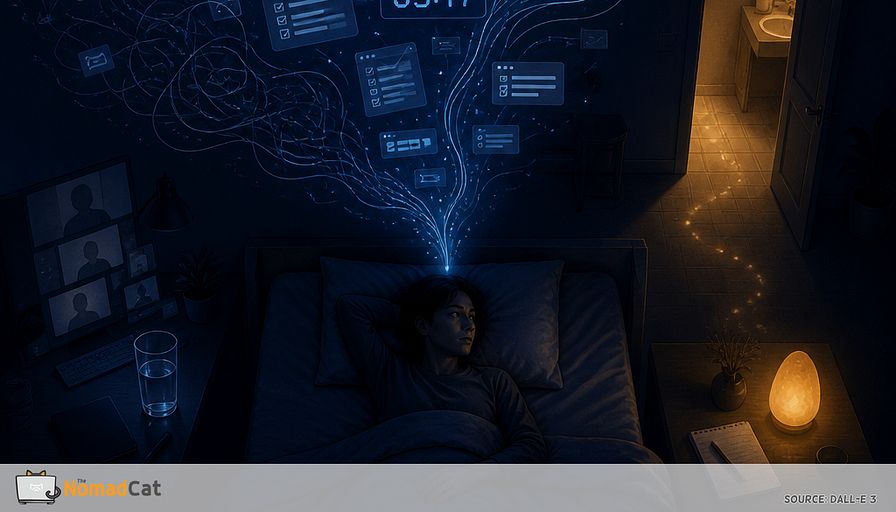
You wake up at 03:17. No drama. No nightmare. Just… fully online, like a laptop that got nudged and decided this is a great time to run updates.
Maybe you do a quick bathroom stop. 3 minutes. Then the real problem starts. The brain opens every tab. Work stuff. Tomorrow stuff. That one message you did not answer. You are not “stressed,” exactly. Just awake in that annoyingly competent way. And even if you still get “enough hours,” the sleep feels fragmented. Like cheap Wi‑Fi that technically works but makes everything lag.
This article is about that specific pattern, and why it is usually more mechanics than morality. Not “try harder.” More like “stop rewarding the wake.” I’ve spent most of my adult life at a desk (Beijing, Berlin, now Lisbon), and the one variable I still don’t reliably control is sleep.
Here’s what you will get, without turning sleep into a new part-time job
- Why a small wake turns sticky, especially if you check the time or touch your phone, and how CBT‑I frames that loop
- How desk days quietly set you up for nocturia, with meeting stacks, delayed drinking, and the “catch up hydration” trap
- A simple 3-day debug using a tiny log that beats memory and keeps the problem concrete
- Practical levers that tend to work in real schedules, like shifting fluids earlier and making the bathroom wake boring again
- When it is worth stopping the DIY debugging and getting checked, because sometimes it is not just logistics
If your nights keep getting interrupted and your mornings feel like they were assembled from thin slices, this will help you see the system. And once you can see it, small inputs start to matter.
When a small wake turns into a full reboot
The pattern you can spot fast
You wake in the second half of the night. The apartment is quiet. Then your brain comes up like a screen that just lit itself. No panic. Just instantly online.
This is usually not a character flaw. Left to myself, I work through the night, and at 52 I know I’ll pay for that later if I don’t adjust. CBT‑I treats it more like a maintenance issue than a discipline issue.
A common pattern
- You fall asleep fine
- You wake 1–3 times between about 01:30 and 05:30
- Often there is a bathroom stop, sometimes more “might as well pee while i’m up” than “emergency” (nocturia just means waking 1+ times to pee)
- The bathroom part takes 3 minutes
- The real cost is the 30–45 minutes after, when planning mode starts
So you can still get “enough hours,” but it lands in your body like sleep on a flaky connection.
Waking once can be normal. The issue usually shows up when it is 2+ awakenings, or when any wake becomes sticky and you do not slide back quickly.
The point is not the pee. It is the on-ramp to thinking.
Why the wake becomes a data pipeline
The resume event problem
A bathroom wake is your system coming out of sleep mode. Checking the time or grabbing the phone is like opening the incident dashboard during an outage. It feels responsible for 12 seconds. It also cranks up brightness and attention, which is exactly what makes insomnia stickier. CBT‑I is blunt about this for a reason. Clock watching is not neutral. It nudges the brain toward more waking and less drifting back.
The loop learns fast
- If you check Slack and reduce uncertainty, waking becomes useful
- If you solve a problem in your head and get that tiny click of certainty, waking gets a reward
The moment the wake becomes useful, your brain starts scheduling it.
Remote work can make it worse because open loops are everywhere. Meetings stack. Context stays half loaded. Then “end of work” is just closing a laptop while the same mental tabs stay open. The green dot can create pressure to stay reachable, which keeps your brain on standby late.
So the bathroom wake becomes the first uninterrupted slot the system can find.
How desk days quietly set up nocturia
Meeting stacks teach you to ignore signals
Back to back calls turn you into a camera statue. You stop drinking because you do not want to interrupt. You stop noticing you should stand. Even “gaps” feel like trapdoors for catch up tasks, not breaks.
Your body still logs thirst and bladder signals. Your brain just marks them low priority, like warnings muted during an incident.
The invoice does not disappear. It arrives later, usually at night.
In a lot of jobs, people delay bathroom breaks and cut fluids because stepping away feels hard or risky. And even without explicit rules, being “reachable” can make leaving your desk feel like a bad idea.
Then fluids get postponed to “later,” and later becomes evening because the day never really ends.
Mechanically, evening catch up drinking increases bladder load right when sleep is lighter in the second half of the night. Then a small wake for any reason turns into a bathroom trip because it feels efficient to empty the tank while you are up.
One useful detail is that not all night peeing starts with the bladder. Sometimes you wake first, and peeing is opportunistic. That matters because it changes what to tweak.
A 3 day debug without turning it into a hobby
The 10 second log that beats your memory
This is not lifestyle tracking. It is debugging.
CBT‑I uses sleep diaries because memory is bad at continuity. You remember “i slept ok” or “i was awake forever,” and you miss the little triggers in between. A tiny log catches the resume events you keep missing and keeps the problem small and concrete.
In the morning, write 3 checkboxes
- Woke to pee 0 / 1 / 2 / 3+
- Return to sleep quick / sticky
- Checked phone or time yes / no
Sticky is the part that ruins you even when total hours look decent.
Two evening checkboxes that explain most nights
In the evening, capture whether the desk day pushed hydration to the wrong place
- Catch up drinking after dinner yes / no
- Any beverage within 60–90 minutes of bed yes / no
Then pick the next lever
- If bathroom wakes cluster on nights with catch up drinking or late beverages, it is often a scheduling problem first
- If wakes happen with no fluid pattern, it may be arousal-first nights where you wake for other reasons and void opportunistically. Or it can be other factors like med timing or sleep disorders
The win condition is not “never pee again.” It is boring continuity you can feel at 09:30. Fewer awakenings, faster sleep after a void, and a longer first uninterrupted block all count.
Fix the timing not the volume
Protected drink windows that survive hostile calendars
The principle is boring and often effective.
Don’t drink less. Drink earlier.
Hard evening restriction often backfires. The day stays dry, then 21:30 hits and you remember hydration exists and chug 2 big glasses.
Daily water needs vary a lot.
- Do not run aggressive evening restriction if you’re pregnant.
- Be careful if you’re older/frail, sick, working in heat, or on fluid-affecting meds.
- If in doubt, match medical advice.
Instead of “sip all day” which dies the first time the calendar explodes, use 2 protected windows tied to events that already happen
- Mid morning after the first long meeting block ends, finish 1 glass
- Mid afternoon after lunch or the first post lunch call, finish 1 glass
Anchors beat intentions. This makes hydration a calendar thing, not a willpower project.
For the space between, a meeting proof micro rule is enough
- Every time you stand up between calls, take several sips
Then add a gentle taper. A common target is less volume in the last 2–4 hours before bed, especially avoiding late chugging. Think move the curve earlier, not nothing after X.
Even with better timing, some wakes will still happen. The next win is making those wake ups boring so they do not turn into a full reboot.
Make the wake boring again
The zero reward bathroom protocol
Treat the wake like a maintenance ticket. Get up, bathroom, back to bed.
- No phone
- No inbox
- No clock
- No “since i’m up” planning
The goal is to stop rewarding wakefulness with anything interesting or useful. Bathroom is not a portal.
Light is the amplifier people underestimate. Bright light at night is basically a notification blast to your circadian system.
Practical setup
- A dim warm night light in the path
- Bathroom light off if possible
- Avoid overhead LEDs
Also avoid “helpful” stimulation like cold water on the face, extra walking around, or stretching under bright light. Keep it minimal and warm enough that you do not fully wake up.
If a thought will not drop, the smallest offload beats recruiting a phone. A paper notepad and 1 line is enough to park it.
When it is not just desk logistics
When to stop debugging and get checked
Sometimes the desk day plus late fluids model fits perfectly. Sometimes it does not. Medication timing is a common hidden variable. Sometimes the night wake is a symptom, not a schedule issue.
A few patterns are worth screening
- New or rapidly worsening nocturia over days or weeks
- Pain or burning when urinating
- Blood in the urine
- Extreme thirst or very high urine volume overall
- Loud snoring, choking, or gasping in sleep, especially with nocturia. Sleep apnea can drive nocturia
- Dangerous daytime sleepiness like nodding off while driving, in meetings, or at the desk
Medication can make timing advice bounce off. Diuretics are the obvious one, but other drugs can increase urine output or shift it later. Sometimes the only issue is when a dose is taken. That is clinician territory.
Success is usually not never waking again. It looks like fewer total wake ups, or the same pee count but faster return to sleep, and less clock or phone checking so the wake stays small. Keep the system intentionally minimal so tracking does not become the new thing that keeps your brain online.
That 03:17 wake is rarely a personal failure. It is usually a small mechanical event that gets rewarded. A quick bathroom trip becomes a full reboot because the system gets fed with light, clock-checking, and “might as well” problem-solving. Add a desk day that delays water until evening, and you have the perfect setup for 2+ night wakes and sleep that technically works but makes everything lag.
The good news is the levers are small. A 3-day log makes the pattern visible. Moving fluids earlier often helps without turning hydration into a project. And when you do wake, making it boring again with dim light and no phone keeps the brain from opening every tab—so the sticky part has less to grab onto.


