Abstract:
The article argues that on work-from-home days many people don’t lack motivation so much as they’ve lost the built-in “outdoor minutes” office life used to provide—those tiny, unremarkable threshold-crossings like walking from a car park, heading to a transit stop, or popping out for a lunch errand—and the cost shows up later as subtle “mood and energy noise” and the nagging feeling at 19:00 that you’re still mentally at work, even if the day went fine. Using a vivid remote-day loop of Slack pings, a boiling kettle, and camera-on calls where you “mute, unmute, nod like a dashboard widget,” it suggests making the invisible gap visible by counting outdoor “exposures” (simply stepping outside) rather than steps, since WFH deletes the triggers that used to deliver 2–6 exposures for free. The piece explains that brief outdoor contact helps by providing strong daylight signals that can boost alertness, breaking the near-only visual strain of constant screen distance, and creating sensory and contextual punctuation that supports psychological detachment; it emphasizes that nature is ideal but “whatever is nearby” is what survives meeting-heavy weeks. Instead of heroic routines or tracking, it proposes “exposure snacks”—30 to 120 seconds outside (or pragmatic fallbacks like a bright lobby or window if weather/ safety blocks you)—made frictionless with shoes/keys by the door and attached to existing cues and dead time (kettle boils, meeting ends, loading screens), with a reputation-safe approach to calls (camera off, “back in 60 seconds”). It closes with guardrails for people sensitive to bright light (e.g., bipolar risk, migraines, eye issues, photosensitizing meds), and a simple 7-day test: pick one reliable cue, do one tiny exposure when it happens, then around 18:00 ask only whether the day felt less stuck than usual.
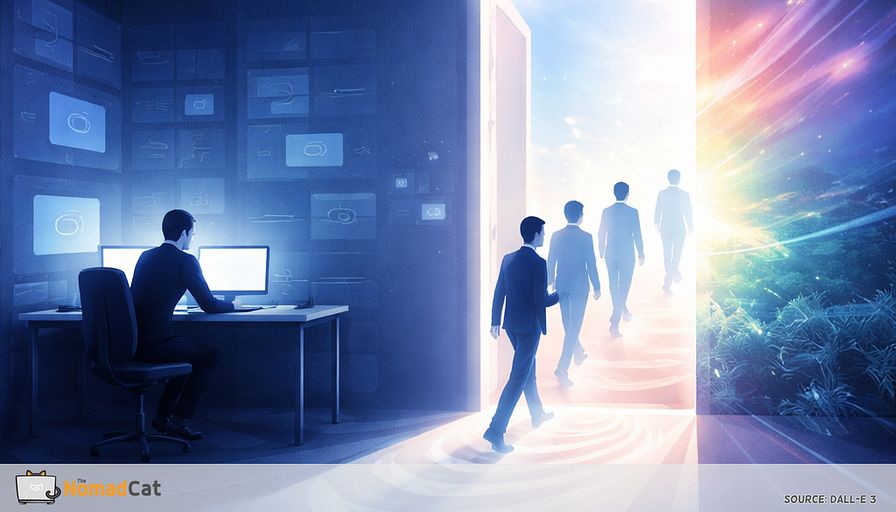
Slack pings. Kettle boils. Camera-on call. You mute, unmute, nod like a dashboard widget. You do the little desk-to-kitchen loop for 10 hours and, technically, yes, there was movement. But no real threshold crossed. No street. No air change. At 18:30 you notice the weird part. You didn’t really go outside even once.
This article is about that missing thing, and why it’s so easy to miss on remote days. It’s not a motivation problem. It’s a defaults problem. More specifically: the missing default is door-crossing outdoor exposure—those tiny exits where you actually leave the building and your environment changes.
Office life used to hand you outdoor minutes for free. I did this for years between Beijing and Berlin: day ends, the body never got the “outside checkpoint” unless the office forced it. Work from home deletes the triggers, and the cost shows up later as mood and energy noise, not as an alarm.
Let’s make the gap visible, then plug it with exits small enough to survive a meeting day.
No branding. No heroic morning routine. Just a small system change that replaces what commute structure used to do automatically. And yes, it can be almost stupidly short. That’s the point.
the outdoor minutes you used to get for free
The missing piece is not motivation. It’s the outdoor minutes you didn’t earn, you inherited.
Office life baked in small outdoor exposures even if you were not “an outdoor person.” At home, nothing is baked in.
A simple way to make this visible is to count exposures instead of steps. Not lux, not medicine. Just: did i cross the door and get real outside input?
Data like ATUS time-use points the same direction on WFH days: time shifts from out-of-home to at-home activities. On a Tuesday, that just means fewer “accidental exits,” even when you feel busy all day.
Many people used to get roughly 2 to 6 small outdoor exposures per day by default with commuting and normal errands. This isn’t a lab number—it’s a quick count from the patterns below. Example: a commute often gives you 4 by itself (out in the morning + back in the evening), and adding a lunch errand makes it 5.
Typical “free” exposures looked like this
1) drive day
- home to car
- car park to office
- then the reverse
2) transit day
- home to stop
- stop to office
- then the reverse
3) lunch errand day
- add a quick “go buy something” loop
Remote work deletes the triggers. No elevator lobby. No street crossing. No “oops i forgot my badge” moment. And these tiny exits don’t register as exercise, so they don’t get protected like a workout slot.
That’s why willpower is a bad tool here. Defaults beat intentions most days. The more reliable move is cue-based: if X happens, then i do Y. Implementation intentions help because you’re not negotiating every time (Gollwitzer and Sheeran, 2006). The annoying part is the penalty is delayed. It shows up later as mood and energy noise, not as an alarm.
why the loss stays invisible
Morning can feel normal. You sit down, you ship things, you even feel focused. Then after lunch, the log gets messy. You’re tired but wired. More irritable at small things. At 19:00 you still feel mentally at work.
A useful label is psychological detachment (Sonnentag and Fritz, 2007). Not a diagnosis. Just a pattern many desk people recognize: your brain never closes the ticket, so the process keeps running in the background.
Part of the reason detachment is harder at home is very physical. Same chair, same air, same screen glow, same view. The brain doesn’t really get the memo that the shift is done, because nothing in the environment changed.
A same-room day often has
- 1 lighting profile
- 1 temperature band
- 1 soundscape
Indoors, especially away from windows, light tends to be stable and flat compared to outdoors. So the day becomes one long scroll. Transitions feel less real because, well, they are less real.
This is not “take more breaks” as a life rule. It’s about state changes that happen without you negotiating with yourself.
what stepping outside was really doing
All of this comes back to the same missing default: door-crossing outdoor exposure creates a fast state change, even when the “break” is short.
daylight is a strong signal
Outdoor daylight is basically your nervous system’s high-power input, while many home offices are stuck on dim mode even if it feels fine—the same lamp glow at 10:00 and 16:00. Bright light can acutely increase alertness (Cajochen, 2007). What that means on a normal workday: you can feel a little more “online” after a quick outside hit, without needing a perfect routine.
Timing matters too. Morning and daytime light tends to pull the schedule earlier, while evening light can push it later. If you already struggle to shut down, blasting bright light late can backfire. The goal is day structure, not a 22:30 “wake up” signal.
Also, seconds-level dosing is not nailed down. Labs often use 10 to 30 minutes of bright light then test vigilance or sleepiness (Souman et al., 2018). Short outside time might still help because outdoor light is intense and light-sensing cells in the eye feed alertness signals (Brown, 2020). Practical implication is simple
- treat short outside time as an experiment
- don’t treat it like a guaranteed trick
outside breaks the near-only loop
A lot of desk fatigue is visual monotony. The 60 cm bubble. Screen, keyboard, phone, repeat. Near work is associated with “computer vision syndrome” type symptoms (Rosenfield, 2011). Dry eye is part of it because sustained device use changes blinking patterns (TFOS DEWS II, 2017).
Outside, even if it’s just looking to the end of the street, the task changes. Your eyes stop doing only near focus. Not dramatic. But it removes one load from the stack.
sensory variance acts like punctuation
WFH days can feel like 1 endless tab that never closes. A step outside gives a different temperature, a bit of wind, maybe sun on the face, maybe the “ok it’s colder than i thought” moment. That’s a boundary cue.
In attention restoration framing, “being away” is not only about forests. It’s about leaving the mental context you were in. And recovery research keeps pointing to the same idea: detachment and recovery experiences link to better well-being over time (Sonnentag et al., 2017). Not luxury. Just a system signal that a chapter ended.
Nature often works better than built environments in studies (Berman et al., 2008). But waiting for ideal is how people get 0. The version that survives meeting-heavy weeks is usually “whatever is nearby.”
exposure snacks that survive real calendars
An exposure snack is a very brief outside contact that aims for
- daylight to the eyes
- far vision
- a context switch
Not exercise. Not a step goal. Not a promise that 60 seconds fixes your brain. And yes, research is a bit annoying here. There aren’t many clean controlled trials on 2-minute-or-less outdoor breaks as a standalone intervention. Still, bright light can increase alertness on short timescales—usually minutes rather than seconds (Cajochen, 2007). So the replacement logic is reasonable.
Low-friction options
- Step outside the building door for 30 to 90 seconds, then back
- Split trash or mail into 2 trips so you get 2 exits
- Kettle boils, stand outside 60 seconds, then tea and back
- Bookend meetings, exit right after, re-enter before the next join
- Balcony or fire-escape 1 to 2 minutes, look far, then return
- Bright lobby or atrium 45 to 90 seconds if outside is complicated
The design trick is to attach them to dead time, not willpower. Use if-then cues instead of goals. Think of it like using existing loading screens
- builds
- exports
- waiting for host
- coffee machine
You are already blocked. So you reassign that buffer to daylight.
Do it between calls, not during. Video meetings push people into a frozen, camera-framed posture, and breaks can feel socially risky (Bailenson, 2021). Keep it reputation-safe. “back in 60 seconds” in chat, camera off, no drama.
make the default faster than the excuse
Outside breaks die from friction stacks. Shoes. Jacket. Keys. Elevator. Weather doubt. “will i look weird”. Then a call starts. Done.
Make the exit path stupidly easy
- Put shoes by the door so “maybe later” becomes now
- Park keys and a throw-on layer together, fewer decisions
- Keep umbrella or cap in reach so weather stops being a debate
And yes, this gets extra real on workations across europe, where the chair is bad, the desk is worse, and the “going outside” plan dies the second you can’t find your keys. Friction is undefeated.
If outside is unsafe or weather is miserable, use a spectrum of options. A bright stairwell, lobby, or glazed corridor still gives a transition and is often much brighter than deep indoor space. If nothing else works, go right to the window, close to the glass, and look far for 1 minute. It’s not equivalent to going outside, so don’t oversell it to yourself. It’s just the fallback that keeps the chain unbroken.
Also please don’t turn this into a macho cold exposure thing. The goal is changing inputs, not suffering. If UVI is 3 or more, basic sun protection applies (WHO UV guidance).
how to tell if it helps without tracking your life
Measure outputs you care about, not steps or streaks. A few boring signals that tend to show up when the day has more boundary cues and a bit more detachment (Sonnentag and Fritz, 2007)
- You start the next task with less friction
- Less tab-staring and scroll fog
- Calmer tone in the last 2 meetings
- At 19:00 you feel less “still at work” in the head
- End of day feels less heavy
My default (physics brain, annoying habit) is to treat this like an experiment: change 1 variable for 7 days and look at 1 output.
If you really want numbers, keep it small. You can do a weekly pulse check with short tools, but don’t let it turn into homework:
-
REQ detachment (4 items): quick check of whether you mentally “switched off” after work, not whether you were productive (Sonnentag and Fritz, 2007)
-
BITe irritability (5 items): quick check of how easily you got annoyed or snapped, not a personality verdict (Holtzman et al., 2015)
Or, if you’re already a data person: use one dumb, passive signal from tools you already own—e.g., sleep timing from a Decathlon sport watch, or resting heart rate trend from a Polar H10—just to see whether late-evening “still at work” fades a bit. No dashboards required.
Measurement can become the new friction, though. If tracking makes you stop doing the thing, it’s not helping.
guardrails and a 7-day debug
This is not a fitness plan. Not a steps pitch. Not a vitamin D lecture. It’s just restoring missing outdoor variability with tiny exposures, with honest uncertainty on seconds-level dosing.
Yes, this is the part where the internet ruins a simple idea.
Bright light is strong enough that a minority of people should be careful
-
Bipolar disorder: bright light can increase switch risk; clinician-guided approaches matter. Research supports safer midday and titrated protocols in bipolar depression (Sit et al., 2018)
-
Migraine or photophobia: glare can be a trigger, keep it softer and shorter
-
Eye disease or recent eye surgery: ask an eye professional before doing anything intense
-
Photosensitizing meds or skin conditions: check your meds
- Don’t stare at the sun
The 7-day test
1) Pick 1 reliable cue you already have every workday, for example “first meeting ends”
2) If that cue happens, then do 1 exposure snack that day, even 60 to 120 seconds outside or your best safe fallback
3) Around 18:00 answer 1 question, no app, no streak
- did today feel less stuck than usual
If you miss 2 days, nothing broke. Make re-entry automatic and cheap. You’re just putting back a default you used to get for free.
WFH isn’t failing you because you “lack motivation”. It’s just missing the tiny outdoor moments office life used to hand you for free. Counting exposures, not steps, makes the gap obvious. A 60 to 120 second exit can add daylight, far vision, and a clean context switch, which often helps with alertness and with that annoying “still at work” feeling at 19:00. The point is not a heroic routine or tracking your whole life. It’s reinstalling a default with low friction by tying an exposure snack to cues you already have, like the end of the first meeting or the kettle boil.
Most people don’t need a new habit. They need one cue they already have to start opening the door.
You might be interested by these articles:


Your remote day needs scene changes not a longer walk

Your remote day is a thermal flatline and your body misses the interrupts

Build an interruption ecology for remote work so your body stops billing you at 18:30

Your hoodie is keeping Slack open in your brain

Micro-exits for remote days that keep your body from timing out

Solving Tech Problems: A Systematic Guide

Mastering EU Compliance with Go: A Guide for Tech Startups