 Gilles Crofils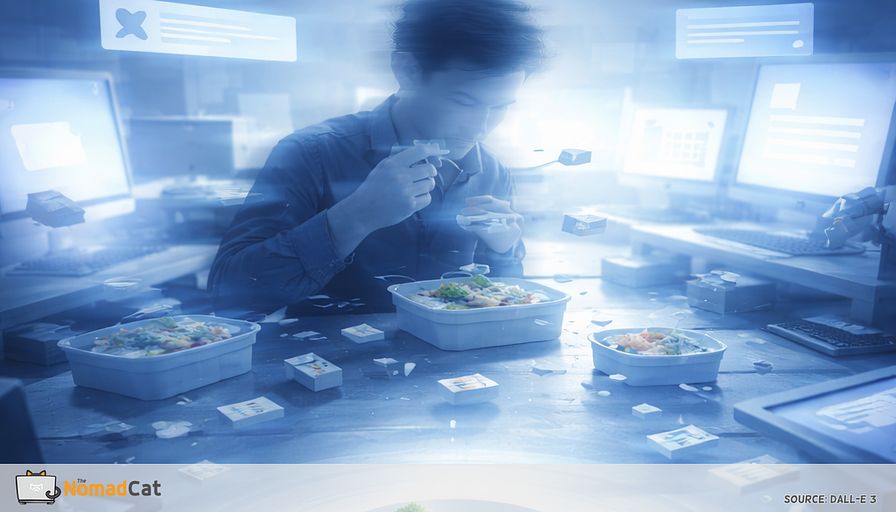
Lunch that doesn’t register
If your lunch happens in the 6-minute gap between 2 meetings, it’s not really a meal. It’s more like clearing notifications. Container open next to the keyboard. 3 bites while answering a “quick question.” Slack ping mid-chew. Then the lid closes and you’re back in the doc like nothing happened.
And later, somehow, you’re hungry again.
I’ve done this for years at a desk—Beijing, then Berlin, now Lisbon—often past midnight.
This is for that exact loop. Not for perfect meal prep. Not for macro math. And not for advice that assumes you have a calm 45-minute lunch break and a separate personality for weekdays.
The goal: fewer 15:00–17:00 “episodes” without changing what you eat. Make lunch land so the rest of the day gets quieter. Less random kitchen drifting. Fewer unplanned snacks that don’t even feel like a decision. Coffee #2 (or #3) feeling optional again. Dinner not turning into recovery mode.
We’ll walk through:
- Why desk lunch often fails to “count” in the brain, even when you ate enough
- The 2 main mechanisms behind it: satiety lag (your signals arrive late) and meal memory (your brain barely logs the meal if attention is split)
- A practical cause-and-effect map of the desk day loop, based on what’s measurable in real work life (calendar saturation, eating while working)
- A small experiment called the 8-minute landing protocol, plus degraded versions for days when your calendar laughs at you
- A tiny debug log that doesn’t turn your life into a tracking app, just enough to see whether anything is improving
No moralizing. No “just slow down” hand-wave. More like fixing a system with bad logging and too many interrupts. Because if lunch gets treated like background noise, your appetite will keep filing tickets all afternoon.
The high speed lunch low signal meal
Lunch that feels like clearing notifications
There’s no clear ending, just an empty box that gets closed like a laptop lid.
This isn’t you being weird. It’s the environment. Microsoft’s Work Trend Index has been flagging calendar saturation and constant time pressure. And US time-use diaries (ATUS, Bureau of Labor Statistics) show eating often isn’t a single protected activity on workdays. It overlaps with other tasks. So even when you eat a real lunch, the context can make it register more like scattered snacking than a finished meal.
So if this isn’t “you chose the wrong lunch,” what is it?
- A sudden “urgent snack” feeling around 15:00–17:00
- Coffee #2 (or #3) stops feeling like a choice
- More kitchen trips than expected, sometimes without a clear plan
- Extra eating episodes that don’t register as meals
- Dinner quietly turns into recovery mode
These are useful because you can notice them without turning life into a tracking app. Counting “episodes,” coffee timing, and kitchen trips is often enough to see the pattern.
This isn’t about perfect ingredients or the right macro split. It’s about signal quality. Speed plus fragmentation, with no clean boundary. Plenty of experts say “slow down,” but they rarely give something that fits inside an actual workday.
Why the meal does not land
2 mechanisms your desk day skips
Speed is one half of the problem. The other half is attention. Meaning what your brain stores as “i ate” versus “something happened near my keyboard.”
Mechanism 1 is satiety lag. Your gut and brain communicate, but the messages arrive late, like notifications on a bad connection. If lunch is finished before the feedback loop catches up, you can end the meal feeling oddly unchanged.
In studies where people eat the same food at different speeds, slower eating tends to increase satiety (Kokkinos et al., 2010)—meaning you’re less likely to get that “urgent snack” feeling at 16:00 even if lunch was the same size. No universal “eat in X minutes” rule needed. The point is simple: it’s possible to out-run your own fullness signals.
Mechanism 2 is meal memory. Distraction doesn’t just change the meal. It changes what happens after. In the Robinson et al. (2013) meta-analysis, distracted eating is reliably linked with more eating later on. If your brain can’t really remember lunch, it keeps looking for “proof” later.
A dramatic example makes the point: in Rozin et al. (1998), amnesic patients who couldn’t remember eating were willing to accept multiple meals close together. Desk work is not amnesia, obviously. The takeaway is that memory is one input in appetite regulation.
Put both mechanisms into a meeting-packed day. Weak satiety signal (because speed outruns feedback) plus weak confirmation (because attention is split) creates a messy result. Then the system tries to patch it with extra snacks, extra coffee, and extra kitchen laps. You’re not even that hungry in the stomach, but the brain keeps sending “go check the kitchen” anyway. Wired-tired.
Caffeine can also muddy the logs. It may suppress hunger briefly for some people, but it does not reliably reduce total intake (Schubert et al., 2014). And late caffeine can hurt sleep (Drake et al., 2013), which can make the next day’s appetite regulation harder.
A desk day cause and effect map
The loop in 4 steps
In a meeting-dense day, fast lunch is a rational response to restart cost. Step away, lose context, then pay the tax to “get back in.” With calendar saturation being a measured pattern (Microsoft Work Trend Index), minimizing offline time becomes a survival move, not a character flaw. Time-use diaries show the same thing from another angle: eating often overlaps with work (ATUS). So the fix has to work inside overlap, not pretend overlap doesn’t exist.
When the system doesn’t clearly confirm a meal, it starts sending you to look for more input. Think of lunch like a transaction. If it doesn’t close, the “did we actually do that?” flag stays open.
- Speed shortens oral processing time, worsening the timing mismatch
- Discontinuity splits attention, so the brain stores less of a clear “meal happened” record
- Result: lunch gets encoded as small packets, not a completed event
Then come the patches, and they make the rest of the day noisier.
- More eating episodes because “real lunch” quietly turns into 3–6 micro-events
- Extra unplanned snacks, the kind you didn’t decide on in the morning
- More kitchen trips “just to check”
- Desk-side grazing like candy bowls or leftover meeting pastries
These are decent diagnostics because they don’t require calorie math. Planned vs unplanned snacks and “episode count” already capture a lot.
There’s also a sleep spillover. Late caffeine can steal sleep (Drake et al., 2013). Short sleep is linked with higher intake and more snacking in controlled settings (Markwald et al., 2013; St-Onge et al., 2012). So the day ends noisy, the night gets lighter, and the next day starts with a fussier appetite system. Not moral failure. Just a feedback loop with bad logging.
How to tell this apart from nearby problems
A nearby pattern looks similar but feels different at noon: stress-muted appetite. One quick diagnostic question helps.
Did food sound appealing at noon?
- If appetite is basically offline at midday, that can fit the stress story. Stress effects vary a lot person to person.
- In the “ate but it didn’t land” story, you do eat, but later the system behaves as if it didn’t happen.
Liquids aren’t the villain. Speed often is. Thicker, slower liquids can sometimes land better than rushed solids.
Safety note so this doesn’t read like a universal work hack.
- If there’s current or past eating disorder risk, focusing on meal pace can backfire.
- If there’s malnutrition risk or medically required high intake, “slow down and stop when full” messaging can be harmful.
- If there are GI motility issues (for example gastroparesis) or hypoglycemia treatment situations, timing and speed can be medically sensitive.
The 8 minute landing protocol
The protocol in one block
Treat this like a 5-workday experiment on 1 meal—usually lunch—not like becoming a new personality. No meal prep. The only variables are pace and a clear boundary so the meal has a chance to commit in your brain.
2-minute ramp-in
- Sit if possible. If not, at least stop moving and face one direction.
- First bite screen-free. No inbox, no Slack, no “quick reply while chewing.”
- Mute inputs for 2 minutes. Phone face down, laptop pushed back 10 cm.
This is mostly about attention. Distracted eating is linked with more eating later (Robinson et al., 2013). Protecting the first bite increases the odds your brain logs “a meal is happening.”
4-minute slow core
Slightly too slow for a workday, but not ceremonial.
- Smaller bites
- Put the fork down sometimes
- Let there be tiny pauses where nothing happens (yes, uncomfortable)
You don’t need rules like “30 chews.” You need a pace that gives signals time to arrive. Slower eating of the same meal tends to increase subjective satiety (Kokkinos et al., 2010). Two desk-legal cues: take a sip of water halfway, and don’t start the next bite until the previous one is fully done.
2-minute ramp-out
Utensils down, close the container, wipe hands, drink water. Then reduce re-entry friction with a 5-second note like “Next: review doc.” This is an end marker. Without it, lunch can stay like an open thread.
If your calendar laughs at 8 minutes, use degraded modes instead of quitting.
Degraded modes for real calendars
If you only have 6 minutes:
1) 90 seconds screen-free start
2) Eat normally for the middle
3) Clean stop (close container + water + “Next: ___” note)
If camera-on meetings make eating weird, apply this to breakfast or your first chewable intake of the day. Not just coffee. First time you eat something you have to chew.
Interruptions will still happen. Use the tiny reboot: 1 breath, screen away for 10 seconds, take 1 bite, then continue. It’s not elegant. It’s Tuesday.
If symptoms are severe or changing, treat it as health, not productivity. New or major fatigue, significant appetite or weight changes, or worsening GI symptoms are reasons to stop experimenting and get evaluated.
The 2 minute debug log
A 2 question check that fits a workday
Before lunch, do a 3-second baseline. Rate urgency to eat as low / medium / high. Not as a feelings exercise. More like a status ping.
Then check the outcome 60–120 minutes after lunch. Label your state as:
- Steady (you can work, lunch is in the past)
- Snacky (you start scanning for “something small”)
- Sleepy (you want a nap, you’re reaching for caffeine, you’re reading the same sentence 4 times)
If you want one objective-ish metric, count behaviors in the 15:00–17:00 window for 5 workdays. And if you already wear something like a Polar H10 or even a basic Decathlon watch, don’t chase calories—just notice whether the post-lunch dip lines up with your snacky window.
- Unplanned snacks (anything you didn’t bring or decide on in the morning)
- Kitchen trips (even “just checking”)
- Workplace purchases (receipt-level data is imperfect, but often less memory-dependent than intake guesses)
If the protocol is working, success looks boring.
- Fewer phantom hunger spikes mid-afternoon
- Fewer just-in-case snacks
- Coffee #2 feels optional again
- Dinner stops being recovery mode
If nothing changes, it doesn’t mean you failed. If episode count doesn’t drop after 5 days, test only lunch size next—keep the same 8-minute boundary.
If it gets worse, or focusing on pace triggers rigidity or anxiety, stop. A systems fix is only useful if it reduces noise without creating new problems. If it creates new problems, it’s the wrong lever, and clinician support beats debugging alone.
If lunch keeps happening in the 6-minute crack between meetings, it’s not a character flaw. It’s a system issue. The meal is fast, interrupted, and doesn’t get a clean “saved successfully” message in your brain. Then satiety arrives late, meal memory is fuzzy, and the afternoon gets noisy. More kitchen laps. More “something small.” Coffee stops feeling optional. Dinner becomes damage control.
The fix here isn’t perfect food or tracking everything. It’s signal quality. The 8-minute landing protocol (or the degraded versions) gives lunch a start, a slower middle, and a clear end, plus a tiny debug log to see if anything changes.
On days when lunch actually lands, the afternoon is quieter. Less scanning, less caffeine bargaining, less dinner damage control.


