Abstract:
The article argues that remote work can leave people feeling oddly unstable after a “fine on paper” 10-hour desk day—stiff neck, tight shoulders, heavy “screen-head,” and especially a slightly sketchy first stair descent—because it quietly removed the unglamorous movement variety we used to get for free from commuting and being out in the world. It calls this lost input “micro rides”: constant tiny accelerations, head turns, cornering, curb steps, escalator timing, and quick corrections that aren’t exercise but act like background calibration for balance by blending vestibular, visual, and body-position signals; when the day becomes screen-fixed and “professional stillness” (video-call statue time, eyes down on Slack during breaks, stacked meetings erasing transition moments), the brain leans too hard on vision and the first real-world minutes can feel “too loud,” floaty, or spatially clumsy even if you hit step goals or use a standing desk. Rather than prescribing a new routine or tracking system, it recommends replacing a little of that missing complexity with tiny “motion snacks” (10–40 seconds) embedded into existing cues—like a doorway loop after clicking Leave, a figure-8 around a chair while the kettle runs, a two-corner indoor loop with near-to-far gaze shifts, or a cautious stair touch with a handrail—plus guardrails to avoid nausea and clear medical red flags, and a deliberately boring 7-day check (a simple yes/no or 0–10 rating at around 18:00) to see whether stairs and the first steps outside feel more normal.
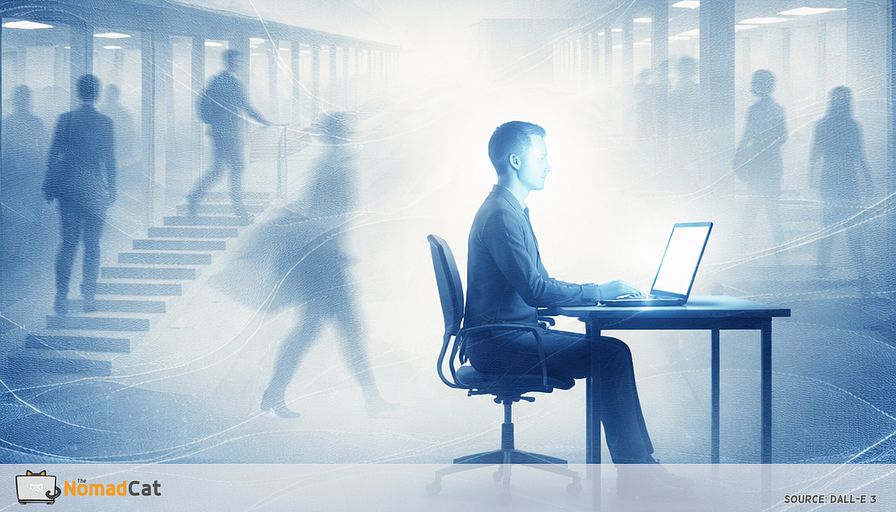
A 10-hour desk day can look weirdly “fine” on paper. You’re in meetings. Lunch happens between 2 calls. Maybe you even hit a step goal. And still, at 18:00, the first stairs feel a bit sketchy. Neck stiff. Shoulders tight. That heavy screen-head thing. Not dramatic. Just… a bit off, you see.
In Berlin my desk days were already long. In Lisbon, they’re still long—just quieter.
This article is about one small missing piece that remote work quietly deleted. It’s not about willpower. It’s about missing input. The boring background motion you used to get for free when a normal day moved you around. Trains, doors, corners, curbs, quick head turns, tiny corrections. The kind of movement nobody brags about, which is exactly why it’s easy to ignore.
The goal here is simple: make that missing input visible, then replace a little of it without adding a new “system” to manage.
Micro rides were quiet maintenance you did not schedule
A normal office day used to move you around without asking permission. Trains, doors, stairs, lobbies, crosswalks. Tiny accelerations, small corrections, quick head turns. Nothing heroic. But it happened all day.
Those bits are what we can call micro rides. Not workouts. More like background maintenance the body got for free.
Remote work removed a lot of it. Not just steps. The variety.
Micro rides were not exercise and that was the point
The highlight reel was not impressive, which is why it was easy to ignore. But the mix mattered.
- stepping off a bus with that half-second timing, then correcting
- stopping short at a crosswalk, then restarting fast
- turning corners without clipping a shoulder
- catching an escalator step that is already moving
- hopping curbs and uneven pavement
- weaving through people while keeping a straight-ish line
- looking up for signage while still walking
- doing quick head turns while moving because a sound or colleague pulled attention
It sounds small. But small inputs can matter when they are frequent.
A useful model for why it mattered
Think of it like background processes on a laptop. You do not run one huge calibration job once per week. The system quietly tunes itself all day, based on the inputs it gets.
Balance works a bit like that. The brain is constantly blending signals:
-
inner-ear motion sensing
- vision
- pressure and position from feet and joints
And it changes which signal it trusts most, depending on the day.
This is a practical model, not a clean metric like “8,000 steps.” Surveys do show people spend less time commuting and out of home (ATUS, NHTS 2017 vs 2022), but they do not measure how much head-and-body motion you got. Also, nobody needs to romanticise commuting. The point is simpler:
When a daily input disappears, it can be worth replacing it with a safe tiny version.
Why tiny motion changes how stable the world feels
After a 10-hour desk day, the body is not “out of shape.” It is often just running on a narrower input set.
Screen days train visual dominance
Hours of near-fixation on a stable screen make vision the main reference. Head motion and whole-body movement gets turned down. It is not exotic, it is just what got reinforced that day.
Reviews on digital eye strain describe common clusters from near work like headache, blurred vision, heavy eyes (Sheppard and Wolffsohn). Some people also report dizziness-like discomfort.
Why the first real-world minutes feel too loud
Then you stand up, walk to the stairs, step outside, turn your head in a busy corridor. Suddenly the inputs change.
A simple way to explain it is mismatch. The brain expects one pattern, it gets another, and it complains. That can show up as disorientation, eye strain, or that “ugh” feeling in the first minutes.
Still fit, still underexposed to motion variety
A gym session later is great. But it is not the same thing. Squats at 19:00 don’t teach your brain to handle the 18:00 stair descent when your head finally moves.
Remote work did not just cut movement volume. It cut movement complexity spread across the day. The missing inputs are turns, uneven surfaces, little bumps, head motion. Commuting used to drip-feed them.
Remote work rewards the stabilized head
Video calls make stillness the “professional” default
A remote day quietly trains one posture. Eyes glued to the screen, head turns minimized, shoulders kept quiet, and a face that says “yes yes i am listening.” With self-view, you end up doing polite statue time.
This lines up with Zoom fatigue ideas like nonverbal overload (Bailenson) and tools like the ZEF scale. The useful part here is not the scale; it’s noticing how much the job rewards stillness—and how quickly you start cooperating with it.
Breaks still happen but the signal is flat
The 2-minute break often looks like this.
Walk to the kitchen while reading Slack. Eyes down. Neck locked. Path straight.
Steps are real, sure. But movement quality changes when attention is split. Texting while walking alters gait (Schabrun et al.). Dual-task costs are a real thing even when it feels “fine” (Yogev-Seligmann).
Stacked meetings erase the seams
When calls are stacked, standing up starts to feel expensive. Between-meeting time gets filled with… nothing.
Some tools tried to bake in buffers with shortened meeting defaults and “Speedy meetings” (Microsoft, Google). It is a structural lever, not a personality test. Ergonomics research also tends to find prompted breaks beat willpower for adherence (McLean et al.). In practice, that means: if you want micro rides back, you’ll get further by attaching them to built-in seams (Join/Leave, kettle, bathroom) than by promising yourself “more breaks.”
The desk day signals that show up first
Small glitches that feel bigger than they should
After a long screen day, the first stair descent can feel weirdly sketchy. Not out-of-breath sketchy. More like feet placing a half-beat late. Extra curb checks. A step too long then a correction.
Stair descent is mechanically demanding and control-heavy compared to going up.
Another common one is the brief floaty moment right after standing from long sitting—basically a quick head-rush right after you stand, usually seconds, not minutes. Clinically it’s sometimes labeled “immediate orthostatic lightheadedness,” and it’s different from longer-lasting “orthostatic hypotension.” You don’t need the labels for the snacks below; the only reason it matters here is that a seconds-long head-rush can be normal, while anything intense or persistent deserves more respect.
Then sometimes it looks less like dizziness and more like mild spatial clumsiness. Bumping a doorframe, misjudging a corner, feeling “spatially fried” without being sleepy.
None of this is a diagnosis. Dizziness and balance trouble have many causes.
If symptoms are new, intense, scary, or come with red flags, this is get-medical-help territory.
With that boundary set, it becomes easier to see why common fixes can still miss the specific missing input.
Why the usual fixes can leave the same gap
Step counts can stay too flat
A flat loop can hit the step goal but still be low-information. Curved paths, corners, slalom-style walking, and head turns are closer to real navigation than straight lines.
Phone use is not a moral failure, it is just work leaking into the walk. But it changes gait and attention.
A low-friction trade-off is a tiny rule that is almost stupidly small:
Take 20 seconds phone-free inside the walk and let the head scan left, right, up. Small cues often beat big rules.
Standing more is still static
Standing is often better than sitting for comfort and breaking up sedentary time. But standing at a desk can still be the same stabilized head and near-gaze pattern, just taller.
So yes, it is possible to stand through meetings and still feel sketchy on the first stair descent. There was no turning, scanning, or down-step exposure.
The better match is often not more intensity. It is more similarity to the old input shape: brief, frequent, varied.
Rehab guidelines for dizziness often use repeated small bouts for a reason. That does not mean you need rehab. It just means “little and often” is a reasonable pattern for systems that adapt.
Motion snacks that fit inside a real day
If the day is 10 hours at the desk, lunch happens between 2 calls, and the only truly free time is at 23:00 when the brain is cooked… anything that looks like a new routine will die fast. I’m good at pretending midnight work is “just one more thing.” It isn’t.
So the goal is smaller and a bit boring.
Replace the missing micro rides with tiny motion snacks that hide inside cues already in the day. No tracking. No performance vibe.
Rules of thumb
-
10–40 seconds tied to something that already happens. A simple cue is the moment after clicking Leave on a call.
-
Add turns and gaze shifts. A few left-right head turns while walking, a near-to-far look, or a short indoor path with 2 corners is closer to real navigation than a straight hallway march.
-
Treat the phone as a trade-off. Even 20 seconds phone-free can switch you from near-gaze to world-gaze.
-
Keep it below the nausea threshold. Snacks should create a mild signal, not spins. If symptoms ramp and do not settle back toward baseline within about 15–20 minutes, the dose is too spicy. Shrink the motion, slow it down, or do it seated. Change 1 variable at a time.
A small menu you can steal from
-
After Leave: do a tiny doorway loop. Walk to a doorway, step through and back, then look left, right, and far once.
-
While the kettle or microwave runs: do a small figure 8 around a chair or table. Curves and direction changes give richer input than straight lines.
-
A boring indoor 2-corner loop you can repeat. Hallway to bedroom door to desk. At each corner add a quick near-to-far gaze shift. Turns are the point, not step count.
-
Optional stair touch if safe and comfortable. One flight down and up, or just to the next landing, focusing on controlled descent and using a handrail. No stairs or it feels sketchy today, skip it.
-
Desk-zone scan that does not look like anything. Once in the morning and once in the afternoon, stand and do a sign-check style scan high, low, and far across the room.
Making it survive meeting-heavy days
Put snacks in off-camera moments, loading screens, Join and Leave buffers, mute moments. If it creates social friction, it will die.
If someone asks, keep it boring:
“Back in 30 seconds, just moving my legs.”
Do not turn it into a system. Pick 1 cue and 1 snack for 7 days. If it fails on Tuesday, it was too complex.
Guardrails and a boring success test
Stop rules
Start gentle. Skip fast spins.
If a snack brings on nausea or dizziness that does not settle back toward baseline within about 15–20 minutes, regress or stop. Extra caution also makes sense with migraine history, known vestibular disorders, or neck-related dizziness.
This is rare, but worth being explicit. Get medical help urgently if symptoms are sudden/severe or come with any of these:
- face/arm weakness, speech trouble, sudden confusion, new double vision, or a new severe imbalance
- fainting or near-fainting
- chest pain or shortness of breath
- recent head injury or a new worst-ever headache
- sudden hearing loss (with or without vertigo)
A 7-day check without building a dashboard
Keep it almost stupid.
For 7 nights around 18:00, ask 1 question and score it yes/no or 0–10:
Do stairs and the first 20 steps outside feel more normal than last week?
No spreadsheet needed. Tools like the ABC Scale or DHI exist, but they can also become homework.
No change is still data. It can mean the dose is too small, too spicy, or the missing input is somewhere else.
Remote work is structurally common now. The commute used to ship motion complexity by default. Remote deleted the default.
Re-add a little signal, keep the rest boring. Configuration, not personality. Most people notice it on stairs first—not pain, just a half-beat of doubt.
You might be interested by these articles:


Your first steps feel wrong because remote work killed the warm up layer

Remote work made your day flat and your joints noticed

Your feet are shrinking under the desk and your 18:00 steps notice

Your 18:00 stiffness is a config bug fix it with micro-variability

The 30 second screen to hallway reset for floaty first steps after desk days

When automation isn’t enough how freelancers can avoid hidden admin risks

Breaking the portfolio plateau for tech minimalists