Abstract:
The article names the brief, slightly “laggy” disorientation many desk and remote workers feel right after standing up—doorframes seeming closer, the first stair feeling sketchy, or head turns producing a tiny camera-delay—as “clumsiness debt,” framing it not as a diagnosis or motivation problem but as a temporary miscalibration that builds when long screen days run on narrow inputs (mostly near vision and finger work) with little movement variety. It argues that modern work creates “single-sensor days,” intensified by camera-on norms that reward stillness, which reduces the everyday “ambient complexity” (small turns, pivots, scanning while walking, stepping over thresholds) that normally keeps balance and gait finely tuned; head turns and stairs expose the gap quickly because they stress gaze stability while moving, mirroring common challenge items in basic gait/balance screens. Rather than prescribing posture fixes or big workouts, it offers “tiny calibration inserts” designed to survive packed calendars—like a 40-second doorway loop with a slow head scan, or walking a wide figure-8 around two objects while the kettle runs—using simple dials (speed, amplitude, support) to scale difficulty down if symptoms spike. The piece closes with modest expectations (making the first 30 seconds after desk mode feel quieter), practical tracking, and clear red-flag warnings (persistent/worsening dizziness, new neurologic symptoms, near-fainting, repeated near-falls) where self-tweaks should stop and medical evaluation is needed.
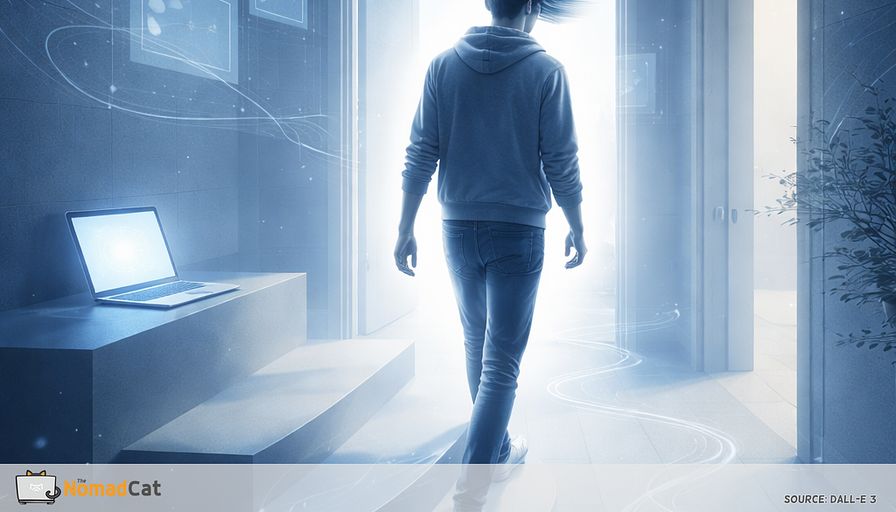
You know that moment when you finally close the laptop and stand up like a functional adult… and the hallway feels slightly off. The doorframe is somehow closer. The 1st stair is weird, the 2nd is fine. Turning your head while walking has a tiny camera-lag vibe. Nothing dramatic. Just noisy for 30 seconds.
If you do 8 to 10 hours at a desk, with meetings stacked, lunch at the desk, and exercise always “later”, this probably sounds familiar. And if you’ve been remote for a while, it’s even louder: no commute, no walk to meeting rooms, fewer “by default” trips for coffee, printer, stairs, anything. And yes, most polished health content makes it sound like you just need more motivation. Not the point here.
This article is here to give that experience a useful name, without turning it into a posture sermon or a diagnosis.
The label is clumsiness debt. Not “something is wrong with you.” More like a system that spent 8 to 10 hours running on narrow inputs, mostly eyes and fingers, low movement variety, then gets hit with a real-world demand spike. The body is not broken. It’s just a bit under-calibrated, like a stale cache.
What you’ll get from the rest of the piece is practical and boring, in a good way. Practical, but not heroic.
- How desk and remote days become single-sensor days, overfeeding near vision and underfeeding motion updates
- Why head turns and stairs expose the gap fast, and why those exact tasks show up in basic gait and balance screens
- The “ambient complexity” modern work quietly removes, even if you still exercise
- A few tiny calibration inserts that fit between meetings and do not require motivation, gym access, or a new identity
- Simple guardrails for when to back off, and clear red flags for when it is not a remote-work quirk
If none of this sounds like you, great, skip it. If it does, the goal is not perfection. It is just to make the first 30 seconds after desk-mode feel less like walking out of a laggy video call and into a 3D world.
The clumsiness debt at the door
Screen work is static by design. It narrows movement options for hours (Wahlström, 2005). Long sitting blocks are basically default in office life (Parry & Straker, 2013). If this sounds familiar, it helps to give it a name that is non-dramatic and usable. I’ve done remote work on bad chairs and worse desks across a few countries, and since 2023 in Lisbon it’s still easy to end up at the desk… often past midnight.
Clumsiness debt is the small miscalibration that builds when the system runs all day on narrow inputs, mostly eyes and fingers, low movement variety, then gets a sudden spike of real-world demands. Constrained work reduces motor variability, meaning fewer small movement options through the day (Srinivasan & Mathiassen, 2012). This is a metaphor, not a diagnosis. Like a service that never got restarted and now runs on stale cache.
This is not
- a posture sermon
- a cardio pitch
- a diagnosis or a claim that something is wrong with you
Sedentary time can coexist with regular training (Tremblay et al., 2017). Also, variability is not automatically better. Stability matters too. The smaller claim is simpler. Desk days—especially remote desk days—often miss a calibration layer that used to come for free from normal friction, so the first real-world demand can feel briefly noisy.
A neutral way to self-ID is to look for repeatable “first demand spike” moments instead of hunting symptoms.
- the 1st stair feels worse than the 2nd, then things normalize
- the first quick head turn after a long call feels floaty, then it is fine
- doorways feel narrower for 30 seconds, like your margins got reduced
- you drift a bit when looking left and right while walking
- you slow down without meaning to when you need to scan for something
- crowds feel briefly loud to navigate, even at normal speed
Head turns and stairs are standard challenge conditions in gait and balance work for a reason. They show up in tools like the Functional Gait Assessment and the Dynamic Gait Index (Wrisley & Kumar, 2010). Not because everyone needs a test, but because these are reliable real-world stressors.
If none of this fits, ignore the rest.
Why remote days become single sensor days
Orientation is a team effort between eyes, inner ear, and body position sense from joints, feet, and pressure. On a remote day, that mix gets biased.
You overfeed near, stable vision at a fixed distance. You underfeed the motion updates that come from turning, stepping, scanning.
Screen work tends to keep the head and trunk quiet for long stretches (Wahlström, 2005). Digital eye strain is also linked to near-work mechanisms like accommodation and convergence fatigue (Sheppard & Wolffsohn, 2018). Put those together and the system starts trusting the one sensor that is screaming the loudest all day.
Video calls add a second constraint. You do not just sit, you perform stillness.
Camera-on etiquette is selection pressure. Stillness reads as attention. Moving reads as distraction. The little tile, the self-view, the feeling of being stuck in frame. Bailenson (2021) points at self-monitoring and being on display as part of video-call fatigue. Add long sedentary blocks shaped by the environment (Parry & Straker, 2013), and it is not a motivation failure. It is reputation management plus chair physics.
Why head turns expose the gap fast
Your eyes need your head and inner ear to agree when you move and scan. Head turns are a demand spike because they stress the reflex that keeps your vision steady while your head moves, while your feet keep going.
That is why dynamic visual acuity often drops when head motion is added in lab and clinical setups (Herdman et al., 1998). If your eyes need a beat to “lock on” after a fast head turn, that’s the exact failure mode.
And it is why “walk and turn your head” is a standard item in the Functional Gait Assessment (Wrisley & Kumar, 2010). Not because it is exotic. Because it reliably shows when calibration is a bit stale.
Boundary statement: the evidence here is suggestive but not perfectly mapped to typical remote-work patterns. Think temporary under-exposure plus sudden complexity spike, not damage.
The ambient complexity you stopped getting for free
A normal day used to include lots of small calibration pings that never looked like exercise. The Functional Gait Assessment is basically a list of these annoyances, just written like a test (Wrisley & Kumar, 2010).
- stepping over a door threshold without looking down
- a quick pivot to grab something behind you
- walking while turning the head left and right to check the room
- looking up while still moving
- speed changes without planning it
- stepping around a chair corner in a tight space
- obstacle negotiation that is not gym clean
People adapt quickly when exposed to small perturbations and recoveries, even over a few trials (Mansfield et al., 2015). Remove the exposure, and the first rep becomes more noticeable.
This also explains the “but i work out” confusion. Often the issue is not strength or cardio. It is that the first trial is the data-gathering one. Balance research sees quick adaptation and practice effects where the first exposure is commonly the messiest (Horak, 2006).
Workouts are often planned, straight-line, repeatable. Ambient life is unplanned, curved, noisy. Both have value. They just train different parts of the system.
When tired eyes make the hallway feel less stable
Vision is not just for reading. It is part of staying upright.
After long near-focus blocks, the eyes can get temporarily slow at switching distance. More blur, more gritty strain from holding accommodation and vergence too long (Sheppard & Wolffsohn, 2018). It can show up right when you stand up and suddenly need far vision again.
What’s plausible: if the visual signal gets a bit less reliable for a moment, posture control can get noisier for some people, especially during head turns and changing optic flow while walking.
What’s uncertain: the link is plausible, not proven for every desk worker. Sensory reweighting is basically the brain doing live sensor triage, leaning more on whatever input seems trustworthy in that moment.
Calibration inserts that do not turn into a program
To make this survive real calendars, it has to be tiny and boring on purpose. The target is not sweat. It is a few missing inputs you sprinkle back in.
- gentle head turning
- small vertical change, sit to stand, 1 step
- near to far gaze shifts
- short walking with scanning
Think background jobs. Low effort, high repeatability.
Big scheduled sessions are like a cron job that fails when the server is busy, which is most weeks. Small inserts have lower start cost and tend to stick when the context repeats (Lally et al., 2010).
A simple 3 dial model keeps it repeatable. Smooth beats fast.
- Speed slow head turns first, then a bit quicker
- Amplitude small turns first, then a bit wider
- Support 2 fingers on a counter, then no hands, then walking
If anything feels sketchy, turn a dial down. Keep the environment boring and safe.
Motion snacks under 40 seconds
Doorframe loop
After Send or Leave, stand up, cross a doorway, take 4 to 6 steps, then do 1 slow left-right head scan while standing or walking, and come back. Done.
The head turn part is not random. It is basically a simplified version of the “walk with head turns” stressor used in the FGA (Wrisley & Kumar, 2010), and head motion is what makes dynamic visual acuity work harder (Herdman et al., 1998).
If stairs exist and are safe, vertical change is an optional ingredient.
Figure 8 loop while waiting
During kettle or microwave time, walk 1 wide figure 8 around 2 objects. Pick 1 far point to look at once per loop. Curves plus far looking gives optic flow variety, and the far point helps after near work fatigue (Sheppard & Wolffsohn, 2018).
Make it survivable in meeting wall weeks
Timers fail because they fire at the worst moment, and prompt fatigue is real in workplace studies (Ho & Intille, 2005; Shrestha et al., 2018). Event cues are cleaner. For me it’s often the late-night ones: after a VPN reconnect or an upload completes, I stand up and do the 20-second loop before I sit back down.
Link inserts to interruption-safe boundaries using if-then planning (Gollwitzer & Sheeran, 2006).
- Join
- Leave
- Send
- upload complete
- VPN reconnect
- build finished
For camera norms, a few reputation-safe scripts reduce ambiguity.
- “Back in 20 seconds, grabbing water.”
- “Quick stretch off camera, still listening.”
- “Switching rooms for better signal, one sec.”
For tracking, keep it boring and outcome-based. At 18:00 write
- 0 to 10 stairs feel normal
- or yes-no first steps sketchy
If symptoms spike, regress the dials and do not push through.
Success signals and boring guardrails
Some changes can feel immediate, and that does not mean anything got fixed forever. It often just means the first minute out of the desk bubble got quieter.
- the 1st stair feels closer to the 2nd
- head turns feel less harsh, less camera lag
- fewer end-of-day near-bumps on doorframes or chair legs
- less of that compressed feeling when leaving the desk area
For mild desk-day stuff, keep expectations modest. Think days to weeks of small exposures, not 1 heroic afternoon.
The classic failure mode is overdoing head turns fast, getting nausea or a headache, then quitting. A clean rule is regress 1 dial immediately if symptoms spike or do not settle quickly. Go slower, smaller, more support.
Safety and when this is not a remote-work quirk
Persistent or worsening dizziness is not a DIY remote-work tweak. Stop now if you get
- dizziness that ramps up instead of settling
- nausea that lingers
- new or unusual headache
- faintness, near-syncope, chest symptoms
- new vision changes, weakness, numbness, speech trouble
- repeated near-falls or frequent grabbing at furniture
Set up like a cautious person, not a hero. Clear the floor, good light, stable counter nearby, handrail for stairs.
Red flag box
Get medical evaluation for dizziness that is sudden and severe, persistent, or worsening—especially if it comes with new neurological symptoms (weakness, numbness, speech trouble, new vision changes) or any fainting / near-fainting. If you’re not sure, treat “new and scary” as a reason to get checked, not a reason to experiment at home.
If the first 30 seconds after a desk block feel weird, it does not mean your body is failing. It is often just clumsiness debt. A day of near vision, quiet head and trunk, and “camera-on stillness” leaves the system a bit under-fed on normal movement inputs. Then real life asks for stairs, quick head turns, and tight doorways, and you feel the stale-cache moment. I’m 52, and I can feel there is a cost later if I let this become the default.
The fix is not a new identity or perfect posture. It is small calibration inserts that fit inside real calendars. A doorway loop, a slow head scan, a short figure 8 while the kettle runs. Smooth, boring, repeatable. Turn the dials down if it feels sketchy, and take red flags seriously.
Most people have one repeatable “first demand spike”—stairs, head turns, or doorframes—and it’s usually the same one every day.
You might be interested by these articles:


The 30 second screen to hallway reset for floaty first steps after desk days

Your first steps feel wrong because remote work killed the warm up layer

Your feet are shrinking under the desk and your 18:00 steps notice

Your 18:00 stiffness is a config bug fix it with micro-variability

Remote work made your day flat and your joints noticed

That 18:00 behind knee bite is not your hamstrings its your desk day setup

Revolutionizing Customer Support with AI Technologies