Abstract:
The article argues that when a long desk day at home feels like one endless, draining “scroll,” the problem is often not lost motivation but a missing set of tiny environmental inputs that offices provide automatically: 6–20 daily microclimate shifts (cool corridors, warm meeting rooms, stairwell drafts, sun patches, vent blasts) that quietly force you to stand, change layers, move a few meters, and mentally “reload” between tasks. Remote work, by contrast, can become a thermal flatline—same chair, same air, same light—leading to the familiar bundle of tight shoulders, stiff neck, lower-back fatigue, post-lunch low energy, and work bleeding into the evening because nothing clearly ends. Rather than claiming temperature boosts intelligence (and admitting there’s no single clean study proving “no drafts causes brain fog”), the author frames microclimate changes as low-effort “state-change interrupts” similar to microbreaks and habit cues, and proposes “temperature punctuation” as a pragmatic debugging experiment: aim for a handful of small, controllable state changes (not discomfort) using existing triggers like ending a meeting or waiting for the kettle, such as standing in a doorway for 10–30 seconds, switching between two spots (sun/shade), toggling a fan, or placing essentials away from the desk to force short walks. A simple 7-day test pairs one trigger with one 20-second climate shift and tracks one daily 0–10 rating (e.g., “brain flatness” or “neck/shoulder invoice”), with guardrails for real-world constraints (bad air quality, humidity/mold risk) and for people who react poorly to temperature swings (migraines, hot flashes, autonomic issues).
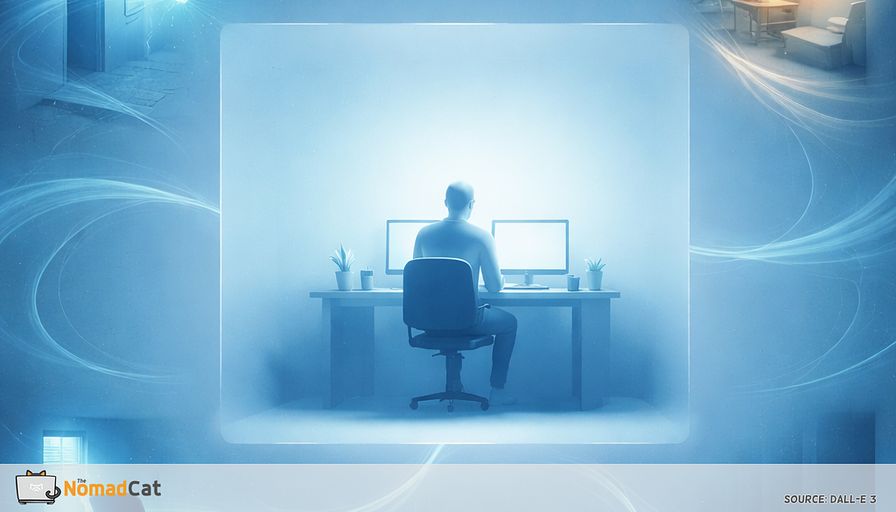
If a 10-hour desk day is starting to feel like 1 long, undifferentiated scroll, it’s probably not because you “lost motivation.” It’s more boring than that. The inputs changed. (I notice it most on the late nights here in Lisbon, when I look up and realize nothing in the room changed for hours.)
In an office, the day is full of tiny temperature and airflow shifts you barely notice. A corridor that’s a bit cool. A meeting room that’s too warm. A draft on the stairs. A sun patch by the window. These little microclimate frictions happen 6–20 times without planning anything, and they quietly force small adjustments. Stand up. Add a layer. Move 2 meters. Change posture. Your body gets interruptions for free.
At home, many remote setups become a thermal flatline. Same chair, same room, same air, same screen distance. Hours pass. Then the familiar stuff shows up anyway.
This article is about a simple idea that sounds almost too small to matter. When you remove those tiny environmental state changes, you also remove a bunch of accidental movement and mental punctuation. Not because temperature makes you smarter, but because the day loses its natural separators.
What you’ll get here is a pragmatic way to test it, without turning your calendar into a new project:
- what microclimate transitions look like in normal office life and why comfort science even models “local discomfort”
- why remote work tends to create longer, uninterrupted sitting and weaker cues to move
- how “temperature punctuation” can recreate a few missing interrupts with low friction
- a boring 7-day experiment you can run using triggers you already have (meeting ends, kettle time, doorway shifts)
- guardrails for real homes and real bodies, including when not to play with temperature swings
Skepticism is welcome. There isn’t 1 clean study that says “remove drafts, get brain fog on schedule.” Think of this more like debugging a system. Change 1 small input, watch what happens, keep what works, drop the rest.
Microclimate friction you did not notice
What thermal transitions look like in a normal office day
A normal office day is a chain of tiny temperature and airflow changes. Not the dramatic kind—just small hot/cold spots and little drafts as you move around. Sometimes it’s a vent blast from the ceiling when you sit in the wrong chair. Sometimes it’s that one corner that’s always a bit warmer.
Even comfort standards (like ASHRAE 55 and ISO 7730) talk about drafts and hot/cold spots because real buildings are never perfectly uniform.
The remote-work thermal flatline
At home, many setups are the opposite. Same chair. Same room. Same air. Same light. Same screen distance. Hours go by, and the main thing that changes is the clock—often with work bleeding into the evening because nothing clearly “ended.”
This is not only vibes. Working from home is often linked with more sitting and fewer breaks. The environment stays constant, so the body gets fewer reasons to change position.
Comfort is not suffering and adaptation is the point
This is not a cold shower pitch. Comfort science is pretty clear: people adapt constantly. They adjust clothing, shift posture, relocate, change air movement, open or close a door.
Offices quietly force small adaptations:
- You bring a layer because some rooms are cooler.
- You move away from the window because the sun patch is too warm.
- You shift your chair because the vent hits your neck like a small personal enemy.
One useful framing is that clothing is a real “knob” you can turn. This is less lifestyle advice and more “inputs changed, system responded.”
A simple tech analogy for why it mattered
Those microclimate transitions are like automatic state-change interrupts. When they disappear, the day runs as 1 long thread. Buffers fill. Task residue sticks.
Microbreak studies often find that short, frequent interruptions reduce discomfort, and performance usually doesn’t drop (sometimes it even improves a bit, depending on the task). No need to claim temperature makes you smarter.
The interesting part is not the thermostat. It is the missing interrupts.
Movement without motivation
The body reacts before the calendar does
When the room feels a bit cold, you stand up and grab a layer. When it feels warm and stuffy, you get water or crack a window. When airflow annoys your neck, you shift position. These are not noble “healthy choices.” They are small fixes using basic levers: clothing, air movement, relocation.
Because non-exercise movement (NEAT) can vary a lot between people and between days, these little movements add up. In an office, that loop runs all day without needing discipline.
Office movement was mostly small bouts
The accurate version of “I walked more at the office” is “I interrupted sitting more often.” Office days create lots of short stepping bouts and sit-to-stand transitions. Working from home tends to compress that into longer uninterrupted sitting bouts, even if exercise still happens later.
A 30-minute walk at 19:30 does not recreate 12 small posture changes that used to happen before lunch.
Punctuation endpoints and missing boundary conditions
Think of office transitions as punctuation. Entering a different room gives a hard sensory boundary: different temperature, different airflow, different people. Your brain gets a free “new state loaded.”
At home, the boundary can be a tab switch. Same chair, same light, same temperature, just a different rectangle. Tasks smear. Fatigue becomes fuzzy.
This lines up with a simple idea from habit research too: a reliable cue triggers a behavior with less willpower. In the office, “drafty” or “warm room” can act as cues. At home, cues are weaker, so the action often doesn’t fire.
A credibility check
There is not 1 clean RCT that says “remove thermal transitions” and you get brain fog on schedule. This is more like a plausible systems lever supported by nearby evidence: comfort adaptation, microbreaks reducing discomfort (and sometimes helping performance), and WFH patterns showing longer sitting bouts.
Treat it like debugging. Skepticism is fine. The goal is a small test, not belief.
What the flat thermal day costs
Attention smear and low-voltage afternoons
Attention smear looks like this:
- rereading the same paragraph 3 times
- bouncing between tabs like a pinball
- rewriting a message because it feels wrong, but you cannot say why
Often it is not laziness. It is a long day with no separators.
Environment can make it worse. Warm, still, slightly stuffy air tends to increase sleepiness for many people. In lab and office-building studies, cooler conditions and better ventilation often support performance or reduce fatigue for many tasks—though not for everyone, and not always. CO₂ is a useful proxy for ventilation, not because CO₂ is the villain, but because it tracks “this room feels heavy.”
A practical test can be simple: note when the room feels heavy and whether opening a window, changing rooms, or adding air movement changes alertness within 10–20 minutes.
Body bracing and the stiffness invoice
Bracing is that quiet muscle-on mode during precision work and video calls. Shoulders creep up. Breathing gets small. Neck holds steady for too long.
Jaw tension can join the party too.
The invoice arrives later. If nothing interrupts bracing for hours, the first real movement happens at the end of the day, and it feels disproportionate: stiff, rusty, sometimes oddly intense compared to how “fine” the day looked.
Microbreak research is boring but useful here: short, frequent breaks tend to reduce discomfort and usually do not tank productivity.
One boundary that matters: sharp or escalating pain, numbness, weakness, or symptoms shooting down an arm or leg are not in the “tiny breaks will fix it” category.
A quick note from the bio, because it explain the whole thing better than theory: I’ve spent most of adult life at a desk (Beijing, Berlin, now Lisbon), often working past midnight. Not in pain, but the early signal is upper-back tightness that builds quietly until it forces movement. A spouse reminder to sit straight works for about 3 minutes. It is possible to work a full day without eating, drinking, or moving, and yes, that is not a superpower.
Temperature punctuation as a replacement principle
Count state changes, not steps
A practical yardstick is 6–12 small “state changes” per workday where temperature or airflow feels different. If it requires negotiation, it fails on Tuesdays when the calendar is a wall.
Microbreak research includes schedules as small as 10–60 seconds showing benefits for discomfort without killing performance. This targets the real WFH shift: longer uninterrupted sitting bouts, not a lack of workouts.
The point is to put the trigger outside mood and memory. Like decent UX, you do not rely on the user remembering. You ship a cue and a default.
Guardrail: the contrast should be small and controllable. The target is “different input,” not discomfort.
Low-friction moves that survive meeting walls
Use meeting ends as an automatic cue. After clicking Leave, stand at a threshold for 10–30 seconds until you feel something change. Cooler air near a door. Warmer spot near a window. More airflow in the hallway. Then go back.
If thresholds are impractical, build 2 microclimates inside the home. Switching should take under 20 seconds:
- fan low on vs off
- sun patch chair vs shade chair
- window cracked in 1 spot only
- a thin blanket stored in the other room
Steal time that already exists. Kettle or microwave gives you 30–90 seconds where you are not producing output anyway. Stand in the coolest or warmest spot you have. Do nothing special. No stretching performance.
Object placement also works. Put the hoodie, water, headphones, notebook, or charger away from the desk so getting it creates a short walk and a small climate change. It is the “move the printer 1 room away” trick, applied to your apartment.
Video calls add pressure. Even normal movement can feel visible. Sometimes a small explicit permission helps (“give me 30 seconds”). Use judgment, obviously.
A boring 7-day test that fits real calendars
Pick 1 existing trigger that already happens on chaotic days (Leave on a meeting, Send on a long message, or when the kettle starts). Pair it with 1 climate punctuation that takes 20 seconds (stand in a doorway or hallway where the air feels different). No stacking.
And yes: you will forget on day 3. Or day 1. That’s fine—just do the next one. The whole point is that it’s too small to guilt-trip you.
If you want to track it, use 1 daily number at about 18:00: a 0–10 rating like “brain flatness” or “neck and shoulder invoice.” Single-item daily ratings are imperfect but often good enough when repeated. Personally, I treat ~2 points on a 0–10 scale as “worth noticing” (this matches how some pain/symptom scales talk about meaningful change, but don’t litigate it).
Success is boring: fewer stuck moments, easier task switching, slightly smaller end-of-day stiffness bill. If nothing changes after 7 days, drop it. The missing input that week may be sleep debt, food timing, workload, or a meeting pile-up.
Guardrails for real homes and real bodies
Not everyone has a balcony or good weather. Indoor contrast still counts, and offices run on small differences anyway.
- Stand in a hallway or near the entry door for 20 seconds.
- Move between sun patch and shade.
- Toggle a fan low on vs off.
- Step briefly onto a tile zone for a different contact temperature.
- Use 1 spot that is slightly cooler and 1 spot slightly warmer.
Windows should sometimes stay closed: wildfire smoke, high pollen, extreme heat, bad AQI days. In those cases, create contrast inside (fan, seat switch, clothing tweak).
If the home runs humid, keeping indoor RH under 60% is a useful line in the sand for mold risk.
Finally, some bodies hate temperature swings. Migraines, cold sensitivity, hot flashes, autonomic issues. Individual differences are large. So keep swings small, controllable, and avoid aggressive drafts. The goal stays simple: rebuild a few tiny state changes that offices used to inject automatically, gentle enough that the system wants to repeat them.
A 10-hour desk day can blur into 1 long scroll, especially at home where the air, light, and chair never change. The point here is not that temperature makes you smarter. It is that offices accidentally gave you small state changes that created movement, posture shifts, and clean endpoints between tasks.
The fix does not need a new routine or heroic motivation. Treat it like debugging. Keep it gentle. Keep it boring. Keep what works.
You might be interested by these articles:


Build an interruption ecology for remote work so your body stops billing you at 18:30

Your watch logged the workout but your shoulders still filed a bug report at 18:00

Your remote day needs friction to make movement normal again

Micro-exits for remote days that keep your body from timing out

Your chair lost its queues so your body files tickets at 18:30

Mesh networks make moving fast and saving money easy

Augmented Reality: Revolutionizing Retail and Reducing Returns