Abstract:
The article explains why, after a day of controlled attention at desk work, many people default to late-night scrolling, gaming, or argument threads that feel like “earned rest” but actually keep the brain in evaluative, high-arousal mode and push sleep later—not from lack of discipline, but from “decompression hunger” seeking three things: agency (choosing something for yourself), novelty (new stimuli after repetitive work), and clean emotion (simple, unambiguous feelings like winning or moral certainty after a day of polite ambiguity and social monitoring). It argues that late-night platforms and content often deliver those needs in the most sleep-expensive format—endless feeds, ranked loops, cliffhangers, autoplay, and link-branching “virtue content” (newsletters, analysis, language streaks, Notion planning, documentaries-to-Wikipedia) that create open loops and anticipation, which fuel a “tired all day, wired at night” second wind; the key issue is less the device/light than interactivity and unresolved arcs, since even books can backfire and a dimmed phone can be fine with low-stakes audio. To identify what’s keeping you up without turning sleep into another project, it offers a tiny three-night check-in (last-hour input type, what your mind replays after lights out, and whether the night had a clean ending), plus a practical shift: focus on format, not virtue, by using a “two-lane evening”—move intense/high-input fun earlier (containerized with boundaries like 2 episodes, 3 matches, autoplay off), and protect the last hour with low-branching, clearly ending rewards (rewatching a comfort episode, a calm audiobook on a timer, repeat playlists, simple fixed-level puzzles, light stretching, packing for tomorrow, tea, basic skincare), including hands-on tasks with natural stop cues like gardening or carpentry (the author notes these surprised them by ending cleanly: water plants, sand one piece of wood, fold laundry for one timer block, prep a lunchbox)—so bedtime doesn’t feel like one more tab left open.
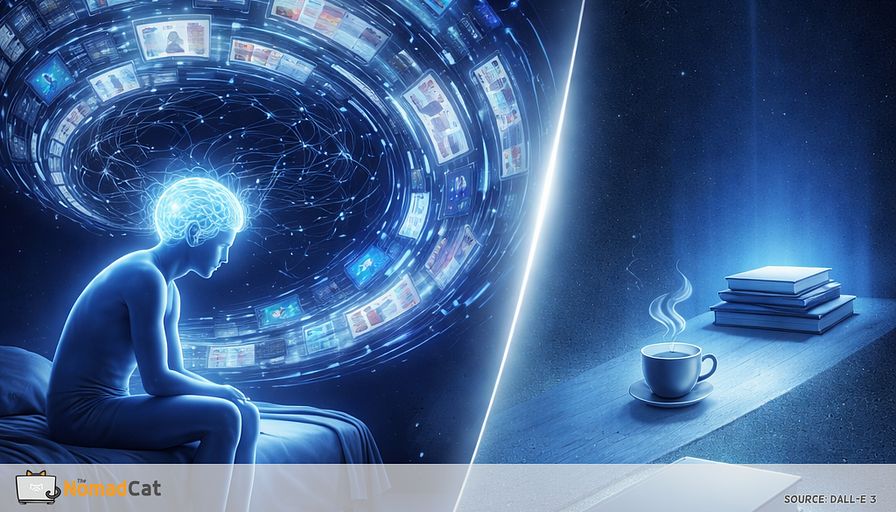
Work is done. Your body is tired. And somehow your hand still opens the same apps like it is part of closing the laptop.
A feed that never ends. A “quick” match to decompress. A thread you don’t even care about, but you keep reading anyway. It looks like rest, but it keeps the brain in evaluation mode right when you need it to downshift. Not because you lack discipline. Because the last hour has a weird job. It is supposed to pay you back for a whole day of controlled attention, and it often does it with high input rewards that crank you up instead of closing the day.
This article is about that specific pattern. The quiet evening where you finally have time, but sleep still gets pushed out.
We’ll break down the 3 drivers that often hide inside decompression hunger
- agency
- novelty
- clean emotion
Then we’ll look at why even “good” content can backfire late, how open loops and cliffhangers keep the nervous system running, and a small 3-night check-in that helps you spot what’s actually keeping you up without turning sleep into a second job.
This is not medical advice and not a clinical insomnia guide. It is about 1 specific pattern in the last hour. Get evaluated if you have dangerous daytime sleepiness (especially sleepy driving), loud snoring/gasping or witnessed apneas, or trouble sleeping that persists at least 3 nights a week for at least 3 months with daytime impact. For persistent insomnia, CBT-i is a first line option in guidelines.
Finally, we’ll focus on the lever that matters most for real life. Format, not virtue. A 2-lane evening that lets you keep the fun, move the intense stuff earlier, and protect the last hour so bed doesn’t feel like one more tab left open.
The last hour that looks like rest
When the evening is quiet but your brain is still on
Work is done, the body is tired, but the hand still goes to the same high input reward. A feed loop that never ends. A ranked match just to decompress. A debate thread you do not even care about, yet somehow you are still reading.
It feels earned. And it is common. In most households I know, evenings are still dominated by TV and phones. The issue is not moral failure. It is that the last hour can keep your nervous system working even when you are off. Evening leisure expands, sleep gets displaced.
This is not always work rumination in the classic sense. It is leisure, but it still asks the mind to evaluate, compare, react, pick a side. There is a name for it: presleep cognitive arousal.
Desk work also creates a specific rebound pressure. Call it decompression hunger. Working remote, I can look up and realize it’s past midnight before I’ve even moved. After a day of controlled attention and low autonomy, you want time that feels like it is yours. A lot of recovery research keeps circling the same point. Control matters. The pipeline is predictable
- cognitive effort all day
- craving for clean agency
- stimulation heavy reward
- delayed downshift
Desk work is also socially evaluative and weirdly ambiguous. You spend the day tone checking messages, guessing what “quick question” really means, doing small performance signaling that nobody calls performance signaling. Even on calm days, the monitoring stays active.
So at night, clean inputs win. Simple emotions, clear rules, instant feedback. No ambiguity. That is the trap.
What your brain is trying to buy with the last hour
The 3 asks hiding inside decompression hunger
Decompression hunger is usually 3 separate asks mixed together. Spotting which one is driving the grab for screens helps.
1) Agency. All day you ship other people’s priorities. At night you pick the feed, the game, the thread.
2) Novelty. All day is the same doc loop. At night you want new tabs, new opinions, new levels.
3) Clean emotion. All day is polite ambiguity. At night you want simple feelings like winning, outrage, or a neat moral verdict.
Novelty is the sneaky one because it feels relaxing while it quietly turns vigilance up. New and attention-grabbing stuff pushes the brain into search mode. Great for learning. Not great for falling asleep.
The next cue is a wanting machine
A cliffhanger ending, a ranked loop that always promises redemption, or a comment thread that keeps moving the goalposts all do the same thing. They keep the reward slightly in the future.
That is why the last hour fails. It optimizes for wanting, not for closure. Anticipation is awake fuel.
Why 23:00 hits differently than 20:00
Even “good” content can be too expensive late. A lot of people get the tired all day, wired at night thing. There is also a normal evening wake push where the system resists sleep onset. Put that on top of novelty plus anticipation, and the second wind stops feeling mysterious.
The looks healthy, sleeps badly trap
Virtue content can still keep you awake
The common feature is not the topic. It is branching.
The last hour can look responsible and still backfire because it expands mental surface area right when timing matters. These are all “good,” but they sprawl:
- industry newsletter with 12 links
- longform analysis that spawns 5 follow ups
- language learning streak
- portfolio check
- planning tomorrow in Notion
- a documentary that turns into Wikipedia
You end up with new tabs in your head and open threads alive into bed. Then you are in the classic loop: thinking about the thing, and also monitoring whether you are falling asleep yet.
This is why the device argument is often a distraction. Light matters, yes. Some light can increase alertness and suppress melatonin, and some studies suggest eReaders can delay sleep onset compared to print for that reason. But payload often dominates. A paper book can be too cliffhanger-heavy. A phone can be fine if it is low stakes audio, screen dimmed, nothing to decide.
Interactivity is the fast proxy. Interactive content forces micro decisions and evaluation loops. After a day of Slack pings and unresolved decisions, your brain treats even “fun” micro-decisions like more work. Platforms also remove stopping points. Autoplay and infinite feeds remove natural boundaries, so there is no clean closure cue. Research on binge watching links it to poorer sleep, with presleep arousal doing a lot of the work.
A simple diagnostic is endings. If the last thing has unresolved arcs, the brain tends to replay it after lights out. If it is a rerun with a flat ending, there is often less fuel.
A 3-night diagnosis without turning sleep into a project
Validated sleep diaries exist, with lots of fields if you want to go full spreadsheet later. Here is a tiny subset. Minimal on purpose. Minimal again, because perfectionism is how sleep tracking becomes a second job.
Each night take 30 seconds and tick 3 boxes
- Last hour input was mostly passive, mostly interactive, or mostly work
- After lights out my mind replayed leisure content, replayed work, or replayed sleep worries
- Felt like I had a clean ending, or an open loop
Then interpret the pattern by what your mind keeps running
- Leisure replay usually means intake mode. The last hour was high input or open loop.
- Work replay is closer to work standby and rumination.
- Sleep replay points to sleep focused worry. Arousal is the issue even if the topic changes.
If you want 1 number, keep it fuzzy. Sleep onset latency is a core sleep diary metric, and under about 30 minutes is a practical target. But avoid nightly score chasing. Look for trends.
The lever is format, not discipline
Rewards with low branching that still feel like rewards
Familiarity is not boring here, it is a feature. Low branching means a reward that feels chosen, but creates almost no new tabs in your head and has a clear end.
Here, “good” means it has agency and a stop point:
- rewatch a comfort episode you already know
- a calm audiobook with a sleep timer
- a playlist you have on repeat
- a simple puzzle game with fixed levels
- 10 minutes of light stretching or mobility
- lay out clothes and bag for tomorrow
- shower and basic skincare, not a 12 step project
- make herbal tea, then stop there
Familiar content is basically cached content. The brain does less prediction work and less vigilance. Novelty keeps the orienting system online, like sleeping in a new place where part of the brain stays on watch.
Hands on activities often work for the same reason, plus they come with stop cues you do not need to negotiate with. I get trapped by one more input easily. Gardening helped more than I expected, and recently carpentry too, because they end cleanly. You reach a physical endpoint, you put the tool down, finished.
Examples that fit a desk evening
- water plants and do 1 small task, then done
- sand 1 piece of wood, stop point is visible
- fold laundry for 1 timer block
- prep tomorrow’s lunch box, close the fridge
Making it repeatable is easier when it is specific. If it is after 22:30, then it must have a clear stop point.
Light is a supporting dial. Dimmer and warmer light reduces alerting signals. Evening light can also shift circadian timing later. This is not a big checklist. Just make the room look like end of day, especially if screens stay involved.
No cliffhangers near bedtime
Cheap stop cues
- stop only on episode or chapter boundaries
- disable autoplay
- set a timer that ends after a summary segment, not mid drama
- avoid modes with no natural endings like infinite feeds
If life is messy, salvage beats perfection. Put high stimulation earlier because downshifting is not instant. If it spills late, downgrade to something with a flat ending instead of trying to win a willpower fight at 23:45.
The 2-lane evening that still lets you have a life
Lane A moves the intense stuff earlier
Lane A keeps the fun but moves it out of shutdown time. Think moving heavy compute away from shutdown. Transitions take time. High arousal can be great for performance, not for falling asleep.
Example: do the ranked match or the spicy debate at 20:30, not at 23:30.
When evenings are short, keep it small. Pick 1 high input thing, then containerize it with a boundary. Autoplay off and 2 episodes max. 3 matches max. 1 thread then tab closed. Without boundaries it is easy to work through the night. A container turns stopping into a rule instead of a negotiation.
Lane B protects the last hour
Lane B is the last hour where the goal is fewer background processes, so bed is not a continuation of intake. Dry analogy: it is like draining the job queue and letting caches cool, not starting new threads.
Success is boring and observable. Less scene replay. Less urge to continue where you left off in the morning. Sleep feels like 1 block even if total hours barely move.
A few permission scripts help reduce the shame spiral
- I am allowed to want fun. I am just moving it earlier so sleep is not the thing paying the bill.
- This is not a perfect routine, it is a shutdown window. Small is fine.
- Stopping at the boundary is the win, not whether the content was good or bad.
The main point stays simple. You are changing format, not proving discipline. Debugging, but for evenings.
That last hour is not a discipline test. It is your brain trying to buy something after a day of controlled attention. Usually it is agency, novelty, or a clean emotion. The problem is that late-night screens often sell those things in the most sleep-expensive format possible.
The practical lever is format, not virtue. Keep the fun, just move the high input stuff earlier, then protect the final hour with low-branching rewards that actually end. A clean ending is often less about discipline and more about choosing formats that actually stop.
You might be interested by these articles:


After dinner no more invisible work so your sleep can actually power down

Your 1st 45 minutes are training your 02:00 brain so change the input order

Your brain needs an off duty signal not an earlier bedtime

The calm second shift that quietly eats your sleep

At 03:00 your brain starts doing reputation management

how freelancers can save more by connecting taxes and pensions

Optimizing Tech Innovations: The Role of RL in Autonomous Systems