Abstract:
The article argues that weekday health fails for many desk workers not because of weak discipline but because of an unspoken mismatch between what “work-you” is rewarded for (constant visibility, instant replies, calm “statue mode” on camera, the green dot staying green) and what “body-you” needs (water, food, movement, daylight, real mental detachment), so advice like “just take a 10‑minute break” quietly assumes social permissions—being briefly unreachable, leaving the desk without looking unreliable, returning a bit sweaty, eating or stretching on camera—that many people don’t actually have in an always-observable workday. Using a debugging metaphor, it describes how responsiveness becomes a performance signal and how breaks start to feel like reputational risk in ambiguous environments, leading to pre-emptive “misses” where a simple impulse (get water) is erased by a ping, another message, and then a meeting. The piece reframes “weekend success” as a diagnostic clue about compatibility rather than inconsistency, and proposes filtering habits by whether they can run in the real “runtime” of weekdays: pause-safe, instantly stoppable, low-setup, low-mess actions with plausible deniability that don’t require looking offline, weird, slow, sweaty, or unavailable—like a few sips between pings, two minutes of movement that reads as thinking, or a tiny walk that fits inside an interruption—so small inputs can stay online and compound even when Slack and the calendar are hostile.
The mismatch nobody names
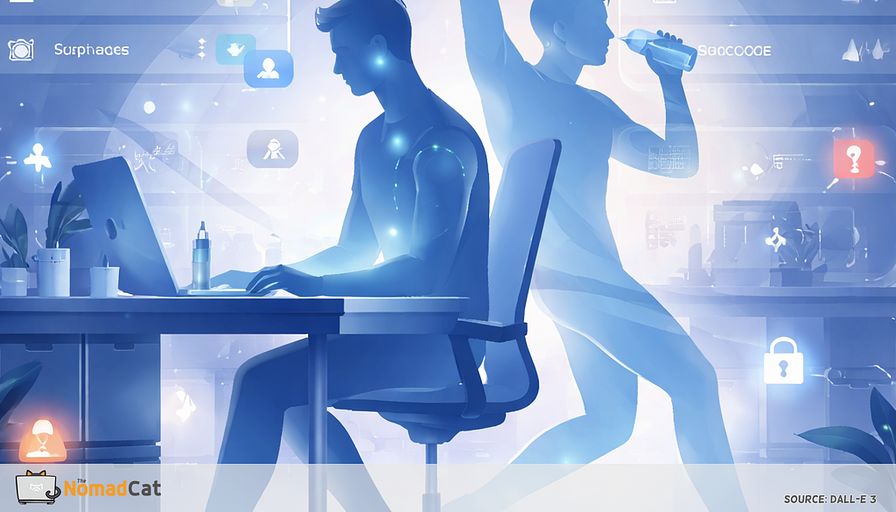
If your day starts with “just a few things” and ends 8 to 10 hours later with the same glass of water still untouched, this is probably you. The camera tile stayed on. The green dot stayed green. You replied fast, looked calm, kept the thread moving. And somewhere between calls, your body quietly checked out.
Most health advice assumes the same version of you is available all day. Like you can stand up, stretch, eat a real lunch, or take a 10-minute break without it costing anything socially. But desk work often rewards a different spec. Always available, interruption-proof, not messy. That is not a character flaw. It is an environment with rules, even if nobody says them out loud.
This article treats weekday health like debugging a system that keeps failing in production. Not because you are “bad at discipline,” but because the runtime is hostile to anything that looks like offline time.
I’m French (born 1974), and I’ve done the same desk-heavy weeks across Beijing, Berlin, and now Lisbon. The pattern is boringly consistent: work slides past midnight, and the first body signal isn’t dramatic, it’s that tightness in the upper back that shows up when I’ve been “professional still” for too long. My wife is a fitness trainer and nutritionist; she’ll tell me to sit straight, and I last about three minutes before work-me takes over again.
Here’s what you will get, without adding another thing to manage:
- Why breaks feel risky when responsiveness becomes a performance signal
- The hidden “permissions” most tips assume, and why they are missing on real calendars
- The 2 scoreboards that grade the same hour, work-you vs body-you
- Why weekend success is a useful clue, not evidence you are inconsistent
- A practical filter for habits that survive weekdays, using stealthy, low-friction behaviors that can run mid-task
The goal is simple. Make breaks cheap enough that you’ll actually take them on a normal Tuesday, even when Slack is loud and your calendar is not in a cooperative mood.
The identity mismatch nobody names
Two versions of you on the same calendar
You sit down “just to clear a few things” and suddenly it’s been 8 to 10 hours.
Not because the work is endless, but because the day is built for interruption while you’re expected to look uninterrupted.
A normal hour comes with silent requirements:
- fast replies
- no visible gaps
- calm face on camera
- low friction for everyone else
- constant “I’m here” energy
The friction isn’t only time. It’s constant mode switching while being observable, even when nobody says they’re watching. Being briefly unreachable has a cost, so you learn to postpone anything that looks like an interruption.
Most health advice assumes a stable self across the day, like the same “you” is available at 10:00 and 16:00.
But desk work rewards a professional identity that is interruption-proof and composed. Many health actions require the opposite: being briefly unavailable, a bit messy, or slightly slower.
That gap is not about “being inconsistent.” It’s about incentives. Your health plan gets written for body-first conditions, then shipped into a work runtime where availability and composure are part of the job. So the same “simple habit” behaves differently, not because you’re weak, but because the environment changes how it runs.
The permissions most health tips assume
The 10-minute permission problem
Most “just take a 10-minute break” advice isn’t really about time. It’s about permission. The tip assumes you can safely stop performing “competent professional” for a moment, without paying for it later.
- Be unreachable without looking unreliable
- Leave the desk without being “missing”
- Come back slightly sweaty or out of breath
- Chew, drink, or stretch while the camera is on
- Not reply instantly without writing an excuse
- Look a bit disheveled for 2 minutes and still be taken seriously
In teams where presence reads as commitment, those permissions are not neutral.
When responsiveness becomes a performance proxy
This does not mean your workplace is evil. It means your body learned the local rules.
When fast replies get interpreted as “on top of it,” the urge to answer starts running like a background process. A small break then stops feeling like health and starts feeling like risk management. You step away for water, come back to 2 pings, and feel you owe a reason, even if nobody asked.
Why even good environments can still feel unsafe
Some workplaces are genuinely fine with breaks. The tricky part is that most days are not explicit. They are ambiguous. And ambiguity is enough for a nervous system to default to the safest interpretation, which is usually “stay available.”
When 2 scoreboards grade the same hour
The work scoreboard vs the body scoreboard
If you are being graded in real time, the next question is what happens at the exact moment a body action tries to start. Because that moment is not neutral. It’s you, mid-task, mid-thread, with the subtle sense that “professional presence” is part of the output.
Work-you gets points for
- replying fast
- staying calm on camera
- being visibly “around”
- keeping friction low for others
- looking busy, not necessarily being effective
Body-you gets points for
- standing up and moving
- drinking water
- eating an actual meal (plus setup and cleanup)
- daylight, even 5 minutes
- rest and mental detachment
Why the plan fails before it even starts
This reframes a common pattern as a diagnostic rather than a guilt trigger. A lot of misses are not “you choosing the wrong thing.” They are pre-emptions that happen before the choice becomes conscious.
Micro-timeline. A ping arrives while you think “I should get water.” You delay 2 minutes to answer, then another message lands, then a meeting starts, and now the water thought is gone. Nothing dramatic happened, yet the body action never started.
A simple test: for one workday, log “events” like errors—three marks only: water sips, one stand-up break, one 2-minute movement break. If you like metrics (I do; I’m the person who owns a Polar H10 and still checks a Decathlon watch), you’ll see exactly where the chain breaks without turning it into a big project.
The forensic tell is weekend success
When things work on weekends and fail on weekdays, it is rarely “inconsistency.” It is compatibility.
Weekends are self-paced, lower visibility, fewer interruptions, and less need to perform responsiveness as competence. Under those conditions, small breaks feel normal.
Weekdays add a visibility layer where being “seen working” can carry signaling power. So the same 5-minute walk can feel like maintenance on Saturday and like reputational risk on Tuesday.
The wrong error labels waste your effort
To fix the bug, it helps to notice that professional stillness is not an accident. It’s trained.
- “I have no motivation.”
- “I’m bad at discipline.”
- “I need a better app.”
- “I just don’t care enough.”
These labels are tempting because they make the problem feel personal and solvable through more pressure. But often the issue is simpler. The environment keeps rewarding the opposite behavior.
Stillness is a performance behavior
Stillness looks like competence
On camera, the safest default is “statue mode.” Minimal fidgeting. Neutral face. Visible availability.
Nobody writes “excellent stillness” in a review, but it reads as control. Remote and hybrid tools also make presence measurable. When real output is hard to see in real time, the system reaches for what it can see, which is responsiveness and “online-ness.”
And if you’ve ever done remote workations across Europe on bad chairs and worse desks, you know how fast “statue mode” turns into that upper-back tightness again. It buys you calm on camera and sells you a stiff neck, tight shoulders, and lower back pain later. Then sleep gets lighter, and the after-lunch energy drop hits harder than it should.
Why breaks become a social event
Visibility can spread good behaviors, but under evaluation it can also suppress them. If someone pings and you do not answer, you feel you need a story, even if nobody asked for one. “I was moving” can feel like you just announced you left the building.
The stealth requirement your habits must meet
Plausible deniability beats motivation
What I keep seeing is this: weekday habits don’t fail on willpower, they fail on explainability.
Can it happen without a story.
If doing the thing forces you to explain sweat, a camera-off moment, a background change, or a delayed reply, it will get postponed until it disappears. This is not paranoia. It’s just how signaling works when presence and responsiveness stand in for commitment.
Useful properties for weekday uptime
-
Pause-safe
-
Instantly stoppable
-
Low setup
-
Low mess
-
Compatible with being mid-thought
Often fails
- anything that creates a shower-level aftermath
- anything that needs a hard offline block and perfect silence
- anything that looks like a disappearance the second a message lands
Often survives
- normal-looking micro-movement that reads like “thinking,” not “working out”
- basic fueling and hydration between pings
- very short walks that fit inside interruptions
If you want a default three (not a perfect plan, just something that survives):
- a few sips of water between pings
- 2 minutes of movement that looks like thinking
- a short walk that fits inside an interruption
Tiny behaviors have surprising uptime, and that’s why they matter.
Mode switching beats routines
From habits to role compatible behavior
Weekday health is less about building a perfect routine and more about running the right behavior in the right mode.
A role-compatible behavior is one that does not make you look offline, weird, slow, sweaty, or unavailable. Treat it like an engineering constraint, not a moral standard. If a behavior keeps crashing into “I should look committed right now,” it will keep failing no matter how clean the plan looks on Sunday.
There is still a tradeoff between what is stealthy and what is most effective. Movement breaks tend to beat just standing. Multiple short breaks across the day often beat 1 perfect exercise block. That’s good news if your calendar refuses to leave a clean 45-minute rectangle.
So the stress test becomes simple.
Does this plan require you to look offline, weird, slow, sweaty, or unavailable.
If the honest answer is yes, it is not a discipline plan. It is an identity plan. And identity plans usually lose unless redesigned.
The goal is not to become a different person at 14:00. It is to make the basics cheap enough that they still happen on real weekdays.
If your workday rewards statue mode and instant replies, it makes sense that “simple” health tips keep crashing. The issue isn’t discipline. It’s a mismatch between what work-you gets graded on and what body-you needs to stay online. Weekday health works better when it’s treated like debugging: check the hidden permissions, notice where breaks feel socially risky, and swap big plans for behaviors that survive the real runtime.
Stealthy, low-mess micro-actions matter because they actually get deployed. A few sips of water between pings. 2 minutes of movement that looks like thinking. A short walk that fits inside an interruption. Small inputs, low social cost, repeated enough to show up in energy, stiffness, and that after-lunch slump.
The block usually isn’t time. It’s the moment you’d have to look briefly unavailable.
You might be interested by these articles:


Your 10-hour desk day needs pause-safe health habits

Status-safe microbreaks for camera-on workdays

Your habits keep crashing on normal Tuesdays

Microbreaks that survive pings and meeting overruns

The invisible work rules that make desk health feel awkward

Camera on jaw clenched the desk day micro hold

The green dot trap why empty calendar time still is not yours