 Gilles Crofils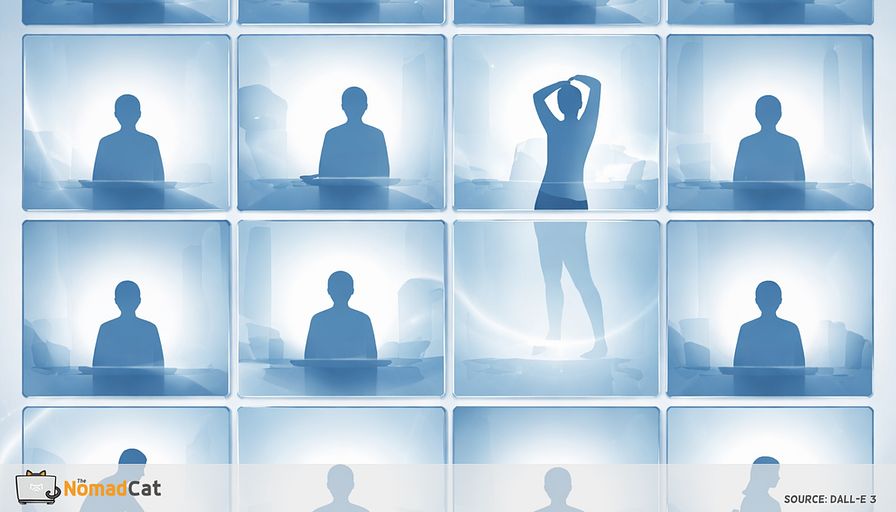
Lunch at the desk. Back to back calls. A “quick” Slack that somehow turns into 20 minutes. Then you stand up at 16:30 and your neck acts like it has been quietly filing tickets all day.
The weird part is that remote work can make the simplest fix feel risky. In an office, shifting in your chair, grabbing water, standing for 30 seconds, it all blends into the background. On video, you’re a tile. Movement becomes visible. And without the commute, stairs, or walk to a meeting room, there’s no background movement left to “hide” inside. Sometimes it even becomes a story other people can interpret. So a lot of people do the safest thing socially and the worst thing physically.
This article is about treating that freeze like what it often is, basic risk management. Not a motivation problem. Not a “you should take breaks” lecture. I’ve done this across offices in Beijing and Berlin, and now from Lisbon: the “freeze” shows up fastest on camera-heavy days.
You’ll get a practical way to make movement boring again, even on camera heavy days, including
- why certain meeting types quietly punish movement more than others
- how to pre-authorize posture changes with 1 short line so nobody starts guessing
- what kinds of movement read as “still present” instead of “checked out”
- simple defaults for different call formats so you’re not running another system in your head
- small environment tweaks that borrow a bit of office physics at home
The goal is not to become a standing desk person. It’s just to reduce the reputational penalty on normal human motion, so your body stops sending invoices after every meeting block.
Stillness as risk management
Why moving at home feels louder
This is not always laziness. It can be basic risk minimization.
At home, stillness has a weird advantage. It has the lowest reputational cost. On video, you are a tile. Movement becomes “a thing” people can notice and interpret. Research on video meetings also points to more self-monitoring and less mobility as part of why they feel tiring (see Bailenson’s Zoom fatigue work).
In an office, movement is socially diluted. People get water, pace on calls, swivel, stand, sit. It’s just background noise. At home there’s no shared script, so stillness becomes the default proof of presence.
Grid view doesn’t help. It’s basically a dashboard. When everything is quiet, one noisy log line grabs attention. A small stretch, a chair squeak, reaching for water. Product UI amplifies it with borders that jump to whoever makes sound, or tiles that reshuffle. Humans notice motion fast, especially human motion.
So the pattern becomes easy to learn. Move and you may pull focus.
The invoice arrives later. More “reputation-safe” immobility often shows up as neck and upper-back stiffness, jaw bracing, or that wired post-call residue where your body feels like it never got the memo that the meeting ended. Micro-breaks are generally linked with less fatigue (Kim, Park & Niu, 2017). Video call mechanics can also make the freeze worse because people move less and watch themselves more (see Bailenson’s Zoom fatigue work).
If you want a fix that actually sticks, the useful question is not “why don’t i take breaks.” It’s where the freeze happens reliably. If you can predict it, you can work with it.
Where movement gets silently outlawed
Two meetings that freeze people fast
Some meetings create baseline pressure. Others turn it into evaluation.
The classic one is the camera-on group call. “Engaged” becomes a tiny performance. Self-view and nonverbal overload push self-monitoring up and mobility down (see Bailenson’s Zoom fatigue work). Measures of video fatigue also include a social and self-related strain dimension: you spend the whole call managing how you look, not just what you say (Fauville et al., ZEF).
Then there are the high-stakes calls. Client pitch. Board update. Performance-review-ish 1:1. Comfort drops in priority behind “look competent.” When behavior doesn’t match expectations, people interpret it. And when things are unclear, observers fill gaps fast.
This is why generic “take breaks” advice collapses on meeting-heavy days. The constraint is not reminders. It’s ambiguity. If you stand, stretch, or look away without context, someone else writes the story. More formats and defaults are in the meeting mode menu section below.
So the practical goal is simple: make movement non-narrative. On a client pitch, that can be as basic as one line upfront so standing doesn’t get interpreted as nerves, disagreement, or “checking out.”
Movement that does not create a story
Pre-authorize movement once
One small line at the start can save 20 tiny explanations later. Think of it like setting a default for the call.
A short, boring context cue reduces uncertainty. It makes your movement predictable, so it doesn’t get misread. Teams with explicit norms tend to feel safer because the “what will people think” tax drops (Edmondson, 1999).
A few scripts that usually land
- Internal team “I might stand a bit, still listening.”
- Cross functional “Quick note, I may stretch on camera.”
- Client facing “If i stand briefly, it’s just posture, i’m here.”
- Large meeting “I’ll be mostly listening, may go off camera briefly.”
The main trap is turning a normal posture change into a TED talk.
Long apologies and backstory can make you sound less confident than the situation deserves, and they invite evaluation you didn’t need.
Before
“Sorry, my back is killing me, i need to stand, hope that’s ok.”
After
“I’ll stand for a minute, still with you. Thanks.”
Once legitimacy is handled, pick movement that reads as presence, not fidgeting.
Pick movement that reads as presence
The safest pattern is slow, low-amplitude movement you can stop instantly. “I’m here” signals, not “i’m restless” signals.
Options that tend to look stable on camera
- Stand still, shoulders quiet, eyes on screen
- Gentle weight shift left to right
- One foot slightly forward, switch occasionally
- Heel to toe rock, subtle and slow
- Off-camera pacing when you’re not speaking
Also, keep expectations realistic. Standing is usually not a guaranteed focus upgrade. Evidence on cognition is mixed and often null (Ojo et al., 2018). It’s best framed as safe to try.
And the real win is not standing. It’s changing position periodically.
Static sitting is a problem. Static standing is also a problem. The advice that holds up most often is simple: alternate, and build up gradually.
A meeting mode menu that makes movement boring
Match meeting type to posture and channel
You don’t need a new system to manage. You need a few defaults that reduce decision-making.
Decision calls and screen shares
Sitting is fine. The trick is a socially clean 20-second stand at clean boundaries, not mid-sentence.
- Stand while people connect
- Stand when the agenda switches
- Stand as you leave
Boundaries still exist even on chaotic days. Micro-breaks between tasks tend to help fatigue most (Kim, Park & Niu, 2017).
Status updates and coordination
Standing by default often fits. A wider camera framing helps so standing reads like “different posture,” not “walking away.” Standing meetings are associated with shorter duration without worse outcomes (Leach et al., 2009). If your team hates it, fine. The default can simply become “camera wider and posture more flexible.”
1:1 catch-ups and sensitive topics
Posture matters less than trust and context. Often the lowest-cost medium is audio-first walking, or camera-off with 1 plain line that removes ambiguity. One caution though: confidentiality rules still apply. Some conversations should stay at the desk, not on a sidewalk.
Large one-way sessions
Camera-off unless presenting is a reasonable default. Not as rebellion. Just reducing nonverbal load and the pressure to perform attention. Camera expectations vary a lot by org and role, so there’s no universal rule.
Tiny scripts that stop people guessing
Say less and get more freedom
Short, time-bounded lines work because they close the attribution gap before it opens.
One rule keeps scripts from turning into body narration: no backstory, no mini confessional, no long justification.
- Internal “I’ll stand for a minute, still listening.”
- Internal “Quick water, back in 20 seconds.”
- Internal “Audio only while i pace, same focus.”
- Client safe “I may go camera-off briefly, still with you.”
- Client safe “Small posture change, i’m here.”
- Any call “Back in 1 minute, please continue.”
If it’s not disruptive, you can skip “sorry” and just state it. If it is disruptive, make it time-bound, then return.
Make movement visually boring
Frame the camera so standing looks normal
A wider frame helps because standing stops looking like an exit. Free version is pushing the laptop back and raising it on books. Small purchase version is a separate webcam.
Kill the mirror when you can
Hide self-view if the tool allows it. Nobody needs a mirror for 6 hours to prove they are alive. Self-view is a self-focus driver (see Bailenson’s Zoom fatigue work).
Use role-based micro mobility instead of timers
Timers get ignored. Not because of laziness. Because meeting walls eat good intentions for breakfast.
A simpler cue is role-based
- Listen equals move
- Present equals still
Example rule of thumb
If you’re not speaking for 2 minutes, switch to audio for 60 to 120 seconds, walk to a doorway and back, then return on camera at the next clean moment.
Borrow office physics at home
Two stations makes posture automatic
Offices have public friction. The environment expects movement, so movement feels normal.
At home you can fake a small part of that with 2 stations and 2 meanings
- Seated desk for deep work and screen-share heavy calls
- A “call spot” where standing is natural, like a counter edge, shelf, or any high surface you already have
No shopping list required. The win is the mapping. Certain meeting types belong to the standing spot, so posture attaches to place, not mood.
And yes, even 10 steps between the 2 stations counts.
One post-call loop that survives chaotic calendars
A durable pattern is event-triggered
If the call ends, then walk a fixed mini route.
Desk → doorway → window → desk works. Desk → kitchen sink → desk works. Keep it boring. No step goal. No “make up for it later.”
Framed as a between-task transition, it can also clear a bit of mental residue before the next tab steals your attention.
Proof without the fitness vibe
Boring signals that the system is working
If you want proof, use a measurement that is almost insulting in how simple it is.
The win is fewer body invoices after meeting blocks
- Less end-of-day upper-back tightness after a camera-heavy run
- Less jaw and shoulder bracing when the stakes are high
- Less wired residue after calls
- First steps after long sits feel less creaky
My bias (physics background) is to measure the smallest thing that changes, not to overhaul the routine.
A tiny 5-day log is enough
- At 18:00, note stiffness 0–10 for 5 workdays
- Or keep it binary, did you stand at join and leave, yes or no
Trends beat perfection. Automaticity builds slowly.
Guardrails and stop rules that keep it sane
This is not medical advice. If anything feels wrong in a sharp or escalating way, stop and get help. My wife is a fitness trainer and nutritionist; her default advice is still boring: stop if it escalates.
Red-flag buckets are boring for a reason
- Dizziness, faintness, or new severe headache
- Sharp or escalating pain that doesn’t settle
- Numbness, tingling, or pain that shoots down an arm or leg
- Symptoms that feel one-sided and sudden, like swelling
- Headaches or neck symptoms that are worsening fast
The point is narrow. Remove the reputational penalty on normal movement.
When movement becomes non-narrative again, norms take over and your body files fewer tickets at 18:00.
Remote work didn’t just move meetings to your laptop. It also removed the small built-in movement you used to get “for free,” and then made whatever was left look suspicious on camera. So the fix isn’t another “take breaks” lecture or a timer you’ll ignore. It’s removing the reputational penalty on moving, so your body stops sending invoices after every meeting block.
Keep it boring. Pre-authorize posture changes with 1 short line. Pick movements that read as present, not restless. Use simple defaults by meeting type so you’re not running an extra process in your head. Nudge the environment too, even 2 stations and a tiny post-call loop can bring back some office physics.
Nothing here requires becoming a standing-desk person. Most days it’s not the workload that locks you in place. It’s the 30 seconds where movement becomes “a thing.” Remove that, and the body bills shrink.


