Abstract:
The article argues that remote work didn’t just remove obvious movement like commuting—it quietly erased the tiny, forced stand-ups that used to punctuate the day, such as waiting at printers, elevators, coffee machines, or reception, and it names these lost 10–180 second gaps “idle upright minutes.” At home, those same waits still happen (loading bars, “joining in 1 min” meeting buffers, kettle/microwave timers, VPN reconnects), but they’re private and frictionless, so they get instantly absorbed by sitting, Slack refreshes, and phone checking, leaving the body feeling “compressed” and stiff by evening. Rather than pitching standing as a fat-loss or productivity hack, the piece makes a modest, evidence-aware case that frequent posture changes and microbreaks can reduce discomfort even if standing isn’t metabolically dramatic and walking is stronger for physiology; the practical advantage is that waiting moments don’t require willpower, scheduling, or guilt. The core recommendation is a simple default that survives busy weeks—“If you are waiting, you are upright”—supported by small “proximity design” cues like creating a tiny no-chair wait zone and keeping the phone off-limits unless standing, plus a basic 7-day experiment (pick one recurring wait and stand every time) with guardrails that acknowledge risks of prolonged standing and special considerations for conditions like orthostatic intolerance/POTS and ME/CFS. Overall, it reframes the goal as restoring effortless “day punctuation” through repeatable micro-waits, not adding another self-improvement project.
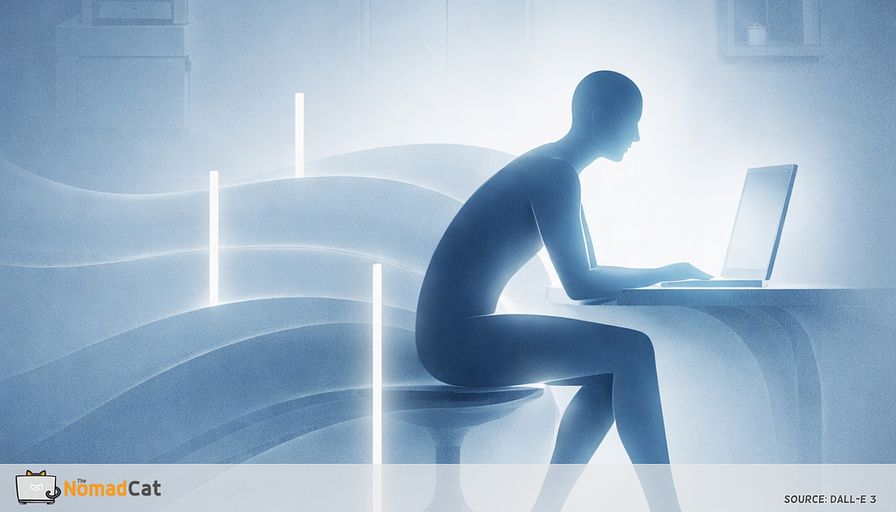
Something got quietly deleted when work moved onto screens. Not a big habit like the commute walk or the stairs. Smaller than that. More annoying, because you barely notice it until your hips feel like they aged 10 years by 6pm.
It’s the tiny waits that used to make you stand up without thinking. The printer moment. The coffee machine moment. The elevator moment. Those 10 to 180 seconds where you were upright because the world required it, not because you had motivation, a timer, or a perfect plan. Remote work didn’t remove waiting. It just made it private, silent, and very easy to fill with “just a quick check” while staying in the chair.
This article calls that missing layer idle upright minutes and makes a modest case for why they mattered. Not as a fat-loss trick, not as a “standing fixes everything” story, but as day punctuation that breaks long sitting blocks with almost zero effort.
What this covers
- the single default: if you are waiting, you are upright
- how to make it camera-safe during meetings
- a small 7-day test, plus basic guardrails (because standing helps, but it isn’t magic)
If the day already feels compressed, this is more of a relief idea. Less “do more.” More “put back the tiny gaps that used to be there.”
Idle upright minutes
The tiny waits that used to move you
Something small disappeared with remote work. It’s almost invisible until it’s named.
Idle upright minutes are those 10 to 180 seconds spent upright while waiting for something to finish. Not exercising. Not “taking a break.” Just standing because the world made you stand.
Typical examples
- waiting for a room to clear
- standing at reception
- elevator time
- coffee machine brewing
- microwave running
- joining a call 1 minute early
- watching an export bar crawl to 100%
Why these 30 seconds mattered more than they should
These micro-waits used to interrupt long sitting bouts without motivation. They happened because the environment forced a posture change.
Think of it as punctuation in the day. Without it, everything becomes one long sentence.
Research on prolonged sitting suggests that even short interruptions can help (Chastin et al., 2015). The simple mechanism is: even 30 seconds changes joint angles, unloads the same tissues, and gives your body a different shape for a moment.
A modest claim that stays true on busy weeks
This is not a fat-loss hack. Standing burns only a little more energy than sitting on average (Saeidifard et al., 2018). And standing is not guaranteed to make the brain sharper either. Reviews tend to find small or neutral effects overall (Commissaris et al., 2016).
The believable promise is boring: more posture changes, a bit more variability, and for many people a bit less end-of-day stiffness. Small doses that survive chaos.
Waiting time got absorbed by the screen
The remote substitution
A progress bar creeps forward. The room is quiet. The chair is right there.
In an office, waiting had friction and a social container. You were already standing because you were at the printer, reception, hallway, coffee machine. At home, waiting is private and silent, and remote work can blur boundaries so the day becomes one continuous thread (Allen, Golden & Shockley, 2015). One practical implication: when the “work zone” is also the “waiting zone,” it becomes easier to stay seated through everything.
Then there’s how quickly phones fill empty moments. A lot of smartphone use happens in short bursts, not long planned blocks (Oulasvirta et al., 2012), and checking is often triggered by waiting, boredom, and transitions (Hiniker et al., 2016). Plain version: the micro-wait still exists, but it gets filled so fast it barely registers—and your body never has to stand up.
No villain here. Someone can ship work, sit through meetings, answer fast, and still end the day feeling weirdly “compressed” in the body. When small breaks disappear, load accumulates and recovery windows shrink.
Why waiting beats willpower breaks
Waiting was physically noisy
“Take a break” advice fails in real calendars because it asks for intent, and intent is expensive at 17:47.
Waiting used to be physically noisy. Feet shifting. Ankles moving. Hips changing position. Nothing heroic, just micro-variation. Postural variability is linked with less discomfort in desk work (Vergara & Page, 2002). Ergonomics keeps repeating the same boring principle: variation protects better than “perfect posture” (Srinivasan & Mathiassen, 2012).
Waiting also isn’t a “break.” A break implies choosing it, sometimes justifying it. Waiting is already allowed. Nobody feels guilty for standing while the printer is thinking.
Studies on short breaks at desks often show reduced discomfort and fatigue without big interruptions (Galinsky et al., 2000). The usable takeaway is not “schedule better breaks,” it’s “use the breaks that already happen.”
A small honesty note about evidence
It’s easy to oversell standing. The strongest metabolic results in sitting-interruption trials usually come from breaking sitting with light walking, not just standing still (Dunstan et al., 2012).
Standing is still useful because it reliably changes posture and often helps with that end-of-day “compressed” feeling. Practical takeaway: alternation is the win, and walking is the heavier tool when physiology is the goal.
Remote waiting became work lite
Why the body stays braced
In a line, you can’t really do “real work.” At home, there is always a bit you can do, so the wait becomes a Slack refresh, a quick reply, a doc tweak. The nervous system stays in task mode, and the posture stays locked.
Interruptions tend to raise stress and the feeling of time pressure (Mark, Gudith & Klocke, 2008), and even a tiny message can leave attention residue (Leroy, 2009). Concrete implication: “just checking” isn’t neutral—your body stays braced because the brain never fully exits task mode.
Also, sitting is not evil. Sometimes it is just the stable platform precision work needs. The point is not standing ideology. It’s noticing that “just enough work” makes the body hold.
A useful default is flexible
- stand for low-stakes waiting and passive moments
- sit when the work is delicate, when speaking intensely, or when fatigue says “not now”
Research comparing sitting and standing for office cognition tends to find small or neutral differences overall (Commissaris et al., 2016). Meeting compression doesn’t help either. Microsoft’s Work Trend Index (2021–2022) described more back-to-back meetings and shrinking buffer time. It’s not personality, it’s calendar physics.
3 remote wait traps
These waits matter because they are bounded, and they repeat all day without asking for motivation.
Loading waits that quietly turn into scrolling
- app launch and login
- build, tests
- export and render bars
- upload and sync
- “joining in 1 minute” meeting buffer
- camera and audio setup
- restarting after an update
- switching accounts or VPN reconnect
Common failure mode: the chair wins, and the phone fills the gap with fragmented checking (Oulasvirta et al., 2012).
It can help to treat this as proximity design, not discipline, because even a silent phone nearby can drain attention (Ward et al., 2017). Practical implication: change what’s within arm’s reach during waits, not what you “promise” yourself.
Kitchen waits and calendar seams
The same theft happens in the 2-minute seam between calls, and it also happens in the kitchen. Kettle starts, microwave hums, and somehow the body is back in the chair “just for 30 seconds” with a phone. No drama, just boundary bleed (Allen, Golden & Shockley, 2015). Waiting is a known checking trigger (Hiniker et al., 2016).
Calendar seams are the other trap. With back-to-back calls, the buffer gets used for fast replies because it feels responsible.
You stand up to fill the kettle, see “2 minutes” before the next call, and sit back down “just to reply.” Ten minutes later you realize you never stood again—because the seam got converted into work.
Printerless admin waits
Office life had forced standing because certain things lived elsewhere: printer, badge reader, meeting room, reception desk. Remote work removes the geography, so “admin” becomes one more seated tab.
- grabbing a 2FA code
- copying details from one system to another
- opening yet another portal
- filing expenses
- renaming and moving downloads
- adding attendees and links
- tiny follow-ups that “take 20 seconds”
These are short, bounded, and repeatable—the perfect place for an automatic upright default, because they rarely require the chair for precision.
The one default that survives deadlines
If you are waiting you are upright
This is a default for micro-waits that already exist. It survives because it doesn’t need scheduling or self-control.
If you are waiting, you are upright.
Near the desk is fine. No shoes. No walk around the block. No outfit change. The point is simply to interrupt long sitting more often (Dempsey et al., 2016). Microbreak research tends to support small doses that reduce fatigue and discomfort (Kim, Park & Niu, 2017).
Mapping helps because it removes the decision
- kettle on, stay standing until it clicks
- microwave on, stand and breathe, nothing heroic
- meeting opens, stand until the first real sentence
- “joining in 1 min,” stand while audio connects
- export running, stand until 100%
- build/tests running, stand and shift weight
- file uploading, stand and look away from the screen
- VPN reconnect, stand and do 5 slow ankle moves
Small caution: the goal is not long motionless standing. It’s variation (Srinivasan & Mathiassen, 2012). Prolonged standing has its own downsides (Tüchsen et al., 2005).
Camera safe waiting
Camera-safe means visually boring. Standing like someone still in the meeting, not stretching like an ad.
A workable pattern
- stand during the pre-meeting minute and first listening minute
- sit for the hard part, the precise notes, the intense speaking
Also, moving the phone away helps. Even silent phone presence can reduce available attention (Ward et al., 2017). Yes it can feel awkward at first. Normal.
Home cues that bring waiting back
A small “no-chair wait zone” in the kitchen or near a window can flip the default. A place where standing feels normal and sitting feels slightly inconvenient.
Phone proximity is the real thief during waits. Two non-moralizing options tend to work better than a hard ban
- phone stays on the counter during kettle and microwave waits
- phone is allowed only if standing
Some days will still be chaos. Tuesday will do Tuesday things. Missing a wait is not a failure. I treat it like logging: one upright wait is a datapoint, not a virtue test. The effect comes from small, repeatable microbreaks across the week, not perfect compliance on one day (Kim, Park & Niu, 2017).
A 7-day test
Signals that it is working
First pass is just comfort signals, not “goals.” Microbreak studies often show less discomfort with short pauses (Galinsky et al., 2000).
- fewer rusty first steps after a long call
- less low-back or hip stiffness at end of day
- less need for a long walk to “unlock” at 19:00
- smoother downshift because the day had clearer breaks
- fewer moments of upper-back tightness building quietly
Quick recalibration: standing-only changes usually don’t move energy burn much (Saeidifard et al., 2018). Trials look stronger when breaks include light walking (Dunstan et al., 2012). The reasonable win is less of the statue-block feeling.
One rule for 7 days
1) Pick 1 recurring wait (kettle, microwave, “joining in 1 min,” export bar).
2) During that wait, no sitting. Phone only if standing.
3) Keep it for 7 days, then forget it or keep it.
If it collapses midweek, shrinking the dose usually beats quitting. Even 20 to 40 seconds upright still counts. The success metric is that it reappears.
Guardrails
For most people this is trivial. But a few conditions make upright time non-trivial, so it’s worth being explicit about red flags before anyone turns “stand more” into a stubborn project.
Safety wins over streaks. Stop if there is
- dizziness or near-fainting
- sharp new pain
- new swelling in legs or feet
- chest pain or pressure
- severe palpitations
- unusual breathlessness
- new weakness, numbness, or confusion
For people with orthostatic intolerance or POTS-style symptoms, supported upright time is discussed in consensus guidance (HRS, 2015). ME/CFS changes the rules again because upright time can be exertion with delayed worsening. NICE NG206 (2021) is explicit that graded exercise therapy should not be offered, and activity management should be individualized and symptom-limited.
Remote work didn’t make anyone “lazy.” It just removed the tiny forced stand-ups that used to break the day into readable chunks. Idle upright minutes were never a workout, and they’re not a magic fix. They’re a small layer of posture change that used to happen for free.
If waiting still exists, it can be used again, instead of being quietly swallowed by scrolling and Slack refresh. Not more effort—just a better default. And with guardrails, because long static standing isn’t the goal either.
You might be interested by these articles:


Your legs are timing out in remote work bring back the missing standing layer

Remote work stole your hallway breaks and your neck feels it

Build an interruption ecology for remote work so your body stops billing you at 18:30

Micro-exits for remote days that keep your body from timing out

Stop relying on break reminders and steal movement from meeting transitions

Advancing Green Manufacturing

Navigating Deep Learning Innovations